Before the blue, there is the stitch. An unfinished cotton cloth in the Victoria and Albert Museum’s collection preserves this preparatory stage. Dated to around 1963, it has been tied and sewn but not dyed. Its record explains that the thread would be removed after dyeing, leaving the pattern produced through the resist process. The cloth offers something a finished textile cannot show in quite the same way: the preparation still in place. Adire is associated with Yoruba women’s textile production in south-western Nigeria. Although its name is commonly translated as “tie and dye”, the techniques documented by the V&A extend beyond binding. Stitching and applied starch also create areas that resist the dye, producing different pattern arrangements across the cloth.
Looking closely at particular examples reveals why those distinctions matter. A circle formed by binding, a pattern organised through sewing and a motif drawn in starch may share a dyed ground, but they take shape through different kinds of work.
Discover how tying, stitching, and starch resist create adire patterns through documented Yoruba textiles, from unfinished cloth to signed designs.
Bound Circles: How Tying Organises the Pattern
The V&A associates raffia-bound resist with adire oniko. Selected areas of cloth are tightly secured before dyeing, helping prevent the dye from reaching the bound fabric. Small stones or seeds can be enclosed to produce small circular forms; larger circles can be created by lifting a point of cloth and binding beneath it. A 1960s cloth from Ibadan in the museum’s collection brings these possibilities together. Rows of large circles occupy the surface, with smaller circles distributed between them. The V&A records its name as olosupaeleso, translated as “moons and fruits”.
The name offers one way into the design. The method offers another: circles of different sizes depend on decisions about where the cloth is gathered and how it is secured. Binding can also work with folding. Another example discussed in the V&A’s introduction to adire was folded diagonally, concertina-style, and bound at intervals. Once dyed and joined, its two sections produced a diamond-shaped arrangement of blue and white stripes. The spacing of the bindings affected the stripe widths. In this example, the cloth’s handling becomes part of its geometry. The pattern begins in the fold, and the interval between bindings becomes visible only after dyeing.
Pattern names require similar care. The V&A notes that names could differ between towns and change over time. “Moons and fruits” is therefore a recorded name attached to a documented example, not a universal label for every comparable arrangement.
The Stitch Before the Dye
The unfinished cloth in the V&A collection makes a different process visible. Stitched-resist adire, described by the museum under the term adire alabare, can involve hand or machine sewing. The V&A also notes that technique categories may overlap when raffia is used for stitching. The unfinished textile’s collection record describes two ways of preparing stitched resist: folding and sewing down the fabric, or sewing designs directly into it. In either case, the thread is removed after dyeing. That sequence gives the unfinished object its particular value. It retains work that completion would partly undo.
The stitching is not a decoration added to an already dyed surface. It belongs to the preparation through which the pattern will emerge. The maker organises the cloth before colour reveals the result. Seen alongside a finished textile, this object encourages a different kind of attention. Instead of asking only what a pattern resembles, we can ask how the fabric was manipulated to produce it.
Starch Resist: Drawing the Design Before Dyeing
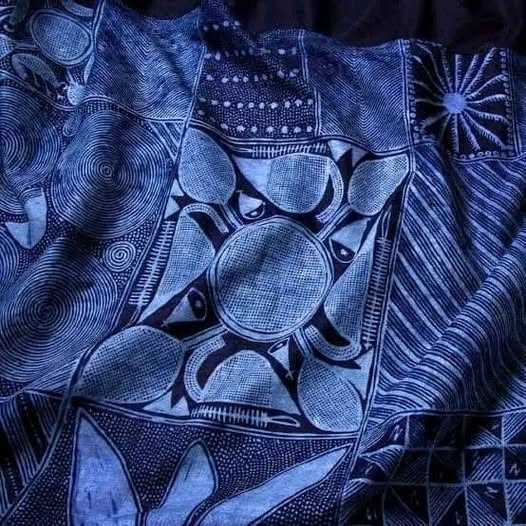
Adire Eleko uses applied starch as the resist. The V&A describes a paste made from cassava flour, applied freehand or through stencils before the cloth is dyed. In the examples discussed, the paste was applied to one side, with the reverse remaining plain blue. The difference between stencilling and freehand application matters. A stencil can organise repeated forms; freehand work allows lines and motifs to be built individually across the surface. The V&A records the use of chicken feathers, palm-leaf midribs and matchsticks to produce different line thicknesses. Hand-painted cloths were often divided into squares or rectangles containing varied designs.
These details connect the appearance of the textile to its production. The shape of a mark relates not only to the intended motif but also to the material and instrument used to apply it.
Reading an Ibadan Dun Cloth
A British Museum textile provides a particularly detailed example. Purchased in Oje market, Ibadan, in July 1971, it comprises two cotton lengths decorated with hand-applied starch resist and dyed indigo. Its catalogue records the name Ibadan Dun, translated as “Ibadan is sweet”. The object record for Af1971,35.15 identifies 21 different patterns, including an umbrella, cassava leaves, guinea fowl and the pillars of Mapo Hall, Ibadan’s town hall. It also records a maker’s signature at the hems. Those details make “patterned cloth” an insufficient description. The catalogue connects motifs to recognisable subjects and preserves evidence of a maker’s mark.
The record does not supply a complete account of the maker’s intentions. It gives us something more specific than a general celebration of tradition: a textile whose technique, motifs and signature can be examined.
A Signature Is Not Always a Recovered Name
The V&A discusses two other cloths carrying a scorpion-like signature on their undersides. One repeats the symbol prominently on its front. The museum suggests that this prominence may indicate a respected maker, but it has not connected the signature to a name. That distinction should remain intact. A surviving mark and a recovered identity are not the same thing. The signature is part of the evidence attached to the cloth. The missing name is a limit of the record, not a reason to ignore the mark.
When Indigo Reveals the Preparation
In the historical process described by the V&A, prepared cloth was immersed in an indigo dye bath and removed to oxidise. Repeated dipping could deepen the colour. Some cloths were subsequently beaten with a mallet to produce a sheen. Dyeing brings the relationship between exposed and protected areas into view. Binding, sewing and applied starch establish different conditions for that encounter with colour. The unfinished cloth returns us to the moment before it happens. Its preparation remains visible, asking us to look at adire before the finished blue commands our attention: at the fold, the binding, the stitch and the applied resist through which a design takes shape.
The Omiren Argument
These clothes demonstrate why technique and attribution belong in fashion coverage. A tied circle, a sewn preparation and a starch-resist motif are not interchangeable descriptions. Nor should a recorded signature disappear beneath the general label “traditional”. Omiren’s position is that cultural recognition becomes more useful when accompanied by material precision. Naming a textile tradition is a beginning. Explaining how a particular cloth was made and identifying its maker where the evidence allows gives that recognition substance.
Also Read:
- How Adire Cloth Holds Memory, Labour and Place
- The African Textiles Guide: Kente, Kanga, and Adire Decoded
- From Lagos to London: How the Diaspora Is Styling Adire for the Modern City
- African Textile Glossary: 20 Terms Fashion Keeps Getting Wrong
Frequently Asked Questions
What is adire?
Adire is a Yoruba resist-dyed textile tradition, particularly associated with indigo-dyed cotton in southwestern Nigeria. Its name is commonly translated as “tie and dye”, but the documented methods include tying, stitching and starch resist. The V&A records examples in which each method shapes the pattern before the cloth meets the dye.
How do tying, stitching and starch resist differ?
Tying uses bindings to protect selected areas of cloth. Stitching uses sewn preparation to create resist areas, and the thread is removed after dyeing. Starch resist uses applied paste, either freehand or through stencils, before dyeing. Some textiles combine techniques, so the categories can overlap in a single cloth.
What is Adire Eleko?
Adire Eleko uses starch resist. The V&A describes cassava-flour paste applied before dyeing to protect selected areas and produce a pattern against the dyed ground. The paste could be applied freehand or through stencils, and in the examples discussed, the reverse side remained plain blue.
Do adire pattern names have fixed meanings?
Not necessarily. Names may vary between places and change over time. Connect a recorded interpretation to its documented example rather than applying it automatically to every similar cloth. “Moons and fruits”, for example, is the name recorded for one 1960s cloth from Ibadan, not a universal label.