Enda put one of its most explicit statements on the outsole of its debut shoe. The word was Harambee, translated in the brand’s account as “all pull together”. Its position mattered: part of the shoe’s identity was carried beneath the foot, rather than concentrated entirely on the side-facing surfaces normally used for recognition. Other references worked less directly. Twelve lines referred to a national anniversary; a heel groove was connected to a landscape; a spear-tip mark operated as the company logo. These details did not all communicate in the same way. Some could identify a brand before their cultural explanation was known. Others required that explanation to become specific.
The debut Iten launched in 2017, following a crowdfunding campaign, according to co-founder Navalayo Osembo-Ombati’s interview with WIPO. Enda’s 2022 account looks back at the choices embedded in that original design. Read together, the sources offer a useful case study: how can a Kenyan footwear company make identity part of the product without asking a single emblem to carry the entire story?
Enda’s original Iten placed Kenyan references across its upper, heel and outsole. See how brand recognition differs from details that need explaining.
Recognition Begins with a Combination

Enda describes the first items as being offered in black, red and green, with white soles. The distinction matters: the brand’s explanation refers to an original colour offering, not necessarily one shoe containing the full flag palette. In its account, those choices connect the product range with Kenya’s national colours. The side logo supplies a more direct company identifier. Enda describes it as a spear tip and connects that form with Kenya’s national imagery. It then gives the mark its own sporting associations: strength, speed, action and forward progression. The cultural reference and the brand interpretation occupy the same symbol, but they are not identical claims.
Colour and logo therefore have different jobs. The colours provide a context-dependent association; none belongs exclusively to Enda or Kenya. The mark can identify the company without requiring someone to explain its source. Together, they establish the first level of the design’s identity: a palette and a recognisable brand device, with additional meaning available through the published account.
A Name Makes the Reference More Particular
The model name narrows the geography. Iten refers to the Rift Valley town associated with running and training. Enda’s explanation names Kenyan athletes connected with the town and describes international runners travelling there to train. The reference is more particular than a general appeal to African athletic excellence. A place name also works differently from a visual motif. It does not need to reproduce a landscape on the shoe. Its significance travels through knowledge: someone familiar with Iten encounters a sporting reference, while another person may first understand it simply as a product name.
That difference is not a defect to be corrected by adding more imagery. It is part of how names operate. The useful critical distinction is between the precision of the reference and how widely it can be recognised without explanation. Enda’s account establishes the former; it does not demonstrate the latter.
Details That Need a Key
The twelve lateral lines make that distinction especially clear. Enda calls them the “12 Jamhuri Lines” and explains the number through 12 December: Kenya’s independence date was 1963, and it became a republic the following year. The design translates historical information into a counted feature rather than printing the full date. The explanation is precise. Twelve is not an arbitrary decorative number; the brand explains why. Yet the reference is not self-translating. A viewer can encounter repeated lines without reading them as a date. The historical meaning depends on a connection made outside the object, through the brand’s account.
The heel groove follows a related logic. Enda connects it with the Rift Valley’s escarpments, assigning a landscape reference to a particular feature. The groove can remain a physical detail for someone unaware of that explanation. Knowing the story adds a geographical interpretation; it does not change the feature into a literal landscape image.
What the Pattern Connects, and What It Does Not Establish
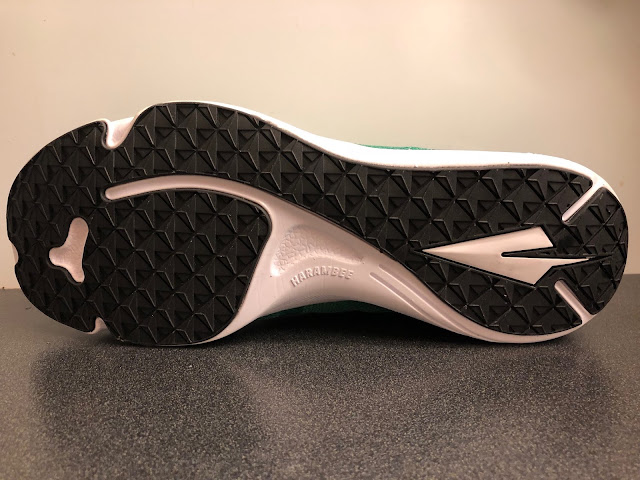
Enda describes repeating triangular patterns on the side mesh, heel strap and outsole. Within the published account, this repetition links several parts of the shoe. The feature is therefore discussed not only as an isolated motif but also as a recurring element distributed across the product. Its cultural attribution is less specific than the explanation of the twelve lines. The brand relates the geometry to Kenyan fabrics and beadwork without identifying a particular textile, maker or community. That is the level at which the article can responsibly report the reference. Assigning the triangles to a named tradition would be inaccurate absent from the source.
This creates a useful hierarchy within Enda’s own explanation. The date reference is tightly defined; the geometric reference is broader. Both can contribute to an identity, but they do not carry equal documentary precision. Assessing that difference is more informative than treating every feature as another interchangeable expression of heritage.
Harambee Has a Documented Connection to the Business
The outsole inscription is the most explicit verbal element in the account. Enda explains Harambee through people combining effort and resources to achieve something they could not accomplish alone. It connects that principle with the support behind the company’s crowdfunding campaign. The business history gives this reference a concrete basis. Osembo-Ombati told WIPO that crowdfunding enabled the launch of the Iten in 2017. The collective language is therefore connected to a documented stage in the product’s development, not merely attached as an uplifting phrase after the fact. Its placement beneath the foot also distinguishes it from the side logo. The company mark identifies; the word states a principle. They occupy different surfaces and need not compete for the same role. That is the most persuasive organisational feature in the published design account: identity is distributed through different kinds of reference rather than repeated in one format.
Kenyan Identity Does Not Describe Every Component’s Origin

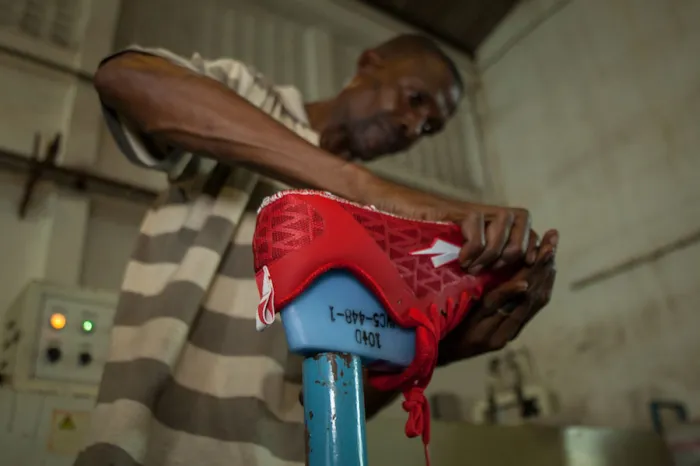
The cultural story should remain separate from the manufacturing claim. In the 2020 WIPO interview, Osembo-Ombati explained that Enda imported some parts from China and combined them with locally available materials while developing production capacity in Kenya. Fully Kenyan production was described as an ambition, not a completed reality. Enda’s June 2017 assembly film provides an earlier, similarly dated account. Osembo-Ombati describes imported parts being assembled in Kenya, and factory contributors explain stages of that work. The film establishes the arrangement the company documented at that time; it does not establish the supply chain of a shoe sold today.
This does not weaken the design’s Kenyan authorship or the significance of the work performed locally. It makes those claims more accurate. Design location, assembly location and component origin are separate questions. A spear-tip logo or national colour reference cannot answer all three, just as imported components do not erase the decisions made by the company developing the product.
Where the Identity Is Most Convincing
The debut Iten’s strongest documented quality is the way its references perform different tasks. The name identifies a place; the logo identifies a company; counted lines encode a date; the outsole carries explicit language; and repeated geometry connects several surfaces in the brand’s account. This is a more developed proposition than applying national colours alone. Its limit is how much meaning explanation can carry. A detailed story can establish why a feature exists without demonstrating that observers recognise the intended reference. Twelve lines do not necessarily announce an anniversary, and a groove does not automatically communicate an escarpment. Their meanings should be credited as deliberate, not assumed to be universally legible.
The strongest conclusion is therefore about the design’s documented organisation, not proven public recognition. Enda gave its debut shoe several routes into Kenyan identity, some explicit and others encoded. The most specific references reward explanation; the broader ones need more restrained interpretation. A complete visual assessment would still need to examine their scale and interaction on securely identified views of the original shoe.
The Omiren Argument
The principle is specificity. A precise explanation can establish why a detail exists. It cannot, by itself, establish how clearly that meaning reaches the viewer.
Enda’s debut Iten is most interesting where its references occupy different roles: brand recognition, geographical naming, encoded history and explicit language. The design account becomes less precise where it invokes a broad cultural category without identifying its source.
The task is to preserve those differences, not to count every feature with a story as equally successful. Identity becomes more substantial when its references are particular, attributable and understood within the object’s actual design.
Also Read:
- Kenyan Menswear: Bespoke Tailoring, Olympic Kits, and the Designers Rewriting the Rules
- Nairobi Street Style: How Kenya’s Fashion Capital Builds Its Own Aesthetic Without Asking Permission
- The Swahili Coast’s Influence on Kenyan Design: Kanga, Kikoi, and the Fabric of an Ocean Civilisation
- Turkana Beadwork Is a Social Archive. Kalenjin Beadwork Needs More Than a Generic Label.
Frequently Asked Questions
Which item does this article examine?
The debut design discussed in Enda’s October 2022 account, with its original colourway of black, red, and green, and white soles. The article does not combine that account with specifications from later Iten versions, and it is not a running-performance review or an assessment of every current Iten.
Why is the shoe called Iten?
Enda names it after the Rift Valley town associated with running and training. Its published explanation names Kenyan athletes connected with the town and describes international runners travelling there to train, making the reference more specific than a general appeal to African athletic excellence.
What do the twelve lines mean?
Enda calls them the “12 Jamhuri Lines” and links their number to 12 December, marking Kenya’s independence in 1963 and its becoming a republic in 1964. This is the brand’s stated explanation. The lines do not announce the date on their own, so the meaning depends on the account published outside the object.
Was the debut shoe made entirely from Kenyan components?
The dated accounts do not establish that. WIPO’s 2020 interview and Enda’s 2017 film describe imported parts alongside production work in Kenya, and describe fully Kenyan production as an ambition. Those sources should not be used to describe the current supply chain without fresh confirmation.