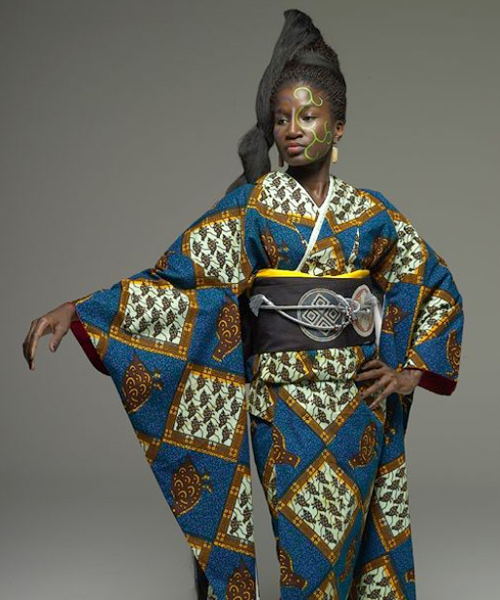
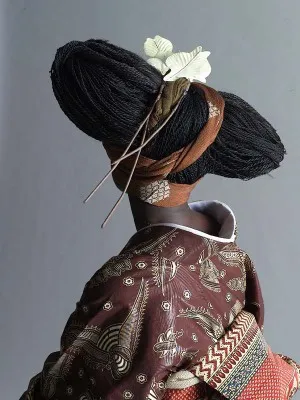
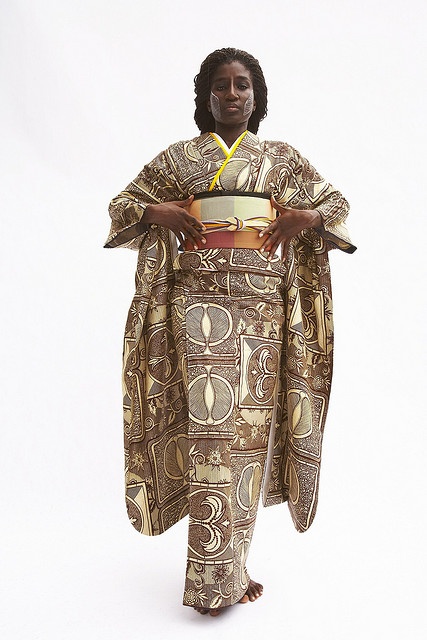
A brown kimono in Serge Mouangue’s WAFRICA practice brings several distinct references into one ensemble. Its bogolan cloth carries a design drawn with fermented mud. The lining of the accompanying haori is embroidered in a Mauritanian style, while a wooden hair comb from Cameroon completes the outfit. These details, recorded in Judith Benhamou-Huet’s illustrated feature “Duality in Design,” give the work a specificity that the phrase “African-inspired kimono” cannot convey. Another ensemble described in the feature places a blue patterned kimono alongside a crafted silk obi from Kyoto and an obi-age, the accessory used to secure the obi, made from Ghanaian kente. The materials do not simply announce two geographical origins. They occupy different positions within a carefully composed garment.
That composition is the most revealing place to begin with WAFRICA. The project is neither adequately explained by its printed surfaces nor exhausted by the idea of two cultures meeting. Its interest lies in the decisions that connect cloth, construction, accessories and the body. Mouangue calls the territory he is developing a “third aesthetic.” Its proposition is already present in the name WAFRICA: a connection between Africa and Wa, which he explains through its associations with Japan and harmony. Understanding that name helps us read the work, but the garments show how much practical negotiation harmony requires.
Explore Serge Mouangue’s WAFRICA kimono, his explanation of Wa, and the African and Japanese textiles and makers behind his third aesthetic.
What Wa Means in WAFRICA
In Mouangue’s explanation of Wa and the WAFRICA name, published by V&A Dundee, he describes Wa as an ancient word for Japan that also means harmony. Connecting it with “Africa” expresses his intention to create a dialogue and develop another aesthetic territory. “The third aesthetic is something for me that is not entirely Japanese or West African,” he explains, “but a new territory of expression.” The distinction matters. Mouangue is not presenting WAFRICA as a representative costume for either place. Nor is he simply arguing that recognisable differences disappear when brought together. His account proposes a space in which those references can contribute to something he defines through his own practice.
Wa is therefore most useful here as part of Mouangue’s stated artistic language. It is not a shortcut for explaining Japanese culture as a whole. Within WAFRICA, it names an ambition: to establish a relationship that can produce another form of expression. The work gives that ambition material consequences. A textile must be selected. Its pattern must be placed. A lining changes what becomes visible. An accessory can introduce a different texture, technique or cultural association. Harmony is not merely an atmosphere surrounding the garment; it becomes a problem the designer and makers must solve.
Learning the Kimono’s Structure
Moungue told V&A Dundee that he arrived in Tokyo in 2006 after working in automotive design. His interest in Japanese aesthetics developed during that period, and he dates the beginning of his kimono exploration to 2007. In his account, WAFRICA emerged through discussion and collaboration with the Japanese kimono maker Odasho. His approach involved learning the garment before attempting to change it. In Judith Benhamou-Huet’s illustrated feature, reproduced on WAFRICA’s website with a Patek Philippe © 2022 credit, Mouangue describes wanting to understand the kimono’s history, codes, cut, proportions, assembly and accessories. He names Kururi in Tokyo and Odasho in Kyoto as collaborators in that learning.
This attention gives the project a firmer foundation than loosely applying “kimono” to any wrapped or flowing garment. Mouangue studied a system in which construction, dressing, and accessories work together. The V&A’s introduction to the kimono’s straight-seamed construction explains that the garment wraps left over right and is secured with an obi. You can adjust its length by drawing excess fabric beneath the sash. The museum also emphasises the importance of pattern, colour and decoration in communicating identity and cultural meaning. A relatively consistent garment structure does not make the design process inconsequential. It changes where the decisions are concentrated. The surface, the placement of motifs, the choice of obi and the relationship between the layers become central.
For Mouangue, learning how the garment is worn was part of understanding how to design it. In the Benhamou-Huet feature, he discusses the folds used in dressing and the sophistication of tying the obi. His account treats these actions as integral to the work, rather than styling added after its completion.
Making Pattern Work Within the Kimono
Mouangue is direct about the materials used in his earliest experiments: he purchased the fabrics rather than designing them himself. That distinction clarifies where his contribution initially lay. It was not necessarily in inventing the textile’s motifs, but in determining how an existing textile could become a kimono. “What is important, in a kimono is that all the parts have to really connect up harmoniously,” he tells V&A Dundee. Working with fabric not traditionally used for kimono made that connection difficult. If the relationship between the parts failed, he explains, the result could lose the appearance of the garment he was trying to retain.
This is where WAFRICA becomes more than an encounter between recognisable surfaces. A patterned cloth already has a visual rhythm. Cutting and assembling it produces another arrangement. The designer must decide how those two systems meet: where repetition continues, where it changes and how the eye moves across the finished form. In the 2022 feature, Mouangue describes his work at Odasho as procuring fabrics and arranging repeated patterns harmoniously across the garment. “Achieving harmony between the cut and the pattern takes great precision,” he says. That precision makes composition an active form of authorship. The cloth is not an anonymous raw material, and the kimono is not a neutral container. Mouangue’s contribution lies in the relationships he constructs between them.
When the Lining Comes Forward
One of the clearest examples concerns a part of the garment that could easily be overlooked: its lining. Discussing a WAFRICA kimono exhibited in Kimono: Kyoto to Catwalk, Mouangue tells V&A Dundee that he deliberately made the lining more prominent. He contrasts this with the expectation of a precious but concealed interior. He intended to give the lining a stronger presence while making the principal pattern less dominant. “So in this kimono the lining bursts out of the kimono,” he explains. This is a useful design observation because it identifies a change in hierarchy. Something associated with the interior becomes expressive at the surface. The garment’s impact depends not only on which textile is used but also on the embroidery and what the viewer is invited to notice first.
It also creates a technical problem. Mouangue explains that allowing the lining to emerge changes the pattern of the entire kimono. He and Odasho had to work together to retain the garment’s image and feel while accommodating that intervention. The aesthetic proposition and the construction challenge cannot be separated. A visible lining is not simply a symbol of openness or exchange; it is a material decision that alters how the garment works.
Specific Textiles, Not a Single “African Print”
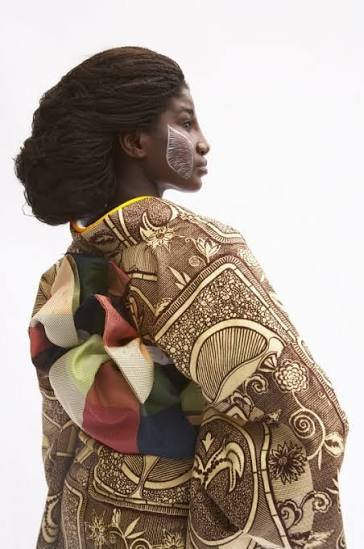
The documented ensembles also resist treating African cloth as one interchangeable category. Benhamou-Huet’s feature names bogolan, wax prints and ndop within Mouangue’s practice. Its illustrated descriptions identify kente, a Mauritanian-style embroidery and Maasai shuka in particular combinations. These examples belong to different garments and accessories; they are not a universal material list for every WAFRICA kimono. The brown bogolan ensemble is especially instructive. Its principal cloth, embroidered lining, and hair accessory each play a distinct role. The design is not explained simply by identifying one continent as the source of decoration. It is built through selection across several references.
The blue ensemble creates another relationship: patterned cloth, Kyoto silk and a kente accessory appear within the same arrangement. Each contributes differently to the whole. These distinctions make the work more legible. Naming an identifiable textile tells the reader more than calling it vibrant, traditional or African. It also preserves the difference between a textile’s identity and the designer’s use of it. Mouangue’s practice can be interpreted without assigning every cloth a manufacturing origin that the available documentation does not establish. The stronger description stays with the particular ensemble and the evidence attached to it.
Collaboration Is Part of the Work
Odasho’s role is not incidental to WAFRICA’s story. In the V&A Dundee interview, Mouangue recalls that the idea was not immediately understood. Collaboration developed through conversation and a willingness to take the work somewhere unfamiliar. His account also identifies the practical importance of working together when changes to the lining affected the garment’s construction. This gives collaboration a specific meaning. It is not a ceremonial acknowledgement appended to an otherwise solitary creative act. It is part of how an idea becomes a workable garment. Naming that contribution does not diminish Mouangue’s direction. It allows a more accurate account. He exercises his choices through relationships with people who bring specialist knowledge, rather than through an imagined freedom from construction.
That distinction connects with Omiren’s argument for treating craft as skilled work rather than anonymous decoration. The finished garment becomes easier to understand when its making is visible. WAFRICA’s authorship is therefore neither entirely solitary nor indistinctly collective. The available accounts identify an artist making compositional decisions through named collaborations. Keeping those roles visible is more illuminating than attributing the work to an abstract meeting of cultures.
What the Third Aesthetic Makes Possible
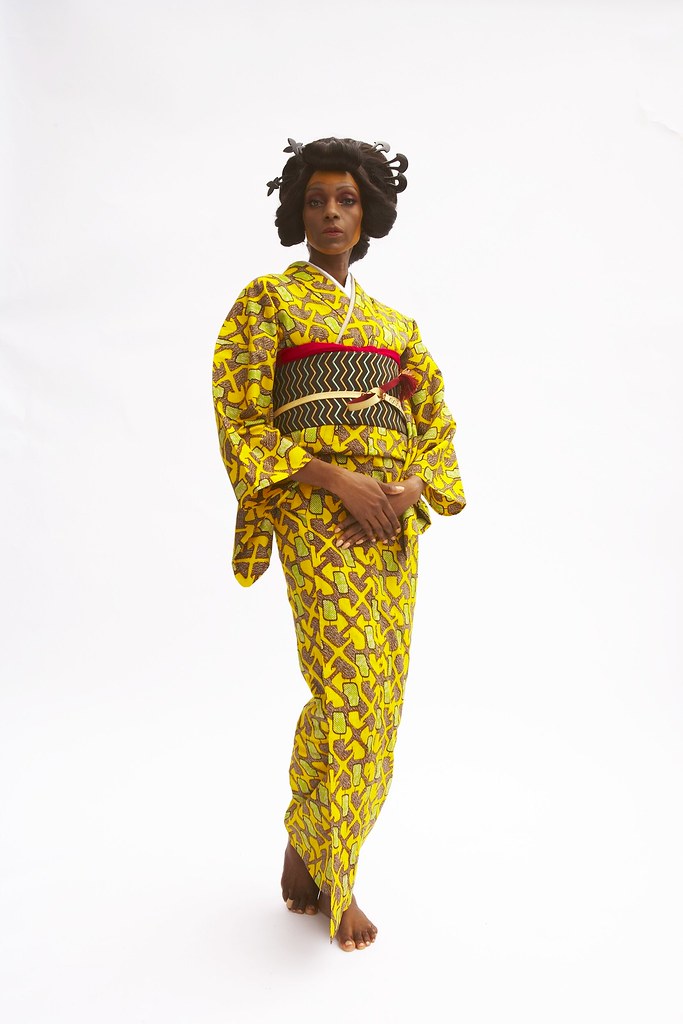
Mouangue’s third aesthetic extends beyond clothing. In the Benhamou-Huet feature, he describes a language expressed through performance, sculpture and visual art as well as garments. The kimono is one site within that larger practice. It is also not confined to one mode of use. “Some of these kimonos are made to be displayed; others are to be worn,” he explains. That distinction opens two related ways of encountering the work. A displayed garment invites close attention to its composition as an object. A worn garment introduces movement, dressing and the wearer’s own decisions. Neither experience cancels the other.
In his V&A Dundee interview, Mouangue also imagines people in West Africa finding new ways to style the garment. This is a proposition about possible use, not evidence of an established market. Its importance lies in his willingness to imagine the kimono’s future through wearers who may approach it differently. The third aesthetic does not need to erase the garment’s recognisable form. It creates room to ask what that form can accommodate and what new decisions it makes possible.
The Omiren Argument
WAFRICA is most revealing when it names its differences rather than blurring them. “Cultural fusion” identifies an encounter, but it does not explain who gave that encounter form. It tells us little about learning a garment’s construction, selecting a textile, positioning a pattern or deciding that a lining should come forward. Omiren’s reading is that these decisions deserve to lead the interpretation. African textiles should not become a general supply of visual excitement. Japanese making should not become an invisible technical service. The work is more precise than either description allows.
The question connects with our reading of Daveed Baptiste’s approach to clothing and cultural meaning: what becomes visible when a designer’s decisions, rather than broad cultural labels, organise the account? In WAFRICA, Wa gives the project a stated ambition of connection and harmony. The clothes reveal that this ambition requires work. Materials do not align themselves. A new relationship between surface, lining and cut must be composed. Mouangue’s third aesthetic is compelling not because it makes cultural boundaries irrelevant, but because it gives us particular garments through which to examine what an artist can do with them.
Also Read:
- Dakar Is Building Its Own Luxury Fashion System
- The Art of Dressing Well Across Cultures: What Global Style Actually Teaches Us
- African Textile Reporting: 8 Editorial Shortcuts That Need Fact-Checking
- Why Global Fashion Keeps Returning to the Same African Craft Traditions
Frequently Asked Questions
What is WAFRICA?
WAFRICA is Serge Mouangue’s creative project connecting African and Japanese references through what he calls a third aesthetic. Its kimono work developed through discussion and collaboration with the Japanese kimono maker Odasho. The practice also extends into performance, sculpture, and visual art, and some kimonos are made to be displayed while others are made to be worn.
What does Wa mean in WAFRICA?
In his V&A Dundee interview, Mouangue describes Wa as an ancient word for Japan that also means harmony. He joins it with “Africa” to express a dialogue and the intention to develop another aesthetic territory. Within the project, Wa names an ambition rather than a shortcut for explaining Japanese culture as a whole.
Who collaborated with Mouangue on the kimono?
The published accounts name Kururi in Tokyo and Odasho in Kyoto. Mouangue describes learning the kimono’s history, codes, cut, proportions, assembly and accessories through these relationships. His V&A Dundee interview also discusses the design challenges he and Odasho faced when the lining of one kimono became more prominent.
Which textiles appear in WAFRICA’s documented work?
Judith Benhamou-Huet’s 2022 feature “Duality in Design” names bogolan, wax prints and ndop within Mouangue’s practice. Its illustrated ensembles also include kente, a Mauritanian-style embroidery, Kyoto silk and Maasai shuka. These belong to different garments and accessories, so they are not a universal material list for every WAFRICA kimono.