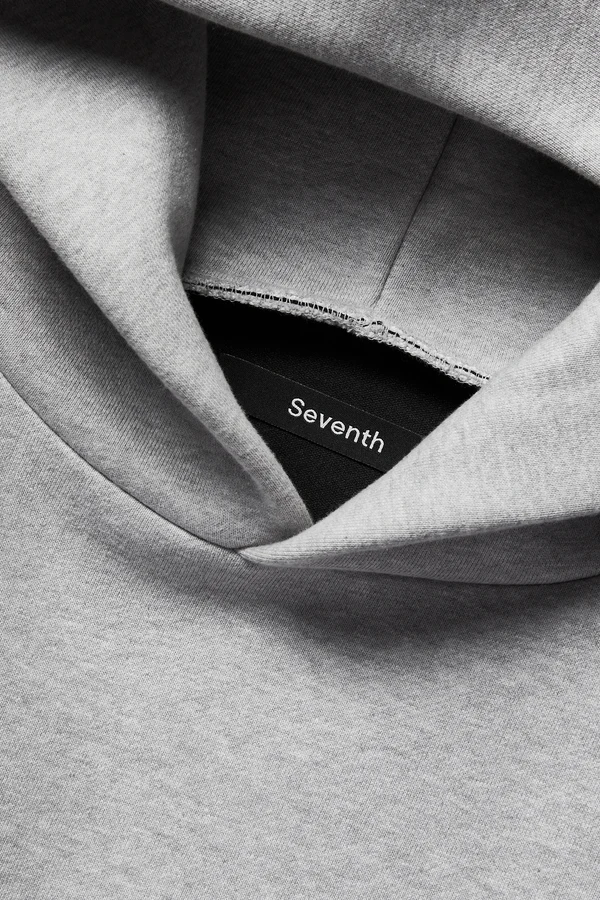
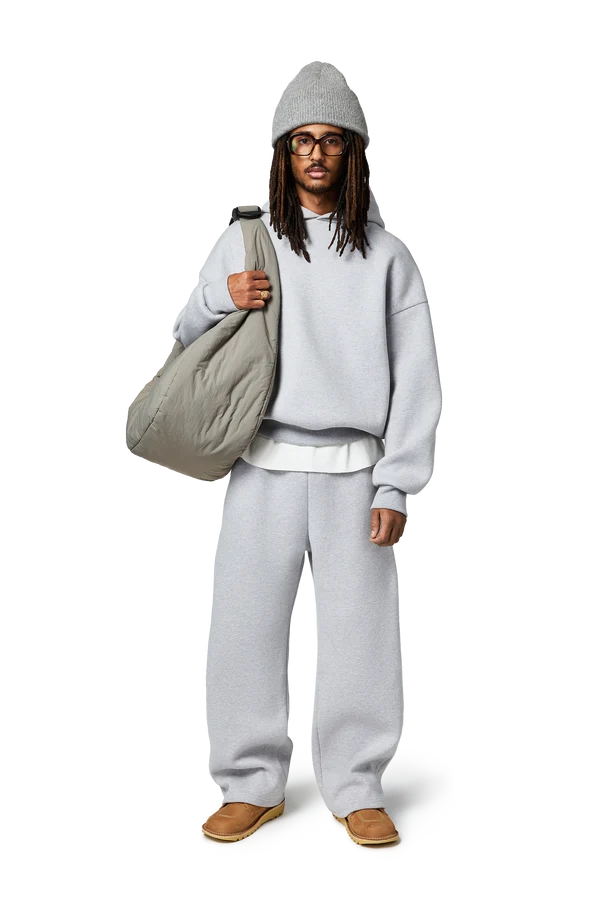
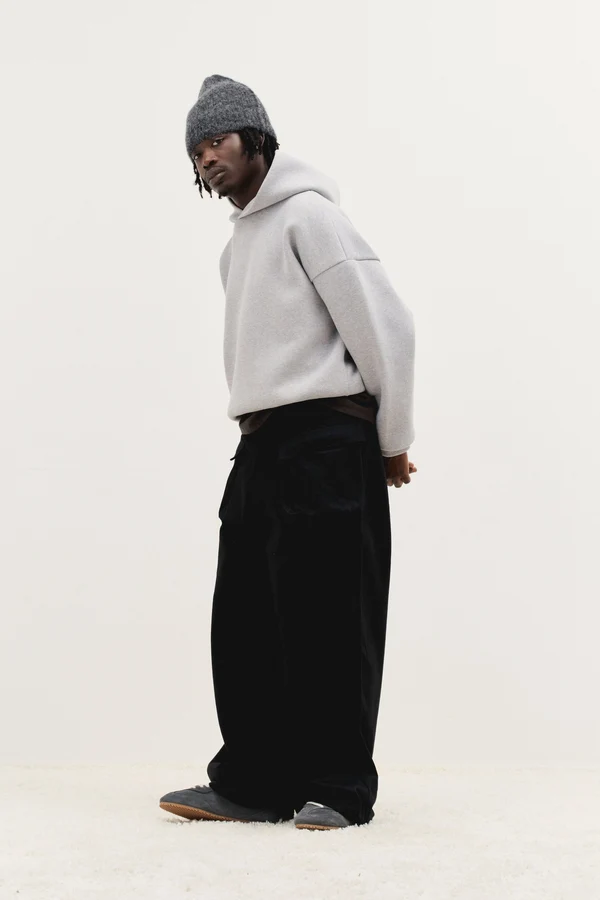
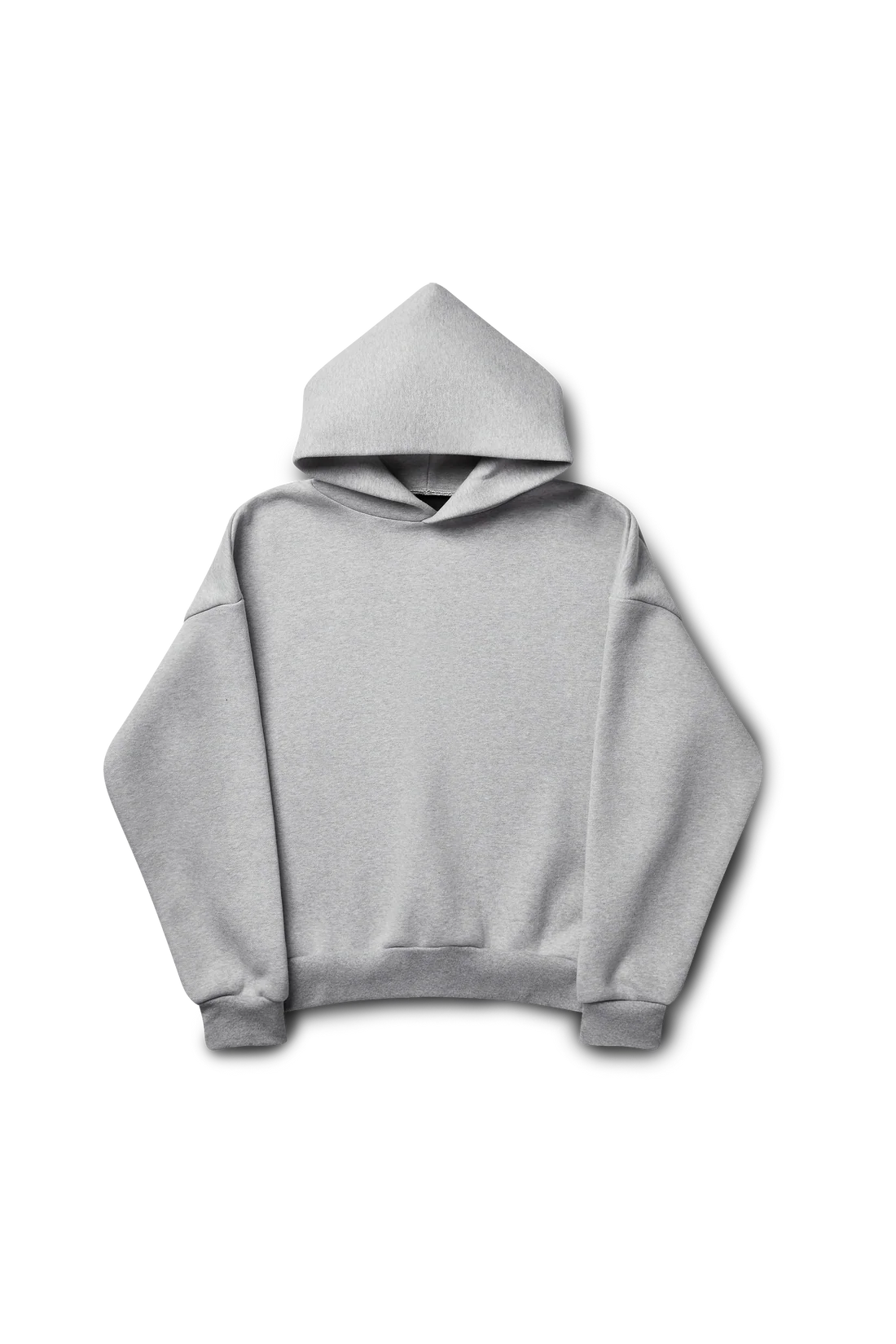
Seventh’s V2 Hoodie in Dune is built around a deliberate imbalance: room across the body without an equivalent extension in length. The brand describes a cropped, boxy torso, dropped shoulders and a curved, rounded profile. Those decisions make “oversized” an inadequate description. The intended effect comes from distributing volume, not simply enlarging every dimension. That distinction gives substance to a statement cited in Georgia Graham’s Liberty interview: “Our silhouette is our logo.” Ojo explains that Seventh’s fabric, silhouette and colour must be distinctive because the clothing does not rely on prominent logos for identification. The V2 is a useful test of that ambition: Seventh identifies it as the foundation of the collection, the piece around which the wider range is built.
The hoodie offers a credible argument for shape as a signature, but not proof of recognition. A deliberate silhouette and a universally identifiable product are different achievements. Its strongest case lies in how it organises several familiar sportswear elements, not in a claim that Seventh invented them.
Seventh’s V2 Hoodie in Dune uses a cropped body, dropped shoulders and substantial construction to make proportion, not graphics, its defining feature.
From Vintage Archive to Edited Sportswear
Ojo’s account of Seventh begins with clothing she already knew through selling it. Speaking to Highsnobiety’s Sam Cole, she described building an archive of 1990s and early-2000s sportswear and streetwear. She admired the quality, fits and silhouettes of those pieces but disliked their colours and logos. Seventh grew out of the decision to use that archive as a guideline while simplifying its visual language. In the Liberty interview, Ojo places the transition from her vintage business, 90ZBACK, to Seventh across 2019–2020. The early hoodies initially sat alongside vintage stock. Duru encouraged the move towards concentrating on the new label, and the team used lockdown to develop its identity. The sequence establishes continuity between the vintage business and the clothing that followed.
This history matters because it makes subtraction a design decision rather than a claim of neutrality. Removing a graphic does not erase a garment’s references. It exposes other choices more clearly. Seventh’s relationship with sportswear remains explicit; the enquiry is what its editing achieves.
Breadth Without Excess Length
The Dune V2’s published description combines a dropped shoulder with a cropped, boxy body. Read together, those features establish a specific proportional intention. The shoulder extends the upper garment’s breadth, while the shorter body prevents that expansion from simply continuing downward. The result Seventh proposes is substantial without being elongated. That is a more useful account than treating looseness as the garment’s defining quality. Extra room can produce many different outlines. Here, the brand identifies a rounded profile, making the relationship between width and length central to the design. The intended volume belongs to the torso rather than to a long, straight fall of fabric.
“Cropped” nevertheless remains relative to the wearer and selected size. Seventh shows a six-foot model wearing size L and publishes garment measurements alongside the product. Those details provide context, not a guarantee that the hem will finish at the same point on another body. The design’s proportional direction is clearer than any universal promise about fit.
Material Is Asked to Sustain the Form
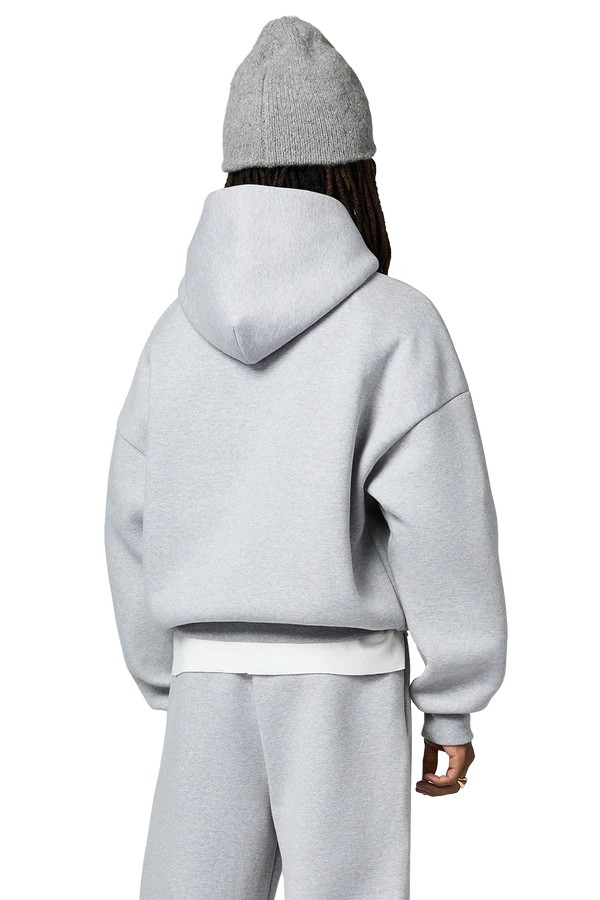
Seventh lists 610 GSM heavyweight cotton and double-layered construction for the Dune V2. The product description assigns those choices a particular job: providing enough substance to maintain the curved shape rather than allowing it to collapse during wear. This is the manufacturer’s explanation of intended performance, not an independently tested result. The relationship is nevertheless important to the design argument. The hoodie’s proposed identity does not depend on its pattern alone. Material and construction are intended to sustain the volume created by the cut. A broad body made in a different fabric could behave differently; Seventh’s specification presents weight as part of the form rather than merely an additional selling point.
That does not make heaviness synonymous with quality. The specification establishes neither a finished garment weight nor tested durability, and it cannot settle on comfort across different conditions. The stronger interpretation is narrower: Seventh has selected a substantial construction to support a particular outline. Whether it does so consistently after movement, washing, and repeated use requires examination beyond the product page.
Simplicity Still Requires Decisions
Duru’s explanation of Seventh’s identity is revealing because he describes simplicity as a constraint. In the Highsnobiety interview, he says the team will not add certain things to a hoodie or silhouette when they conflict with the brand’s established character. He connects that discipline with clothing, packaging and content. For the V2, this makes restraint an active process. The familiar hoodie category remains; the shoulder, body length and material become more consequential because an applied graphic is not being asked to dominate attention. Simplicity does not mean that every component has equal importance. It means the design has fewer prominent diversions from the relationships it wants to establish.
The limit is that a plain surface cannot establish distinction by itself. The absence of a large logo is not an exclusive feature. Seventh’s claim becomes convincing only when that absence is paired with a particular organisation of the garment. The V2’s published specifications make a coherent proposal, but the word “minimal” should not be allowed to complete the assessment for them.
Shape Is Not Working Alone
Ojo’s explanation to Liberty names three contributors to Seventh’s identity: fabric, silhouette and colour. The headline proposition therefore needs qualification. Even in the brand’s own account, shape is not an independent substitute for every other identifying device. It operates within a combination. Duru describes choosing colours by imagining someone crossing Shoreditch High Street and considering what would catch his attention. Ojo explains the importance of a distinctive colour vocabulary, giving examples such as “night,” “indigo” and “dove.” These statements suggest an ambition to be noticed through controlled choices rather than through a conspicuous emblem.
That is a more precise reading of the V2 than describing it as anonymous clothing. Dune is one named version within a wider system of products and colours. Its identity depends partly on the garment and partly on the repeated context in which Seventh presents it. Removing a prominent logo changes how branding operates; it does not make the product free of branding.
The Brand Has Already Questioned Weight
The most useful challenge to the V2’s heavyweight identity comes from Ojo herself. Discussing Seventh’s SS23 collection with Highsnobiety, she said the team’s tastes had centred on weighted products. Designer and developer Jared had helped her recognise that “quality and desirability aren’t all about weight.” Her response was to describe greater attention to silhouette, cut, breathable textures and function. Duru likewise discussed the challenge of working with different textures and moving beyond his preference for matching sets. The account establishes a design tension rather than a completed verdict on the collection: how could Seventh retain its character while changing the physical behaviour of its products?
That question sharpens the assessment of the V2. If weight alone creates identity, the label’s vocabulary is difficult to transfer. If identity lies in proportion and the materials selected to support it, lighter garments can participate without imitating the hoodie’s heft. The V2 is therefore most useful as an example of a method, not a specification every subsequent product must repeat.
A Signature, Not an Invention Claim
The V2’s strongest documented feature is the connection among its parts. A broad, comparatively short body establishes one direction; the dropped shoulder reinforces breadth; the double-layered material is intended to retain rounded volume. These are related decisions rather than a list of unrelated premium features. They are also decisions made within an acknowledged sportswear inheritance. Ojo’s account explicitly identifies vintage garments as guidelines. Seventh does not need a claim of complete formal novelty for its work to be assessed seriously. Its contribution can lie in selection, adjustment and consistency. Can a shape do the work of a logo? The V2 supports a qualified yes as a design proposition. Its identity is directed toward relationships within the garment rather than concentrated in an applied symbol. But shape does not work alone, and the published information cannot demonstrate public recognition or long-term performance. The convincing claim is not that this is the only broad, cropped hoodie. It is that Seventh has made those proportions central to a consistent design approach.
The Omiren Argument
The principle is proportion. Removing a prominent logo does not remove the need for identity; it transfers more of that work to the garment’s shape, material and colour.
Seventh’s V2 makes a specific proposal through breadth, a comparatively short body and construction intended to retain rounded volume. Its strongest argument is not that plainness guarantees quality, or that familiar elements become unprecedented when combined. It is that deliberate relationships can make an ordinary garment category particular. The question is how convincingly those relationships work, not how loudly the garment announces its name.
Also Read:
- Locked Society Is Building Streetwear Around the Work Nobody Sees
- Fora Leonara Is Betting That Quiet Luxury Still Needs a Point of View
- Wales Bonner x Adidas: The Design and Commercial Reach Behind a Long-Running Collaboration
- Vanhu Vamwe and the New Language of African Luxury
Frequently Asked Questions
Which Seventh Hoodie does this article examine?
The article examines the pullover V2 hoodie in Dune. Its specifications should not be confused with those of a zipped version or another iteration in the range. Seventh describes the V2 as the foundation of its collection, the piece around which the wider range is built.
How is the Dune V2 intended to fit?
The official listing describes a cropped, boxy fit, dropped shoulders and a rounded silhouette. It labels the product true to size and provides garment measurements. The model is six feet tall and wears size L; that is a presentation context, not a fit guarantee for another wearer.
What does the fabric specification establish?
The seventh lists 610 GSM heavyweight cotton and double-layered construction, and says these choices help hold the garment’s rounded form. They do not, on their own, establish a finished garment weight, tested comfort, wash performance or durability, all of which would need examination beyond the product page.
Who is behind Seventh?
The interviews identify Bukki Ojo as the founder and Emmanuel Duru as the creative director. Ojo connects the label’s development with her earlier vintage business, 90ZBACK, and its archive of 1990s and early-2000s sportswear and streetwear, which she used as a guideline while simplifying the visual language.