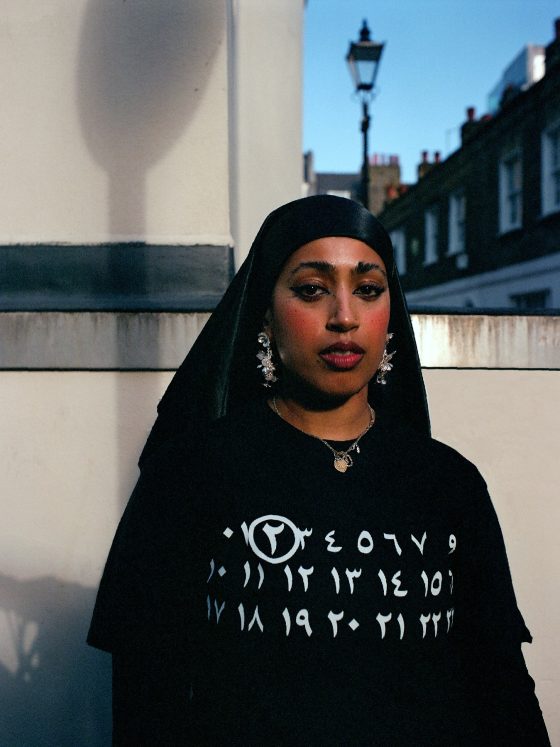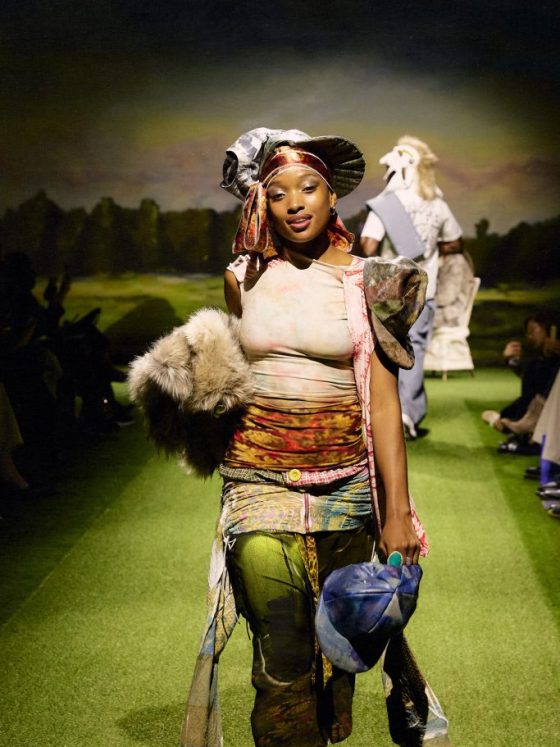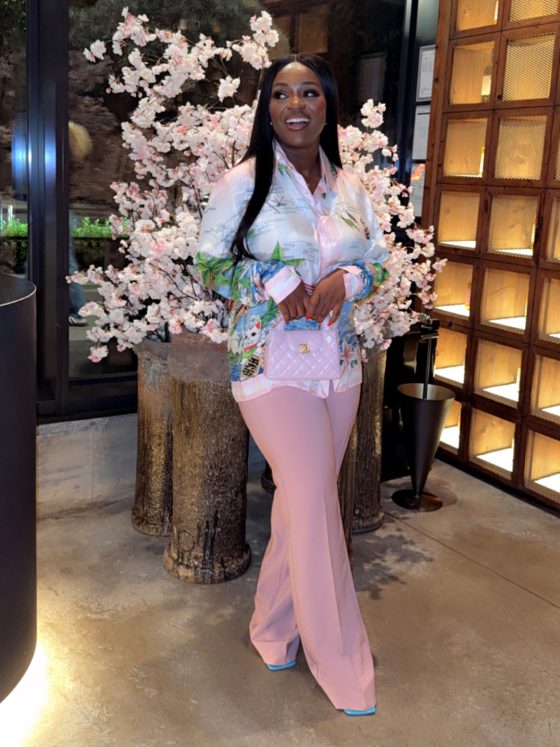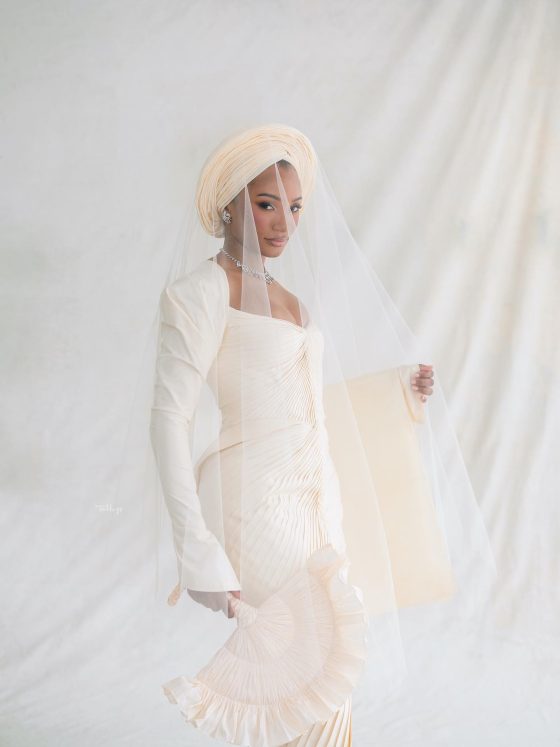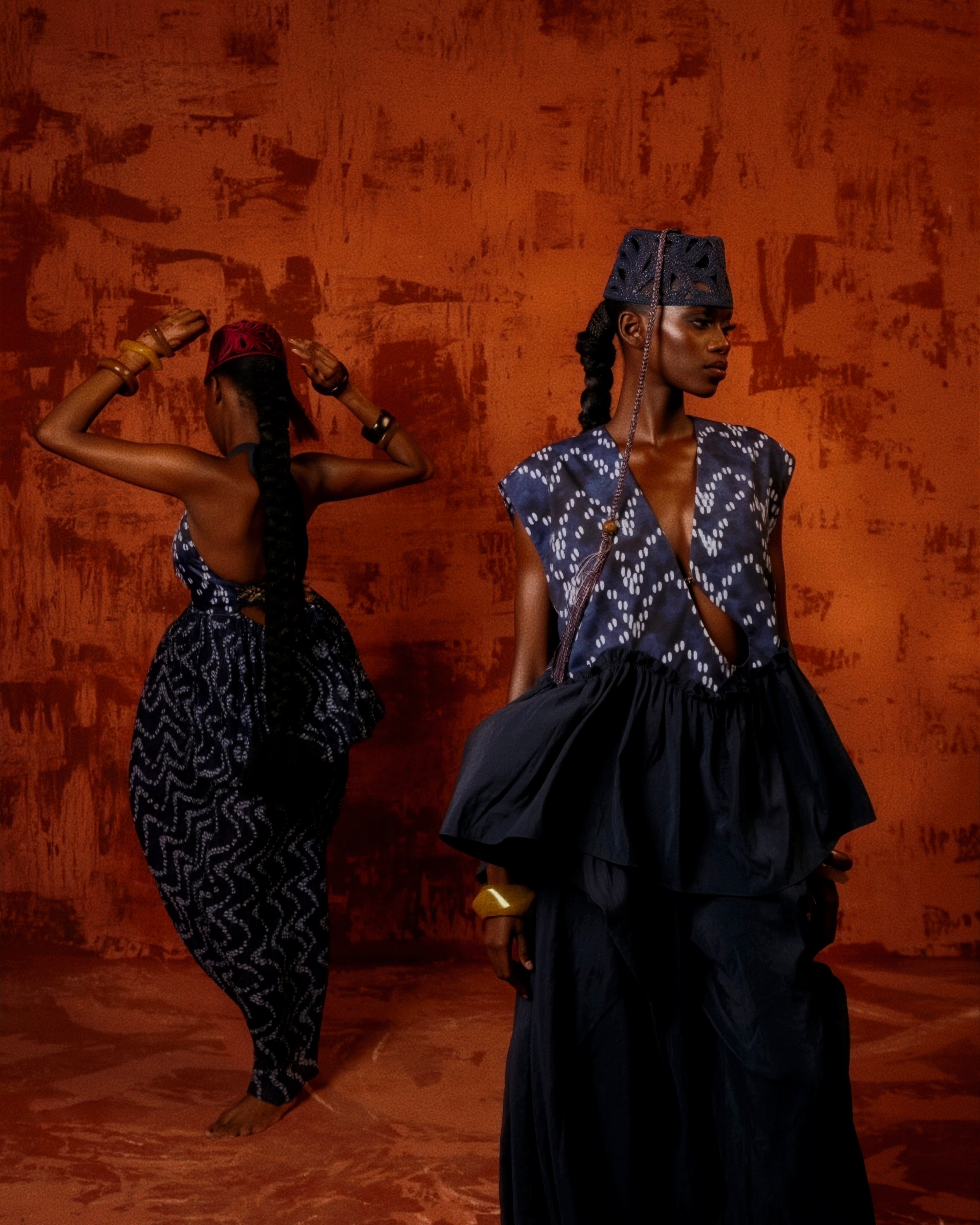
Christie Brown’s The Crossing is most persuasive as a design proposition when it names what it carries forward. The collection statement identifies “the structure, rhythm and heritage of the Volta Region’s Agbamevo” as its reference, then asks: “What if moving forward didn’t mean leaving anything behind?” That gives the collection a more particular starting point than the familiar promise of a woman entering a new chapter. It proposes continuity through the reworking of a textile reference, rather than change understood as a complete departure. For the label’s wider story, see our profile of Christie Brown and Aisha Ayensu.
The named garments provide a route into that proposition. On the brand’s own site, Serafina is described as a sleeveless kente blazer with a contrasting vegan-leather lapel; Ariel as an asymmetric kente panel skirt. Elsewhere in the Fall/Winter 2026 selection, Fleur Stripe, Yemi Stripe and Ines Blue introduce embroidery, stripes, cut-outs, ruching and drape. The distinction between those descriptions matters: some explicitly identify the textile reference, while others establish a broader set of design decisions.
A useful reading should not require every piece to illustrate the statement literally. It should, however, distinguish what the garments’ documentation supports from the meanings the campaign supplies. The clothes need room to be particular, rather than becoming interchangeable evidence for an uplifting story.
A garment-led reading of Christie Brown’s Fall 2026 proposition, examining how named designs relate to its stated ideas of heritage and transformation.
Serafina and Ariel: the clearest connection to the collection statement
Serafina offers the most direct point of entry because its description brings a named textile into a recognisable garment form. Christie Brown calls it a “sleeveless Kente blazer with contrast vegan leather lapel.” The blazer reference, sleeveless treatment and contrasting lapel are separate elements within the same proposition. Based on the description, the design does not present Kente as an isolated surface: it places it within a form that already carries its own conventions.
That is where the collection’s question becomes tangible. Continuity need not mean retaining every aspect of a garment’s established form, just as change need not mean removing the textile reference. Serafina’s documented combination allows both ideas to coexist. The lapel preserves a recognisable part of the blazer vocabulary while introducing a second material; the absence of sleeves modifies the overall form. This is a reading of the stated design decisions, not a verdict on their visual balance or execution.
“A reference only means something once you can see what it has been asked to do.” Omiren Styles Editorial Intelligence
Ariel extends the discussion into a different garment category. Described as an “asymmetric Kente panel skirt,” it places asymmetry and panel construction alongside the textile identification. Rather than repeating the blazer’s solution, its description proposes another way of organising the reference. The collection can therefore be understood, at least at the level of its documented design, as testing how one textile vocabulary operates through more than one garment structure.
A shared reference does not make the garments interchangeable.
The distinction between Serafina and Ariel is important to the criticism. A collection becomes less interesting when every piece is described through the same broad phrase, heritage meeting modernity, regardless of what the designer has actually changed. Here, the available descriptions identify different operations: a familiar tailored form modified through sleeves and material contrast, and a skirt organised through panels and asymmetry. Those differences deserve more attention than a repeated assertion that the collection looks forward.
The product information also has a clear boundary. Christie Brown identifies both garments as kente, while the collection statement names Agbamevo in relation to the Volta Region. The listings do not establish the textiles’ full production history. The appropriate claim is that the garments’ descriptions connect directly with the collection’s stated reference, not that the documentation independently verifies their weaving location, makers or provenance.
Fleur Stripe and Yemi Stripe: another pattern language
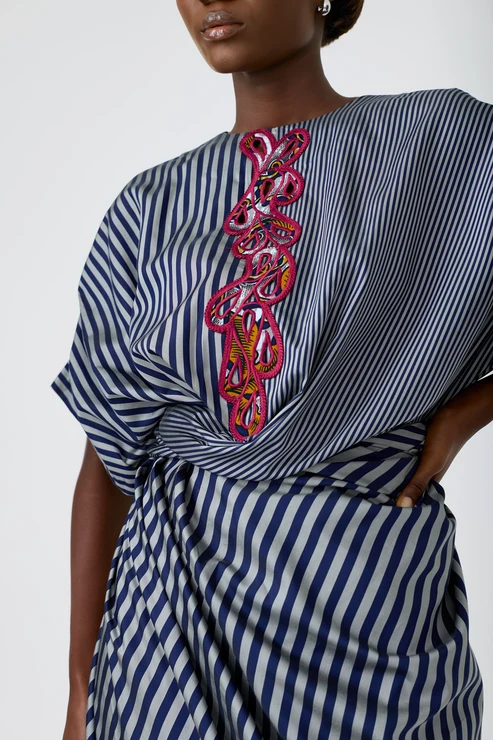
Fleur Stripe and Yemi Stripe widen the collection’s documented vocabulary beyond garments explicitly identified as kente. Fleur Stripe is an extended-sleeve wrap dress with embroidery detail. Yemi Stripe is a blue-striped, hand-embroidered cut-out skirt. Both appear in the official Fall/Winter 2026 selection, but their descriptions foreground different relationships: stripes with embroidery, and familiar garment types altered through sleeve treatment or cut-outs.
The interest lies in the layering of decisions. A striped surface already contains repetition; embroidery adds another intervention. The wrap dress and skirt supply recognisable formats, while their specified modifications distinguish them from an unaltered basic. These are not reasons to declare the designs successful without examining them. They are reasons to resist treating the pieces as filler around the collection’s more explicit textile references.
They also show why a collection statement should not absorb every detail into one explanation. The word “rhythm” may make stripes sound immediately relevant to the Agbamevo premise, but vocabulary alone cannot establish the relationship. Likewise, embroidery should not automatically acquire a regional meaning because it appears in a collection with a named cultural reference. The clearer reading is that Fleur Stripe and Yemi Stripe contribute a second pattern language whose specific relationship to the collection’s premise remains distinct from the direct material identification of Serafina and Ariel.
That distinction does not make these garments peripheral. It prevents the criticism from assigning them meanings it has not shown them to carry. A collection may develop through related but non-identical ideas; coherence does not require every piece to function as the same illustration.
Ines Blue: a different emphasis within the selection
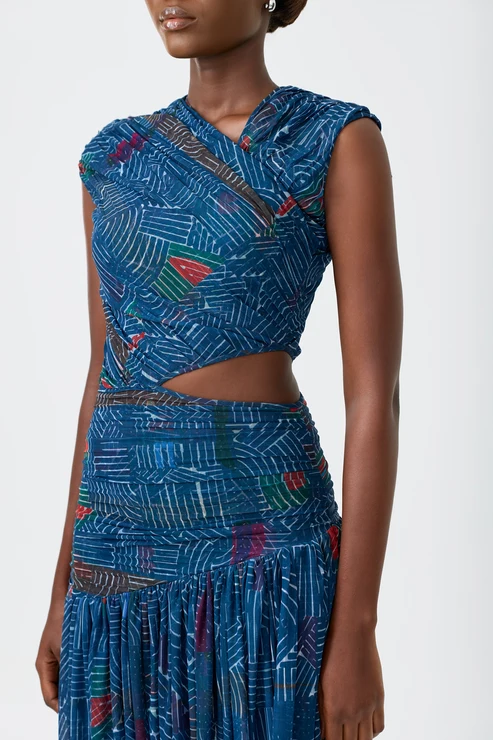
Ines Blue shifts attention towards the treatment of the dress itself. Christie Brown describes it through printed tulle, ruching, a side cut-out at the waist and a draped detail. Unlike the descriptions of Serafina and Ariel, this account does not identify kente. It emphasises the material and the garment’s arrangement around the body.
The distinction creates a useful limit for interpretation. It would be easy to fold the dress into the campaign’s language of transformation simply because ruching and drape change a surface. That would be an analogy supplied by the writer, not evidence of the collection’s intended relationship with Agbamevo. The documented features support a narrower observation: the seasonal selection offers another approach to form, described through gathering, exposure, and drape rather than through a named woven textile.
This does not establish a weakness in the collection. Nor does it establish an unexpected success. It places Ines Blue differently within the available evidence. Serafina and Ariel connect most directly with the stated textile premise; Fleur Stripe and Yemi Stripe introduce another relationship between pattern and garment modification; Ines Blue foregrounds manipulation of printed tulle. Preserving those distinctions produces a more useful account than declaring that all five garments express the same idea.
Where the campaign’s language helps, and where it cannot decide
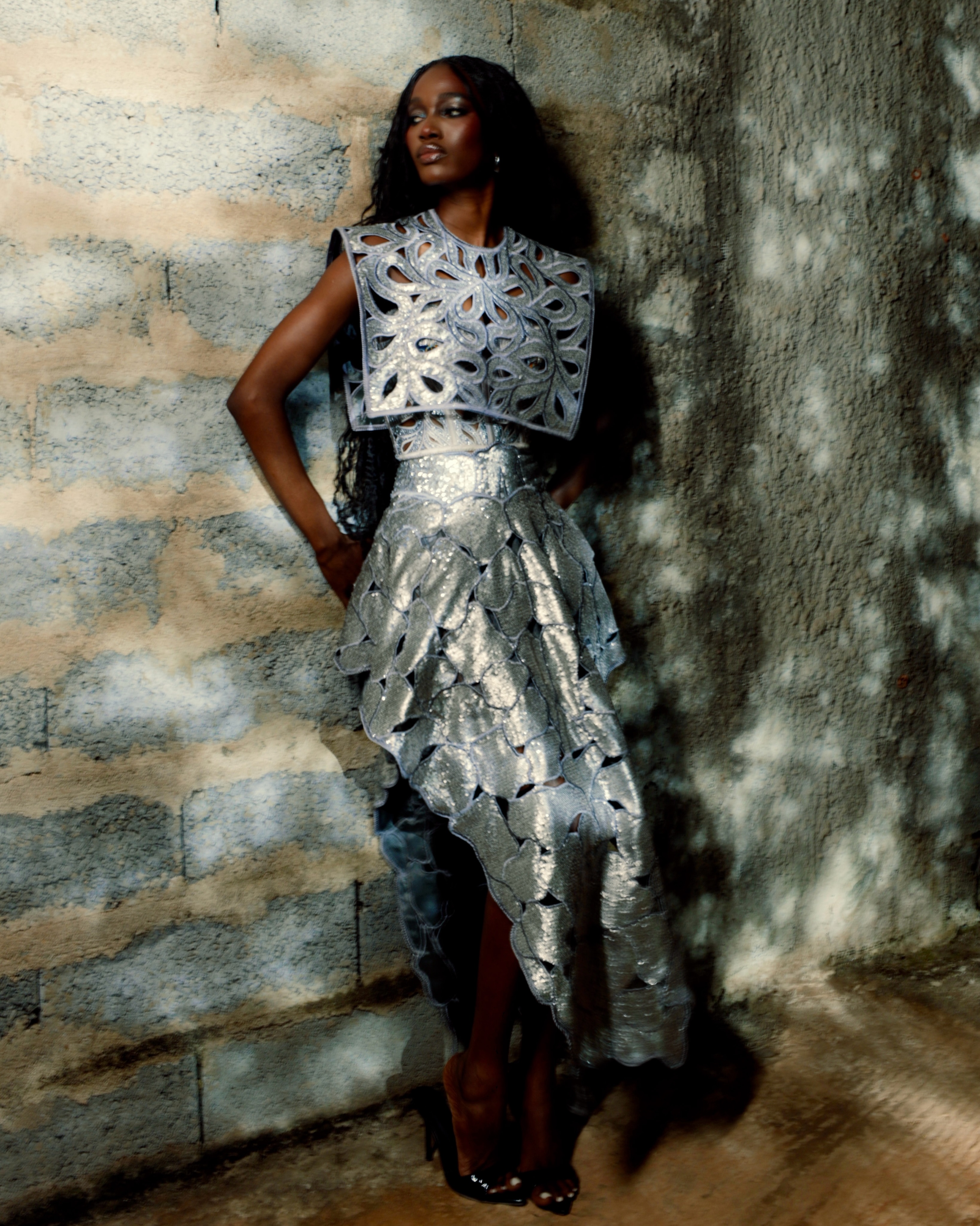
The campaign operates in two registers. Its specific statement identifies a regional textile reference and invokes structure and rhythm. Its broader language describes becoming, strength and moving forward, including the claim that carefully coordinated details can support and carry a woman into her next stage. The specific register gives criticism something to examine. It directs attention towards materials, garment forms and the relationship between repeated elements. The broader register establishes an emotional setting, but it cannot determine the clothes’ achievement. A statement about strength does not establish how a garment performs; a promise of transformation does not demonstrate that a composition is convincing.
The distinction should not be mistaken for a demand that fashion abandon storytelling. A campaign can offer a productive question. The problem arises only when its answer is assumed in advance, when every design becomes evidence of continuity, confidence or change because those words have already been supplied. The Crossing is more interesting when the garments are allowed to complicate that language.
On the documentation available, the strongest finding is therefore specific rather than comprehensive: the collection’s continuity proposition has a direct basis in named kente garments developed through different forms. The wider seasonal selection contains additional design languages that should be assessed on their own terms, rather than automatically enlisted to prove the same claim.
What the garment descriptions contribute
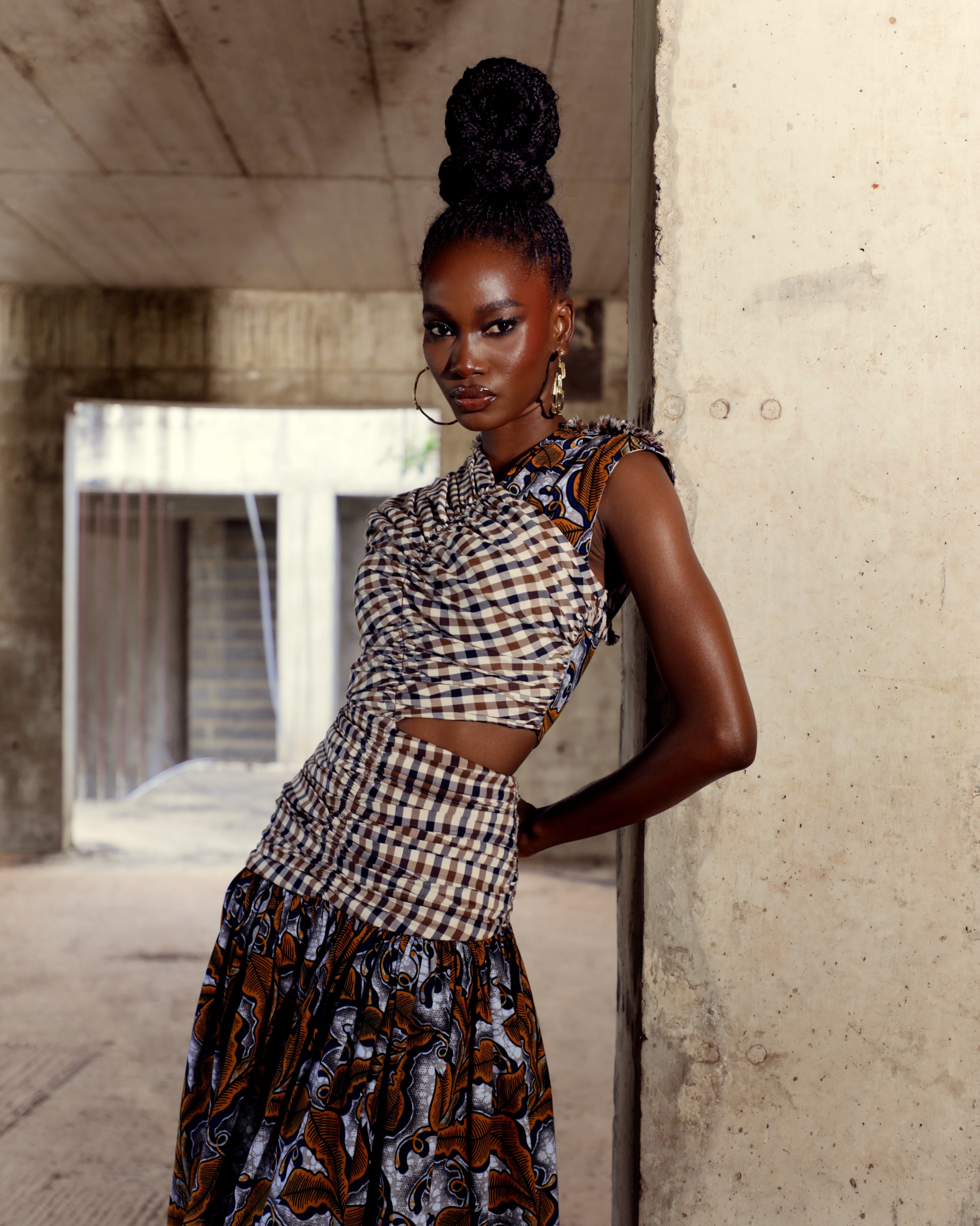
Product language is often treated as secondary to a campaign, yet here it sharpens the argument. “Sleeveless,” “contrast lapel,” “asymmetric,” “panel,” “wrap,” “cut-out” and “ruched” identify decisions more precisely than “becoming” can. They don’t replace looking at the clothes, but they keep the discussion from floating entirely above them. They also help establish the right scale of a claim. The descriptions can identify what Christie Brown says it has made. They can support an interpretation of how those decisions relate to the stated premise. They cannot settle the visual success of a complete ensemble, the handling of a textile in movement or the quality of its construction.
The appropriate result is a bounded reading, not an inflated verdict. The Crossing offers a specific proposition about retaining a reference while changing its expression. Its named garments make that proposition concrete enough to discuss without requiring the campaign’s emotional language to do all the work.
The Omiren Argument
The useful concept in The Crossing is translation, not as a synonym for any use of heritage, but as a question about what changes when a reference enters another garment form. Serafina and Ariel provide the clearest documentary basis for that question. Christie Brown identifies kente in a sleeveless blazer with a contrasting lapel and in an asymmetric panel skirt. The continuity lies in the named reference; the difference lies in the garment decisions through which it is expressed.
The rest of the selection should not be forced into the same reading. Stripes, embroidery, cut-outs and drape deserve precise attention, not automatic cultural attribution. A collection can contain several related propositions without every garment carrying the same explanatory burden.
For Omiren, that is the more useful critical position: begin with what the designer has specifically proposed, distinguish it from the campaign’s promise and keep the judgement proportionate to the evidence. The clothes should not disappear beneath the story told about them. More of our fashion coverage is at Omiren Styles.
Also Read:
- Top Ghanaian Fashion Designers Shaping Africa’s Global Fashion Narrative
- The Ghanaian Women Redefining Fashion on Their Own Terms
- Ghana’s Premium Fashion Tier Is Building What Fast Fashion Can’t Buy
- Accra Fashion: How Women in Ghana Are Redefining Personal Style in 2026
Frequently Asked Questions
What is The Crossing’s stated reference?
The collection statement names “the structure, rhythm and heritage of the Volta Region’s Agbamevo” and asks: “What if moving forward didn’t mean leaving anything behind?”
Which garments are identified as kente?
Serafina, a sleeveless kente blazer with a contrasting vegan-leather lapel, and Ariel, an asymmetric kente panel skirt. The other garments discussed are not identified as kente.
Do the product listings verify where the textiles were woven?
No. The listings identify the garments as kente but do not establish weaving location, makers or complete production history. The connection to Agbamevo comes from the collection statement.
Has Omiren Styles assessed fit or artistry?
No. This is a source-led reading of the official statement and garment descriptions. It makes no claim about independent visual inspection, textile provenance, fit or construction quality.