A textile becomes something only after a moment before it is a curtain, a chair cover, a dress, or a wrap. Before it is bought or worn or washed or worn out. The moment when someone works out how colour and pattern will behave on a surface, what a repeat will do, and how layers of dye will interact. That is design labour, and it tends to disappear behind the finished object.
Althea McNish’s Tomee gives us access to that earlier moment. The V&A holds it as a textile design made for Danasco Fabrics Ltd in 1961, with museum number E.1029-1979. Not a furnishing fabric. Not a dress. A design. That distinction is not a bureaucratic nicety. It tells you something about what the object preserves and what it does not yet tell us.
On the same V&A page that introduces McNish’s practice, other works have their categories made explicit: Gilia, Golden Harvest and Trinidad are described as furnishing fabrics; Tropic is identified as dress fabric. Tomee is presented as a textile design for Danasco. Those are different things. A finished textile can give evidence about material, printing, production and how the cloth wore over time. A design records an earlier stage: the work through which a surface is proposed, organised and prepared for possible translation into manufacture. The relationship between the surviving Tomee design and any commercial fabric it may have produced requires documentation that goes beyond what is available here.
Althea McNish designed Tomee for Danasco Fabrics Ltd in 1961. The V&A holds it as a textile design, museum no. E.1029-1979. This is a source-led reading of what the object preserves and what it tells us about McNish’s practice.
Who Made It and How She Got There
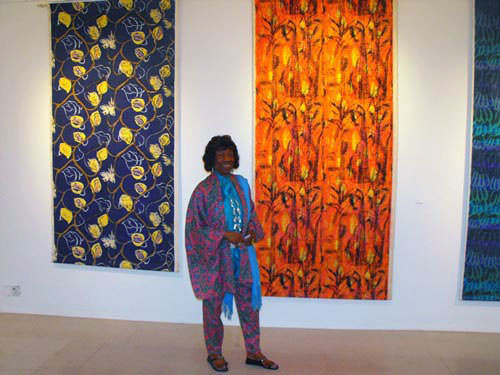
Althea McNish was born in 1924 in Port of Spain, Trinidad, and died in 2020. The V&A describes her as among the first, if not the first, designer of African-Caribbean descent to achieve international recognition. Her mother was a well-regarded dressmaker and dress designer; her father was a writer and publisher. Both fostered her interest in drawing and painting from an early age. McNish was a junior member of the Trinidad Arts Society and presented her first exhibition in Port of Spain while still a teenager. She arrived in London in 1951, aged 27, with her mother.
She had secured a scholarship to the Architectural Association but did not take it up. By her own admission, the prospect of seven British winters during a seven-year degree was too much. Instead, she enrolled at the London School of Printing and Graphic Arts, where she studied screen printing with leading industry figures. That turn away from architecture and toward print was, by the evidence of her career, exactly the right decision. The technical foundation she built at the London School of Printing gave her, in the V&A’s phrase, the distinct advantage of being able to ‘talk to printers on their own terms’.
After the London School of Printing, she took night classes with Eduardo Paolozzi at the Central School of Art and Design. Paolozzi was already a defining figure in British postwar art and a founding member of the Independent Group. He recognised McNish’s talent and encouraged her to apply it to textiles rather than fine art. She later completed a postgraduate degree at the Royal College of Art, then at the V&A.
The Technical Knowledge Behind the Colour
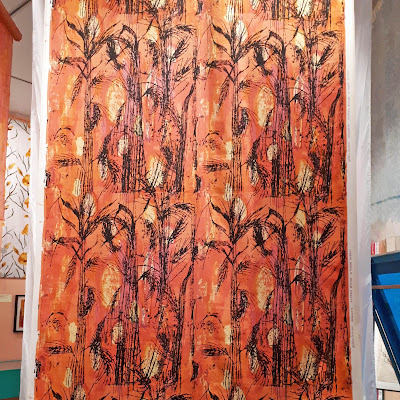
It is easy to describe McNish’s work in terms of energy and feeling. The V&A does so: dazzling, contrasting colours; movement and expressive lines; natural imagery; a tropicalised interpretation of the British landscape; lively abstract patterns bursting with energy and visual complexity. These are real accounts of how the work reads.
What they leave out is what made the colour possible. McNish honed her expertise in printing, textile repeats and colourways to a level that gave her control over industrial production processes and enabled her to achieve depth and form through distinct layers of colour. She could propose an effect and then have the authority to see it through. The V&A quotes her directly:
‘Whenever printers told me it couldn’t be done, I would show them how to do it. Before long the impossible became possible.’ Althea McNish, in Women Design by Libby Sellers, 2018
That statement is not evidence of a specific dispute over Tomee. It describes how she approached production generally. McNish’s colour was not just a visual sensibility. It was supported by technical authority.
This matters for reading Tomee because Danasco was a commercial client. A design submitted to a fabric company is not a painting handed over and hoped for the best. It is a proposal that has to survive translation into manufacture, which raises questions about repeat, colour separation, what a printing process can handle, and what it cannot. McNish’s training meant she had thought about those questions before anyone at the print house had to raise them.
A Career That Moved Between Forms
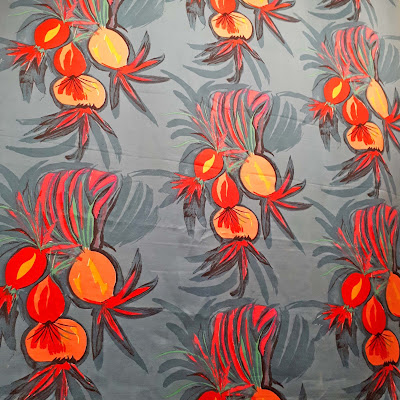
Printed cotton furnishing fabric
By 1961, when Tomee was designed for Danasco, McNish’s career was already taking shape across several kinds of commissions. Arthur Stewart-Liberty, chairman of Liberty, had seen her graduation show at the RCA and commissioned her to create exclusive designs for fashion and furnishing fabrics. Among them was Cascade (1959), an abstract cotton poplin with a black-and-blue background and overlaid circles in bright reds, greens and blues. It was one of the first commissions from a career that would go on to include Heal’s, Ascher, Hull Traders and Danasco, as well as wallpaper commissions, architectural murals and work for Design Research Unit clients including British Rail and the SS Oriana, launched in 1959, for which McNish designed restaurant murals including Rayflowers.
Each involved a different surface, a different production system, and a different relationship between the designed image and its final form. Fashion fabric is cut and worn. Furnishing fabric is seen across a room, folded, gathered, subjected to light at different times of day. A wallpaper pattern recurs across a wall. A mural is fixed and architectural. McNish moved between all of them, which means her understanding of what colour does in a space was built across formats rather than settled into one.
Her first design for Hull Traders, Golden Harvest, shows how observation and memory worked together in her practice. In 1957, during her final year at the RCA, she visited the Essex home of her tutor, the painter and graphic artist Edward Bawden. Walking near Bawden’s home, she encountered a wheat field for the first time. It recalled sugarcane plantations in Trinidad. That encounter stayed with her, and in 1959 she used the wheat motif in Golden Harvest. The furnishing fabric, printed heavy cotton satin, was produced in four colours and became Hull Traders’ best-selling design on release, staying in production until the 1970s. The V&A documents this connection explicitly. It belongs to Golden Harvest. It should not be transferred to Tomee simply because McNish made both.
A tropical eye, not a label
McNish said in 2015, ‘Everything I did, I saw it through a tropical eye.’ The V&A uses this to open its introduction to her work, and it is a valuable account of how she understood her own perspective. It is not, however, a key that unlocks any specific design. It tells us something about the sensibility she brought to her work; it does not tell us which shapes in Tomee are tropical references or what sources informed its palette.
The temptation to describe everything in her practice as tropical flora or Caribbean memory is one to resist. Her sources were not confined to one place. The Essex wheat field became Golden Harvest. Paolozzi’s teaching at the Central School shaped how she thought about abstraction. Her understanding of British Modernism was not only an outsider’s view. It was an engaged, technically capable participant’s view, formed through years of study and professional work in London.
What Danasco and the 1961 Date Tell Us
The Danasco attribution places Tomee within McNish’s freelance career as it was developing in the early 1960s. By 1961 she had already worked with Liberty and Hull Traders and had begun working with Ascher, whose printed silks attracted couture clients, including Christian Dior. Danasco was one of several textile businesses with which she maintained commercial relationships.
The V&A record connects the surviving object to a named company and a date. What it does not yet tell us, from the documentation available here, is how many colourways were produced, how much fabric was manufactured, at what scale it was distributed, whether it ever reached a finished interior or whether any length of the commercial fabric has been separately documented. A textile design and a manufactured fabric are different objects. Keeping that distinction visible is not pedantic. It allows the design to be valued accurately as design labour, rather than being asked to carry a domestic history it has not yet been shown to have.
Art and Everyday Life
One of the most useful observations about McNish’s practice comes from her husband, the designer John Weiss, quoted in Pop Art and Design (2018):
‘She does not seem to have been interested in other people’s perceptions of boundaries between fine art and manufactured textiles and simply continued working as a painter and textile designer side by side.’John Weiss, Pop Art and Design, 2018
The record supports her disregard for the boundary between fine art and commercial design. McNish described herself as an artist. She continued to paint alongside her freelance work throughout her career. In 1961, the same year as Tomee, she was exhibiting paintings at the Commonwealth Institute in London as part of Paintings by Trinidad and Tobago Artists. In 1978, her paintings and drawings were shown at the V&A itself.
Her 1966 contribution to the Ideal Home Show makes her interest in design as an everyday environment concrete. She designed and dressed a Bachelor Girl’s Room for the exhibition: a studio-like space, in the V&A’s interpretation, for the independent woman of the sixties, pursuing her own interests and career. It was an exhibition setting, not an actual room. It does not tell us that Tomee appeared there. It shows that McNish treated the surfaces of everyday life as a legitimate territory for the same creative intelligence she brought to painting.
Tomee sits within that larger practice. It is one design, from one year, for one company. Its significance is in what it demonstrates: that McNish’s engagement with colour in everyday surfaces was sustained and commercially serious, not incidental to the rest of her work.
What the Record Preserves
The V&A holds Tomee as a named design, by a named designer, for a named company, in a named year, with a museum identifier that makes it findable and citable. Those details may seem modest beside a story about transforming the British interior. They are nevertheless valuable. They allow the design to be discussed as McNish’s specific work rather than absorbed into a generic account of post-war pattern.
McNish was not the only Caribbean designer working in Britain in this period, but she was, in the V&A’s account, among the first to achieve international recognition. The wider story of Caribbean contributions to British dress and textile history provides the context in which her work makes most sense. Tomee is one documented point within it.
As Omiren Styles has established in its work on heritage textiles, the knowledge embedded in a textile design is not always legible from the surface. What Tomee carries is the record of colour approached as technical practice, by someone who had learned printing from industry professionals, studied abstraction under Paolozzi, argued with printers at the colour separation stage, and spent a decade developing commissions for the most demanding commercial clients of post-war British design. The label says 1961, Danasco Fabrics. The label cannot carry how much of McNish’s knowledge went into making it possible.
ALSO READ
- Brixton’s Caribbean Dress Legacy
- How Adire Cloth Holds Memory, Labour and Place
- Can Heritage Textiles Scale Without Losing Their Meaning?
Frequently Asked Questions
What is Althea McNish’s Tomee?
Tomee is a textile design Althea McNish made for Danasco Fabrics Ltd in 1961, held in the V&A collection as E.1029-1979. The V&A catalogues it as a textile design rather than a finished furnishing fabric, which is a meaningful distinction: the surviving object records an earlier stage of design labour rather than a finished manufactured product.
Is Tomee a finished furnishing fabric?
The V&A identifies Tomee as a ‘textile design’ for Danasco, not a finished furnishing fabric. On the same V&A page, other McNish works are explicitly described as furnishing fabrics or dress fabric. Those distinctions should be respected rather than treated as interchangeable. The precise relationship between the surviving design and any commercial fabric requires documentation beyond what is currently available.
Who was Althea McNish?
Althea McNish (1924–2020) was a Trinidad-born artist and textile designer who moved to London in 1951. She studied at the London School of Printing and Graphic Arts and the Central School of Art and Design and completed a postgraduate degree at the Royal College of Art. The V&A describes her as among the first, if not the first, designer of African-Caribbean descent to achieve international recognition. She maintained commercial relationships with Liberty, Ascher, Heal’s, Hull Traders and Danasco while continuing to paint and exhibit throughout her career.
Why did McNish’s printing training matter for her design work?
Her training at the London School of Printing gave her technical knowledge of screen printing, textile repeats, and colourways, enabling her to work with industrial production processes rather than simply handing over designs and hoping they survived translation. The V&A records her expertise in this area as giving her control over production and the ability to achieve depth and form through distinct layers of colour. She is directly quoted as saying she would show printers how to do things they claimed were impossible.
What can Tomee tell us about McNish’s career in 1961?
Tomee was designed in 1961, by which point McNish had already worked with Liberty (since her graduation), Hull Traders (from 1959, when Golden Harvest became a best-seller), and Ascher (whose couture clients included Christian Dior). Danasco was one of several commercial relationships she maintained as a freelance designer. The design falls within a period when her freelance career was well established, and her technical authority was already demonstrably influencing production.
What does the Ideal Home Show commission tell us about McNish’s interest in everyday life?
In 1966 McNish designed and dressed a bachelor girl’s room for London’s Ideal Home Show. The V&A describes it as a studio-like space for an independent creative woman – for the independent woman of the sixties, unshackled from traditional familial and social expectations. It was an exhibition setting, not an actual room, and it does not establish that Tomee appeared in it. It shows that McNish’s interest in colour in everyday environments was direct and deliberate, not incidental to her broader practice.