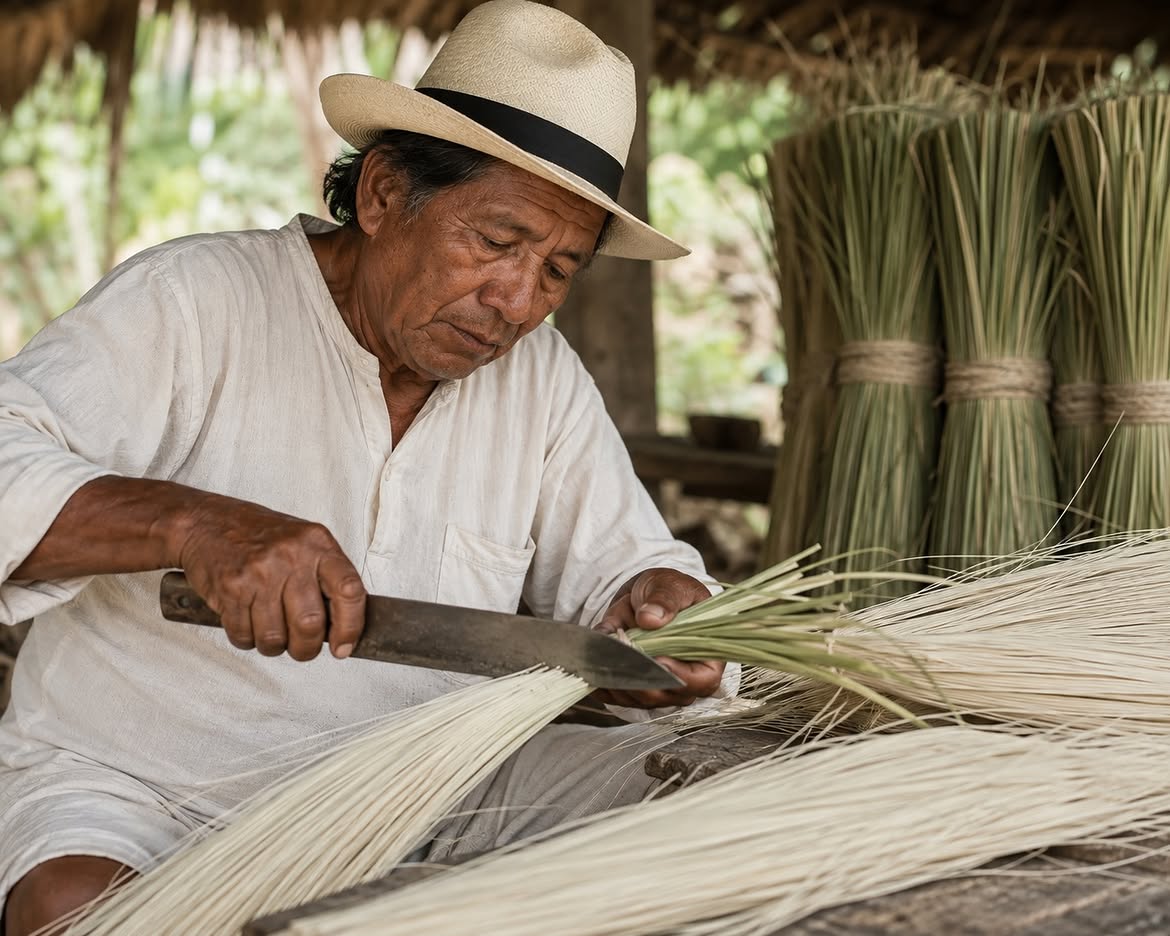
A hat woven in Ecuador has an international retail name that does not identify its country of origin. It is called a Panama hat. Its material is paja toquilla: the fibre of the Carludovica palmata plant, native to coastal Ecuador, whose tenderest young shoots are stripped, boiled, dried and split into the strands that Ecuadorian artisans weave by hand into a textile so fine that the finest examples can be rolled into a cylinder, passed through a ring and unrolled without losing their form.
The name ‘Panama hat’ has a historical explanation: in the nineteenth century, Ecuador’s low international trade profile meant artisans brought their finished hats to the busier transit port of Panama for distribution to Asia, the rest of the Americas, and Europe. The hats acquired their commercial name from their point of international sale rather than their place of origin. The explanation does not change the consequence: an Ecuadorian craft tradition inscribed on UNESCO’s Intangible Cultural Heritage list in 2012 is sold, at the point of sale, under the name of a country whose artisans did not produce it.
This article reads the retail vocabulary used to describe toquilla weaving at the point of sale, from specialist Ecuadorian exporters to international fashion retailers. It asks what that vocabulary establishes about provenance, quality, and craft, and what it consistently omits about the artisans, their specific communities, and the economic relationship between the hat’s retail value and the payment reaching the weaver who made it.
Ecuador’s toquilla straw hats are sold internationally under the name of another country. This article examines the retail vocabulary used to describe them at the point of sale: what it establishes, what it omits, and what questions a buyer should be asking.
What the Retail Vocabulary Says
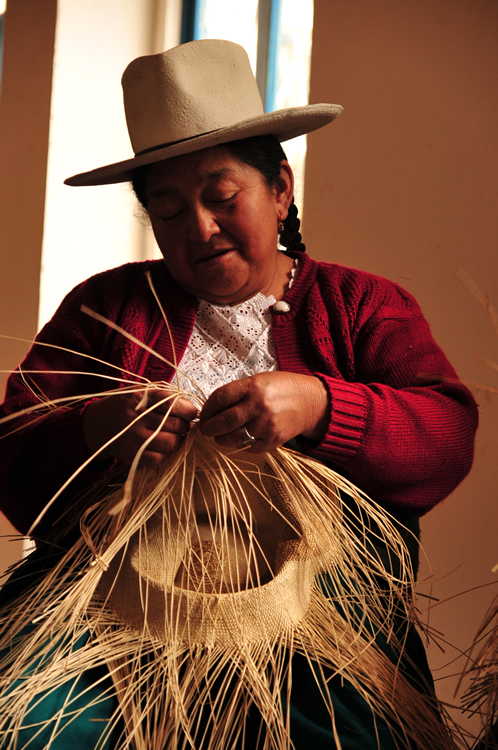
The dominant language at the point of sale for authentic toquilla straw hats is composed of a small set of recurring claims. Reading them across multiple retailers, specialist exporters and fashion accessory brands produces a consistent picture of what the retail vocabulary considers worth saying and what it does not.
The Origin Claim
The highest-quality toquilla straw hats sold with genuine provenance claims identify Montecristi as the specific weaving location, not merely Ecuador as a country. Montecristi, in the Manabí province, is the primary centre for the finest superfine hats; Pile is a specific village near Montecristi where some of the most skilled weavers practise. Cuenca, in the Azuay province, produces hats in larger volumes at varying quality levels, with Cuenca hats typically woven more quickly and at lower price points than Montecristi superfines. An authentic hat from Montecristi and an authentic hat from Cuenca are both genuinely Ecuadorian and made from genuine toquilla straw; they are not the same product.
Most retail point-of-sale descriptions do not make this distinction. A hat described as ‘handwoven in Ecuador from 100% toquilla straw’ confirms the country and material but does not specify the weaving centre or quality grade. A buyer who understands the difference between Montecristi and Cuenca hats knows that one description covers a range of quality and price that the other does not. Most retail descriptions cover this range with a single origin claim that flattens it.
The UNESCO and Authenticity Language
UNESCO inscription appears at the point of sale in two distinct ways, and the distinction matters. The first is accurate: some retailers state that toquilla straw hat weaving was inscribed on UNESCO’s Representative List of Intangible Cultural Heritage in 2012, identifying the inscription as recognition of the craft tradition itself. The second is misleading: some product descriptions describe the hat itself as ‘UNESCO certified,’ which it is not. UNESCO inscribes living cultural heritage traditions; it does not certify individual products. A hat is not UNESCO certified because it is made from toquilla straw. The inscription recognises the weaving practice as a living tradition worth preserving; it says nothing about the quality of any individual hat within that tradition.
The word ‘authentic’ at the point of sale carries a similar range. In its most specific use, authentic distinguishes a hat genuinely handwoven in Ecuador from toquilla straw from a machine-made or non-toquilla imitation that uses the Panama hat name. In its less specific use, ‘authentic’ becomes a quality claim whose meaning varies with the seller’s definition: an ‘authentic’ Cuenca hat and an ‘authentic’ Montecristi superfine are both authentically Ecuadorian toquilla hats whose quality and production time differ by a factor of between five and twenty depending on the specific comparison.
The Craft and Time Vocabulary
Retailers describe theailers describe the production process of a ly than its geographic origin. Several elements appear across multiple retailers: the Carludovica palmata plant source; hand weaving described as generational craft; the blocking process that shapes the unfinished hood into a hat; the finishing process in which a specialist trims the edges (called an azocadora) to prevent fraying; the hammering out of the straw’s natural oils to produce softness and sheen; and the pressing that recovers the hat’s shape. These are genuine descriptions of the production process.
What the production description omits at most points of sale: the specific time required to produce the hat being sold. The production time for a toquilla straw hat ranges from a few days for a basic Cuenca hat to six months to a year for a Montecristi superfine, whose weave density can exceed thirty fibres per inch. A product description that identifies a hat as handwoven without specifying the weaving time has described the process without giving the buyer the single most informative indicator of the hat’s quality and the labour invested in it.
The finest Montecristi superfine hats require six months to a year of sustained weaving. The retail description at the point of sale typically says ‘handwoven’ and moves on. The six months is where the value lives. The description elides it.
The Artisan Language
‘Master artisans’, ‘expert artisans’, ‘master craftsmen’, and ‘artisan tradition’ appear at the point of sale in descriptions of toquilla straw hats across quality levels. The vocabulary is consistent: the skill is generational, the artisans are masters, and the tradition is centuries old. These descriptions are broadly accurate for the craft tradition. They are not applied specifically: the hat’s retail listing typically does not name the individual weaver, the specific community they work in, or the percentage of the retail price that reaches the weaver as payment for the specific hat being sold.
Artisan language in retail descriptions of toquilla weaving functions as a quality and authenticity signal rather than a credit mechanism. It tells the buyer that a skilled person within a craft tradition made the hat. It does not create a relationship between the buyer and that person, and the person receives no credit in the transaction beyond the payment they received from the exporter or wholesaler who purchased their hat and placed it in the supply chain that ends at the buyer’s purchase.
What the Retail Vocabulary Does Not Say
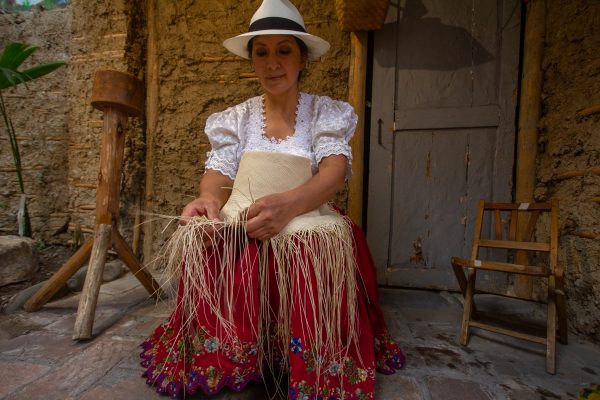
Reading the point-of-sale vocabulary for toquilla straw hats across the retail landscape produces a consistent set of absences alongside the consistent set of presences. The following dimensions are rarely addressed at the point of sale:
- The weaver’s name. Hats sold as ‘handwoven by master Ecuadorian artisans’ do not typically name the artisan who wove the specific hat being sold.
- The weaving community. ‘Handwoven in Montecristi’ is the most specific origin claim commonly available. The specific village, cooperative or household that produced the hat is rarely disclosed.
- The price paid to the weaver. The retail price of a fine Montecristi hat can reach several hundred to several thousand dollars in specialist retail contexts. The percentage of that price that reaches the weaver, who spent six months to a year making it, is not disclosed at the point of sale.
- The finishing location. Hats are often woven in Ecuador as unfinished hoods, exported, and blocked and finished in the destination country. A hat described as ‘handwoven in Ecuador’ may have been shaped and trimmed in the United Kingdom, the United States or another market. The retail description may name both facts or may describe only the weaving origin.
- The quality grade corresponds to the weave density. Fibre count per inch is the most specific available quality measure. Most retail descriptions do not quantify the weave density of the specific hat being sold.
The Wholesale Vocabulary and Its Contradictions
The wholesale market for toquilla straw hats presents a specific version of the vocabulary problem: wholesale listings for toquilla stne the language of artisan craft with the economics of volume production. A wholesale listing that describes hats as ‘handmade by expert artisans’ while offering factory prices and minimum order quantities is using the artisan vocabulary as a product category rather than as a description of the specific production relationship for the lot being sold.
This is not a claim that wholesale toquilla hats are not handwoven. Most toquilla straw hats sold through wholesale channels are genuinely handwoven from toquilla straw. The contradiction is more specific: the artisan vocabulary implies a direct relationship between maker and buyer in which the maker’s skill is the primary value. The wholesale relationship is a commercial intermediation in which the skill’s value is aggregated across large volumes at prices that make individual artisan attribution practically impossible and financially irrelevant to the transaction. The vocabulary survives the transition from craft to commerce; the relationship it implies does not.
The Geographic Name Problem
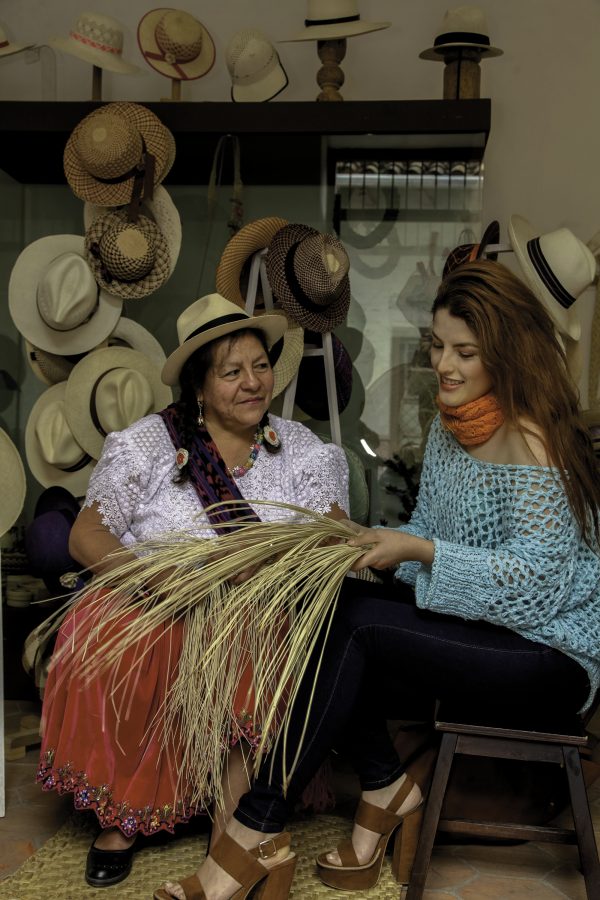
The deepest point-of-sale description problem for toquilla straw weaving is not the artisan vocabulary or the UNESCO language. It is the name. A hat that the entire global retail market calls a Panama hat, including the retailers, importers and exporters in Ecuador who sell to international buyers, is described by a name that attributes it to a country that did not produce it. This is not a recent commercial error that a correction campaign could resolve. It is a nineteenth-century commercial accident that has become a global retail convention so entrenched that Ecuadorian exporters use it to sell their own products to international buyers who would not find those products by any other search term.
The situation has no direct parallel in the world’s other major heritage textile and craft traditions. A Welsh blanket is not sold as an English blanket. A Japanese kimono is not sold as a Chinese kimono. A Ghanaian kente cloth is not sold under another country’s name. Ecuador’s toquilla straw hat is the single most significant example in global fashion retail of a craft tradition whose commercial identity is defined by the name of a country that did not originate, develop or sustain the craft.
The Ecuadorian hat industry has responded by using both names simultaneously, identifying hats as ‘Panama hats, handwoven in Ecuador’ or ‘authentic Ecuadorian Panama hats,’ which is accurate but requires the buyer to understand that the name and the origin are different. Some specialist retailers and advocacy voices within Ecuador’s toquilla straw weaving community argue for using ‘sombrero de paja toquilla’ or ‘Montecristi hat’ as alternatives that foreground the craft and geographic origin rather than the commercial distribution accident. Those terms have not yet displaced ‘Panama hat’ at the global retail point of sale.
What a Buyer Should Ask
A buyer purchasing a toquilla straw hat who wants their purchase to reflect the hat’s actual provenance and quality needs more information than the standard retail point-of-sale description provides. The following questions close the gap between the description and the evidence:
On provenance:
- Was this hat woven in Montecristi, Pile or Cuenca? These are different production centres with different quality profiles and production timescales.
- Was the hat blocked and finished in Ecuador or exported as an unfinished hood and blocked elsewhere?
- Who wove this hat? If the retailer is a direct supplier from Ecuador, can they identify the weaver or cooperative?
On quality:
- How many fibres per inch does this hat contain? The answer places the hat in a specific quality band: a basic hat has fewer than fifteen fibres per inch; an extra-fine hat has between twenty-three and thirty-two; a superfine hat exceeds thirty-two.
- How long did this hat take to weave? The production time is the single most informative quality indicator available.
On the artisan relationship:
- Does this retailer work directly with weavers or cooperative organisations, or through intermediary exporters?
- What percentage of the retail price reaches the weaver who produced this hat?
The Omiren Argument
The point-of-sale vocabulary for Ecuador’s toquilla straw weaving is simultaneously the most honest and the most misleading in the heritage craft market. It is honest because the best specialists in the category use precise language about materials, weaving centres and production process. It is misleading because the trade name under which the entire category is sold attributes the craft to the wrong country, because ‘artisan’ and ‘master craftsman’ are used as quality signals rather than as credit mechanisms, and because the single most important quality indicator, the weaving time, is rarely disclosed at the point of sale.
As Omiren Styles has established, in its field-by-field analysis of fabric provenance claims, geographic origin claims operate at different levels of precision, each requiring different documentation. The toquilla straw hat market demonstrates what happens when the category-level geographic origin claim (Ecuadorian) and the product-level geographic origin claim (Montecristi superfine, six-month weave) are both available but only the first is routinely disclosed. The buyer who purchases an ‘authentic Ecuadorian Panama hat’ has received the country. They have not received the weaver, the village, the fibre count or the time.
As Omiren Styles has argued throughout its coverage of heritage textiles and the Global South, the Global South made fashion and never got credit. The artisans of Montecristi and Pile, who weave the world’s finest toquilla straw hats over six months to a year of sustained, expert work, sell those hats into a global market that does not name them, does not name their community, does not disclose the time their work required and sells their product under the name of a country whose transit port was simply more convenient for nineteenth-century shippers. The hat is called a Panama hat. The skill is Ecuadorian. The credit is absent.
ALSO READ
- A Fabric Provenance Claim, Field by Field: What a Buyer Should Ask to See
- Colombian Traditional Clothing: Regional Dress, Fabrics and Fashion
- The Global South Made Fashion. It Just Never Got Credit.
Frequently Asked Questions
Why are Ecuadorian toquilla straw hats called Panama hats?
The name is a commercial accident with a nineteenth-century origin. Ecuador’s limited international trade infrastructure in the 1850s meant artisans brought their finished hats to the busier transit port of Panama for distribution to international markets in Asia, the Americas, and Europe. The hats acquired their commercial identity from their point of international sale rather than their place of production. The name ‘Panama hat’ has since become so entrenched in global retail that Ecuadorian exporters use it to reach international buyers who would not find the product by any other search term. The craft tradition whose name was displaced was inscribed on UNESCO’s Intangible Cultural Heritage list in 2012 as ‘the traditional weaving of the Ecuadorian toquilla straw hat’.
What is paja toquilla, and where does it come from?
Paja toquilla is the fibre of the Carludovica palmata, a palm-like plant native to Ecuador’s coastal regions. Only the tenderest young shoots are used; they are stripped, boiled, dried, and split into fine strands for weaving. The plant grows only in specific regions of Ecuador, making the fibre unique to Ecuadorian geography in a way that cannot be replicated with other palm species. The quality of the finished hat depends on how the fibre is selected and prepared before weaving begins.
What is the difference between a Montecristi hat and a Cuenca hat?
Both are genuine Ecuadorian toquilla straw hats. Montecristi, in the Manabí province, is the primary centre for the finest superfine weaves, with production times ranging from several months to a year for a single hat and weave densities that can exceed thirty fibres per inch. Pile is a specific village near Montecristi where some of the most skilled weavers practise. Cuenca, in the Azuay province, produces hats in larger volumes at varying quality levels, typically woven more quickly and at lower price points than Montecristi superfines. The two traditions differ in quality range, production time, and price. Most retail descriptions describe both as ‘handwoven in Ecuador’ without making the distinction.
What does ‘UNESCO certified’ mean on a toquilla straw hat?
It does not exist as a product certification. UNESCO inscribes living cultural heritage traditions, not individual products. UNESCO inscribed the traditional weaving of the Ecuadorian toquilla straw hat on its Representative List of Intangible Cultural Heritage in 2012, recognising the weaving practice as a living tradition worth preserving. A retailer who describes an individual hat as ‘UNESCO certified’ is misusing the UNESCO inscription. UNESCO does not certify the hat; it inscribes the craft tradition of which it is an example. The distinction matters for a buyer assessing what the claim establishes about the specific hat they are purchasing.
How can a buyer assess the quality of a toquilla straw hat at the point of sale?
The most specific available quality indicators, in descending order of usefulness, are the number of fibres per inch (a basic hat has under fifteen; extra fine has twenty-three to thirty-two; superfine exceeds thirty-two); the production time for the specific hat (days to weeks for a basic hat; six months to a year for a superfine); the specific weaving location (Montecristi/Pile superfines command the highest quality tier; Cuenca hats span a wide quality range); and whether the hat was blocked and finished in Ecuador or exported as an unfinished hood. A retail description that provides none of these indicators names the material without characterising the hat’s quality within the material’s range.
EXPLORE MORE
Read the full Material Intelligence and Heritage Craft and Provenance coverage at Omiren Styles for ongoing analysis of heritage craft description at the point of sale, provenance claim evidence and the vocabulary gap between artisan knowledge and retail communication. Discover travel and heritage intelligence across Latin America, the Caribbean and Africa at Rex Clarke Adventures.