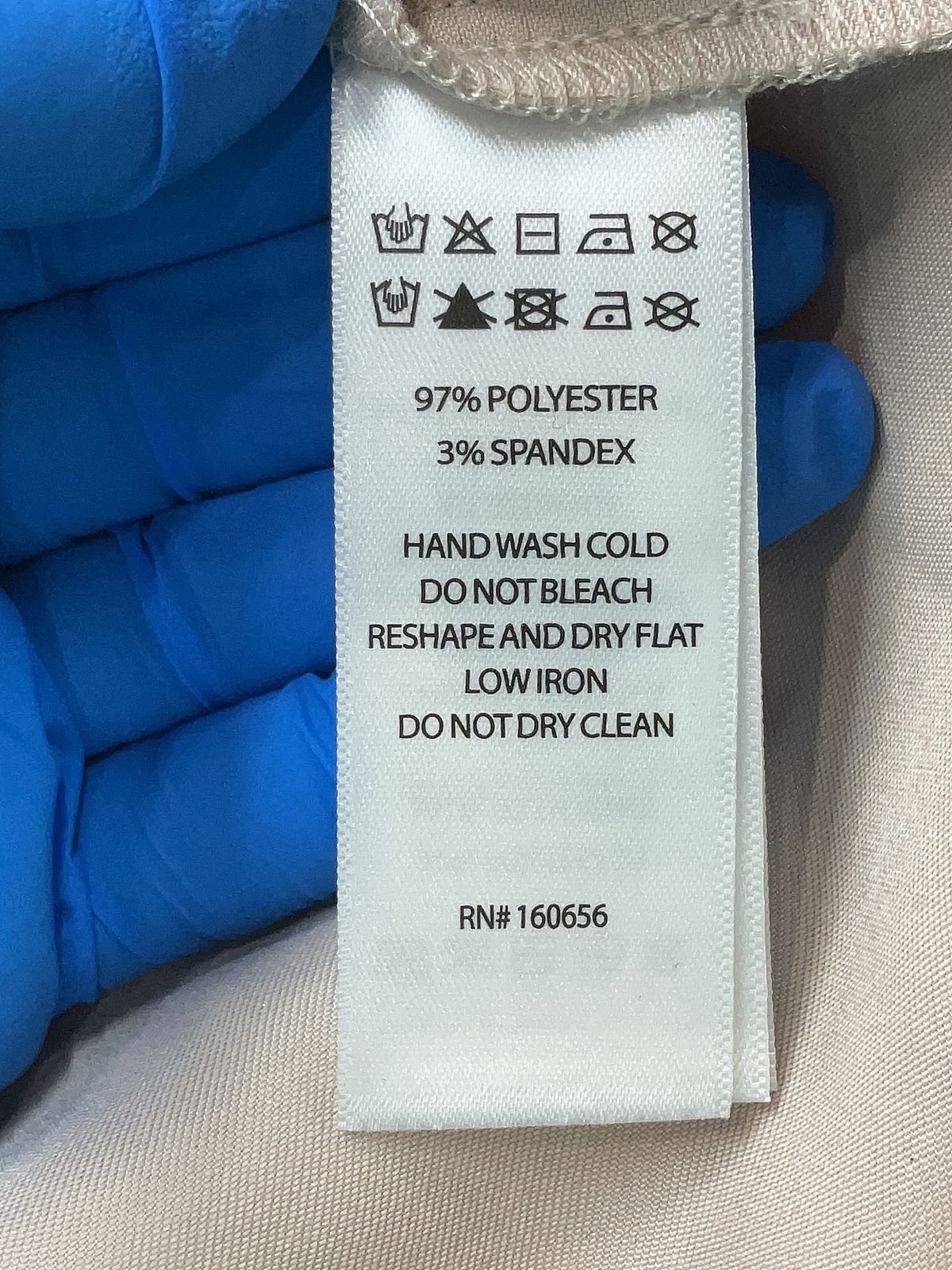
A label might read ‘80% cotton, 20% polyester ‘. It may carry care symbols, a country name and a marketing claim such as ‘responsibly made’. It is tempting to read those lines as a compact history of the garment.
They are not. The fibre percentages describe the garment’s composition as stated by the business responsible for the product. The care information tells you how to treat the item. A country-of-origin statement, where present, makes a different claim again. None of these automatically identifies the farm, recycling source, spinning mill, dye house, garment factory, or working conditions.
That does not make labels useless. It makes them worth reading precisely: take each statement at face value, and notice which questions it leaves open.
A fibre composition label tells you what a product says it contains. A care label tells you how to wash it. Neither maps where the garment came from nor who made it. This consumer guide explains what each part of a label actually establishes and which questions it leaves open.
What the Law Requires in Great Britain
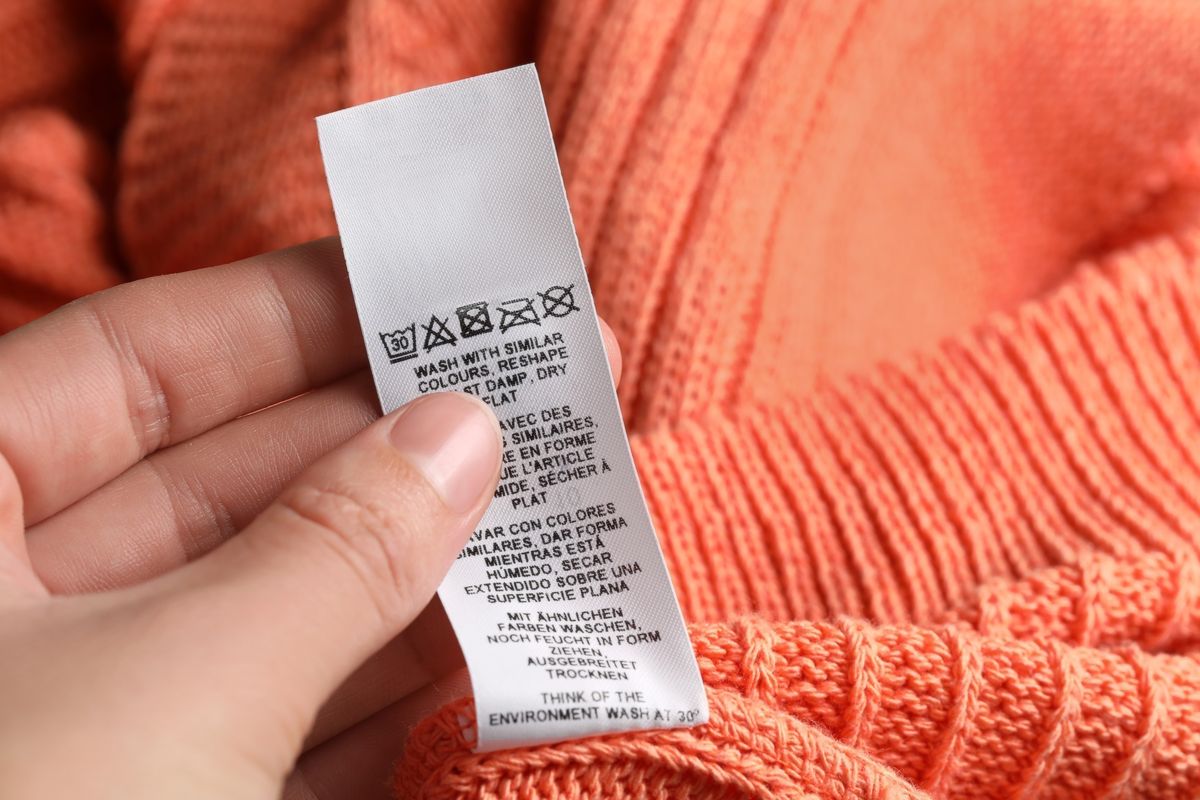
UK government guidance on textile labelling states that textile products must show their fibre composition. If a product has two or more components with different fibre compositions, it must show the content of each separately. Manufacturers and retailers must comply with these requirements. The guidance applies to England, Scotland and Wales.
What the law in Great Britain requires on a textile label is primarily fibre composition information. It does not require the label to identify the manufacturer, the country where the fibre was grown, the mill where it was processed, or the factory where the garment was assembled. A brand may provide any of that information voluntarily, and some do. They are not required to put it on a sewn-in tag.
The European Commission’s guidance on EU Regulation 1007/2011, which governs textile labelling across the EU market, confirms a comparable position for EU products: the regulation does not require the label to identify the manufacturer, country of origin or factory working conditions. EU businesses may provide origin or sustainability information voluntarily, as long as it is not misleading. The EU regulation is cited here for comparison only; shoppers in Great Britain should refer to UK government guidance for the rules that apply in this market.
Reading the Fibre Composition
The fibre percentages answer a specific question: what fibres does this product say it contains, and in what proportions? They help you compare materials, identify blends, and understand which components of a garment differ from the main fabric.
Read the whole label, not just the opening claim. A jacket sold as ‘wool’ may have a wool-rich outer fabric and a different lining; describe both separately. A dress may use one blend in its main panels and another in its sleeves or facing. The component descriptions clarify which part of the garment each percentage applies to.
What fibre percentages cannot tell you: how fine the wool is, how the cotton was grown, whether a polyester is recycled, where the fibres were spun, where the fabric was woven, or what treatment the cloth received before it became a garment. A label stating ‘100% cotton’ does not establish that the cotton was grown in a cotton-producing country, that the fabric was made sustainably, or that the production workforce was fairly paid. The percentage describes the fibre in the finished product. It does not describe the journey from fibre to product.
A label is not proof of its own accuracy. It is a product statement subject to applicable labelling rules. If a fibre claim is disputed, the appropriate course is to examine or test the product, not rely on the printed tag alone.
Reading the Care Information
GINETEX, which administers the care-symbol system used across many clothing markets, states that care instructions account for the textile article’s critical features, including its colouring, finishing, and accessories such as buttons and zips. It also states explicitly that care labelling does not guarantee quality. This is an important clarification that labels themselves rarely make.
Care symbols tell you how to treat the finished garment. They do not tell you how long it will last, who made it or where the fabric came from. Two garments with identical fibre compositions may carry different care instructions because their constructions, finishes or trims differ. ‘Dry clean only’ does not identify the fabric’s source. A 30°C wash recommendation does not prove that a garment is fragile, nor does a 60°C recommendation prove it is durable.
The most useful time to read a care label is before purchase. If a garment requires a cleaning method you will not follow, or a fabric or material that needs treatment you cannot provide, the fibre content alone is not sufficient to make it a practical choice. A beautiful wool coat that requires hand washing will not wear as intended for someone who machine-washes everything.
In the EU, the European Commission’s guidance on Regulation 1007/2011 states that the EU textile-fibre regulation does not lay down harmonised EU requirements for washing or maintenance instructions. National rules or schemes may apply in specific markets. The UK government guidance similarly distinguishes between the fibre-composition requirements it sets out, and care information, which separate guidance or scheme rules may address.
Reading Origin Claims Narrowly
A statement such as ‘Made in Portugal’ makes a country-of-manufacture claim. It tells you the business is associating a production stage with that country. It does not, on its own, confirm where the cotton was grown, where the yarn was spun, where the fabric was dyed, or where every other step in the garment’s production occurred.
Different wording describes different things. ‘Designed in London’ refers to the design stage, not to manufacturing. ‘Italian fabric’ may mean woven in Italy, finished in Italy, or supplied by an Italian company: these are distinct possibilities that a short label phrase may not resolve. ‘Handmade in [country]’ refers to a production method but does not specify who did the handwork, under what conditions, or at what pay rate.
The absence of a country-of-origin statement is equally easy to misread. No origin on the label establishes that the label does not provide that information. It does not prove that production was poorly managed, that the brand has something to conceal, or that the garment came from a high-risk supply chain. A brand may provide origin information on its website, through customer service or in supplier records; it may also be unable or unwilling to answer. The label’s silence is an information gap, not a verdict on production.
Three Hypothetical Labels, Read Carefully
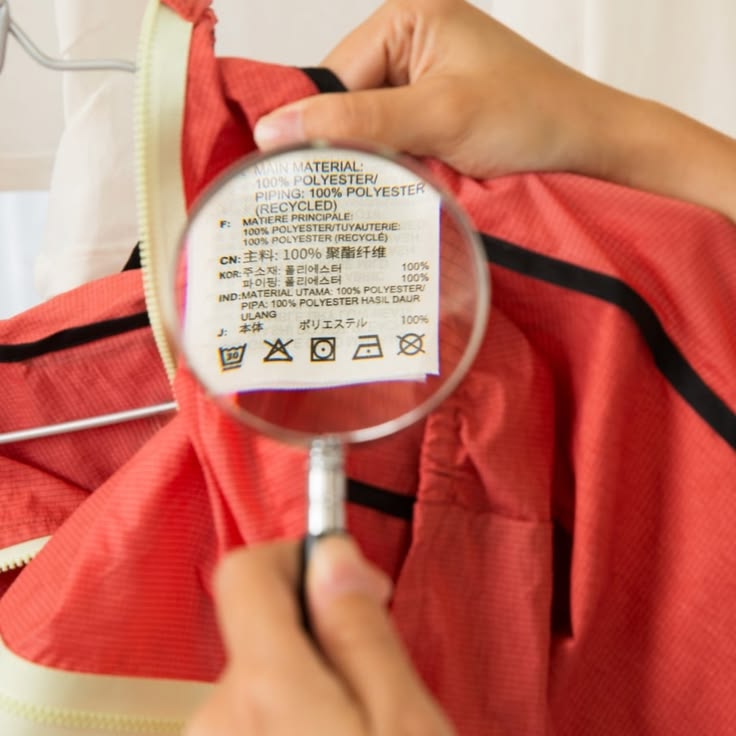
The following examples are illustrative only. They are not photographs or assessments of any real product. A human editor should replace them with accurately transcribed real labels and verified product-page information before publication.
Hypothetical Label A: ‘100% cotton. Machine wash 30°C.’
What the label states: The seller states the relevant textile material is cotton and gives care instructions appropriate to the finished garment.
What the label does not address: Where the cotton was grown, which country processed it, whether it is organically certified, who dyed the fabric, and whether any chemical finishing was applied before assembling the garment.
Hypothetical Label B: ‘Outer: 80% wool, 20% polyamide. Lining: 100% polyester. Made in Portugal.’
What the label states: The stated fibre compositions differ by component, which is correctly disclosed separately; it also provides a country-of-manufacture claim for the garment as a whole.
What the label does not address: Where the wool was sourced or what breed produced it, where either fabric was woven or finished, and which specific production stages occurred in Portugal rather than in other countries within the same supply chain.
Hypothetical Label C: ‘100% polyester. Recycled material. Wash at 40°C.’
What the label states: The fibre is stated as polyester; a separate recycled-material claim is made; a care instruction is provided.
What the label does not address: The proportion of recycled content, the source of the recycled material (post-consumer bottles, industrial offcuts, reclaimed fibre), the certification or transaction evidence supporting the recycled claim, and whether ‘recycled material’ refers to the polyester, the label, the packaging or all of the above.
The third example is worth examining closely. The word ‘polyester’ names the fibre. ‘Recycled material’ makes a separate sourcing or content claim. A shopper cannot verify that second statement by reading the first: the fibre name and the recycled claim are two different pieces of information, and only one falls under the fibre-composition labelling requirement.
UK government guidance on environmental claims advises fashion businesses to hold robust, credible, relevant and up-to-date evidence for environmental claims made in the course of commerce and to obtain appropriate supporting evidence from their suppliers. For the shopper, the practical implication is that ‘recycled material’ printed on a tag is a claim that the brand should be able to support with more than the printed words. Asking specifically what proportion is recycled, how it was verified and by which certification (where applicable) is a reasonable consumer enquiry.
A Label Is Not the Supplier File
A detailed supply-chain record contains fabric codes, purchase orders, mill names, lot numbers, certifications, transaction certificates, test results and documents connecting each production stage to the next. That is what a buyer inside a fashion company uses to assess a provenance claim. It is not what a consumer label was designed to reproduce, and it is not reasonable to expect a sewn-in tag to carry that information.
This difference should protect shoppers from two opposite and equally unhelpful responses. The first is assuming that an ambitious-sounding claim on a label is substantiated by its presence. The second is assuming that a short, conventional tag proves a brand has nothing behind it. Neither conclusion follows from a label alone.
As Omiren Styles has established in its field-by-field analysis of fabric provenance claims, a provenance claim is a set of fields, each requiring different evidence from a different point in the supply chain. A label is one output of that system. It cannot reproduce the system.
As Omiren Styles has established in its guide to what fashion brands need before they say ‘sustainable’, ‘local’, or ‘community-made’, the evidence a claim requires depends on the specific claim. A shopper applying the same logic to a label is asking: what specific claim is this sentence making, and what would it take to support that claim beyond the words printed here? That is a narrower and more useful question than asking whether the brand is trustworthy in general.
Five Questions to Ask Before Buying
Use the label as the beginning of a purchase decision, not its conclusion.
- What are the stated fibres and percentages? Check the main material and any separately listed components, including the lining, the trim or a differently constructed section.
- Can I care for this garment as instructed? Consider the whole item, not just the fibre you recognise most.
- What exactly does any origin wording describe? Separate design, fibre source, fabric production and garment manufacture – these can occur in different countries.
- Are there additional claims beyond fibre content? Words such as ‘recycled’, ‘organic,’ ‘responsibly made’ or ‘sustainably sourced’ need their own definitions and their own evidence. Find out what the brand means by each term and what supports it.
- What is the single most important missing fact for this purchase? Identify it and ask the brand directly rather than attempting to infer it from the label.
The Omiren Argument
A fibre and care label is a compact consumer tool. It can help you compare compositions, anticipate how a garment needs to be maintained and notice when a brand has made a separate claim worth examining more closely.
Its limit is as important as its usefulness. Fibre content is not fibre origin. Care instructions don’t test durability. A country name doesn’t record every stage of manufacturing. An absent factory name is not evidence of poor conditions. Read what is on the label. Notice what is not there. And when a product story extends beyond what the label says, ask for evidence that extends beyond it too.
As Omiren Styles has argued throughout this series, the Global South made fashion and never got credit. A label that says ‘80% cotton’ and nothing else may reflect the work of weavers, dyers, spinners, and garment workers whose names, locations, and contributions are absent from the sewn-in tag. Reading the label carefully does not recover that record. But it does help distinguish between what has been stated and what has been assumed, and that distinction is where better consumer decisions and more honest brand conversations begin.
ALSO READ
- A Fabric Provenance Claim, Field by Field: What a Buyer Should Ask to See
- What Can a Fashion Buyer Actually Verify About Peruvian Alpaca?
- The Finish After the Fibre: Five Questions That Change a Fabric Specification
- When a Brand Says ‘Handmade,’ What Should a Customer Be Allowed to Ask?
- The Global South Made Fashion. It Just Never Got Credit.
Frequently Asked Questions
Does a clothing label tell you where the fabric was made?
UK government guidance on textile labelling requires manufacturers and retailers to show fibre composition on textile products sold in Great Britain. It does not require the label to identify the mill, dye house or country where the fabric was produced. An optional country-of-origin statement refers to a manufacturing claim stated by the brand; it does not automatically describe every stage of production. A shopper who wants to know where the fabric was made should ask the brand directly rather than inferring it from the label.
Does ‘100% cotton’ mean the garment was made in a cotton-growing country?
No. The statement describes fibre composition, meaning the textile material is cotton. It says nothing about where the cotton was grown, where it was spun into yarn, where the resulting fabric was woven, dyed or finished, or where the garment was cut and assembled. Those stages may have occurred in different countries, and the fibre-composition label is not designed to record them.
Do care labels guarantee quality?
GINETEX, which administers the widely used care-symbol system, states explicitly that care labelling does not guarantee quality. Care instructions reflect the treatment appropriate for the finished garment, taking into account its fibres, colouring, finishing and accessories. They guide maintenance, not predict durability or assess the production standards used during manufacturing.
Does a missing country-of-origin label mean a brand is hiding something?
Not necessarily. The absence of a country-of-origin statement on a label establishes only that the label does not include that information. In Great Britain, fibre-composition labelling requirements do not mandate country-of-origin information on the sewn-in tag. A shopper can still ask the brand for that information. A brand that declines to answer may be exercising commercial confidentiality, operating in a complex multi-country supply chain, or unwilling to disclose. You can’t read any of those responses from the label’s silence alone.
Does ‘recycled material’ on a label prove the recycled content?
UK government guidance on environmental claims in the fashion industry advises brands to hold robust, credible and relevant evidence for any environmental claim they make. The words ‘recycled material’ on a label make a claim; they do not independently verify it. A shopper who wants to understand what the claim means should ask the brand: what proportion of the product’s material is recycled, what the recycled source was, and what evidence supports the statement? A brand making this claim in good faith should be able to answer each of those questions.
Does this article apply outside Great Britain?
The legal references in this article apply to Great Britain – England, Scotland and Wales – and draw on UK government guidance current at the time of writing. EU textile-labelling rules are mentioned for comparison, clearly identified as EU-specific, and sourced to the European Commission’s guidance on EU Regulation 1007/2011. Other markets have their own textile-labelling requirements, which may differ in scope and application. This article is not a compliance guide and should not be used as one in markets outside Great Britain.
EXPLORE MORE
Read the full Style and Consumer Intelligence sections at Omiren Styles for practical guides to understanding the material claims behind fashion products and the evidence that can and cannot support them. Discover travel and heritage intelligence across Africa, the Caribbean and Latin America at Rex Clarke Adventures.