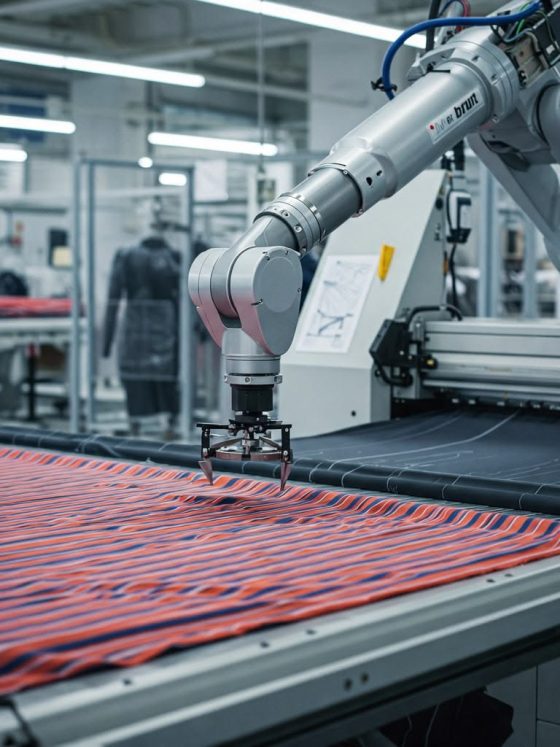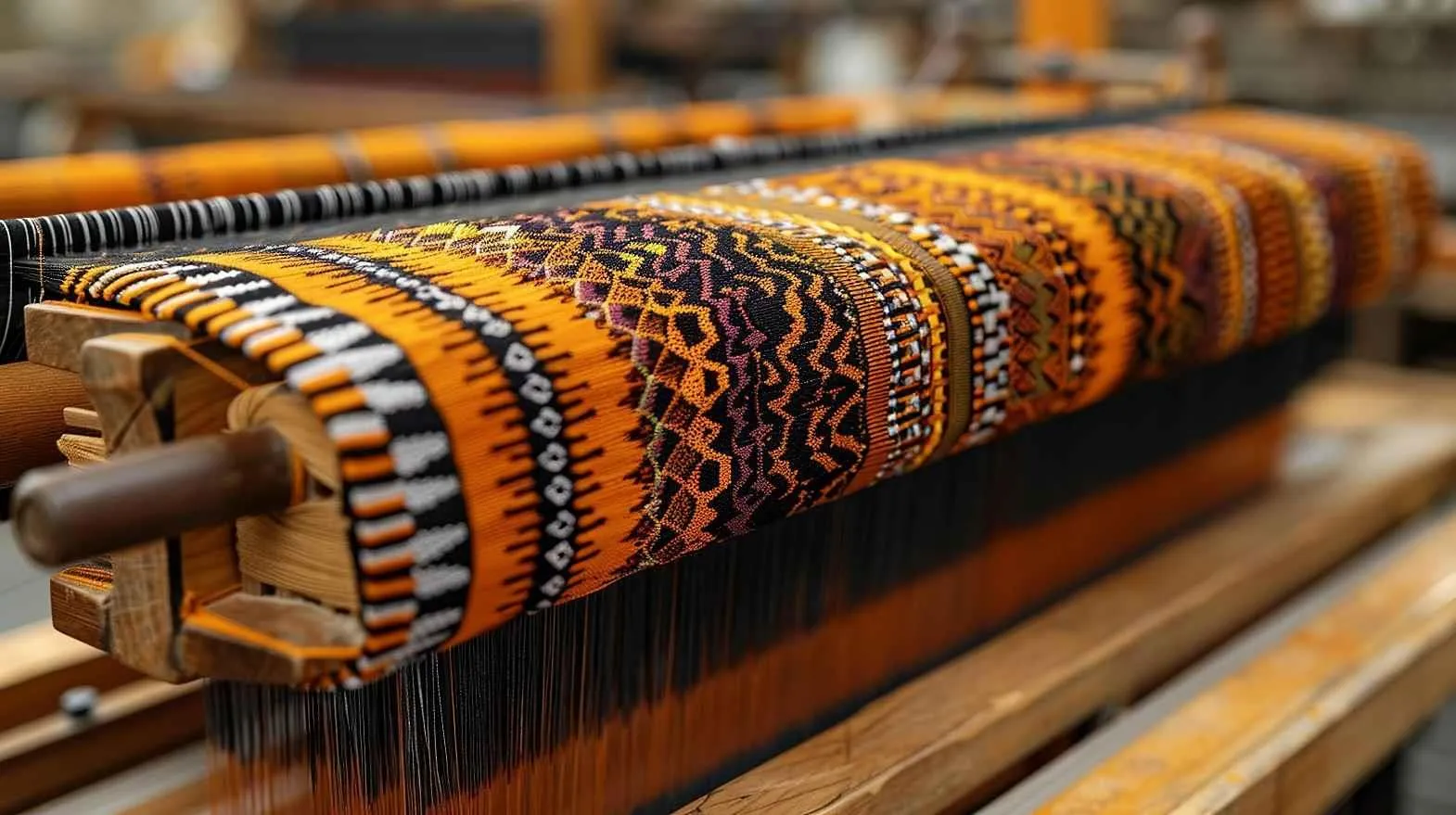
Four previous articles in this series have examined what fibre labels say and do not say about alpaca grades and certification; what a naturally dyed claim requires the buyer to understand about cochineal and mordants; how a fabric provenance claim breaks into fields, each requiring different evidence. All four articles dealt with what the fabric is before finishing. This article addresses what happens after the fibre is woven or knitted, at the stage most brands document least and most labels omit entirely.
Finishing is the collective term for every process applied to a fabric between the grey goods stage (the raw woven or knitted cloth) and the finished fabric that a brand cuts into a garment. It includes mechanical processes that alter the fabric’s surface texture or hand; chemical processes that impart functional properties; and wet processes that carry the largest share of the fabric’s manufacturing environmental footprint. This stage determines most of a fabric’s functional character: whether it repels water, resists pilling, feels soft against skin, holds its shape through washing, or releases dyes when abraded.
According to Carbonfact’s analysis of textile manufacturing environmental footprints, finishing accounts for the largest share of the environmental footprint. Most of the environmental impact in finishing, up to 70%, comes from heating water: to facilitate the reactions of dyes and textile chemicals, water is boiled to create steam used throughout the wet-finishing process. This means that the fabric whose fibre origin has been carefully documented and whose certification chain has been verified may still carry a substantial manufacturing footprint whose source is the energy used to heat water in the finishing dye house, a fact that no fibre-level certification captures.
A fabric’s finishing specification determines most of its functional character and, by many measures, generates the largest share of its manufacturing environmental footprint. Most brand product specifications address finishing last. Most brand environmental reporting addresses it least. The five questions in this guide bring finishing from the back of the specification to the front.
Finishing determines a fabric’s functional character and accounts for the largest share of its manufacturing environmental footprint. This guide presents five questions a designer or buyer should ask about finishing before finalising a specification.
Why Finishing Is the Missing Specification
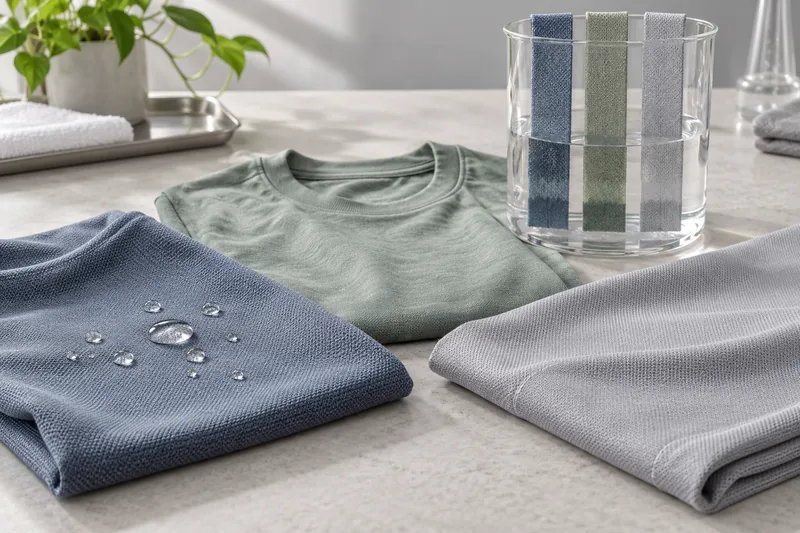
A designer specifying a fabric typically starts with fibre content, moves through construction (weight, weave structure, yarn count) and arrives at finishing as an afterthought: ‘add a soft hand,’ ‘make it water-resistant,’ ‘I want it to feel luxurious.’ These instructions go to a mill whose finishing capabilities, chemical inputs and environmental practices are usually not documented in the buyer’s specification and often not disclosed in the brand’s sourcing record.
The missing specification has direct consequences. A finishing process that uses chromium-based dyes produces a different environmental outcome from one that uses reactive dyes with low-liquor-ratio equipment, even if the fibres and the construction are identical. A water-repellent finish applied with fluorocarbon chemistry creates a regulatory risk in multiple markets from January 2025 onwards, regardless of whether the fabric’s fibre certification is impeccable. A mechanical softening finish produces a different end-of-life recyclability outcome from a silicone-based chemical softener, because the silicone coating can interfere with fibre separation in mechanical recycling processes.
Over 60% of textile buyers now prioritise suppliers with transparent environmental and chemical management practices. Finishing specifications are the part of the production process that lags furthest behind buyer expectations for transparency. The five questions in this guide are designed to close that gap, one specification decision at a time.
Question 1: What outcome are we specifying, and is finishing the right way to achieve it?
The first question is not about finishing at all. It is about whether finishing is the right production stage to achieve the fabric property the specification calls for.
Finishing divides into two broad categories: mechanical and chemical. Mechanical finishing processes alter the fabric’s properties physically, without introducing new chemical compounds. Calendering compresses the fabric between rollers to create a smooth, flat surface or a subtle sheen. Brushing and raising lift surface fibres to create a soft, napped texture. Sanforising controls shrinkage through compressive shrinkage processes. Mechanical finishing generally has a lower environmental impact than chemical finishing because it does not introduce new chemical compounds to the fabric, does not generate chemical effluent and does not typically require the heated water baths that account for the majority of finishing’s energy footprint.
The limitation of mechanical finishing is equally specific: it cannot add properties that are not present in the fibre and construction. Mechanical finishing can make a fabric smoother, softer, more compacted, or more dimensionally stable. Mechanical finishing cannot make a fabric water-resistant, antimicrobial, fire-retardant, or stain-repellent on its own. These functional properties require chemical finishing, and chemical finishing has the biggest downstream impact on specification decisions.
The designer must ask whether the performance outcome they are specifying genuinely requires a chemical finish, or whether the fibre choice and construction can deliver the same functional property without one. Wool, for example, is naturally water-repellent to a degree that makes a chemical DWR finish unnecessary for many applications. Tightly woven synthetic fabrics can achieve wind and shower resistance through construction alone. A designer who understands the properties of the fibre and construction they are working with may be able to specify a performance outcome without the chemical finish that would otherwise carry it – and without the regulatory, environmental and end-of-life consequences that finish brings with it.
Question 2: What chemistry is being used to achieve the finish, and what does it require?
For specifications that require chemical finishing, the second question is the specific chemistry: what compound is applied, what conditions it requires to work, and what that means for the manufacturing process and the finished fabric.
The most commercially significant current example is the water-repellent finish category, where the regulatory and environmental picture has changed substantially since 2024 and 2025.
Durable water repellent (DWR) finishes have historically used per- and polyfluoroalkyl substances (PFAS), a class of more than 12,000 fluorinated organic chemicals. PFAS are exceptionally effective at repelling both water and oil, and for decades they were the default chemistry for performance outerwear DWR finishes. They are also persistent in the environment and in human tissue, accumulating in air, water, food and human bloodstreams. PFAS appear in 72% of water-resistant apparel tested in an independent study, most commonly in DWR coatings, stain finishes, PTFE membranes and fluoropolymer seam tapes.
The regulatory response is now active. California AB 1817 and New York S.1322 banned intentionally added PFAS in textiles, effective January 2025. Maine Title 38, Section 1614 extended that ban to most textile articles effective January 1, 2026. Colorado SB24-081 takes full effect from January 2028. The European Union’s PFAS restrictions under REACH are moving in the same direction. As of January 2025, all Bluesign-approved materials must be PFAS-free. Patagonia committed to making all new products without intentionally added PFAS from Spring 2025.
The most common failure point in PFAS compliance is not the face fabric. In 2024 and 2025 sourcing audits, seam tape was the single most common failure point on otherwise compliant outerwear programmes. Brands that tested their face fabric for PFAS compliance but missed the seam tape delivered non-compliant products. The specification question is not only ‘Is the DWR finish fluorine-free? It is also: ‘Is the membrane, the seam tape, the zipper tape and any stain-resistant finish on the same garment also fluorine-free?’
PFAS-free alternatives exist for water repellency and are commercially available. Water-based finishes, silicone-based finishes, wax-based finishes and dendrimer chemistry can achieve excellent water repellency without fluorocarbon compounds. The performance gap that remains is in oil repellency: modern PFAS-free solutions achieve excellent water repellency, but oil repellency, which fluorocarbon finishes historically managed better, remains the area where PFAS-free chemistry performs less equivalently. A specification for a garment that requires both water and oil repellency needs to account for this trade-off honestly.
The second question applies beyond DWR. Wrinkle-resistant finishes traditionally used formaldehyde-based compounds; formaldehyde-free alternatives are now available and are required under GOTS and OEKO-TEX STANDARD 100. Softening finishes traditionally used silicone compounds; plant-based and biodegradable softeners are increasingly available but require confirmation of their performance characteristics under the washing and wear conditions the garment will experience. For every chemical finish in a specification, ask: what is the compound, what does it require in application, and what are the alternatives if the compound creates regulatory, environmental, or end-of-life problems?
Question 3: Does the finish survive washing and wear at the rate the garment’s end use requires?
The third question is about durability – specifically, the durability of the finish relative to the durability of the fabric it is applied to, and whether the finish’s degradation over the product’s use life creates problems the brand has not accounted for.
A fabric specification that calls for a functional finish without specifying the finish’s durability standard is incomplete. ‘Water-resistant’ as a specification describes a property at the point of manufacture. It says nothing about whether the finish will perform after 20 washes, 50 washes or two seasons of use. A consumer who buys a jacket described as water-resistant based on the fabric specification at the time of manufacture and finds it is no longer water-resistant after 10 washes has encountered a durability gap the specification did not address.
The standard test for DWR durability is the AATCC 22 water spray test (or equivalent ISO 4920), typically reported as a score from 0 to 100. The test describes the finish’s performance at the point of testing; it does not describe performance after accelerated washing cycles. A more complete durability specification states the required score after a specified number of washes – for example, a score of 80 or above after 20 AATCC 135 wash cycles. This is a different, more demanding specification than initial finish performance alone.
The durability question also applies to chemical softeners, antimicrobial finishes and any finish whose performance is expected to persist through the product’s use life. An antimicrobial finish applied to a medical-adjacent or sportswear fabric may degrade substantially after repeated washing, removing the functional property the specification was intended to deliver. A softening finish may wear out faster than the fabric itself, changing the hand significantly within one season of wear.
For the designer, the durability question requires a conversation with the mill about the finish’s expected performance curve: at what wash count does the finish begin to degrade noticeably, and what responsibility disclosure does the brand make to the consumer about maintaining the finish through the product’s life? A PFAS-based DWR finish, for example, can often be reactivated by tumble drying or low-heat ironing. A PFAS-free DWR finish may have different reactivation requirements or may not be reactivatable at all, which changes the maintenance instructions the brand needs to provide.
Question 4: How does the finish change other fabric properties?
The fourth question addresses the fact that finishing processes rarely change only the property they are intended to change. Every finish affects the fabric’s other properties, and a specification that optimises one property through finishing without accounting for secondary effects builds unintended consequences.
Water-repellent finishes reduce breathability. A DWR coat on a fabric’s outer surface makes water bead and roll off; it also makes it harder for water vapour generated by the wearer’s body to escape through the same surface. This is why performance outerwear typically pairs a water-repellent outer surface with a breathable membrane: the membrane manages vapour transmission while the DWR manages external water ingress. A specification that calls for a water-repellent finish on a fabric without considering breathability may produce a garment that keeps rain out but makes the wearer uncomfortably warm.
Softening finishes affect drape, pilling resistance and colour fastness. A silicone softener that improves a fabric’s hand may also reduce surface friction, changing how the fabric drapes and its tendency to slip at seams. The same finish may slightly reduce the fabric’s pilling resistance by lubricating the surface fibres, or it may affect the fabric’s ability to accept further finishing processes applied later in the production sequence.
Stain-resistant finishes affect recyclability. A fabric treated with a fluoropolymer stain finish is harder to separate into its constituent fibres during mechanical recycling. If a brand’s sustainability positioning includes end-of-life recyclability as a claim, the finishing specification needs to be checked against the recyclability outcome: a stain-resistant finish that helps the garment look good for longer may also prevent the fabric from being recycled at the end of that longer life.
Antimicrobial finishes affect the skin microbiome. A fabric treated with biocide-based antimicrobial finishes to prevent odour in sportswear is, by design, biologically active against microorganisms. When that fabric is worn against skin, it is in contact with the skin’s own microbiome. The long-term implications of repeated exposure to biocide-treated fabric against skin are a subject of ongoing research, and a brand making an antimicrobial claim on fabric worn for extended periods against skin should understand the antimicrobial chemistry and what its activity profile means for skin contact.
As Omiren Styles has established in its field-by-field analysis of fabric provenance claims, environmental process claims in fabric provenance require evidence of the specific dyestuff, mordant and effluent treatment system at the finishing stage. The fourth question extends that logic into the functional finish layer: every finishing decision has consequences elsewhere in the fabric’s properties, in the garment’s performance across its use life and in the fabric’s behaviour at end of life. A specification that documents only the intended effect of each finish, not its secondary effects, will generate surprises later in the supply chain.
Question 5: What happens to the fabric when the product leaves use?
The fifth question is about end of life, and it is the most frequently absent from finishing specifications.
The finishing decisions made at the mill largely determine what options are available for a fabric at the end of the garment’s use life. A fabric that carries a complex finishing stack – DWR coating, silicone softener, antimicrobial treatment, stain-resistant laminate – is significantly more difficult to recycle mechanically than a fabric whose fibre content is simple and whose finishing is minimal. If a brand intends to make an end-of-life claim (take-back scheme, recyclability, compostability), it must audit the finishing specification against that claim before the garment enters production.
Mechanical recycling of textiles separates fibres mechanically. Finishes that bond to fibres, coat them chemically, or alter their surface properties can interfere with separation and downgrade the quality of the recycled fibre output. A fabric that is marketed as ‘100% recyclable’ because its fibre content is a single material type may not be mechanically recyclable at equivalent quality if it carries chemical finishes that resist separation.
Chemical recycling processes, which dissolve fibres and reconstitute them chemically, are more tolerant of finishing chemistry than mechanical recycling. Still, they are not universally available at commercial scale, and their economics at the point of writing in 2026 depend significantly on the fibre type being recycled. A specification designed around chemical recyclability at end of life requires confirmation that the relevant chemical recycling pathway exists and is accessible at the scale the brand will need.
Natural fibre compostability claims require that the entire garment, including all finishes, meets compostability standards. A wool garment treated with a moth-proofing biocide may not biodegrade at the rate or in the conditions that a compostability claim implies. A cotton garment with a polyurethane coating will not biodegrade as cotton; the coating is a polymer that will not compost under standard conditions. The finish is part of the product, and the end-of-life claim must be accurate for the complete product, not only for the fibre.
The fifth question is also about transparency: what does the brand disclose to consumers and future recyclers or composters about the garment’s finishing chemistry? A hangtag that says ‘natural fibres’ and omits the silicone softener, the fluorine-free DWR, and the stain-resist laminate describes the fibre and omits the product. The EU Digital Product Passport requirements, phasing in from 2026 onwards, will require that product-level information include finishing chemistry as part of the documented specification. Brands that begin documenting finishing now will have significantly less work to do when that documentation becomes mandatory.
What the Five Questions Look Like in a Specification
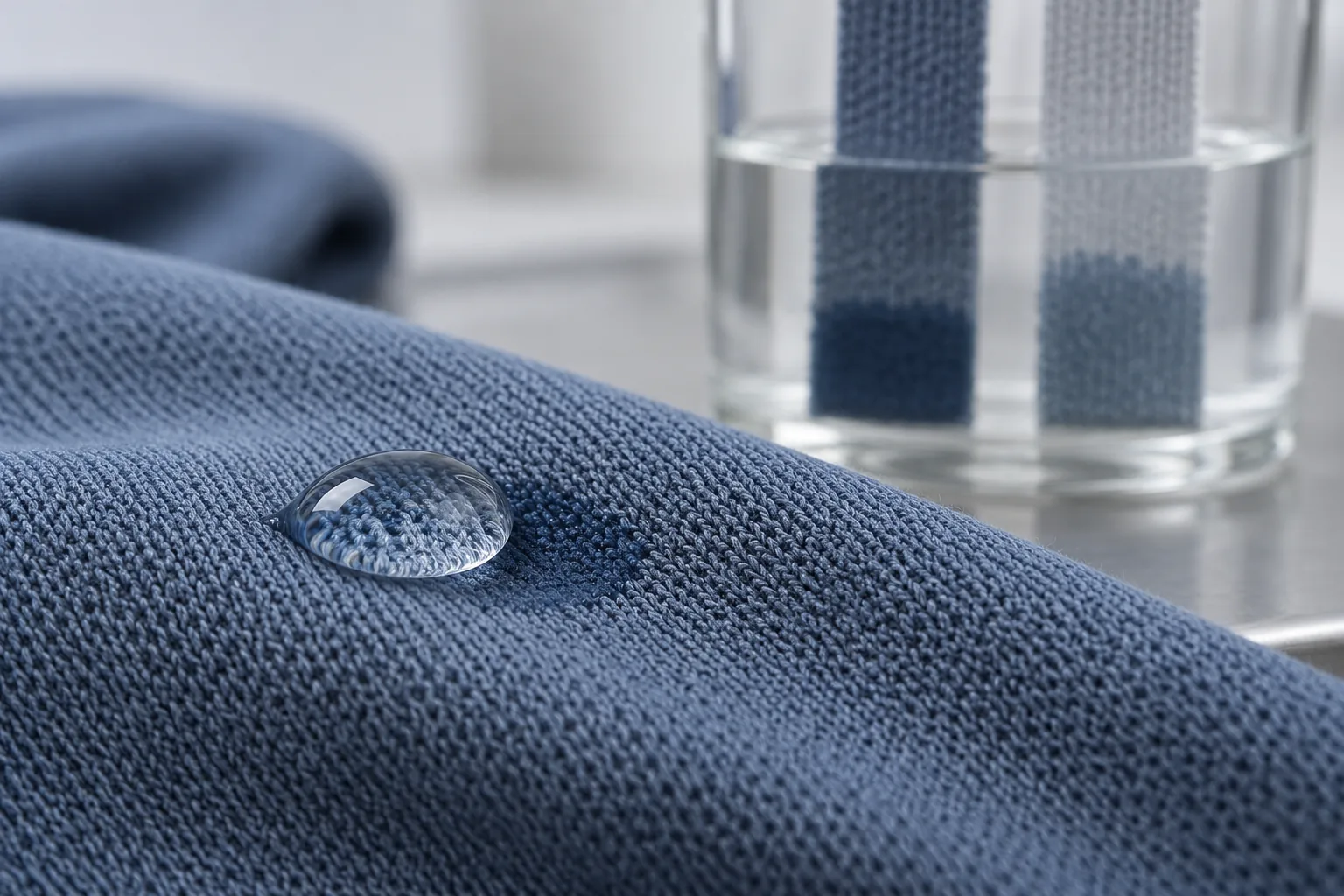
Applied to a single fabric specification, the five questions produce a set of finishing clauses that a design or sourcing brief should include:
- Outcome: State the functional property the finish is intended to deliver (water repellency, softness, wrinkle resistance, antimicrobial performance). Specify whether mechanical finishing can achieve that outcome without chemical treatment.
- Chemistry: Name the specific finish compound or chemistry type permitted. Where relevant, specify restrictions: PFAS-free, formaldehyde-free, GOTS-approved auxiliaries, Bluesign-approved chemistry. Require that the restriction applies to all components – face fabric, lining, membrane, seam tape, zipper tape.
- Durability standard: State the performance standard required after a specified wash cycle count. For DWR, state the AATCC 22 or ISO 4920 score required after the relevant wash count. For softening finishes, state whether performance must be maintained after a specified number of washes.
- Secondary effects: Confirm that the finish has been assessed for its effects on breathability, drape, pilling, colour fastness, recyclability and any other property relevant to the garment’s performance brief. Where trade-offs exist, state them explicitly in the specification so they are a design decision rather than a production surprise.
- End of life: State the intended end-of-life pathway (mechanical recycling, chemical recycling, compostability, take-back) and confirm that the finishing specification is compatible with that pathway. Where it is not, either change the finish or revise the end-of-life claim.
The Omiren Argument
Finishing is not the finish line. It is the stage where most of a fabric’s product identity is determined and where most of its environmental cost is generated. A specification that documents fibre content, country of origin, certification status, and weave construction without documenting finishing documents the raw material and leaves the product undescribed.
As Omiren Styles has established, in its analysis of what makes a fashion manufacturer verified and what evidence that verification requires, every production claim requires evidence at the level of the claim being made. The finishing specification is the evidence layer for a product’s functional claims. ‘Water-resistant’ is a finishing claim. ‘Machine washable’ is a finishing durability claim. ‘Sustainable production’ is partly a finishing process claim. None of these claims is substantiated by fibre certification alone. All of them require documentation of what happened at the mill after the fabric left the loom.
As Omiren Styles has argued throughout this series, the Global South made fashion and never got credit. The mills where fabric is finished – in Peru, in Turkey, in Bangladesh, in India, in China – are where the finishing knowledge, the investment in low-liquor-ratio equipment, the transition away from coal boilers, the shift to PFAS-free chemistry and the development of bio-based finishing alternatives are happening at speed and at scale. A brand that specifies a fabric without engaging with the finishing stage is not only missing the largest share of its environmental footprint. It is also missing the part of the supply chain where the most significant sustainable manufacturing investments are being made, by mills that are investing in that transition without receiving the documentation credit, the sourcing premium or the recognition that the investment warrants.
ALSO READ
- Alpaca Fibre Grades: What a Label Tells a Designer – and What It Does Not
- A Fabric Provenance Claim, Field by Field: What a Buyer Should Ask to See
- What Makes a Fashion Manufacturer ‘Verified’? A Practical Framework for Emerging Brands
- Cochineal on Cloth: The Questions Behind a ‘Naturally Dyed’ Claim
- The Global South Made Fashion. It Just Never Got Credit.
Frequently Asked Questions
Why does finishing have such a large environmental footprint compared to fibre production?
According to Carbonfact’s analysis of textile manufacturing, finishing accounts for the largest share of the environmental footprint, with up to 70% of its impact coming from heating water. Wet finishing processes – dyeing, scouring, softening, applying functional finishes – require water to be heated, often to high temperatures, to facilitate the reactions of dyes and textile chemicals. The energy used to heat that water is the dominant driver of finishing’s carbon footprint. This means a fabric with sustainably certified fibre and low-impact construction may still carry a substantial environmental footprint driven by the energy mix of the finishing mill’s boilers. Transitioning away from coal-fired boilers to natural gas, biogas, biomass, or heat pump systems is the single most impactful finishing-stage environmental improvement available to mills.
What is PFAS and why does it matter for a fabric specification in 2026?
PFAS (per- and polyfluoroalkyl substances) are a class of more than 12,000 fluorinated organic chemicals used in textile finishing primarily as durable water repellent (DWR) coatings, stain-resistant finishes, and waterproof membranes. PFAS are persistent in the environment and in human tissue. California AB 1817 and New York S.1322 banned intentionally added PFAS in textiles effective January 2025. Maine Title 38, Section 1614 extended that ban effective January 1, 2026. As of January 2025, all Bluesign-approved materials must be PFAS-free. For a designer specifying a water-resistant fabric in 2026, the practical implication is that PFAS-based DWR chemistry is now legally restricted in multiple major markets, including California and New York, and the specification must confirm that the DWR finish, the membrane, the seam tape and any stain-resistant treatment are all fluorine-free. Seam tape is the most commonly missed element in compliance audits.
What is the difference between mechanical and chemical finishing?
Mechanical finishing alters a fabric’s properties through physical means without introducing new chemical compounds. Examples include calendering (compressing between rollers for a smooth finish or sheen), brushing and raising (lifting surface fibres for a soft napped texture), sanforising (controlling shrinkage through compressive processes) and embossing. Mechanical finishing generally has a lower environmental impact than chemical finishing because it does not generate chemical effluent and does not require the heated water baths responsible for the largest share of finishing’s energy footprint. Its limitation is that it cannot add properties not present in the fibre and construction: a mechanically finished fabric cannot be made water-resistant, antimicrobial or fire-retardant without chemical treatment. Chemical finishing extends the fabric’s properties beyond what the fibre and construction deliver. Still, it introduces chemical compounds whose safety, environmental impact, durability, and end-of-life behaviour require documentation in the specification.
How does a finishing specification affect end-of-life recyclability?
A fabric’s finishing stack directly determines what end-of-life pathways are practically available for the garment. Mechanical recycling separates fibres mechanically, and finishes that coat or chemically bond to fibres can interfere with that separation and downgrade the quality of the recycled output. A garment described as recyclable based on its fibre content may not be mechanically recyclable at equivalent quality if it carries DWR coatings, silicone softeners, stain-resistant laminates, or other chemical finishes that resist fibre separation. Chemical recycling is more tolerant of finishing chemistry but is not universally available at commercial scale in 2026. If a brand’s sustainability positioning includes an end-of-life recyclability or compostability claim, the finishing specification must be audited against that claim before production begins, not after the garment is on the market.
Are PFAS-free water-repellent finishes as effective as fluorocarbon finishes?
For water repellency, modern PFAS-free solutions can perform very well. Water-based finishes, silicone-based finishes, wax-based finishes and dendrimer chemistry can all produce effective water repellency without fluorocarbon compounds. The performance gap between PFAS and PFAS-free finishes is most significant in oil repellency: fluorocarbon finishes historically outperformed alternatives in repelling oils and fatty substances, and PFAS-free chemistry remains less effective in this area. For a specification whose primary requirement is water repellency, modern PFAS-free alternatives are commercially viable. For a specification whose requirements include stain resistance against oils and fatty substances, assess the trade-off between PFAS-free chemistry and performance against the specific use case and applicable regulations in the target market.
EXPLORE MORE
Read the full Industry and Material Intelligence and Sourcing sections at Omiren Styles for ongoing analysis of fabric specification, finishing chemistry, supply chain documentation and the evidence frameworks that convert sourcing decisions into defensible product claims. Discover travel and heritage intelligence across Africa, the Caribbean and Latin America at Rex Clarke Adventures.