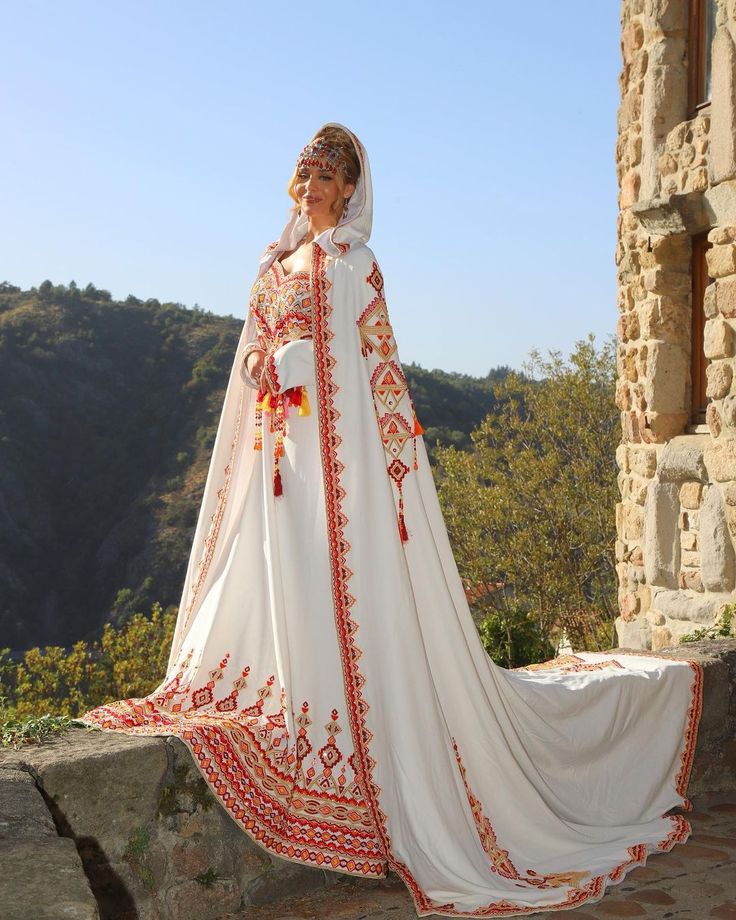
In the village of Ath Yenni in the Tizi Ouzou province of northern Algeria, there is a silversmith’s workshop that has been producing the same jewellery forms for at least two centuries. The pieces leaving this workshop are not decorative. They are structural elements of a dress system whose most complete expression is the Kabyle wedding: a multi-day ceremony in which the bride is assembled, layer by layer, into a composed statement of family wealth, cultural continuity, and Amazigh identity that the surrounding Kabyle mountains have been refining since before the French arrived and long after they left.
The Kabyle wedding dress is not worn. It is assembled from layers of silk, silver, and ancestral meaning. Inside the thakandorth, Ath Yenni jewellery, and the Kabylia bridal tradition.
Who the Kabyle Are
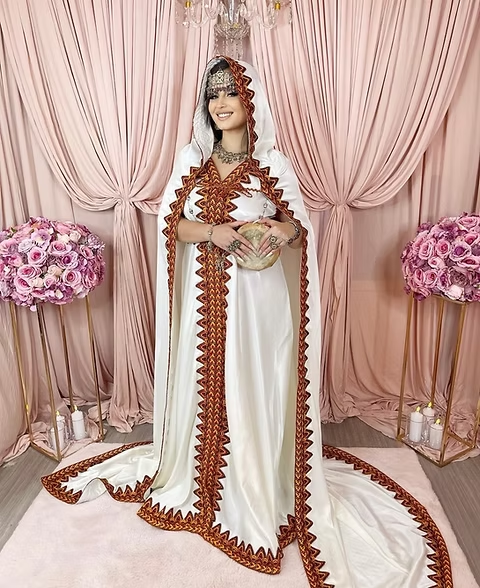
The Kabyle are an Amazigh people concentrated in the Kabylia region of northern Algeria, a mountainous area spanning the Tizi Ouzou, Bejaia, Bouira, and Boumerdes wilayas to the east of Algiers. Kabyle is the most widely spoken Tamazight variety in Algeria, with approximately 8 to 10 million speakers, according to the Haut Commissariat à l’Amazighité, the Algerian state institution established in 1995 to promote and preserve the Amazigh language and culture. Tamazight was granted constitutional recognition in Algeria in 2016, giving the language official status alongside Arabic, though implementation of that status across government services and education remains uneven.
The Kabyle maintained a documented culture of resistance to successive external powers: Roman, Arab, Ottoman, and French colonial. French colonisation of Algeria from 1830 onward brought sustained pressure on Kabyle cultural life, including attempts to use the Kabyle people as an intermediate administrative class in a strategy of division that became known as the Kabyle Myth. That strategy failed on its own terms and left behind a documented Kabyle cultural assertiveness that has consistently centred on language, dress, and ceremony as markers of a specific identity that is neither Arab nor French. The wedding regalia is among the clearest expressions of that assertion.
The Thakandorth: Assembly, Not Just Garment
The thakandorth is the name of the Kabyle bridal dress in its complete assembled form: a full regalia rather than a single garment. It encompasses a layered costume of silk or silk-effect fabric in specific colours, a structured headdress, and an elaborate jewellery set whose individual pieces are named, positioned with precision, and understood as carrying specific social and spiritual meaning. As the Musee du Bardo in Algiers has documented in its collection of Kabyle material culture, the thakandorth is among the most complete surviving examples of North African Amazigh ceremonial dress, preserved in rural Kabylia communities where urban migration and Arabisation pressures have not fully displaced the tradition.
The base garment of the thakandorth is typically a deep red dress, often described as burgundy or carmine, made from silk or a silk-effect fabric with sufficient weight to allow the layered elements to sit properly. Over it, a second layer in a contrasting colour, traditionally yellow or saffron, is draped and secured. The colour combination of red and yellow is documented across Kabyle ceremonial dress as carrying specific cultural associations: red for blood, life, and protection; yellow for light, wealth, and divine blessing. The headdress, the taharikt, is constructed from folded fabric, silver pins, and additional jewellery elements that sit along the brow and temples, framing the face in a composition that Kabyle cultural researchers at the Université de Tizi Ouzou have documented as a precise visual grammar rather than an aesthetic preference.
“The Kabyle bride is not dressed. She is composed. Each element of the thakandorth communicates to everyone present who this family is and what they are claiming for their daughter.” — Documentation of Kabyle ceremonial practices, Musee du Bardo, Algiers.
Ath Yenni Silver: The Jewellery That Carries the Argument
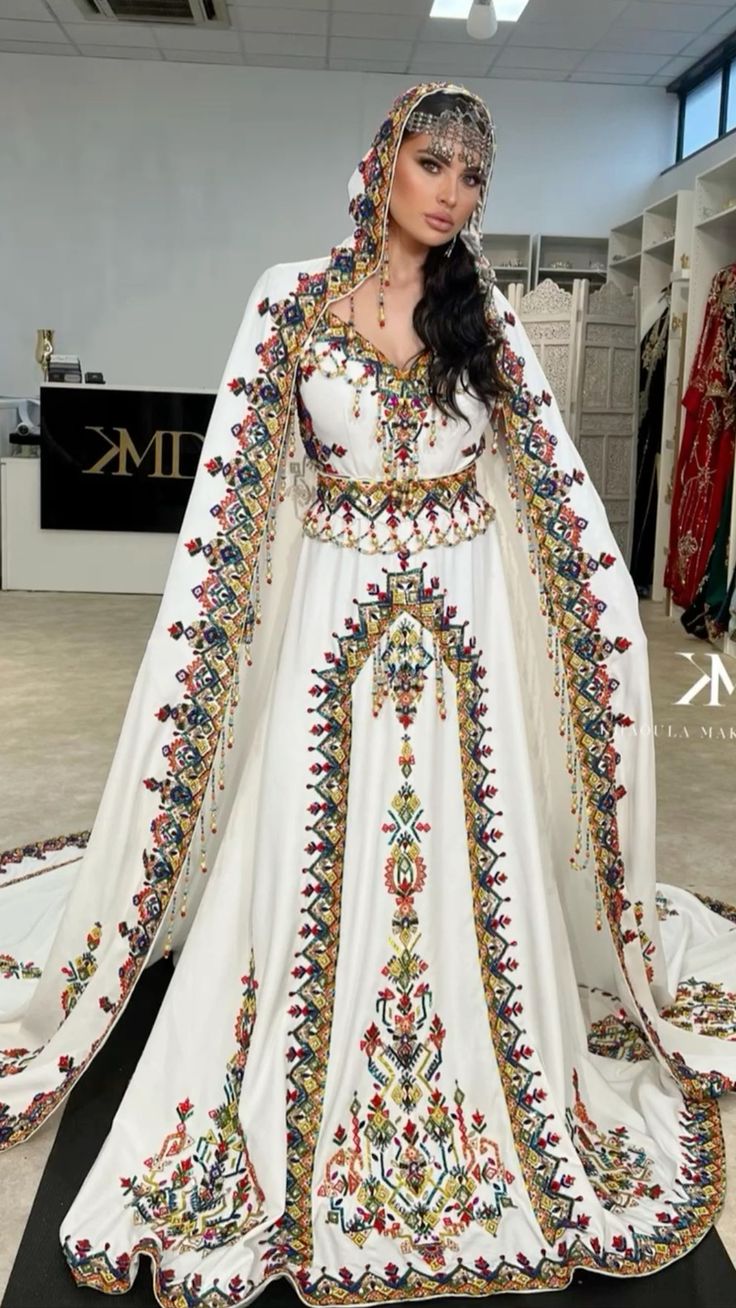
The UNESCO Intangible Cultural Heritage list recognises the Ath Yenni jewellery tradition as a living artisan practice of cultural significance. The inscription, granted in 2018 under the name “Kabyle Jewellery Craftsmanship,” recognises the silversmithing tradition of the Ath Yenni village area in Tizi Ouzou province as a knowledge system transmitted through apprenticeship within families of specialist craftsmen, predominantly male, while the cultural knowledge of when and how to wear the jewellery is transmitted through women.
The pieces that make up the complete Kabyle bridal jewellery set are named and positioned with precision. The tizerzai are the large fibulas, brooch-like clasps of worked silver and enamel that secure the outer drape of the dress at the shoulders. They are typically produced in pairs and are the most visually striking single element of the thakandorth. The ikhilalen are earrings, often large and pendant-style, with enamel inlays in blue, green, and yellow on a silver base. The tazrurt is the necklace, constructed from silver links, coral beads, amber, and, in historical pieces, glass beads of Venetian or Ottoman origin that entered Kabylia through trans-Saharan trade routes. The tikchbibin are bracelets, typically made of solid silver with geometric engraving. The total weight of a complete set of Ath Yenni bridal jewellery can exceed two kilograms.
The enamelling technique used in Ath Yenni jewellery is cold enamel or vitreous enamel fired at specific temperatures, producing colours that have remained consistent across documented pieces from the eighteenth century to contemporary production. The geometric patterns used in the enamel work mirror those documented in Kabyle pottery, tattoo traditions, and carved wood decoration: a unified visual vocabulary that the Institut Royal de la Culture Amazighe and Algerian cultural researchers have traced to a pre-Islamic North African aesthetic tradition shared across Amazigh communities from Morocco to Libya.
The Wedding Ceremony and Its Dress Stages
The Kabyle wedding is a multi-day ceremony whose dress codes shift across its stages. The Algerian Ministry of Culture’s documentation of national intangible heritage identifies the Kabyle wedding as among Algeria’s most formally documented ceremonial traditions, with regional variation between Upper and Lower Kabylia that affects both the specific garments worn and the sequence of ceremonial events.
The ceremony begins with the henna night, the timellalin, when the bride’s hands and feet are decorated with henna patterns in a gathering of women that serves as a formal farewell from her family home. The dress for this occasion is lighter than the full thakandorth: a simpler version of the layered silk dress without the complete jewellery regalia, often in the same red and yellow colour scheme but less formally assembled. The henna night dress is worn by both the bride and her female relatives, who participate in the henna application and the accompanying songs, tizrarin, whose lyrics are specific to the wedding ceremony and whose transmission is itself an act of cultural preservation.
The wedding day itself is when the full thakandorth is assembled. The bride’s dressing is performed by the thamgharth, an elder woman who holds the specific cultural knowledge of how each element of the regalia should be positioned. This is not a private dressing room moment. It is a social ceremony within the ceremony: women of the family and community observe and participate, and the correct assembly of the thakandorth is itself a demonstration of the family’s cultural competence. A bride whose thakandorth is correctly assembled is a bride whose family knows who they are.
What the Regalia Carries
The thakandorth carries several simultaneous arguments. The first is economic: the weight and quality of the Ath Yenni silver set, and the quality of the silk fabric, communicate the family’s wealth and their willingness to invest it in the daughter’s wedding regalia. The jewellery set is typically owned by the bride’s family rather than the groom’s, a significant distinction from many African and Middle Eastern bridal traditions, where the groom’s family provides jewellery as part of the marriage payment. Among the Kabyle, the bride’s family’s jewellery is her own property, transmitted matrilineally and available to her throughout her marriage. As researchers at the Université de Bejaia’s Amazigh Studies department have documented, this matrilineal jewellery inheritance is one of the clearest material expressions of Kabyle women’s documented position as economic agents within the household.
The second argument is cultural: the specific patterns of the Ath Yenni enamel work, the geometric vocabulary of the Kabyle visual tradition, and the specific colour combination of the dress are all legible as specifically Kabyle rather than generically North African or Arab. In a country where the Arabisation policies of successive Algerian governments from independence onward applied sustained pressure on Amazigh cultural expression, wearing the full thakandorth at a wedding is a political act as well as a cultural one.
The third argument is spiritual: the jewellery is understood within the tradition to serve a protective function against the evil eye, a logic documented in Amazigh tattoo traditions and amulet culture across North Africa. The coral beads of the tazrurt necklace, in particular, are understood as protective material. As Omiren Styles has documented in its analysis of Amazigh facial tattoos, protective marking and adornment are consistent features of Amazigh women’s cultural practice across the region, encoding spiritual intention in material form.
Preservation and Contemporary Pressure
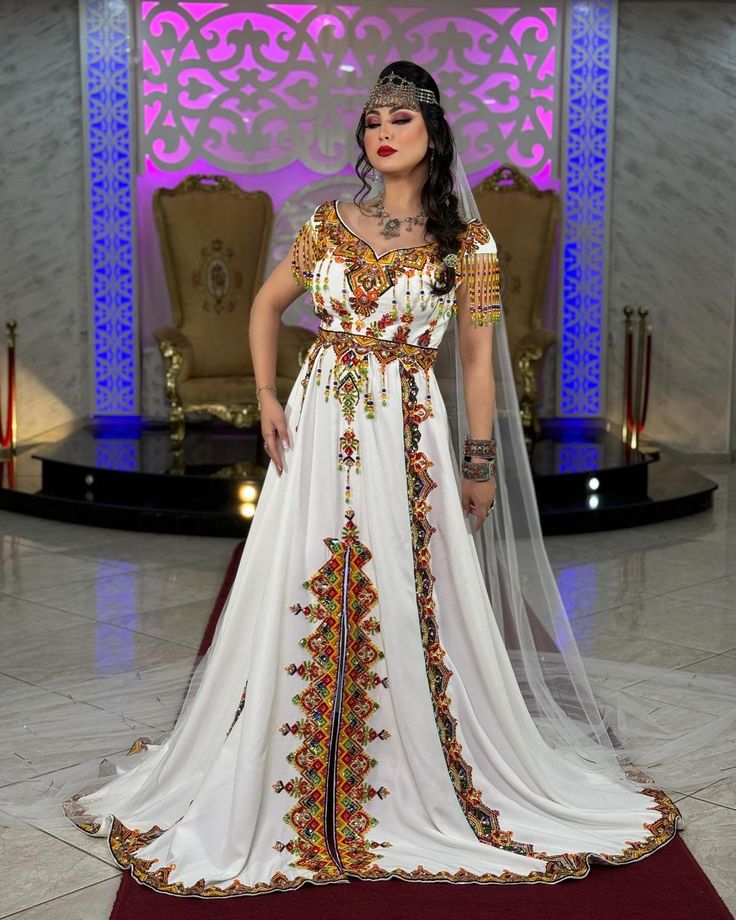
The UNESCO inscription of Kabyle jewellery craftsmanship in 2018 has provided international recognition of the Ath Yenni tradition and additional institutional support for the transmission of the apprenticeship system. The UNESCO documentation notes that the tradition faces pressure from mass-produced imitation silver-and-enamel pieces manufactured outside Kabylia and sold at significantly lower prices, undercutting the artisan workshop economy that sustains authentic production. The authenticity problem is well documented: Ath Yenni pieces bear maker’s marks and specific construction characteristics that distinguish them from imitations, but the distinction requires knowledge that buyers outside the tradition may lack.
The thakandorth itself faces different but related pressures. Urban migration from Kabylia to Algiers, France, and other European cities has created a Kabyle diaspora community for whom the full wedding ceremony is both logistically more difficult and culturally more significant, serving as an assertion of identity in the context of migration as much as a family ceremony. Diaspora weddings often use a simplified version of the thakandorth, sometimes assembling the jewellery without the full layered dress, or wearing the dress for the ceremonial photography rather than for the full duration of the multi-day event. Contemporary Kabyle designers, including Nadia Ziane and the growing atelier scene in Tizi Ouzou, are producing updated versions of the thakandorth that maintain the jewellery regalia and the colour coding while adapting the silhouette and fabric for contemporary wear. This preservation-through-adaptation approach mirrors what has been documented in the evolution of Rwandan umushanana.
The Omiren Argument
The thakandorth is not a wedding dress in the sense that the global bridal industry uses the term. It is a composed argument about identity, wealth, cultural continuity, and spiritual protection, assembled on the body of a woman whose family has spent years acquiring the pieces and the knowledge to put them together correctly. The Ath Yenni silver set, weighing two kilograms when worn by a bride, is not an ornament. It is the material form of a family’s claim to cultural seriousness. The UNESCO recognition of the jewellery craftsmanship tradition is significant, but it is a recognition of one component of a complete cultural system. As Omiren Styles has argued in its analysis of African women’s fashion archives, the most important cultural repositories are those held in practice rather than in institutions.
The pressure on the thakandorth from mass-produced imitations and from diaspora distance is the same pressure documented in every living ceremonial dress tradition Omiren Styles covers: it is the tension between preservation and evolution, between the knowledge system that makes the dress meaningful and the commercial or logistical forces that make the full system harder to maintain. The Kabyle response, both in the UNESCO inscription and in the contemporary atelier adaptations, is to insist on the jewellery. The tizerzai fibulas, the tazrurt coral necklace, the ikhilalen pendant earrings: these are the non-negotiable core of the thakandorth. Strip the silk layers, and the colour coding can survive in updated form. Lose the Ath Yenni silver, and what remains is not a Kabyle wedding dress. It is a costume. As Omiren Styles has documented in its analysis of the Amazigh facial tattoo tradition, Amazigh cultural knowledge lives in practice, in the hands of those who still know how to make and read it. The thakandorth is held in the same way.
The Kabyle wedding dress is not a garment with jewellery attached. It is a jewellery set with a garment beneath it. That distinction is everything.
ALSO READ
- Amazigh Women’s Facial Tattoos: Siyala, Jedwel, and the Tradition Near Extinction
- African Women Have Been Keeping Fashion Archives for Generations. Museums Are Just Catching Up.
- The Afro-Arab Street Fashion Movement Reshaping Global Style
- Umushanana Rwanda: Gusaba Ceremony, Kigali Bridal Boutiques, and Modern Bridalwear
Frequently Asked Questions
What is the thakandorth?
The thakandorth is the complete Kabyle Amazigh bridal regalia: a layered ceremonial dress system worn by brides in the Kabylia region of northern Algeria. It consists of a base dress in deep red or burgundy, an outer drape in yellow or saffron secured by silver fibulas, a structured headdress called the taharikt, and a complete set of Ath Yenni silver and enamel jewellery whose individual pieces are named, positioned with precision, and understood to carry protective and social meaning. It is assembled rather than simply worn, with the dressing performed by a designated elder woman who holds the cultural knowledge of correct assembly.
What is Ath Yenni silver, and why is it significant?
Ath Yenni is a village in the Tizi Ouzou province of Kabylia, northern Algeria, whose silversmithing tradition was inscribed on UNESCO’s Intangible Cultural Heritage list in 2018 under the title “Kabyle Jewellery Craftsmanship.” The tradition involves the production of worked silver and vitreous enamel jewellery in geometric patterns that mirror the broader Amazigh visual vocabulary documented across North African Amazigh communities. A complete bridal set of Ath Yenni jewellery can weigh over two kilograms and includes the tizerzai fibulas, ikhilalen earrings, tazrurt necklace, and tikchbibin bracelets. The jewellery is typically the property of the bride’s family and is transmitted matrilineally.
What does the colour combination of the Kabyle wedding dress mean?
The red and yellow of the thakandorth carry documented cultural associations within the Kabyle tradition. Red is associated with blood, life, and protection. Yellow is associated with light, wealth, and divine blessing. The specific combination is documented throughout Kabyle ceremonial dress as a precise communication system rather than an aesthetic preference, with variations in shade and proportion that can convey additional information to those who know the tradition’s visual grammar.
How does the Kabyle wedding ceremony use dress across its stages?
The multi-day ceremony begins with the timellalin, the henna night, when the bride and her female relatives wear a lighter version of the layered silk dress without the full jewellery regalia. The henna night dress is accompanied by tizrarin, ceremony-specific songs whose transmission is itself a form of cultural preservation. On the wedding day, the full thakandorth is assembled by the thamgharth, an elder woman who holds the cultural knowledge of correct assembly. The dressing is a social ceremony within the ceremony, observed by the community and understood as a demonstration of the family’s cultural competence.
Is the Kabyle wedding dress tradition still practised today?
Yes, in Kabylia and among diaspora Kabyle communities, though with varying degrees of completeness. The UNESCO inscription of the Ath Yenni jewellery tradition in 2018 has provided institutional support for the silversmithing craft. Contemporary Kabyle designers in Tizi Ouzou are producing updated versions of the thakandorth that maintain the jewellery regalia and the colour coding while adapting the silhouette and fabric for contemporary wear. Diaspora communities in France and elsewhere often use a simplified version, sometimes wearing the dress for ceremonial photography rather than the full duration of the multi-day event. The jewellery is treated as the non-negotiable core of the tradition, even where the dress elements are adapted.