There is a fashion story that gets told often in the wrong register. It goes like this: African communities adopted European clothing during colonialism, and what resulted is an interesting cultural hybrid. Charming. A bit ironic. Good for a photo essay.
The Herero dress of Namibia is not that story.
What the Herero people did with Victorian-era clothing, and what that clothing came to represent after one of the first genocides of the twentieth century, belongs in a completely different register. It belongs not in a photo essay about cultural curiosity, but in a conversation about how communities protect memory when those trying to destroy them control everything except what they choose to wear.
The Herero dress survived the German colonial state’s attempt to erase the people who wore it. That survival is the most important fact in this article. It is also a fact that fashion media, when it covers the Herero at all, consistently fails to foreground.
The Herero dress of Namibia was borrowed from German missionaries. Then the Germans tried to exterminate the people wearing it. The dress survived. Here is why that matters.
What Herero Women Wore Before the Missionaries Came
Before German missionaries arrived in Namibia in the mid-nineteenth century, Herero women wore leather aprons, front and back, made from sheep, goat, or game skins. Over these, they wore ostrich shell-embellished overskirts. Metal beadwork and carved-horn cuffs of brass and copper at their wrists and ankles completed the dress system. This was not a minimalist tradition. It was a sophisticated one, developed within a cattle-pastoralist society whose wealth, social structure, and spiritual life were organised around livestock.
The arrival of Rhenish missionaries from Germany changed what women wore, and the change was not voluntary. Missionary logic held that the Herero body was immodest and required covering. Victorian European dress provided the template. The long-sleeved, high-necked, floor-length gown imposed a European standard of modesty on a community that had its own complete dress logic. Maria Caley, a fashion lecturer at the University of Namibia, has noted: “We don’t know if it was a choice to adopt that dress, or if it happened by force.” What is certain is the result.
From Missionary Cloth to Herero Architecture
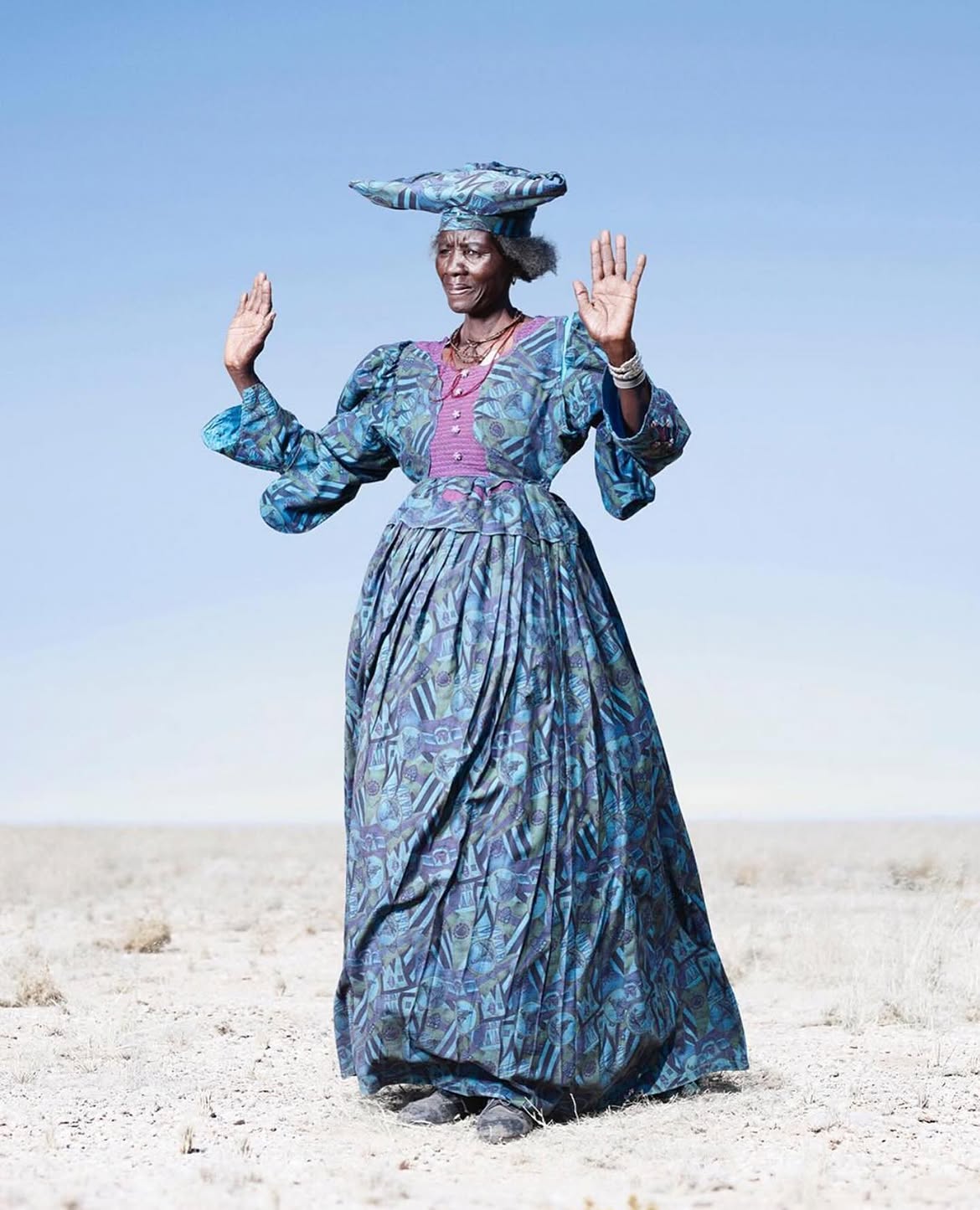
What happened next is not what the missionaries intended. Herero women looked at the Victorian silhouette and rebuilt it from within. The structure remained: the layered petticoats, the fitted bodice with its Empire line, the long gigot sleeves full at the shoulder and tight to the wrist, the high collar. What the missionaries had brought as an instrument of cultural erasure became, within a generation, the site of a different cultural argument altogether. The dress is not alone in this. As Omiren Styles has documented in The Geometry of Heritage: Why Shweshwe Still Defines South African Fashion, Shweshwe arrived in Southern Africa through missionary networks and became an indigenous South African symbol; the Basotho blanket entered Southern Africa through trade and absorbed the prestige of the king who wore it. But the Herero case carries a particular weight because the transformation was tested in the most extreme way imaginable.
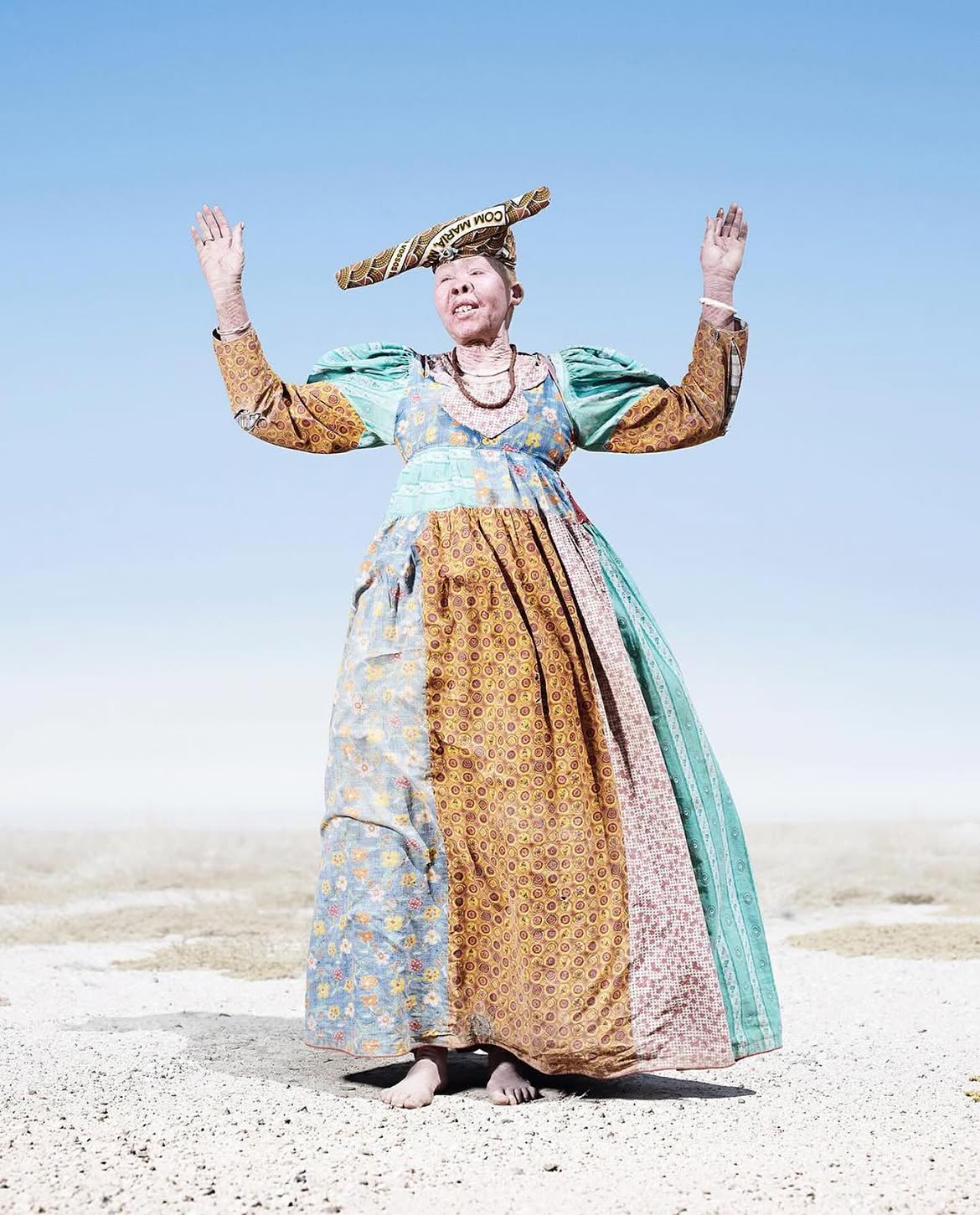
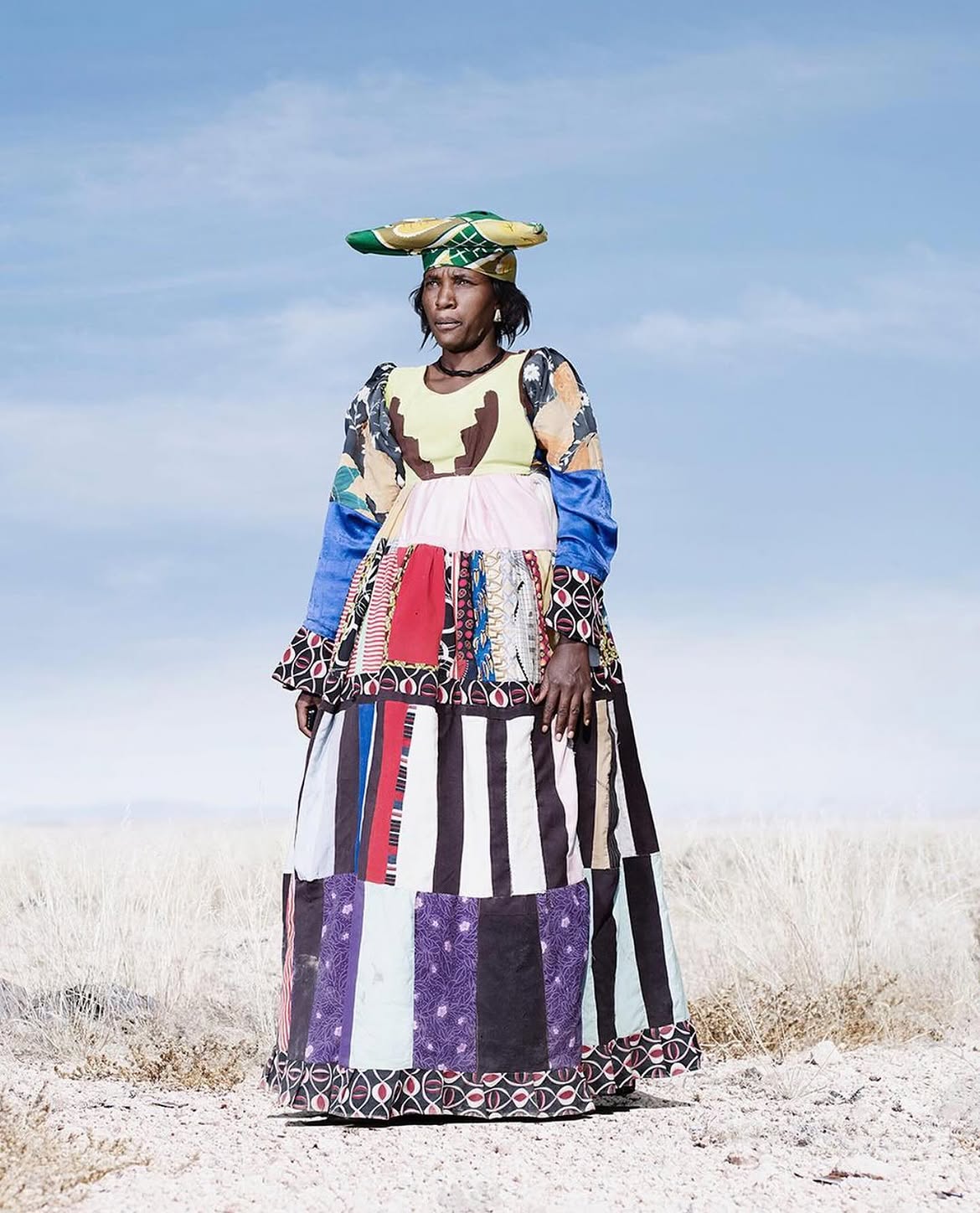
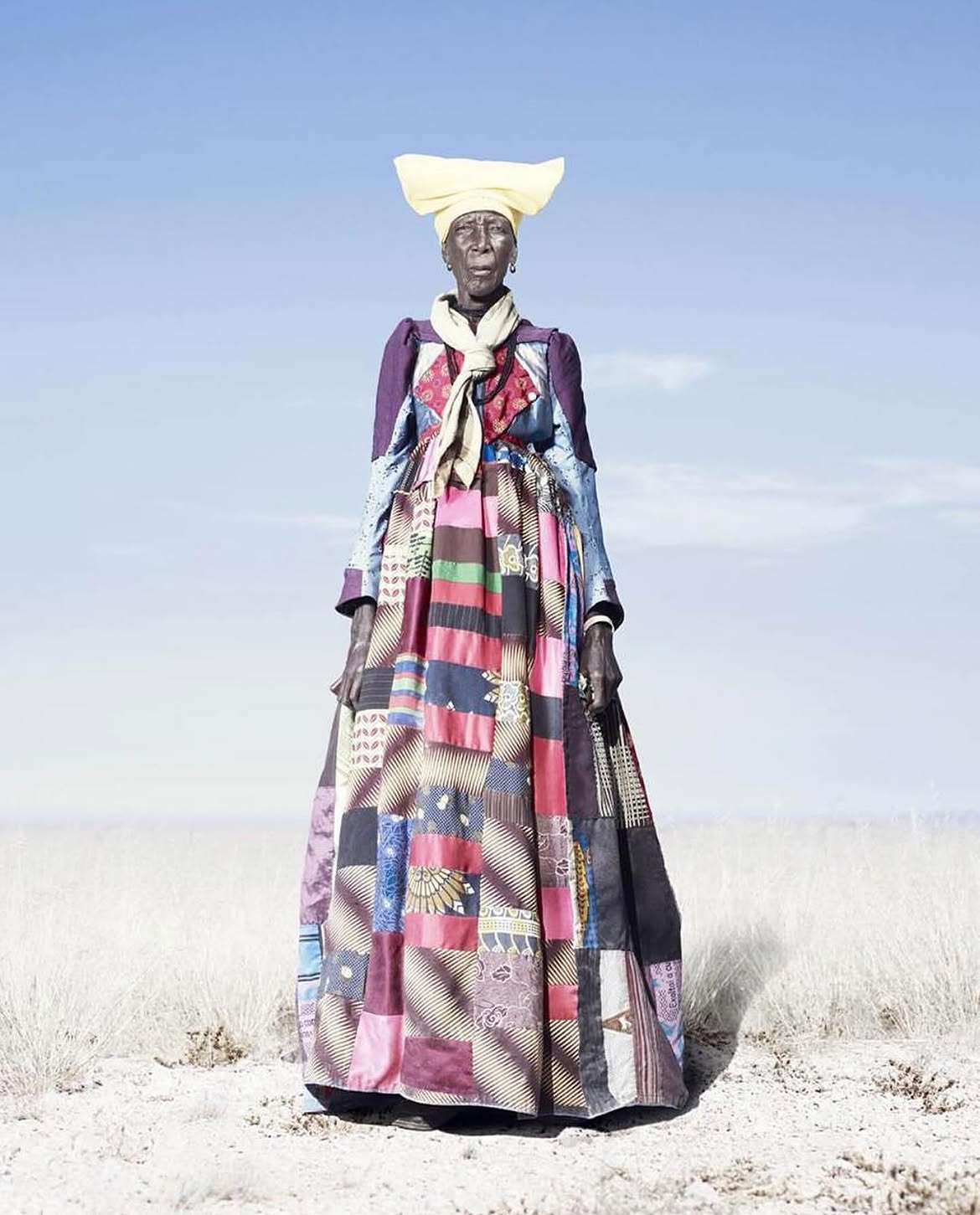
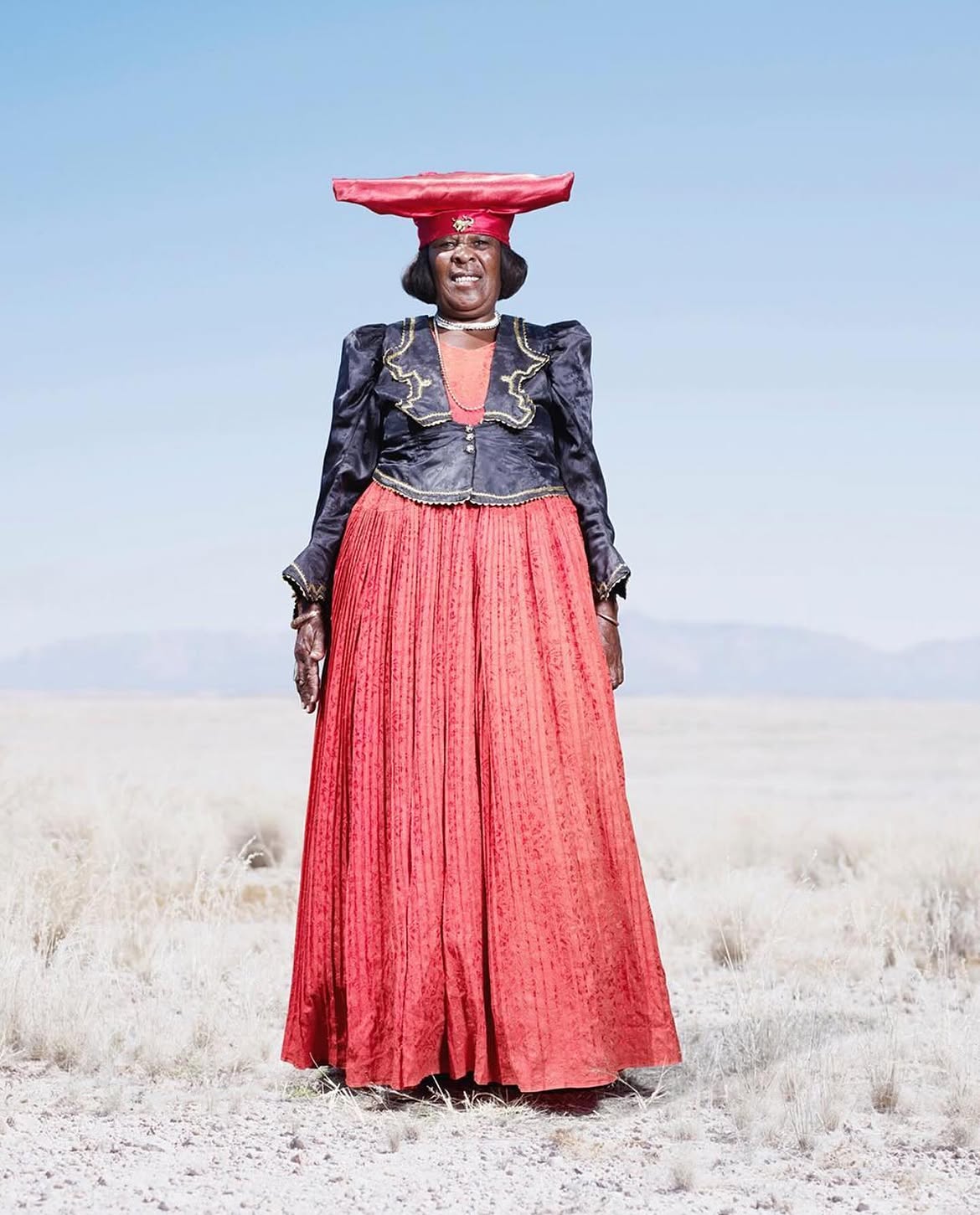
Colours deepened and became bolder: saturated reds, electric blues, forest greens, royal purples. The Herero palette does not hedge. It is bold in the way confidence is. Layers of petticoats multiplied until a single dress might require seven or more metres of cloth. And at the top of the ensemble, Herero women added the otjikaiva, a fabric headdress constructed from cloth matched to the dress, rising from the head in two curved points that mirror the horns of cattle.
The otjikaiva is the crown of the argument. In Herero culture, cattle are not simply livestock. They are spiritual currency, social currency, and the measure of a family’s standing. To wear the cattle-horn silhouette on your head is to carry your ancestors’ wealth and identity in visible form. The missionaries brought a dress to impose modesty. Herero women added the cattle horn to it and wore their civilisation on their heads. In the space of one generation, an imported garment became a Herero garment. The structure remained European. Everything that gave it meaning was entirely Herero.
The Herero dress is not a colonial relic. It is the proof that culture cannot be legislated out of a people. When you try, they wear the evidence.
The Genocide, and What the Dress Became After It
Between 1904 and 1908, German colonial forces under General Lothar von Trotha carried out a systematic campaign of extermination against the Herero and Nama peoples of what was then German South West Africa. On 2 October 1904, von Trotha issued his extermination order: “Within the German boundaries, every Herero, with or without a gun, with or without cattle, will be shot dead.” It is now formally recognised as one of the first genocides of the twentieth century. The German Federal Government’s own accounting places the death toll at approximately 100,000 people from both the Herero and Nama nations. Of the Herero specifically, approximately 60,000 to 80,000 people died, representing around 80% of the pre-war Herero population, through direct violence, forced marches into the Omaheke Desert, and concentration camps. Germany formally acknowledged the genocide in 2021.
Those who survived were stripped of land, cattle, and legal personhood. What the German colonial state could not strip was memory. And memory, for the Herero, was encoded in the dress.
In the years and decades that followed the genocide, the ohorokova became more than everyday clothing. It became a refusal. To wear it was to assert that the Herero people still existed, still carried their own aesthetic logic, still honoured the cattle that the colonial state had seized. The otjikaiva horn headdress carries this meaning directly: it is a daily act of remembrance for what was taken, and a daily assertion of what remains. By adopting the style of dress of their oppressors and reframing it on their own terms, the Herero chose to diminish the occupier’s power. They took the symbol of the colonial civilising mission and made it carry a completely different argument.
ALSO READ
- The Geometry of Heritage: Why Shweshwe Still Defines South African Fashion
- Top 5 Traditional Styles for Ndebele Women in 2026: History, Beadwork, and Ceremony
The Anatomy of the Ohorokova
To understand the Herero dress, it helps to understand its architecture precisely, because every structural element carries weight.
The skirt is long, full, and heavily layered with petticoats, up to seven layers in a full ceremonial dress. This is its most immediately striking feature: the sheer volume of fabric, the geometric authority it gives the wearer, the way it moves. In Namibia’s dust and heat, this is not the obvious choice. That impracticality is partly the point. The dress signals occasion, status, and deliberateness.
The specific palette carried in a dress communicates chieftaincy and ancestral lineage. The Maharero house wears red. Other ancestral lines carry their own colours. This is not decoration applied to a silhouette. It is a genealogy worn on the body.
The otjikaiva headdress is the crown of the ensemble. Constructed from fabric matched to the dress, it rises from the head in two curved points that mirror the horns of cattle. The bodice and gigot sleeves complete the Victorian silhouette, but are reshaped by generation after generation of Herero women who have made it entirely their own. Getting the first ohorokova is a rite of passage: it marks a Herero girl’s entry into womanhood. The dress that a girl receives for the first time, made specifically to her measurements and personal style, is both a garment and a declaration of who she is becoming.
How the Dress Is Worn Today
The dress is not a historical costume. Elder Herero women wear it daily, for shopping, for church, for the market, for every occasion of ordinary life. For younger women and those in urban settings, it is worn for weddings, funerals, church gatherings, and ceremonial events. In both cases, it is worn with full awareness of what it carries.
The annual Maharero Day, held on the Sunday nearest to 23 August in Okahandja, brings together Herero communities from across Namibia for one of the most significant commemorative gatherings on the country’s calendar. Women march through the town in the colours that identify their particular ancestral house and chieftaincy. Red for one lineage. Green for another. White, black, and combinations that carry genealogical information in their palette. The dress does not represent the past. It is the past, the present, and the continuity of a people in a single garment.
The dress has also entered a new generation of contemporary design. Namibia’s leading fashion designer, McBright Kavari, has been showing the ohorokova on runways in China, Ethiopia, Ghana, and Germany itself, the former colonial power, adapting hemlines and introducing non-traditional fabrics while maintaining the essential grammar of the garment. “I want to show it to the world to tell more people about our Herero people,” Kavari has said. “Once it’s on stage, it wows everybody. Everybody wants to know more about it. It’s very attached to history as well.” This tension between preservation and evolution, the same tension visible in every Southern African dress tradition, is where the living culture actually operates. As Omiren Styles has documented in The Zulu Reed Dance and the Dress That Carries a Nation’s Dignity, a dress that has already decided what it means does not require the world’s permission to be authoritative. The Ohorokova made that decision over a century ago.
What Global Fashion Owes to the Herero Dress
Herero fashion sits at an intersection that global fashion media has yet to map properly. It is simultaneously one of the most visually striking traditional dress traditions in the world and one of the least covered by the publications that claim authority over global style. When Vogue covers African fashion, it tends to reach for the most globally legible reference points: West African designers with European stockists. These runway collections speak the language of international luxury. Southern African traditional dress, with its own deep vocabulary and its own civilisational argument, remains at the margins of that coverage. As Omiren Styles has documented in the context of Ndebele beadwork and Southern African dress traditions, a woman’s beadwork is a running biography, and the most valuable thing in an African woman’s wardrobe is rarely what the market assigns a price to. The same principle applies to the ohorokova: its value cannot be read by a system that has not done the work of understanding what it carries.
That absence is not neutral. The dress survived a genocide without a single editorial feature. But the absence reveals something about which African aesthetics the global fashion media considers worthy of serious attention, and which it treats as a spectacle for a photo essay.
What the dress deserves is the rigour applied to any garment that carries this density of meaning: a full accounting of its history, its symbolism, its makers, and its evolution. Not a photo caption. Not a trend piece on global style inspiration. A reckoning with what the ohorokova is, which is one of the most politically and culturally loaded garments on earth.
ALSO READ
- The Zulu Reed Dance and the Dress That Carries a Nation’s Dignity
- Maasai Beadwork: Meaning, Symbolism, and the Language of Identity
WHAT THE DRESS PROVED
The Herero dress began as an imposition and became a declaration. It was worn by women who had survived the systematic murder of their community, who had lost their land, their cattle, and their legal rights, and who chose to encode everything that mattered in the one thing that could not be confiscated: how they dressed. The extermination order said every Herero would be shot. The dress said otherwise. It said: we are still here, and we are still dressed as ourselves.
The ohorokova is not an interesting example of cultural hybridity. It is a proof of cultural resilience at the extreme end of what resilience is ever asked to do. The Victorian structure remains. The Herero argument, carried in the colours, the volume, the petticoats, and above all the cattle-horn headdress, is not Victorian. It was never Victorian. It was built inside the Victorian structure by women who understood that the dress a coloniser imposes can still be made to carry your own flag. Omiren Styles will be returning to Southern African fashion: to the Ndebele beadwork that global luxury brands have borrowed without credit, to the Basotho blanket that carries a nation’s ceremony in its weave, and to the other traditions this region has been carrying, largely unacknowledged, for generations. The Herero dress is where that conversation begins.
Frequently Asked Questions (FAQs)
What is the Herero dress, and where does it come from?
The Herero dress, known as ohorokova, is the traditional dress of the Herero people of Namibia. It derives its structure from Victorian-era European clothing introduced by German and Rhenish missionaries in the mid-nineteenth century. Before colonisation, Herero women wore leather aprons, ostrich-shell overskirts, and metal beadwork. They adopted the Victorian silhouette under colonial pressure and then, over generations, rebuilt it with their own colours, proportions, and the cattle-horn headdress called the otjikaiva, which carries the central symbolism of Herero pastoralist culture.
What is the otjikaiva headdress, and what does it mean?
The otjikaiva is the fabric headdress worn with the ohorokova dress. It is constructed from cloth matched to the dress and rises from the head in two curved points that mirror the horns of cattle. In Herero culture, cattle are the measure of wealth, status, and spiritual life. The otjikaiva carries the cattle-horn silhouette on a woman’s head as a daily act of cultural assertion, a visible connection to the livestock the colonial state confiscated and the community that survived.
How does the Herero dress relate to the 1904-1908 genocide?
Between 1904 and 1908, German colonial forces under General Lothar von Trotha carried out a campaign of extermination against the Herero and Nama peoples of what is now Namibia. An estimated 60,000 to 80,000 Herero, approximately 80% of the pre-war population, were killed through direct violence, forced displacement, and concentration camps. Germany formally acknowledged the genocide in 2021. After the genocide, the ohorokova became more than everyday dress: it became a refusal. To wear it was to assert that the Herero people still existed. The dress that the colonisers had imposed was rebuilt on Herero terms and worn as evidence that the community had survived.
Who is McBright Kavari, and what is he doing with the Herero dress today?
McBright Kavari is Namibia’s leading fashion designer and the figure most associated with the contemporary evolution of the ohorokova. From his workshop in Windhoek, he has been adapting hemline lengths and introducing non-traditional fabrics while maintaining the dress’s essential grammar. His collections have been shown on runways in China, Ethiopia, Ghana, and Germany. He describes his motivation as wanting to show the dress to the world and to bring more people into the story of the Herero people.
What is Maharero Day and why is it significant?
Maharero Day is the annual commemorative gathering of Herero communities across Namibia, held on the Sunday nearest to 23 August in Okahandja. It is one of the most significant cultural events in the country’s calendar, bringing together thousands of Herero in the colours of their ancestral chieftaincy and lineage. Women march through the town in the full ohorokova, wearing the specific colour palette that identifies their particular ancestral house. The gathering honours past leaders and remembers the genocide. The dress is the medium through which that memory is publicly carried every year.
How is the Herero dress worn today, and is it still in active use?
Elder Herero women wear the ohorokova daily for every occasion of ordinary life, from shopping to church to community gatherings. Younger women typically wear it for significant occasions: weddings, funerals, church services, and cultural ceremonies, including Maharero Day. Getting the first ohorokova is a rite of passage, marking a Herero girl’s entry into womanhood. Elder Herero women wear the ohorokova every day for ordinary occasions, including shopping, church, and community gatherings. For younger women, it is worn for significant occasions: weddings, funerals, church services, and cultural ceremonies. A dress made for a specific occasion, particularly a wedding or funeral, is custom-fitted to the wearer and kept as a permanent possession. The reality of daily wear is that the dress is never fully off-duty for the generation of women who have chosen to carry it as an everyday identity.