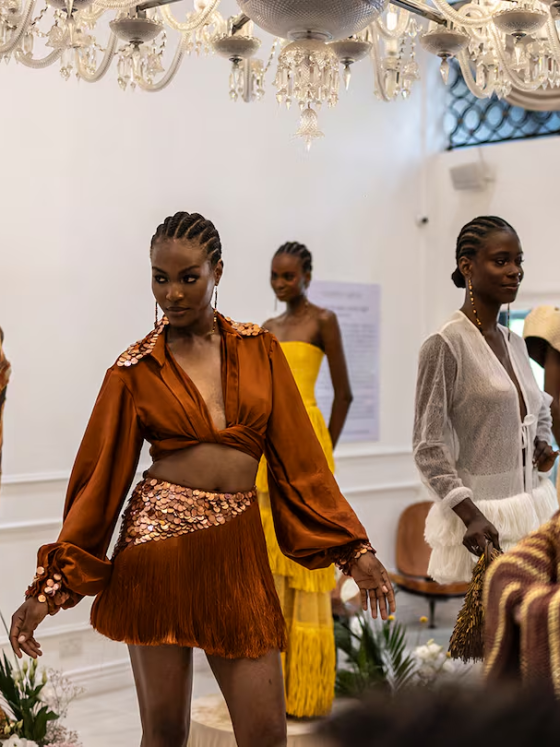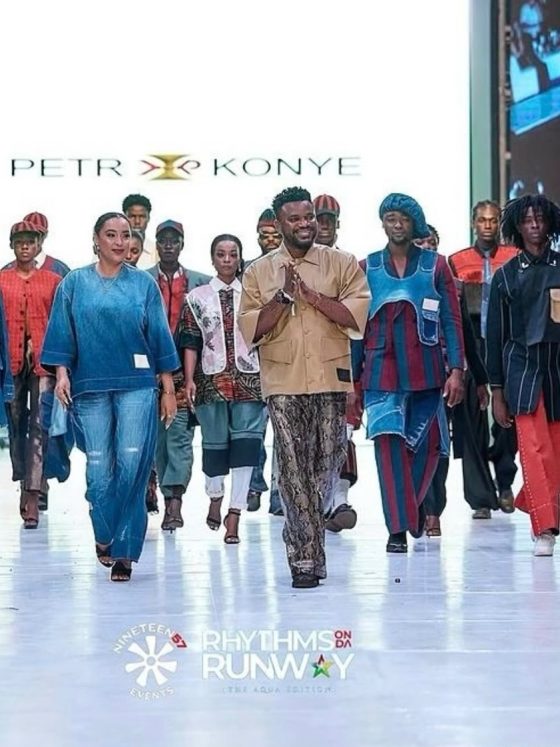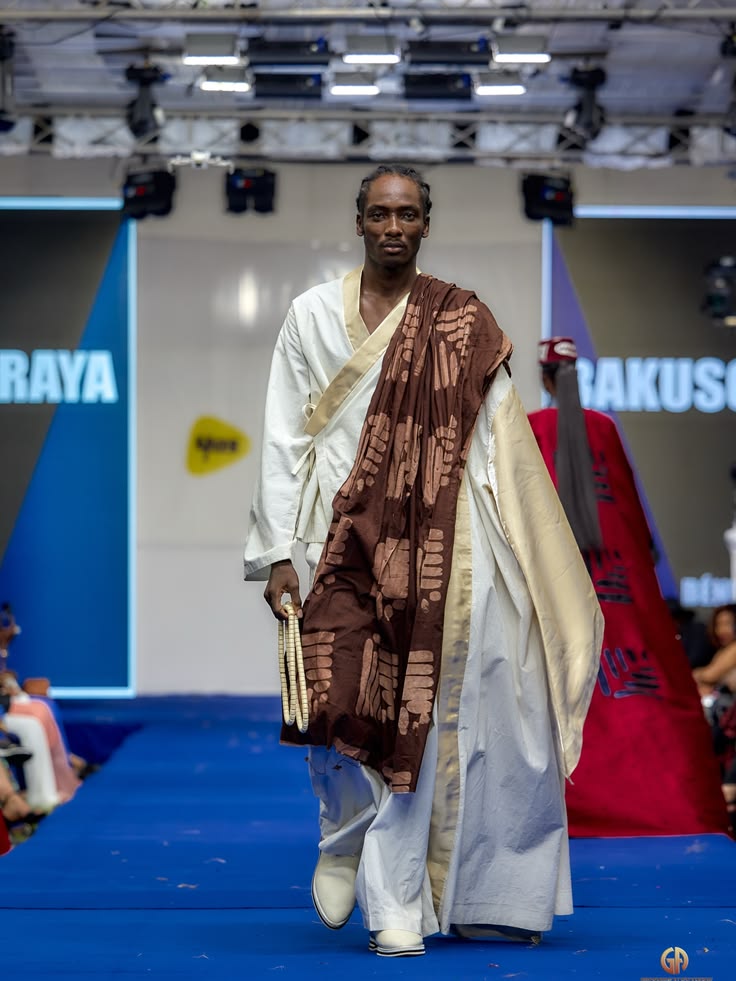
Isabelle Egin made a collection from kanvô. That sentence is accurate, but it is not the full argument. Egin is a political science student, and her stated intention in creating Ecological Splendour was neither to celebrate a Beninese textile tradition nor to demonstrate the fabric’s contemporary relevance. She intended to use fashion as a collision between art, craft, and political power. In her own words, confirmed by Africanews: “Woven fabric is of great beauty and above all showcases local craftsmanship and labour. I’m also a political science student, and I wanted to combine these two worlds, a collision between art, fashion, and politics.”
She won the jury prize at the fourth edition of the Festival International des Arts du Bénin (FInéAB) in February 2026. The jury was chaired by Alphadi, the Nigerien couturier who founded the Festival International de la Mode Africaine in 1998 with UNESCO support. Egin is at the beginning of her public profile: no solo exhibitions, no confirmed press coverage beyond the FInéAB bulletin. What exists are the collection, the prize, the political-science framing, and the choice of kanvô.
The Omiren Argument: When a political science student chooses to make a fashion collection entirely from the royal handwoven fabric of the Dahomey Kingdom, the choice is not decorative. The fabric is the argument. Kanvô was the cloth of kings. Making it the cloth of a political statement is a precise act, not an aesthetic one.
Isabelle Egin won the FInéAB 2026 jury prize for Ecological Splendour, a collection made from kanvô. Politics, craft, and Benin identity in one collection.
What Kanvô Carries Into the Political Argument
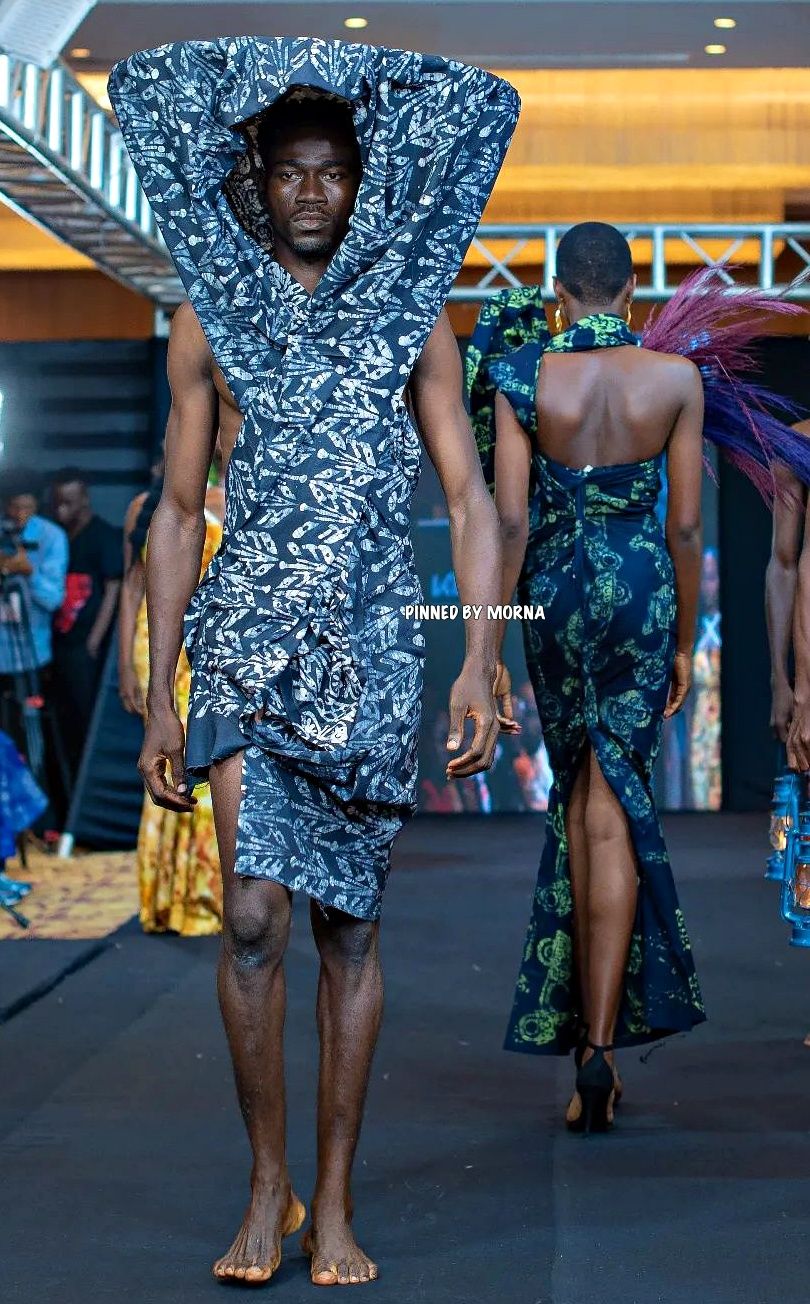
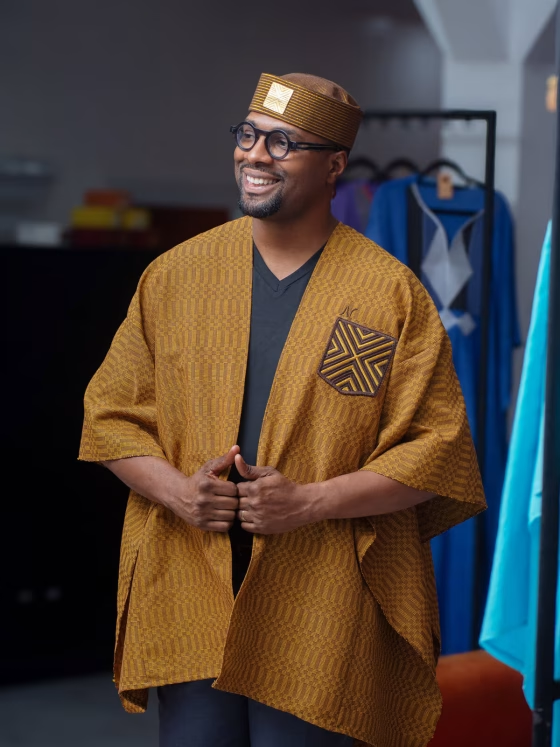
Kanvô is not a neutral textile. Introduced to the Dahomey Kingdom by King Agonglo at the end of the 18th century, it was the fabric of the royal court, worn on great occasions by the kingdom’s rulers, including King Behanzin, the last independent Dahomey monarch. When French colonial forces dismantled the Dahomey court in 1894, they also dismantled the institutional structure that produced and patronised kanvô. The fabric survived that dismantling through the weaving families who maintained the tradition, and through designers like Elvira Akplogan of LOAN-H and Peter Toni-Basengula of FARE, who have built contemporary practices around it.
The Beninese government officially labelled kanvô in 2020, giving it formal cultural recognition as a specifically Beninese material. That labelling is itself a political act: the state asserting that this fabric belongs to Benin, that its production tradition is Beninese, and that its use and value should be protected by institutional authority rather than left to market forces. When Egin chooses kanvô as the material for a collection she frames as a collision between art, fashion, and politics, she is working with a fabric that already carries a dense political history.
The specific history kanvô carries is one of royal authority, colonial disruption, artisan survival, and national reclamation. All four chapters of that history are present in the fabric when Egin uses it. She does not need to explain them in the garment because they are already there. The political science student choosing kanvô is not adding political meaning to a neutral material. She is activating the political meaning the material already holds.
Fashion as Political Theory: The Intellectual Tradition Egin Is Working In
The idea that clothing carries political meaning is not a contemporary fashion theory. It predates academic fashion studies by centuries and exists across cultures. In Yoruba tradition, the Egungun costume is a material argument about ancestral authority. In the Dahomey court, kanvô was a material basis for arguments about royal power. In colonial West Africa, the adoption of European dress by educated elites was simultaneously a tactical accommodation and a political aspiration, documented in detail by scholars of African colonial history.
What Egin’s framing adds to this tradition is the explicit connection to political science as an academic discipline. Political science studies the distribution of power: how it is acquired, maintained, contested, and transferred between actors. Fashion, in this framework, is not a soft cultural product but a mechanism for power communication. A garment communicates social position, cultural affiliation, institutional authority, and political aspiration. The choice of fabric, cut, and adornment is a set of claims about who the wearer is and what power they hold or aspire to.
Egin’s collection, Ecological Splendour, uses kanvô to make this argument on a competition platform. The FInéAB jury, chaired by Alphadi, recognised it with the jury prize. Alphadi has spent more than three decades arguing, through his design practice and through the festival he founded, that African fashion is not a local cultural product waiting for international validation but an authoritative creative tradition with its own criteria of excellence. His decision to award the jury prize to a collection built on kanvô and framed as a political act is itself a statement about what Beninese fashion can mean.
Ecological Splendour: Reading the Title
The title Ecological Splendour carries two registers. The ecological register is the one that the FInéAB 2026 coverage emphasised: ecological commitment was a common thread across the young designers’ collections. Using kanvô, a fabric with local production roots, instead of imported synthetic or industrial materials, is an ecological choice because it keeps the production chain within Benin and avoids the environmental costs associated with imported textile infrastructure.
The splendour register is the more interesting argument. Splendour, in the context of kanvô, directly references the fabric’s royal history. Kanvô was splendid in the specific sense of royal magnificence: it communicated the dignity, authority, and cultural achievement of the Dahomey court. Ecological Splendour is a title that refuses to separate the environmental argument from the historical one. It does not say: this collection is sustainable because it uses local fabric. It says: this collection is splendid because it uses the fabric of kings, and the kings’ fabric is locally produced, and those two things are the same argument.
This is a sophisticated piece of political communication, made through naming rather than through verbal explanation. Egin does not need to write an essay about kanvô’s political history. She names her collection Ecological Splendour and lets the fabric carry the argument she has set up for it. The political science training is visible not in any statement she makes about power theory but in the precision with which she has constructed the conditions under which the fabric can speak.
ALSO READ
- Rolande Houvo: The Young Designer Putting Benin’s New Generation on the Runway
- Kanvô: Benin’s Royal Handwoven Fabric, Fully Explained
- Elvira Akplogan and LOAN-H: Bringing Kanvô Back to the World Stage
The Jury Prize and What It Means
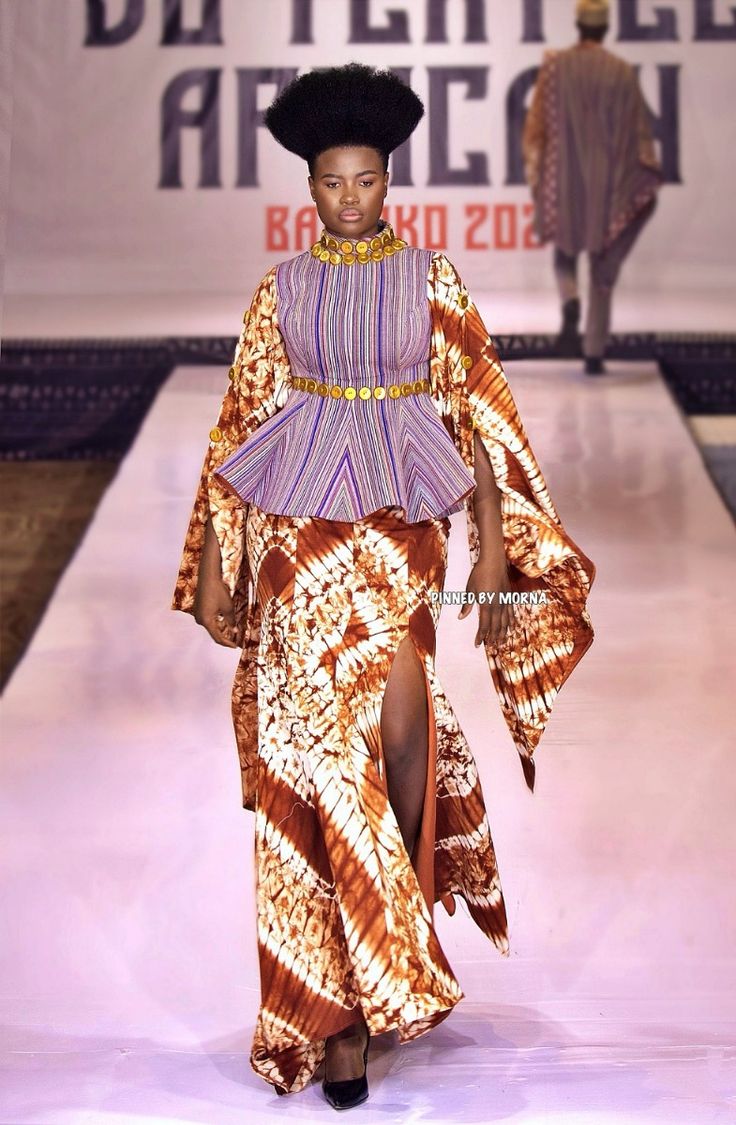
At FInéAB 2026, three prizes were awarded in the young designers’ fashion competition. Rebecca Houénou, aged 17, won the grand prize for Todagbé, a collection from beach plastic and seashells. Rolande Houvo won third prize for Blossoming, a collection of Ganvié straw. Isabelle Egin won the jury prize for Ecological Splendour. The jury prize is typically the award the jury assigns based on its own criteria rather than a popular vote or ranking formula. Alphadi’s decision to award it to Ecological Splendour is a statement about what the jury valued: not the most visually striking work or the most emotionally resonant narrative, but the most intellectually precise argument.
All three collections share the ecological commitment identified as a generational thread in the coverage. But Egin’s collection adds a layer that the other two do not explicitly address: the political-philosophy framing. The jury prize suggests that Alphadi, whose own practice has always been an argument about African cultural authority in an industry that has historically undervalued it, recognised in Egin’s framing a form of creative intelligence that goes beyond technical craft.
The grand prize for the youngest competitor, Rebecca Houénou, 17, for work on ocean conservation made from beach waste, is a recognition of creative ambition and social conscience. The jury prize to Egin for a collection framed as a collision between art, fashion, and politics is a recognition of something more specific: a designer who understands that fashion is an argument and who has built her collection to make that argument with precision.
Kanvô and the Generation It Now Belongs To
Kanvô was introduced to the Dahomey court by a king in the 18th century. It was preserved by weaving families through colonisation. It was relabelled by the Beninese government in 2020. It was modernised by Elvira Akplogan and sold to clients in 40 countries. FARE used it to dress ODUMODUBLVCK. And at FInéAB 2026, it was used by a political science student to argue for the relationship between craft, identity, and power. That argument won the jury prize at a competition chaired by one of Africa’s most significant fashion voices.
Each of these chapters is part of the same story, and none of them is the end of it. Kanvô belongs to the generation that is currently using it. That generation includes Egin, Houvo, the FLY incubator’s cohorts, the ACMB’s emerging members, and the students at Beninese universities who are watching what happens when a political science student wins a jury prize with a fashion collection and deciding what that means for what they might do next.
Egin’s public profile is, at the time of this article, limited to the FInéAB coverage. That is the entirety of the English-language editorial record for a designer who has produced work significant enough to win the jury prize at a national arts festival chaired by an international jury. The record begins here. What happens next belongs to Egin and to the ecosystem she is entering.
“When a political science student chooses to make a fashion collection entirely from the royal handwoven fabric of the Dahomey Kingdom, the choice is not decorative. The fabric is the argument. Kanvô was the cloth of kings. Making it the cloth of a political statement is a precise act, not an aesthetic one.”
Frequently Asked Questions
Who is Isabelle Egin?
Isabelle Egin is a Beninese political science student who won the jury prize at the fourth edition of the Festival International des Arts du Bénin (FInéAB) in February 2026, in the fashion competition that formed the festival’s central focus that year. Her collection, Ecological Splendour, was made entirely from kanvô, Benin’s royal handwoven fabric. She described her intention as combining fashion with political science to create a collision between art, fashion, and politics. She is at the beginning of her public profile, with no solo exhibitions or press coverage beyond the FInéAB 2026 context.
What is the Ecological Splendour collection?
Ecological Splendour is the collection that Isabelle Egin presented in the FInéAB 2026 young designers’ competition, for which she won the jury prize. It was made entirely from kanvô, Benin Republic’s royal handwoven fabric, introduced to the Dahomey court by King Agonglo in the late 18th century. Egin’s stated intention was to use the collection as a collision between art, fashion, and politics. The ecological dimension references the local production roots of kanvô. The splendour dimension references the fabric’s royal history. The title holds both arguments simultaneously.
Why is kanvô a political fabric?
Kanvô carries a dense political history. Introduced to the Dahomey court by King Agonglo as a royal textile, it communicated political authority for more than a century. French colonisation in 1894 dismantled the Dahomey court and disrupted the production traditions kanvô depended on. The Beninese government officially labelled kanvô in 2020 as a nationally protected cultural material, itself a political act of national reclamation. When Egin uses kanvô in a collection she frames as a collision between art, fashion, and politics, she is working with a fabric that already carries all four chapters of that history: royal authority, colonial disruption, artisan survival, and national reclamation.
What is the difference between the jury prize and the grand prize at FInéAB 2026?
At FInéAB 2026, three prizes were awarded in the young designers’ fashion competition. The grand prize went to 17-year-old Rebecca Houénou for Todagbé, a collection from beach plastic and seashells. Third prize went to Rolande Houvo for Blossoming, a collection from Ganvié straw. The jury prize went to Isabelle Egin for Ecological Splendour. The jury prize is typically awarded at the jury’s own discretion rather than through a ranking formula. Jury chair Alphadi described having great difficulty choosing between the young designers, whose creativity and maturity commanded admiration.
What is Alphadi’s significance as jury chair?
Alphadi (Sidahmed Alphadi Seidnaly) is one of Africa’s most internationally recognised fashion figures. Born in Timbuktu, Mali, he trained in Paris and has spent three decades arguing, through his design practice and his Festival International de la Mode Africaine (FIMA), that African fashion is an authoritative creative tradition rather than a regional cultural product awaiting international validation. He was featured in the Victoria and Albert Museum’s 2022 Africa Fashion exhibition. His decision to award the jury prize to Egin’s kanvô-based, politically framed collection is a statement about what he values in Beninese fashion’s emerging generation.
What does Egin’s collection tell us about Benin’s fashion future?
Ecological Splendour represents one dimension of what Benin’s emerging fashion generation is capable of: work that is simultaneously technically grounded in a specific local textile tradition, intellectually framed in a discipline outside fashion, and politically precise in its use of material meaning. Alongside Rolande Houvo’s Blossoming and Rebecca Houénou’s Todagbé, it is part of a generational argument that Beninese fashion can be made from specifically Beninese materials, can carry specifically Beninese cultural and political histories, and can make that argument at an international competition level.
Explore more from our Industry section, where Benin’s emerging designers are documented from the moment their public record begins.