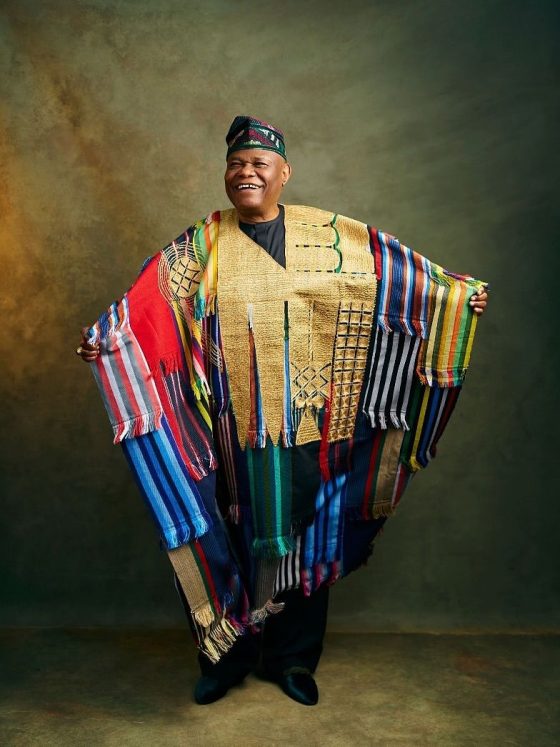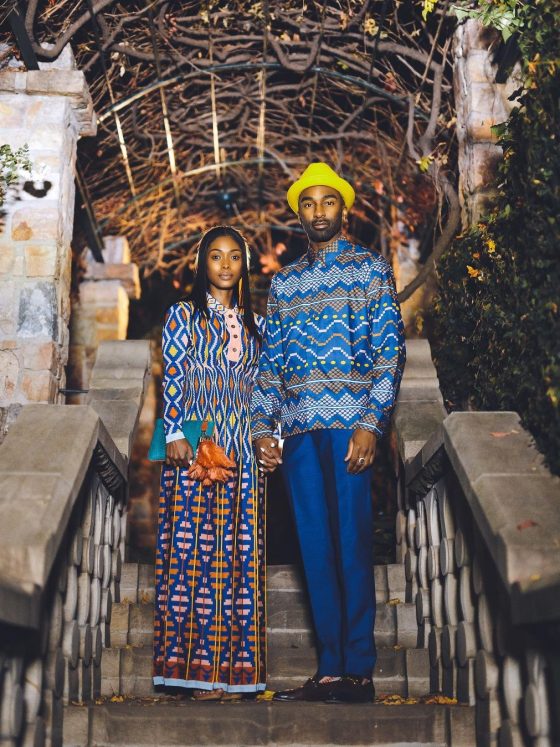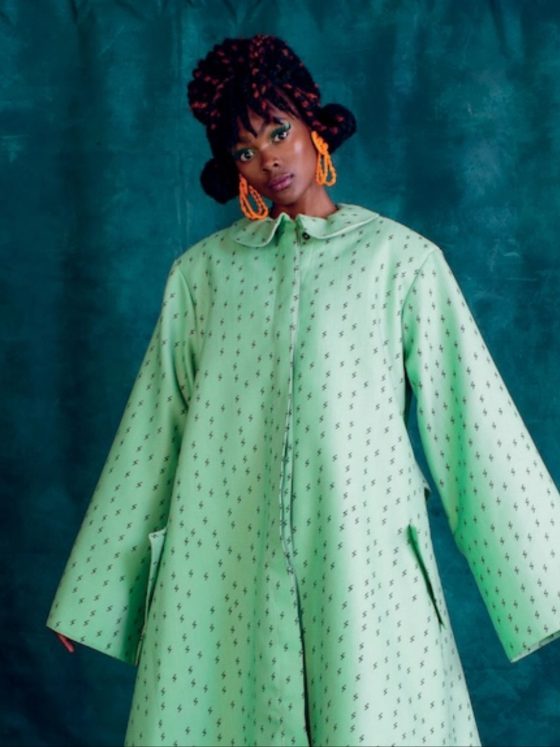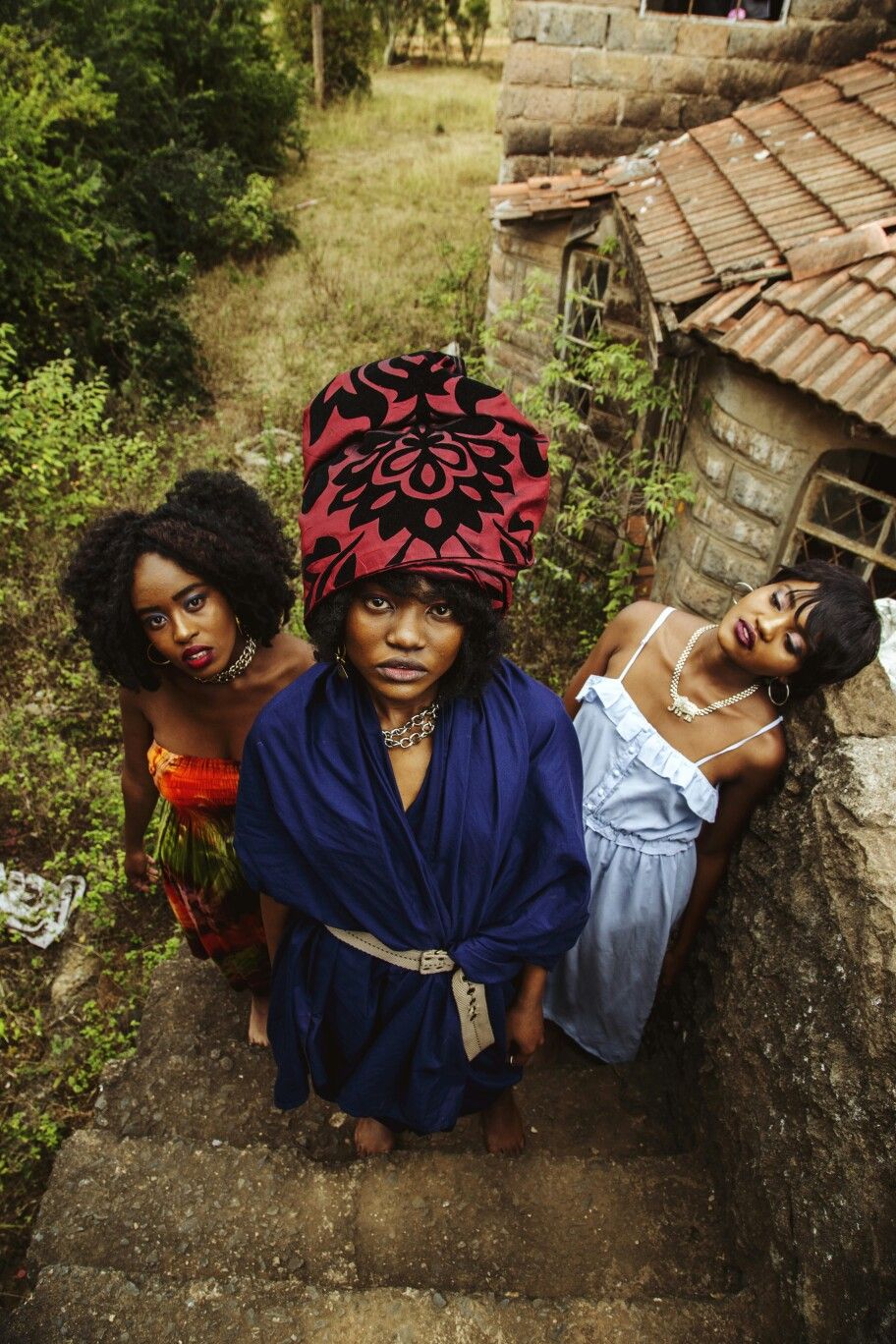
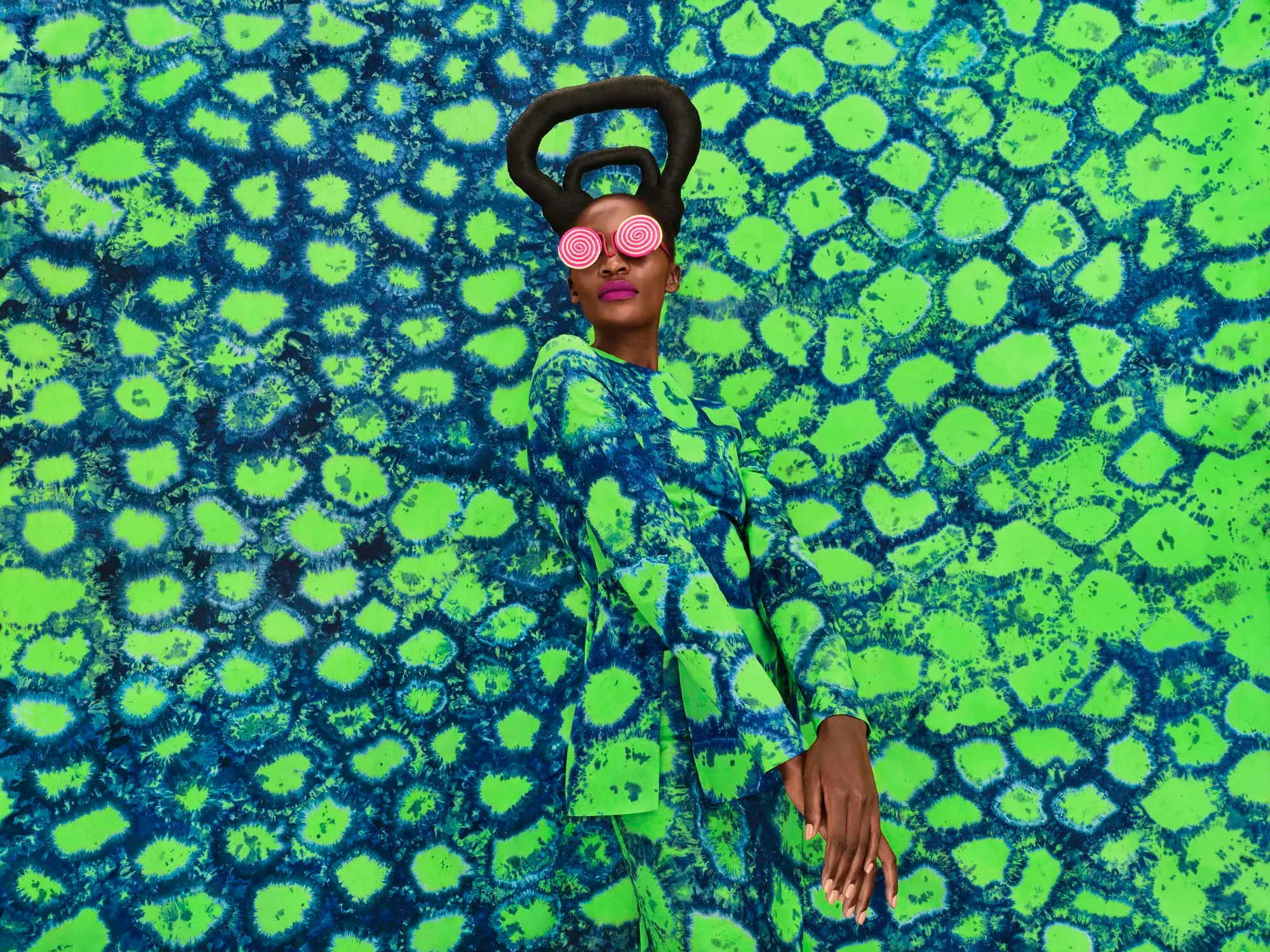
In her Camo series, Thandiwe Muriu places dark-skinned Kenyan women in front of walls of kitenge fabric that matches their garments exactly. The subjects simultaneously disappear into the background and emerge from it. The illusion is not digital. It is constructed on set, using fabric selected from Nairobi’s markets, accessories made from everyday Kenyan household objects, including soft drink cans, plastic tea strainers, and clothes pegs, and models whose specific beauty is precisely what the series insists upon: dark-skinned, Kenyan, photographed without lightening, without Eurocentric beauty adjustments. The work is both a fashion image and an argument.
Osborne Macharia was born in Nairobi in 1986 and is self-taught. His Afrofuturist practice builds alternative visual universes from Kenyan cultural material: post-colonial imagery, representations of elders and marginalised communities, and speculative futures grounded in African historical knowledge. He was the first Kenyan selected as a jury member for the Cannes Lions creative awards in 2018. Marvel and Disney commissioned him to create Afrofuturist artwork for the London premiere of Black Panther, a project titled Ilgelunot (Maasai for The Chosen One). His clients include Disney, Forbes, Guinness, and Mercedes-Benz.
The Omiren Argument: Kenyan fashion photography does not document Kenyan fashion from outside. It argues for it from inside, and the two practitioners who have built the strongest international records are making the same argument from different formal positions: that Kenyan visual culture is foundational, authoritative, and requires no external validation.
Kenyan fashion photography does not document Kenyan fashion from the outside. It argues for it from inside, and the two practitioners who have built the strongest international records are making the same argument from different formal positions.
Thandiwe Muriu: Camo and the Politics of Visibility
Muriu was born and raised in Nairobi. She taught herself photography from books and video tutorials after her father taught her to use a digital camera at fourteen. By seventeen, she was working professionally. By twenty-three, she had shot her first solo advertising campaign. The Camo series was Muriu’s first artistic work, conceived as she confronted questions about the role of women in Kenyan society while working as the only woman in a male-dominated advertising industry. She opened her first solo show at 193 Gallery Paris in October 2023, launching her public artistic career. The series, developed from her experience as the sole woman in Kenya’s advertising photography industry, prompted her to push beyond commercial work. The Camo series became the foundation of an international artistic career.
Camo works through a specific formal logic: the model and the background are made from the same fabric, producing an optical illusion in which the subject is simultaneously present and absorbed. But the illusion is never neutral. As an Institute Artist documents, Muriu’s clients include Adidas, Christian Dior, Nespresso, Longchamp, Swatch, Bic, and the United Nations. She has exhibited at Paris Photo 2024, the 1:54 Contemporary African Art Fair in London, the Venice Biennale 2024 (Passengers in Transit, a Collateral Event presented by CCA Lagos), and the WAX exhibition at the Musée de l’Homme in Paris organised with 193 Gallery. She has had a third solo exhibition at 193 Gallery in Paris. Her book Camo was published by Chronicle Books in 2024, and in the same year, her work appeared in Passengers in Transit, a Collateral Event of the Venice Biennale presented by CCA Lagos.
Each image in the Camo series is paired with an African proverb that expresses the collective oral wisdom of generations. The handmade accessories constructed from everyday Kenyan objects are, as Muriu describes them, objects she interacted with as a Kenyan throughout her childhood. The work is culturally specific in every element of its construction: the fabric, the proverbs, the objects, the models, and the beauty standard. Nothing is generic. Nothing imports an external visual language.
Osborne Macharia: Afrofuturism as a Kenyan Archive
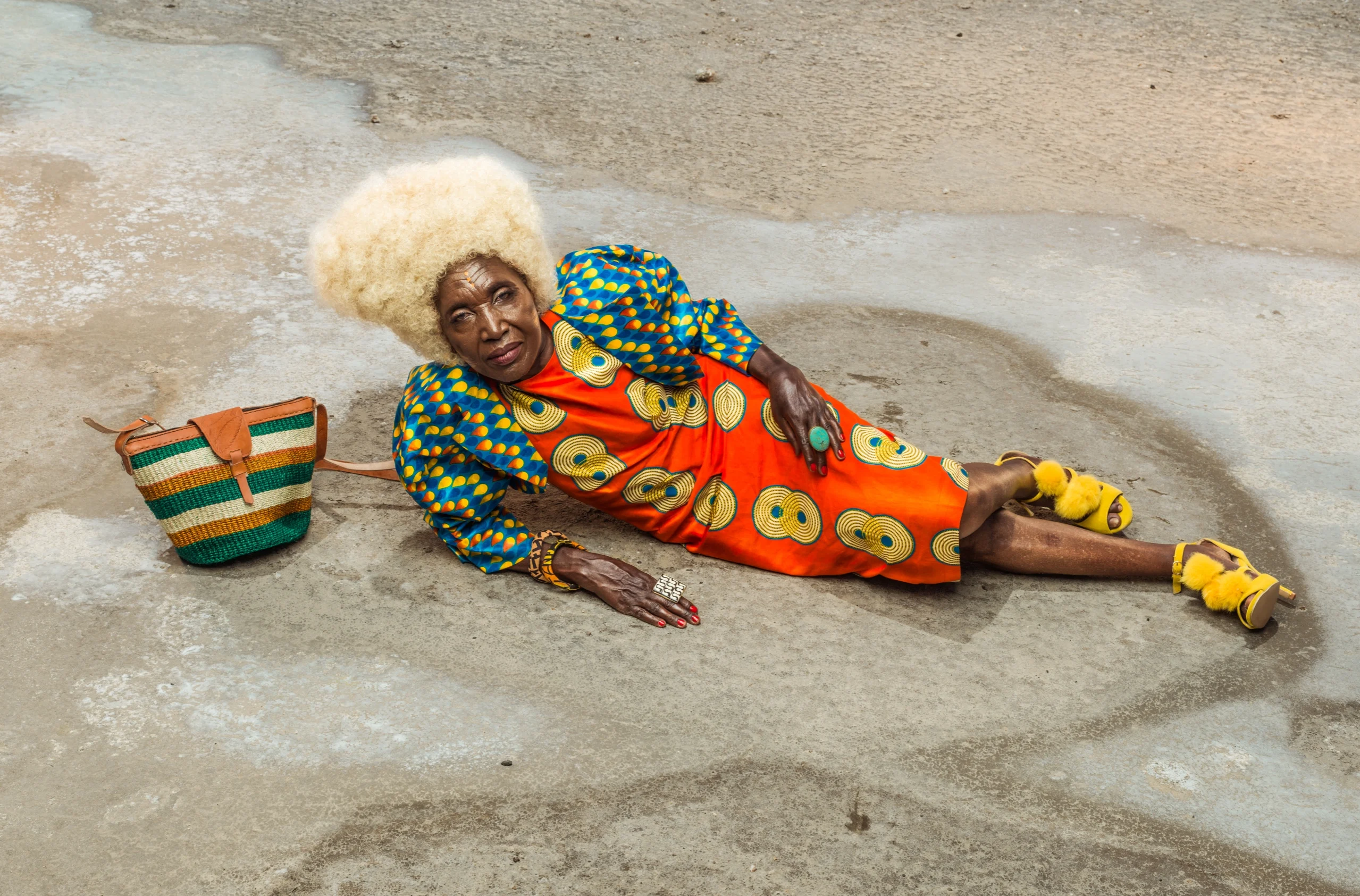
Macharia’s practice is distinct from Muriu’s in form but not in purpose. Where Muriu builds illusionist images from Kenyan domestic material, Macharia builds speculative narratives from Kenyan cultural history: alternative universes where elders hold power, where marginalised communities are visually centred, where Kenyan identity is placed in a future that has not required Western cultural mediation to arrive.
He was commissioned by Safaricom, Kenya’s telecommunications company, to produce a photographic collection titled This Is My Kenya. He travelled along Kenya’s coast for ten days, producing images whose stated aim was to challenge negative stereotypes of the country. He was the first Kenyan invited to sit on the Cannes Lions jury in 2018. Marvel commissioned a Black Panther piece from him, now shown in Marvel Studios: Ten Years of Heroes. He works at the intersection of commercial photography, fine art, and social argument.
Macharia has described his visual practice as creating worlds where everyone matters, where representation matters, and where people discriminated against by society have a place. This is not a mission statement. It is a description of the images. His work places people who are typically absent from commercial visual culture at the centre of visual universes built with the full technical and conceptual capability of a world-class image-maker.
ALSO READ
- Déborah David: The Garífuna Model Who Made Latin America Look
- Stella Jean: The First Black Italian Designer Who Forced Milan to Look
- The Language of Adinkra: When Cloth Becomes Scripture
What These Two Practices Say About Kenyan Fashion Photography
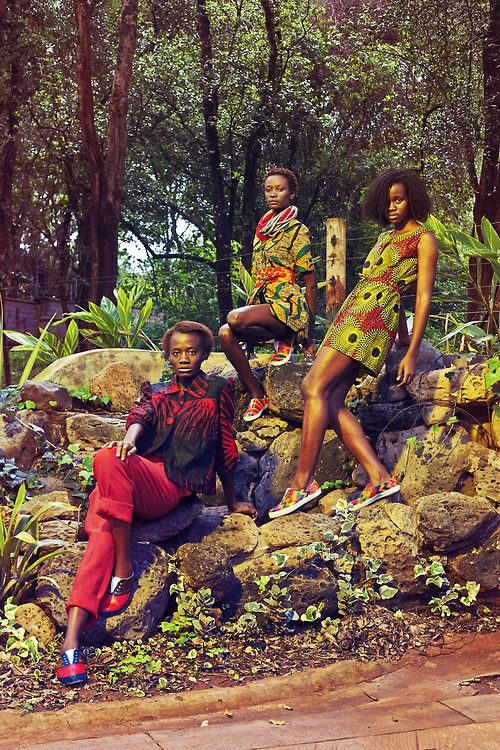
Muriu and Macharia are not the only significant practitioners in Kenyan fashion photography. Diana Opoti, Sunny Dolat, Brian Babu, and Annabel Anyango are among those cited by the Nairobi fashion ecosystem documentation as having shaped Africa’s fashion story on the global stage. What Muriu and Macharia represent is a specific kind of practice: one in which the image is not just documentation but argument; one in which the visual language is entirely sourced from Kenyan cultural material; and one in which international recognition has arrived on the terms of the work, not through compromise of it.
This is the standard that Kenyan fashion photography sets. It is not a standard that documents fashion from outside, following the subject wherever it leads. It is a standard that argues for the subject from inside, insisting on specific beauty, specific objects, specific cultural knowledge, and specific futures. The image is the argument.
The Commercial and the Artistic as a Single System
Both Muriu and Macharia operate across commercial and artistic registers simultaneously, and in both cases, the commercial work and the artistic work are inseparable. Muriu’s clients include Adidas, Christian Dior, Nespresso, and Longchamp. These commissions came because of the Camo series. The artistic work built the commercial credibility. Commercial work funds the conditions under which artistic work continues to be produced. Neither track is subordinate to the other.
Macharia’s client list includes Marvel, Disney, Forbes, and Mercedes-Benz. He was commissioned to build a world for Black Panther. That commission came from an Afrofuturist practice built on Kenyan cultural material, executed at a technical level that matched the most resourced visual production in the world. The commercial and the artistic are not in tension in Macharia’s practice. The artistic philosophy is what makes the commercial work worth commissioning.
This model has implications for how the broader Kenyan fashion photography ecosystem is understood. Diana Opoti, Sunny Dolat, Brian Babu, and Annabel Anyango, named by the Nairobi fashion ecosystem as practitioners who have shaped Africa’s fashion story on the global stage, each operate from a similar principle: the cultural argument and the commercial opportunity are not separate tracks. You build the argument first, and the market follows. The Kenyan fashion photography ecosystem is structured around this sequence, and it is producing practitioners whose international profile is built on exactly this foundation.
The record that Muriu and Macharia have built is not exceptional within Kenyan photography. It is exceptional within global fashion photography as a whole. The fact that it comes from Nairobi is not incidental to that achievement. It is the source of it. The specific cultural materials, visual references, and creative intelligence that produced the Camo series and the Afrofuturist archive could not have come from anywhere else. That is what Kenyan fashion photography offers the world, and the world is still in the early stages of understanding what it is receiving.
“Kenyan fashion photography does not document Kenyan fashion from outside. It argues for it from inside, and the two practitioners who have built the strongest international records are making the same argument from different formal positions.”
Frequently Asked Questions
Who is Thandiwe Muriu?
Thandiwe Muriu is a self-taught photographer born and raised in Nairobi. She began photographing professionally at seventeen and is known internationally for her Camo series, which creates optical illusions by placing Kenyan women models in front of matching kitenge fabric backgrounds and using handmade accessories made from everyday Kenyan objects. Her clients include Adidas, Christian Dior, Nespresso, Longchamp, the United Nations, Apple and the Swiss Red Cross. She has exhibited at Paris Photo 2024, the 1:54 African Art Fair in London, the Venice Biennale 2024 Collateral Event, and in solo exhibitions at 193 Gallery in Paris. Her book Camo was published by Chronicle Books in 2024.
Who is Osborne Macharia?
Osborne Macharia is a self-taught photographer and digital artist born in Nairobi in 1986. His practice focuses on Afrofuturism, creating alternative visual universes from Kenyan and African cultural material. He was the first Kenyan selected as a jury member for the Cannes Lions creative awards in 2018. He has been commissioned by Marvel (Black Panther), Disney, Safaricom, the Oprah Winfrey Network, Forbes, Guinness, and Mercedes-Benz.
What is the Camo series?
Camo is an ongoing photographic series by Thandiwe Muriu, her first artistic work, which launched her public career when her debut solo show opened at 193 Gallery Paris in October 2023. It places dark-skinned Kenyan women in front of walls of kitenge fabric that matches their garments, creating optical illusions in which subjects simultaneously disappear into and emerge from the background. The illusions are not digitally produced; they are constructed on set. Each image is paired with an African proverb. Accessories are handmade from everyday Kenyan objects. The series is a meditation on identity, cultural belonging, and female empowerment.
What is Afrofuturism in the context of Kenyan photography?
In the context of Osborne Macharia’s practice, Afrofuturism is the construction of alternative visual universes grounded in African cultural history and focused on representing marginalised people with power, dignity, and complexity. Macharia builds speculative narratives from Kenyan material: elders, coastal communities, warrior traditions, and post-colonial histories that are reframed as future sources of authority rather than as past footnotes.
What makes Kenyan fashion photography distinctive?
Kenyan fashion photography, as practised by Muriu, Macharia, and their peers, is distinctive in that it sources its visual language entirely from Kenyan cultural material rather than importing external aesthetic references. The fabric, objects, proverbs, models, beauty standards, and cultural narratives are all Kenyan. The work argues for Kenyan visual culture as both authoritative and foundational, rather than as a local variation on a global aesthetic norm.
Explore more from our Directory, where Africa’s most significant photographers and visual artists are documented with the depth their practice deserves.