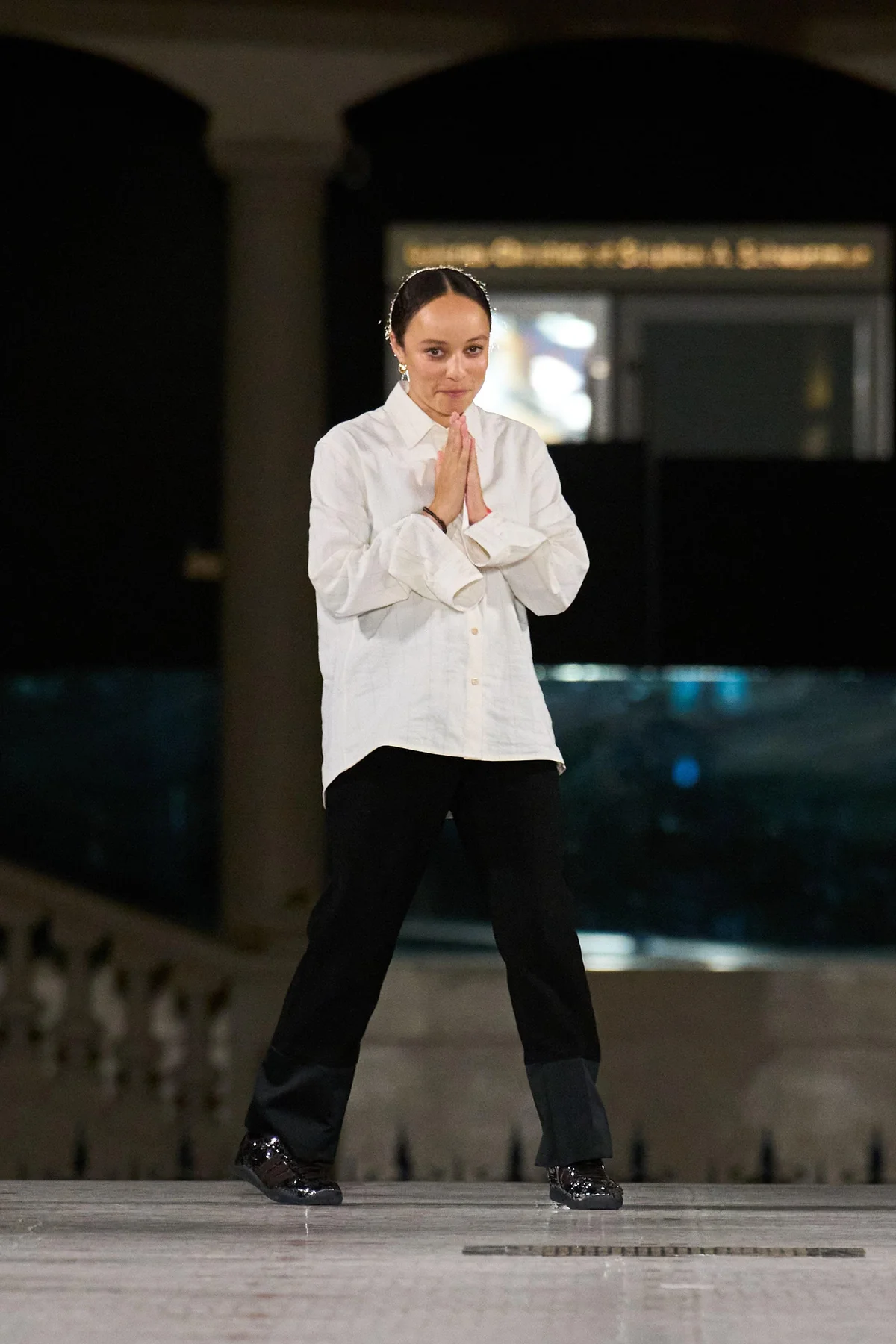
Grace Wales Bonner has spent the past decade building one of the most intellectually serious practices in contemporary fashion: a body of work grounded in Jamaican heritage, Black British experience, Afrocentric scholarship, and artisan textile traditions. Her collections for her eponymous label, established in London in 2014 after she graduated from Central Saint Martins, have been shown at leading fashion weeks, stocked by major retailers such as Selfridges, Browns Fashion, Dover Street Market and SSENSE, and recognised with prizes including the British Fashion Awards Emerging Menswear Designer award and the CFDA International Men’s Designer of the Year.
By the early 2020s, Wales Bonner’s work had moved firmly into the cultural canon. Her garments and installations were exhibited in major institutions, including the Victoria and Albert Museum in London and the Museum of Modern Art in New York, and her ongoing collaborations with adidas Originals turned deeply researched, Black Atlantic-inflected design into some of the most talked-about trainer releases of the decade.
In late 2025, industry reporting began linking Wales Bonner to a senior creative role at Hermès, the French luxury house whose global reputation is built on leatherwork, silk, and meticulous craftsmanship. The details of that role, and what it will mean in practice, will only be fully understood once her first work for the house is shown. What is clear now is that any such appointment would be historically significant: a British-Jamaican designer whose practice centres Black identity and Caribbean diaspora culture stepping into leadership at one of European luxury’s most closely guarded institutions.
What follows is a profile of Grace Wales Bonner as she stands today: an independent designer whose work treats clothing as an argument and an archive, and whose influence now reaches from London runways and West African weaving workshops to global wholesale floors and museum galleries.
Discover Grace Wales Bonner, the Jamaican-British designer whose decade of Afrocentric scholarship and luxury craft has made her one of the most significant voices in contemporary fashion.
Biography and Heritage: From South London to Central Saint Martins to the World

Grace Wales Bonner was born in 1992 in South London, the daughter of a Jamaican father and an English mother. Her upbringing in Tooting placed her inside one of the most culturally layered communities in Britain: a neighbourhood shaped by Jamaican, Sri Lankan, and South Asian migration, by Caribbean foodways and music, by the specific texture of Black British working-class life in the 1990s and early 2000s.
She studied at Central Saint Martins, graduating with a Master’s in Fashion in 2014. Her graduation collection, titled Africa, set the terms for everything that followed. It drew on research into African and Caribbean cultural history, scholarship on Black masculinity and identity, and the visual languages of tailoring traditions across the diaspora. It was not a student collection in the way the fashion industry usually understands that term. It was a thesis. It won the L’Oreal Professional prize and the Diesel Award for Innovation at the International Fashion Showcase, and the industry noticed immediately.
Wales Bonner launched her label the same year. From the beginning, the practice was scholarly as much as sartorial. Each collection was built around specific research: into the Harlem Renaissance, into Sufi philosophy, into Jamaican Rastafari culture, into the history of African resistance movements, into the visual archives of Black sporting identity. Collaborators were not stylists or photographers in the conventional sense. They were musicians, poets, and academics who brought their own intellectual authority to the work.
The Jamaican dimension of Wales Bonner’s heritage is not biographical decoration in her collections. It is structural. The relationship between Jamaica and Britain, between the Caribbean and the colonial metropole, between Black Atlantic cultural production and the institutions that have historically excluded it, is the intellectual scaffolding on which every Wales Bonner collection is built. When she told Vogue in 2021, “I want to explore what it means to be British and to be of the Caribbean,” she was describing a project that has never been resolved, only deepened.
The label received early support from the British Fashion Council, including the BFC/GQ Designer Menswear Fund. In 2015, she received the British Fashion Awards Emerging Menswear Designer prize. International prize recognition followed in 2016. Major collaborations with adidas Originals brought the label to a vastly wider audience while maintaining the intellectual seriousness of the practice. The adidas x Wales Bonner pieces, Samba colourways and Spezial silhouettes in handwoven West African textiles became some of the most culturally resonant trainer releases of the past decade.
Stockists followed: Dover Street Market, Selfridges, SSENSE, 10 Corso Como, Browns London. By 2021, Wales Bonner had been named CFDA International Men’s Designer of the Year. By 2022, she had received an MBE. By 2023, her work was the subject of major institutional exhibitions at the V&A Museum and MoMA New York. Industry reporting in late 2025 began linking her to a senior role at Hermès, a development whose significance would be difficult to overstate if confirmed.
Design Signature: Intellectual Luxury and the Architecture of Black Identity
The Wales Bonner aesthetic is immediately recognisable, though not in the way that most luxury fashion signatures work. It is not a silhouette, a colour palette, or a recurring motif, though those elements are present. It is a quality of attention. Every Wales Bonner garment carries the evidence of serious research, of decisions made at the level of meaning rather than only at the level of style.
The tailoring is typically precise and Savile Row-adjacent in its construction, but with a softness and sensuality specific to Wales Bonner’s hand. She works primarily in menswear and gender-fluid pieces, and the male body in her collections is a site of tenderness and intellectualism rather than of the hard confidence that luxury menswear has historically demanded. Black masculinity in Wales Bonner’s work is scholarly, spiritual, expressive, and at ease.
The textiles are often sourced through collaboration: handwoven West African cloths, Peruvian knitting traditions, artisan embroideries commissioned specifically for each collection. This is not surface decoration. The textiles carry their own histories, their own communities, their own arguments. When Wales Bonner puts a handwoven kente-adjacent textile into a tailored jacket, she is not borrowing an aesthetic. She is placing two knowledge systems in conversation.
The Fall/Winter 2023 collection, Duality, is characteristic. Built around research into the Jamaican Rastafari tradition and the Sufi philosophy of the Tijaniyya brotherhood, it brought together two spiritual frameworks from the African diaspora and the Islamic world. It asked what they share: a relationship to cloth as sacred, to colour as meaning, to the body as a site of devotion. The garments, linen suits in golden ochre, embroidered leather shoes, and hand-stitched knitwear were not costumes illustrating the research. They were the researchers who made the wearable. This is what distinguishes Wales Bonner from designers who mine African and Caribbean culture for aesthetic material: for her, the research is the practice. The investment in textile heritage that runs through her work is not a trend decision. It is a philosophical commitment.
“I want to explore what it means to be British and to be of the Caribbean.” – Grace Wales Bonner, Vogue 2021
The Spring/Summer 2022 collection, A Love Supreme, referenced the jazz tradition, specifically John Coltrane’s 1965 album, exploring the relationship between Black American spiritual music and the diaspora’s quest for transcendence. The pieces were structured around a palette of cream, ecru, and ivory, with bursts of deep red and ochre, and the knits were handcrafted in Peru in collaboration with local artisan communities. The show notes functioned as an essay. Fashion critics and cultural theorists alike reviewed the collection.
The reported Hermès appointment, if confirmed, would bring this practice into contact with a house whose foundational language is also about craft, about material intelligence, about the relationship between artisan knowledge and luxury. It would be a meeting of two traditions whose intellectual seriousness is built in on both sides.
Social Impact: Cultural Reclamation, Community Investment, and the Wales Bonner Foundation

The social impact of Grace Wales Bonner’s practice operates across several registers, from the individual collection to the institutional programme. The most immediate is the collections themselves: a body of work that has spent a decade placing Black identity, Caribbean heritage, Afrocentric thought, and diaspora experience at the centre of luxury fashion rather than at its margins.
The luxury fashion industry has historically treated African and Caribbean cultural production as resource material for non-African and non-Caribbean designers: an aesthetic quarry from which pattern, colour, textile, and motif could be extracted and recontextualised. Wales Bonner’s practice reverses this. The communities whose cultures she draws on are not source material. They are interlocutors, collaborators, and authorities in their own right. Every collection credits its research sources, names its collaborators, and positions African and Caribbean cultural production as the intellectual foundation of the work rather than as decoration applied to a European luxury base.
This matters commercially as well as culturally. When Wales Bonner puts handwoven West African cloth at the centre of a luxury collection, and that collection is stocked at Selfridges, Browns, and Dover Street Market, she is making an argument about value: placing artisan production from communities that the global fashion economy has systematically undervalued into the highest-prestige retail contexts available. The argument connects directly to the broader question of who the global fashion system credits and compensates for the cultural production it depends on.
The Wales Bonner Foundation, established in 2022, extends this into a formal programme. The Foundation provides grants for Black creative practitioners in the United Kingdom: artists, writers, musicians, and designers working across the cultural sector. It is a direct reinvestment of Wales Bonner’s institutional success into the community that produced the cultural knowledge her practice draws on. The Foundation positions itself as infrastructure, not charity: a mechanism to ensure that the creative economy, which has long benefited from Black British cultural production, begins to compensate and sustain the people who produce it.
The representation dimension of Wales Bonner’s work is equally significant. Her runway casts and campaign imagery have consistently centred Black men and women, queer individuals, and bodies that do not conform to the luxury industry’s historical ideals. Black masculinity in Wales Bonner’s presentations is intellectual, tender, spiritual, and multidimensional: a direct response to how the fashion industry has historically either excluded Black men or admitted them only on the condition that they perform a narrow version of masculinity.
The Wales Bonner Foundation’s work also intersects with a longer history of cultural resistance and preservation in the Black Atlantic world. The creative practices that Wales Bonner’s work draws on and sustains, Jamaican music, West African textile traditions, and Caribbean diaspora visual culture, have survived centuries of colonial suppression and continue to require active support. The Foundation is one mechanism for that support. It connects to a wider argument about what it means to invest in the preservation of cultural production rather than simply extract from it.
Economic Impact: Global Wholesale, Institutional Prizes, and a Practice Built for Scale
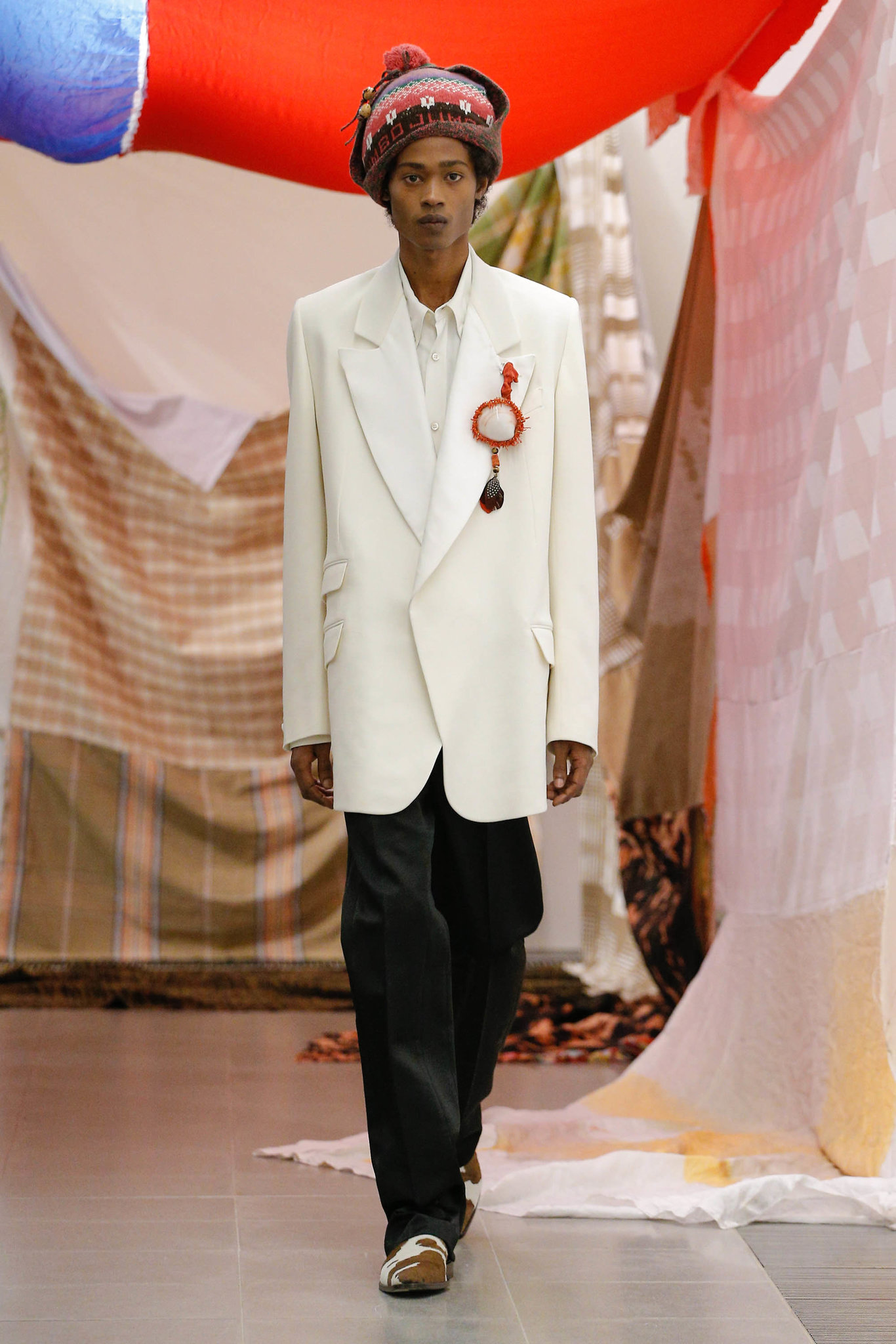
The economic profile of Wales Bonner as a designer is unusual in its structure. The label operates at a relatively small production volume, maintaining the craft integrity and limited distribution that are fundamental to its identity. But its commercial footprint is disproportionately large, driven by high-profile collaborations, major institutional recognitions, and a wholesale network that places Wales Bonner in the most prestigious retail environments globally.
UK retail is anchored at Selfridges, Browns Fashion, and Net-a-Porter, with Dover Street Market providing global flagship positioning. Internationally, the label is stocked at SSENSE, 10 Corso Como, Joyce, and through SSENSE’s US and European operations. The wholesale network spans the Americas, Europe, Asia, and Australia.
The adidas Originals collaboration series, spanning multiple seasons and including trainer colourways, apparel, and accessories, gave Wales Bonner access to a mass-market audience on a scale unlike the label’s core distribution. The Wales Bonner x adidas Samba, with its handwoven West African textile upper, was one of the most discussed sneaker releases of the year, selling out globally and generating secondary-market demand that reflected the brand’s cultural authority. The collaboration is significant not only commercially but as a model: luxury craft and intellectual seriousness applied to a mass-market product at the point of the collaboration, not diluted by it.
The institutional recognition has been consistent and cumulative. International prize recognition in 2016 provided both a financial award and the institutional credibility that accelerated the label’s position in the global wholesale market. The BFA Emerging Menswear Designer award in 2015 and the CFDA International Men’s Designer of the Year award in 2021 placed Wales Bonner within the institutional frameworks of both British and American fashion, extending the label’s reach across both markets.
The V&A exhibition in 2023 and the MoMA New York exhibition brought Wales Bonner’s work into the museum economy. Museum exhibitions in the fashion context are economically significant: they generate press coverage, attract buyers and collectors, and position a label’s work as heritage rather than merely a current product. Wales Bonner’s work is in permanent collections. This is a form of economic value that compounds over time.
If the reported Hermès appointment is confirmed, it would represent a qualitative shift in economic scale and visibility. Hermès is among the highest-value luxury houses in the world by market capitalisation, with a global distribution network and a client base at the apex of luxury spending. Any creative role there would place Wales Bonner’s design intelligence at the centre of an operation with reach far beyond what her eponymous label can access alone.
The Wales Bonner Foundation’s grant programme represents a further economic dimension: a reinvestment of institutional success into the Black British creative community, creating a pipeline of funded creative practice that extends Wales Bonner’s economic impact beyond her own label.
ALSO READ
- Martine Rose: The British-Jamaican Designer Rewriting the Rules of Menswear
- Investing in Textile Heritage: The Business Case for Preserving What Western Fast Fashion Cannot Copy
- Clothing as Cultural Identity: When Dressing Becomes Declaration
- The Governance Gap: Why Investors Pass on African Fashion
Where to Buy Grace Wales Bonner in the UK

Grace Wales Bonner is available in the UK at Selfridges (in-store and online), Browns Fashion (Brook Street and online), Net-a-Porter (online, with regular new-season drops), and Dover Street Market London (in-store, Haymarket). The official Wales Bonner website at walesbonner.net carries the full collection with international shipping to the UK.
Price points for the ready-to-wear collection range from approximately 250 pounds for accessories and small leather goods to 1,200 pounds and above for tailored outerwear and structured knitwear. Adidas x Wales Bonner collaboration pieces are available through adidas and selected stockists at premium trainer prices, typically 120 to 250 pounds.
What to Watch
The most significant development on the Wales Bonner horizon is the reported appointment to a senior creative role at Hermès. Industry sources linked her to the position in late 2025. If confirmed, the first work produced under that arrangement would likely appear in the Paris men’s fashion week calendar. Watch for official announcements from Wales Bonner and Hermès for the definitive timeline.
Before any Hermès-related work, Wales Bonner is expected to continue presenting her eponymous label at London Fashion Week. Also watch for further adidas x Wales Bonner collaboration releases, which continue to sell out quickly and generate significant secondary-market activity.
The Wales Bonner Foundation will continue to announce grant recipients annually. Following the Foundation’s output is one of the best ways to track the next generation of Black British creative talent that Wales Bonner’s institutional success helps sustain.
FAQs
Who is Grace Wales, Bonner?
Grace Wales Bonner is a British-Jamaican fashion designer, born in South London in 1992, who founded her label Wales Bonner after graduating from Central Saint Martins in 2014. She is known for collections rooted in Afrocentric scholarship, Caribbean diaspora identity, and luxury craft, recognised with the BFA Emerging Menswear Designer award and the CFDA International Men’s Designer of the Year. Industry reporting in late 2025 linked her to a senior creative role at Hermès.
Where can I buy Grace Wales Bonner in the UK?
Wales Bonner is available in the UK at Selfridges, Browns Fashion, Net-a-Porter, and Dover Street Market, London. The official Wales Bonner website at walesbonner.net ships internationally to the UK. Adidas x Wales Bonner collaboration pieces are available through adidas and selected stockists. Check the official channels for any future availability regarding the reported Hermès role.
What is the Wales Bonner Foundation?
The Wales Bonner Foundation, established in 2022, is a grant programme for Black creative practitioners in the United Kingdom, supporting artists, writers, musicians, and designers across the cultural sector. It functions as infrastructure rather than charity: a mechanism for sustaining the creative community that produced the cultural knowledge Wales Bonner’s practice draws on, and a reinvestment of her institutional success into that community.
What is Grace Wales Bonner’s connection to Hermès?
In late 2025, industry reporting began linking Wales Bonner to a senior creative role at Hermès, the French luxury house. The details and official terms of any such role had not been publicly confirmed at the time of publication. Any appointment would be historically significant, given Wales Bonner’s practice and the cultural weight of the house. Check official communications from Wales Bonner and Hermès for confirmed details.
What collections is Grace Wales Bonner known for?
Key Wales Bonner collections include Africa (2014 graduation collection that launched the label), A Love Supreme (SS22, referencing John Coltrane and Black spiritual music), and Duality (FW23, bringing Jamaican Rastafari and Sufi philosophy into conversation). Each is built around specific scholarly research, produced in collaboration with artisans, musicians, and cultural practitioners. The adidas x Wales Bonner Samba and Spezial colourways in West African textiles are among the label’s best-known products.
CONTINUE READING
Martine Rose: The British-Jamaican Designer Rewriting the Rules of Menswear