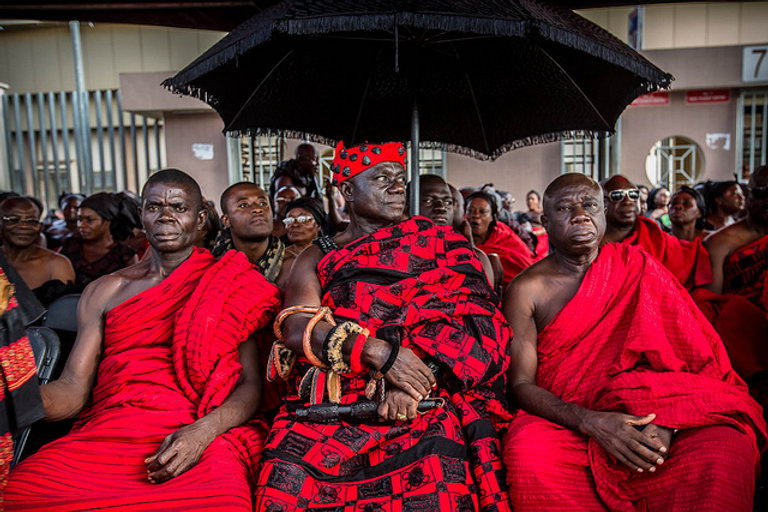
A Ghanaian funeral is not a spectacle. It is a system of cloth, colour, movement, and communal meaning. It can cost a significant amount in Ghanaian cedis, depending on the family, the region, and the deceased’s social standing. The final cost is usually decided by relatives, who set the scale of the cloth, tailoring, catering, music, announcements, and any fantasy coffin. That spending is not excessive for its own sake. It is how Ghana marks death as a transition, a communal duty, and a final public statement of identity.
Funerals begin before the burial. The one-week celebration, or Nnawotwe da, confirms arrangements and sets the tone. Billboards appear. Musicians are booked. Fabrics are chosen. Tailors begin work. By the time the funeral takes place on Saturday, the community is already speaking through dress.
The phrase Ghanaian funeral fashion tradition does not describe a side detail of mourning. It names the ceremony itself.
Ghanaian funerals are not a spectacle. The colour of every mourner’s cloth, the shape of every coffin, the dance of every pallbearer carries a complete theology of death.
The language of cloth
In Ghanaian funeral practice, colour is a grammar. The cloth worn by mourners tells the community how closely they knew the deceased, how they understand the death, and what they believe about the passage into the ancestral realm.
As SevenPonds’ documentation of Ghanaian funeral fabrics confirms, red and black worn together signal intimate grief, usually for immediate family. White and black express sorrow and gratitude at the same time. White alone, worn when the deceased was elderly, marks a life completed in honour. On the final Sunday of the funeral rites, white is often worn by all mourners to show that the deceased has crossed over successfully.
This is the heart of the meaning of Ghana funeral colours. The cloth is not only decorative. It is a public code of mourning.
Red alone carries the deepest personal grief. Black alone signals a less intimate form of mourning. White alone says something different again. It says life was long, the journey was complete, and death is not the end of the story.
Funeral cloth as a statement
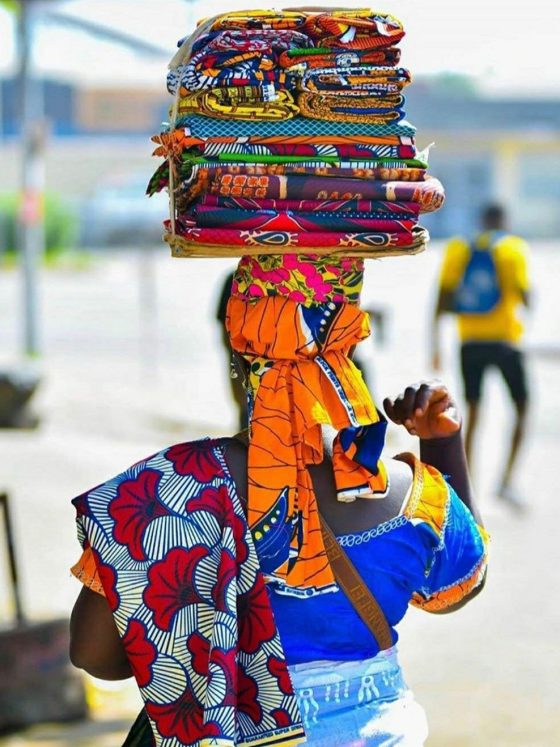
The Akan term eyie ntomaa means funeral cloth. It refers to the patterned fabric chosen for a particular funeral and worn by those who wish to align themselves with the family and the occasion’s meaning.
As Zedi Ghana’s documentation of funeral cloth traditions confirms, many of these fabrics carry names and meanings. That means mourners are not only choosing a colour. They are choosing a text to wear. The family selects the pattern, the mourners wear it, and the wider community reads it immediately.
This is why eyie ntomaa funeral cloth matters as a search phrase and as a cultural idea. Cloth here is both material and message.
The kaba and slit economy
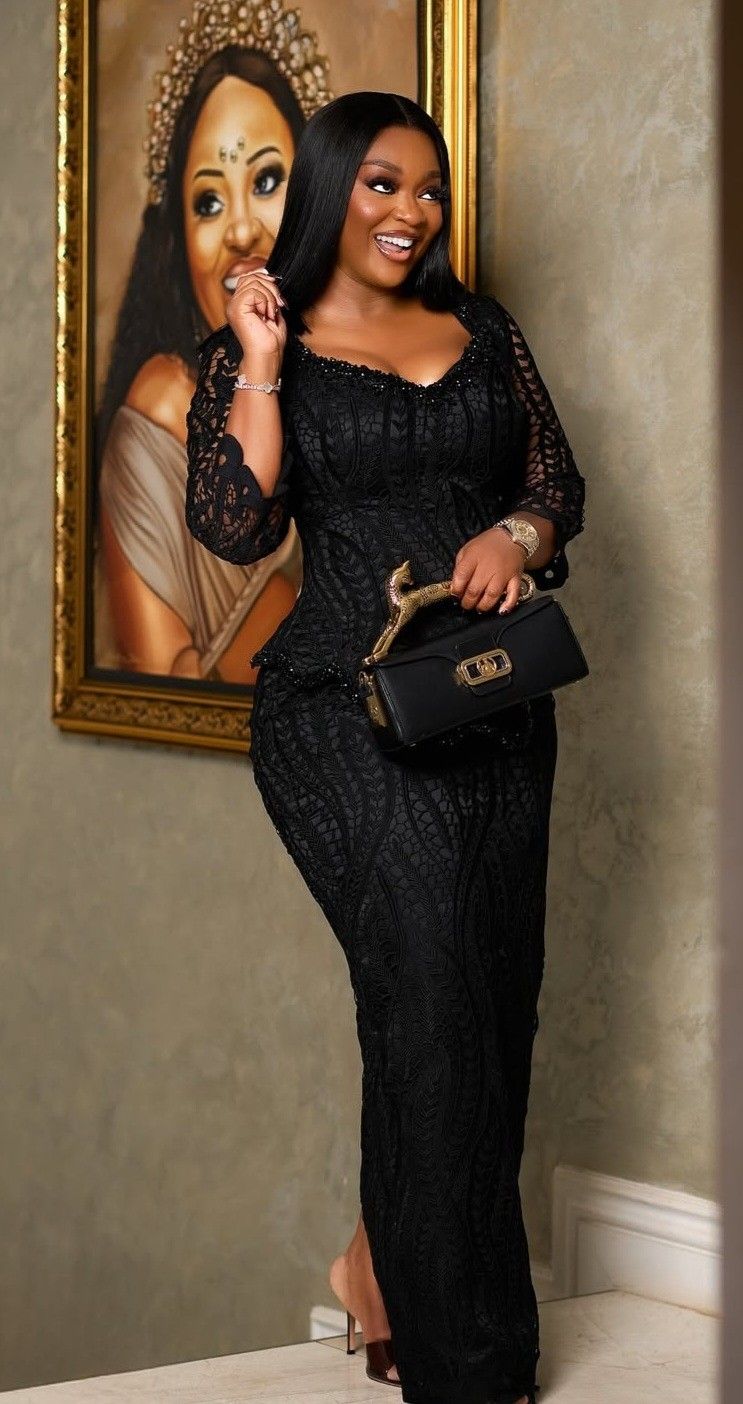
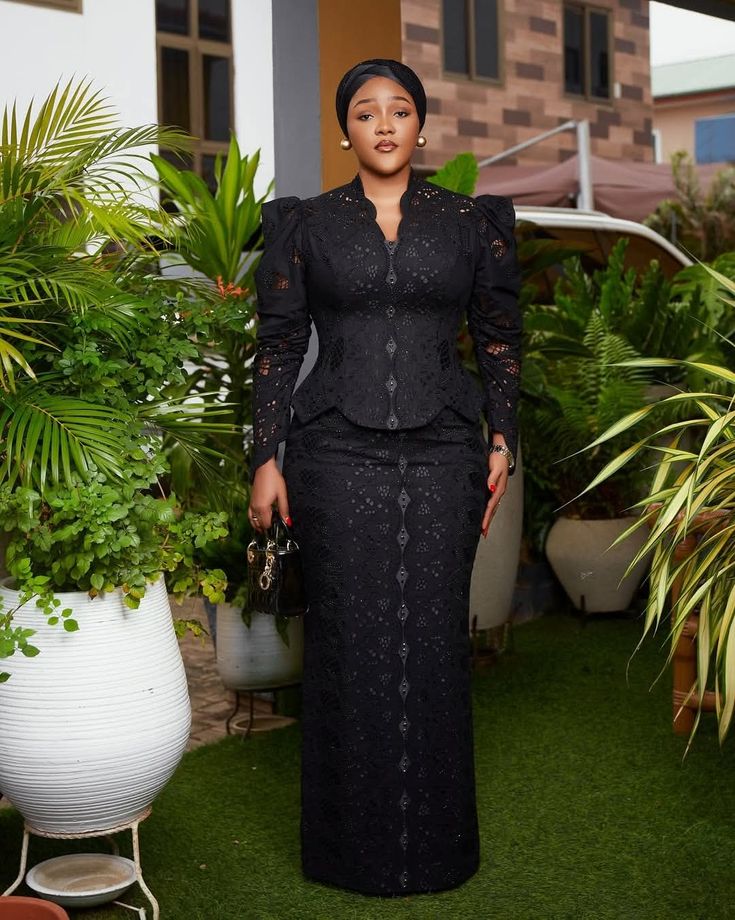
The most common women’s funeral outfit in Ghana is the kaba and slit, a fitted blouse and matching wrap skirt usually made from the selected funeral fabric. It is where textile culture, tailoring, and the mourning economy meet.
When dozens or hundreds of mourners need garments in the same cloth, the funeral creates work for tailors, fabric sellers, dressmakers, and accessory makers. As Madison Manor’s documentation of Ghanaian funeral traditions confirms, the scale of the event is often substantial, with costs shaped by family choice and the size of the gathering.
The Ghana funeral dress economy is therefore real and sustained. A funeral not only absorbs money. It moves money through local hands. That is why the event is both ceremonial and commercial.
Coffins as proverbs
The most visually radical expression of Ghanaian funeral culture comes from the Ga people of Greater Accra, whose fantasy coffins are known as abebuu adekai, or proverb boxes. The name is exact. A coffin here is not a neutral container. It is a public statement about the person inside it.
As Young Pioneer Tours’ documentation of Ghana fantasy coffins confirms, the tradition is traced to carpenter Seth Kane Kwei of Teshie in the early 1950s. One of his early famous commissions was a cocoa-pod-shaped palanquin later used as a coffin. Another was a plane-shaped coffin made for his grandmother, who had always wanted to fly.
A coffin shaped like a fish says something about a fisherman. A coffin shaped like a microphone says something about a performer. A Mercedes-Benz coffin says something about aspiration and status. In each case, the coffin becomes the final public portrait of the dead.
This is why Ghana’s fantasy coffins are now recognised worldwide as one of the most original funerary art forms.
From local practice to global art
Kane Kwei’s workshop in Teshie laid the foundation for a tradition that continues through artists such as Paa Joe, formally Joseph Tetteh Ashong. As the East-West News Service’s documentation of the tradition confirms, his work has been exhibited internationally and held in major museum collections, including the British Museum, the Brooklyn Museum, the Royal Ontario Museum, the Museum of Fine Arts in Boston, and the National Museum of Ethnology in Osaka.
That recognition matters, but it should not be mistaken for the origin of the tradition. The coffins were meaningful long before museums collected them. They were already functioning as social commentary, spiritual passage, and identity in the communities that produced them.
The animal rule is especially revealing. Lion, eagle, and elephant coffins are reserved for chiefs. In other words, the shape of the coffin is part of the social hierarchy. Death does not erase rank. It clarifies it.
Dancing pallbearers and theology
When the dancing pallbearers of Ghana began to draw international attention around 2012, many outsiders treated the practice as pure entertainment. They saw choreography, surprise, and spectacle. What they missed was the theology.
The movement of the pallbearers expresses a central Ghanaian understanding: death is not an end but a transition. The community does not simply grieve the loss of the person. It sends the person onward. The dancing, therefore, becomes part of the ritual logic of departure. It does not deny sorrow. It places sorrow alongside honour, rhythm, and release.
The viral fame of the dancers turned a funerary practice into a global meme, but the practice itself stayed rooted in belief. The dance says that death is a passage, and the community has a role in guiding it properly.
Also Read:
- The Significance of White in African Mourning: Why the Continent’s Grief Dress Is Not What the West Assumes
- The Language of Adinkra: When Cloth Becomes Scripture
- Lesotho’s Basotho Blanket: The Story of a Colonial Trade Good That Became a Symbol of Sovereignty
Faith, ancestry, and public mourning
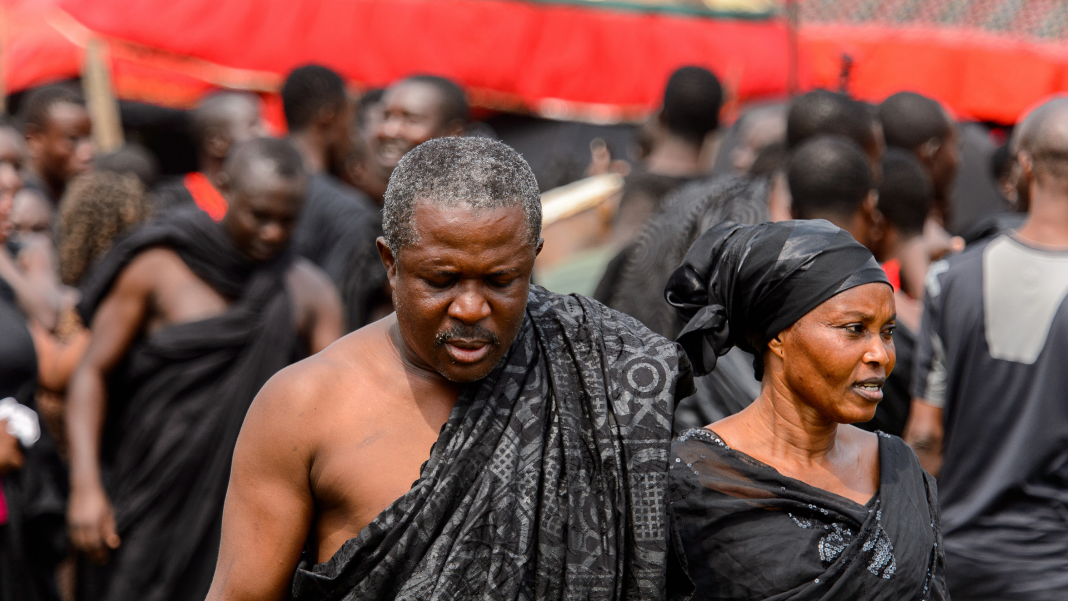
Ghana is majority Christian, but traditional spiritual frameworks remain deeply influential in funeral life across religious communities. The ancestors are treated not as abstractions but as active members of the moral world. A funeral is the ritual that allows the deceased to join the community properly.
This is why the event can hold grief and celebration together without contradiction. The cloth, the coffin, the music, the dance, the billboards, the public attendance, and the cost all work towards the same end. They mark a crossing. That is why the phrase “Ghanaian funeral fashion tradition” captures more than just appearance. It describes a social theology in the form of fabric, movement, and ritual.
Why the world misreads it
International coverage often describes Ghanaian funerals as colourful, extravagant, or unusual. Those words are not wrong, but they are incomplete. They focus on the surface and ignore the system beneath it. The cloth is selected with meaning. The coffin is shaped with meaning. The dance is choreographed with meaning. Even the cost has meaning, because it reflects the value placed on communal honour.
The African fashion market is worth 31 billion dollars, but figures like that only matter when the cultural systems behind them are understood. Ghanaian funeral culture is part of that economy because it sustains textile production, tailoring, carpentry, accessory making, music, and event organisation. It is not a fringe curiosity. It is a major creative economy in motion.
That is why funeral culture belongs inside serious fashion coverage. It is not about costume. It is about how communities encode status, grief, belief, and memory through clothing.
The Omiren argument
Ghanaian funerals are among the most serious fashion events in West Africa because they are grounded in the belief that cloth speaks. Red, black, and white are not decorations. They are codes for grief, respect, and transition. Eyie ntomaa is not a fabric detail. It is a public statement. The kaba and slit are not just women’s styles. It is the standard form in which the funeral’s meaning appears on the body. Abebuu Adekai are not novelty coffins. They are proverbs in three dimensions.
The Language of Adinkra: When Cloth Becomes Scripture, The Significance of White in African Mourning: Why the Continent’s Grief Dress Is Not What the West Assumes, and Lesotho’s Basotho Blanket: The Story of a Colonial Trade Good That Became a Symbol of Sovereignty all sit in the same intellectual lane. They show that African dress systems are not ornamental add-ons to life. They are one of the ways communities think.
That is the argument Omiren Styles exists to make. Ghanaian funeral fashion is not a side story. It is a central African fashion system, and one of the clearest demonstrations that clothing can carry theology, economy, and identity at once.
Frequently asked questions
What do Ghanaians wear to funerals and why?
Ghanaian funeral dress follows a colour system in which red, black, and white communicate grief, relationship, and theological meaning. Families also choose a specific cloth pattern, and mourners wear it to show their connection to the deceased and the family.
What does the colour system at a Ghanaian funeral mean?
Red alone signals intense grief. Red and black together signal intimate mourning. Black alone signals deep mourning. White alone is worn when the deceased was elderly, while white on the final Sunday signals the community’s assurance that the spirit has crossed over successfully.
What are Ghanaian fantasy coffins?
They are custom coffins, known in Ga as abebuu adekai, made in shapes that reflect the deceased’s life, status, or aspirations. They are widely recognised as a major form of funerary art.
Who invented the dancing pallbearers in Ghana?
The practice emerged around 2012 and became internationally famous when coffin-bearing turned into part of funeral processions. It reflects a Ghanaian view of death as a transition rather than termination.
How much does a Ghanaian funeral cost?
A Ghanaian funeral can cost a significant amount in Ghanaian cedis. The final cost usually depends on the family, the region, and the social standing of the deceased, as well as the scale of the cloth, tailoring, catering, music, announcements, and any fantasy coffin.
Explore more
Read the full Culture > Heritage & Identity section at Omiren Styles for documentation of the dress traditions, textile systems, and ceremonial practices through which African communities communicate who they are, what they believe, and what they owe the dead.