Uganda’s olubugo is not a heritage textile awaiting commercial discovery. It is a living Baganda royal craft tradition with named custodians, a specific tree, a seasonal production process documented by UNESCO, and a clear lineage from the 12th century through to the Kabaka’s coronation ceremonies of the present day. The question the industry is now attempting to answer is whether the institutional recognition that heritage provides can be converted into economic value through a geographical indication, and whether that value will return to the Ngonge Clan producers and Mutuba tree growers who constitute the practice’s living base.
The African fashion market is worth 31 billion dollars. Uganda’s barkcloth sits within that market as one of the most distinctively characterised and most specifically provenance-linked textile traditions on the continent. In May 2026, Uganda’s Registration Services Bureau took the first formal step toward protecting that provenance through geographical-indication registration. The GI process is not complete. The commercial outcome is not yet known. As Omiren Styles’ documentation of African sacred textiles, including barkcloth, confirms, barkcloth is one of the traditions that the world is finally beginning to take seriously. Whether taking it seriously translates into taking it fairly is the question the GI process must answer.
Uganda’s olubugo barkcloth has UNESCO recognition and a 2026 GI registration in progress. The question the industry must now answer is whether protection becomes value.
What Uganda’s Barkcloth Is and Why Origin Matters
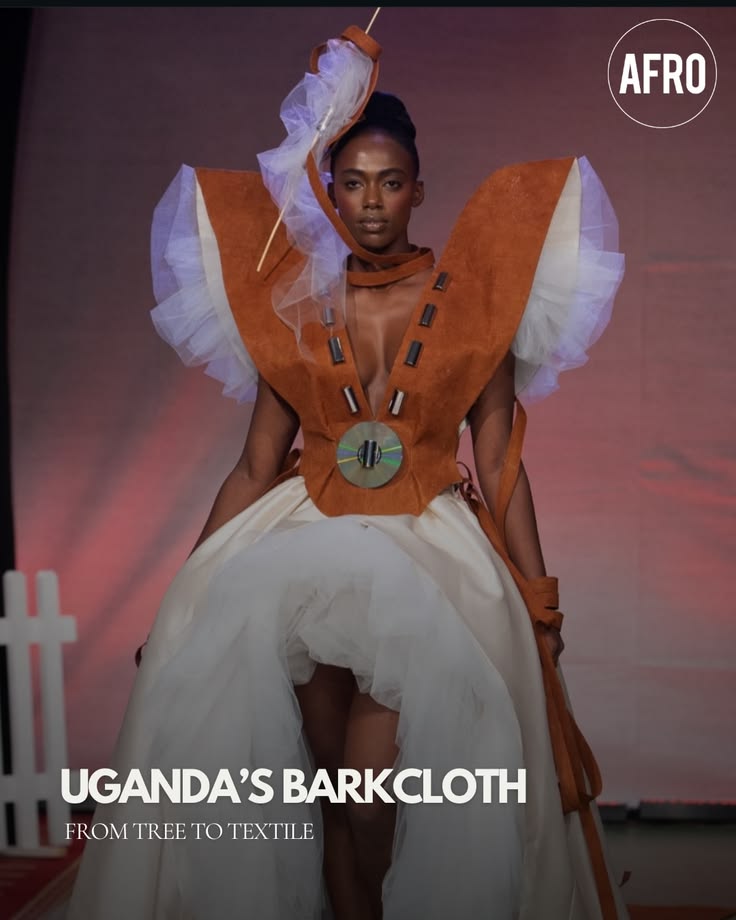
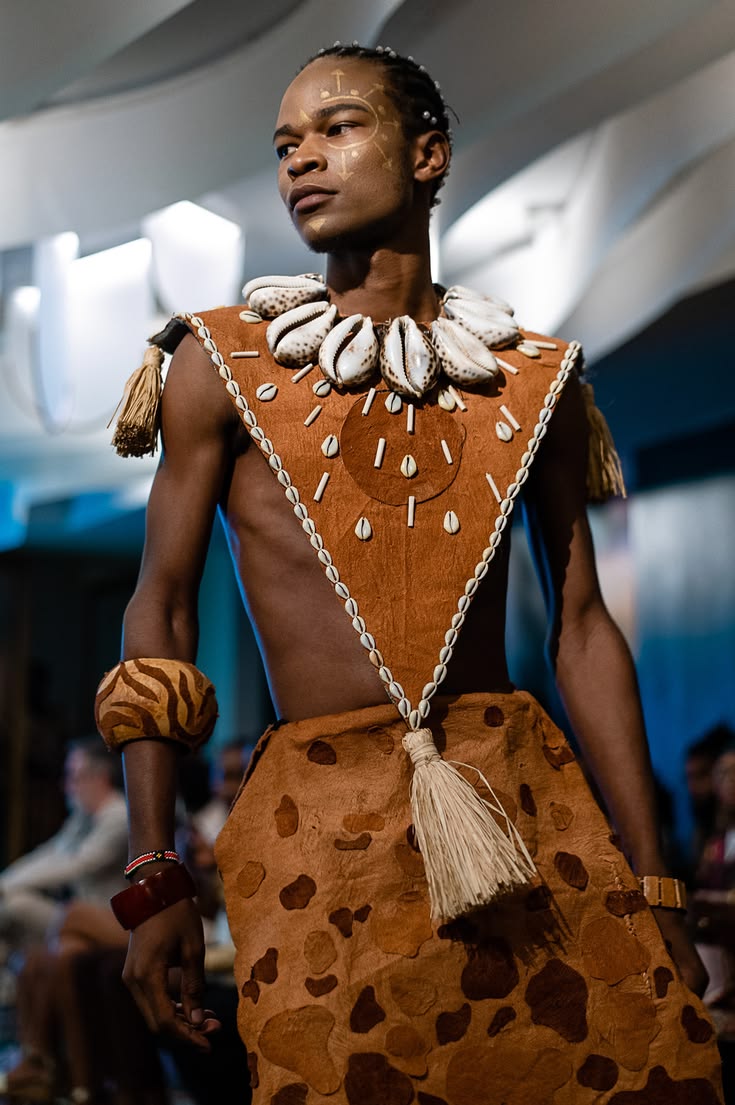
Olubugo is the Luganda name for barkcloth as produced by the Baganda people in the Buganda Kingdom of southern and central Uganda. As UNESCO’s Representative List inscription for barkcloth making in Uganda confirms, the Ngonge Clan’s hereditary artisans, led by the kaboggoza, have traditionally produced barkcloth for the Baganda royal family and wider community through a technique that predates the invention of weaving, making it one of humanity’s earliest surviving textile-making methods. The production process is entirely specific: the inner bark of the Mutuba tree, Ficus natalensis, is harvested during the wet season and beaten with hardwood mallets in a long, laborious process that produces a soft, fine cloth with a consistent terracotta colour.
The Ngonge Clan’s connection to barkcloth production is not only ancestral. It is actively royal. The URSB’s May 2026 engagement documentation confirms that the Ngonge Clan is credited with inventing barkcloth between the 13th and 14th centuries, with Wamala of the Ngonge Clan identified as the originator of the technique, discovered while hunting in Mawokota County in Buganda. The kaboggoza, the hereditary chief craftsman of the Ngonge Clan, still produces the Luyiira, the specific barkcloth worn by the Kabaka at coronation ceremonies. The production tradition is therefore not a historical artefact. It is an active royal responsibility.
The Ngonge Clan has been producing barkcloth for the Buganda royal family since the 12th century. Wamala of the Ngonge Clan is credited with inventing the technique. The kaboggoza still makes the Luyiira barkcloth worn by the Kabaka at coronation. That is not heritage in need of branding. That is a living royal responsibility that requires economic infrastructure.
What UNESCO Recognition Protects and What It Does Not
UNESCO proclaimed barkcloth making in Uganda a Masterpiece of the Oral and Intangible Heritage of Humanity in 2005 and inscribed it on the Representative List in 2008. The inscription recognises and supports the safeguarding of the knowledge, skills, processes, and cultural significance of the barkcloth-making practice. It identifies the Ngonge Clan and the kaboggoza as custodians and documents the seasonal production process and the Mutuba tree as the specific material foundation of the craft.
What UNESCO recognition does not do: it does not create a trademark on the name olubugo or barkcloth. It does not certify individual products. It does not establish an export price. It does not prevent non-conforming material from being sold as barkcloth in commercial markets. A product labelled Uganda barkcloth that was not made by the documented process with Mutuba bark by Buganda producers bears no direct relationship to what UNESCO recognised, and no legal mechanism currently prevents that substitution.
This is the commercial gap the GI registration process is designed to address. A geographical indication attaches enforceable standards of origin and production to a product name. If Olubugo is registered as a GI, producers whose barkcloth meets the GI specification would be legally entitled to use the protected designation; products that do not meet the specification could not claim it. The economic logic is that a verifiable, protected provenance claim can support a higher price and greater market confidence in the authenticity of what buyers receive.
The GI Registration: What May 2026 Actually Established

On 7 May 2026, URSB held an engagement with artisans and producers from the Ngonge Clan in Bweza, Busujju, led by Michael Wabugo, Senior Registration Officer in URSB’s Intellectual Property Department. As the URSB’s official documentation of the engagement confirms, the meeting aimed to support the registration of Olubugo as a Geographical Indication, a move intended to protect its unique cultural identity, origin, and traditional value. Participants resolved to begin the GI registration process immediately, and the Ngonge Clan agreed to establish and formally register an entity to represent artisans and producers throughout the registration process and the product’s future management.
This is a significant institutional commitment, not a completed process. The GI registration has been initiated, not approved. What has been established is a decision to pursue protection and an agreement to create the producer entity that will govern the GI once it is approved. The substantive work of defining the GI specification, establishing the geographical boundary, setting the quality and process standards, and building the inspection and certification system that gives the GI commercial credibility lies ahead.
URSB’s GI framework makes explicit what the protection would achieve. As URSB’s geographical indications documentation confirms, a GI protects products whose qualities or reputation are linked to their place of origin. It helps prevent the misuse of protected names by products that do not meet the prescribed standards. For Olubugo, a GI would mean that only barkcloth made according to the registered specification, by registered producers in the designated geographic area, could legally be sold under the protected designation.
The Production Process and the Mutuba Tree
The Mutuba tree’s role in barkcloth production is not interchangeable. The inner bark of Ficus natalensis is the specific material from which olubugo is made. As TDSBlog’s 2018 documentation of Uganda barkcloth production confirms, the traditional harvest process does not fell the tree. The Mutuba tree can be harvested over several years, with bark regenerating between harvests when trees are properly managed. To prevent the bark from drying too quickly, artisans work in an open shed during the beating process. The Buganda region’s extensive Mutuba planting historically supported the tradition’s scale, with barkcloth production present in almost every village of the Buganda Kingdom at its peak.
The regenerative nature of the Mutuba harvest is central to barkcloth’s ecological positioning in contemporary sustainability conversations. A material whose primary raw material is harvested without killing the plant and whose production cycle is calibrated to allow regeneration is structurally different from most industrial textile raw materials. Whether this translates into commercial premium depends on buyers who value it, verification systems that confirm it, and management standards that ensure the regenerative cycle is maintained at production scale rather than only in small-batch demonstrations.
Contemporary applications for olubugo have moved beyond the toga and ceremonial cloth of the tradition’s royal origins. Documented uses now include wall coverings, curtains, wallets, bags, bedding, storage wares, and slippers, as well as interior design applications and composite material research. The Bukomansimbi cooperative in Kalisizo, documented in published research, represents one of the organised producer models through which barkcloth has moved toward structured commercial production. These applications demonstrate that the material can be used in contemporary markets. They do not yet establish what price those markets will sustain for verified Olubugo as distinct from generic barkcloth.
Verified Conditions and Open Questions
Verified conditions (sourced):
UNESCO recognition: barkcloth making in Uganda proclaimed 2005, inscribed 2008.
Ngonge Clan: documented custodians with royal responsibility for kaboggoza and Luyiira production.
Mutuba tree (Ficus natalensis): documented as the specific raw material; harvest without felling; regeneration possible with proper management.
URSB GI engagement: 7 May 2026, initiation of registration process confirmed.
Contemporary applications: wall coverings, interior design, accessories documented.
Open market questions (unresolved):
What price premium, if any, do buyers currently pay for traceable Olubugo versus generic barkcloth?
How many producers would qualify under the GI specification, and what production capacity do they collectively represent?
What boundary, quality standards, process specifications, and inspection system will the GI establish?
Which fashion, interiors, or architecture markets have repeat demand at margins that sustain artisan livelihoods?
How will GI value be distributed between Ngonge Clan makers, Mutuba tree growers, processors, and exporters?
What GI Protection Would and Would Not Do
A GI for Olubugo would provide a legal mechanism to protect the product name from misuse. Producers meeting the GI specification could use the protected designation; products that do not meet the specification could not use it. This creates the commercial infrastructure for a credibility-based premium: buyers who want verified Olubugo would have a legally enforced standard to trust.
What the GI would not do: it would not create buyer demand where it does not exist. It would not set an export price. It would not automatically deliver UNESCO recognition as a luxury marketing asset. It would not guarantee that the financial return from a higher price reaches the Ngonge Clan producers and Mutuba growers who constitute the practice’s living foundation. As Omiren Styles’ analysis of who benefits when African craft appears on a luxury runway confirms, the relationship between an African craft tradition’s recognition of heritage and the economic return to the community whose knowledge and labour produced it is not automatic. A GI is a legal tool. Its value depends on what the designated producer community does with it, whether the specification is rigorous, whether buyers are educated about its meaning, and whether the commercial models built around it distribute value to the people who produced the craft rather than only to those who market it.
The Omiren Argument
Uganda’s olubugo barkcloth is not a heritage material waiting to be discovered by the luxury fashion industry. The African fashion market is worth 31 billion dollars. The Ngonge Clan of the Buganda Kingdom invented the barkcloth-making technique, has been producing it for the Buganda royal family since the 12th century, and still provides the Luyiira for the Kabaka’s coronation. UNESCO recognised the practice in 2005 and inscribed it in 2008 as one of humanity’s earliest surviving textile-making techniques. In May 2026, URSB and Ngonge Clan producers initiated GI registration, choosing to pursue the legal protection tool that could make UNESCO’s cultural recognition commercially enforceable. This is the most significant institutional development in Uganda’s barkcloth industry in the current period. It is a decision to begin a process, not a completed commercial transformation. The premium market claim, the export value story, and the sustainability positioning all depend on what happens next: whether the GI specification is rigorous, whether the producer entity is representative of the Ngonge Clan and associated growers and processors, whether buyers are educated about the distinction between certified Olubugo and non-conforming barkcloth, and whether the economic value generated by the designation returns to the community that holds the knowledge this designation is built on.
Also Read:
- Why Global Fashion Keeps Returning to the Same African Craft Traditions
- Bogolan Is Not Mud Cloth: Why the Name Matters and Who Benefits From Getting It Wrong
- African Textile Glossary: 20 Terms Fashion Keeps Getting Wrong
- Afro-Peruvian Women’s Chincha Dress: Clothing, Dance, and Cultural Memory
Frequently Asked Questions
What is olubugo Uganda barkcloth?
Olubugo is the Luganda name for the barkcloth produced by the Baganda people of the Buganda Kingdom in southern and central Uganda. It is made from the inner bark of the Mutuba tree (Ficus natalensis), harvested during the wet season without felling the tree and beaten with hardwood mallets in a process that predates the invention of weaving. The resulting cloth has a soft, fine texture and a consistent terracotta colour. UNESCO proclaimed barkcloth making in Uganda a Masterpiece of the Oral and Intangible Heritage of Humanity in 2005 and inscribed it on the Representative List in 2008. Traditionally, artisans of the Ngonge Clan, led by the hereditary chief craftsman known as the kaboggoza, produced olubugo for the Buganda royal family and wider community.
What is the current GI status of Uganda barkcloth?
As of August 2026, Uganda’s barkcloth (Olubugo) is in the initiation stage of geographical indication registration. On 7 May 2026, URSB held an engagement with Ngonge Clan artisans and producers in Bweza, Busujju, to support GI registration. Participants resolved to begin the process immediately, and the Ngonge Clan agreed to establish a formally registered entity to represent producers throughout the registration process and in future management. The GI registration has been initiated, not approved. No GI certification currently exists for Olubugo.
What did UNESCO recognise about Uganda barkcloth?
UNESCO recognised barkcloth making in Uganda as a living intangible cultural heritage practice of the Baganda, and inscribed it on the Representative List in 2008 following a 2005 proclamation as a Masterpiece of Oral and Intangible Cultural Heritage. The recognition identifies the Ngonge Clan and the kaboggoza as traditional custodians and documents the Mutuba tree-harvesting and beating process as a technique predating weaving. UNESCO recognition supports safeguarding of the practice; it does not certify individual products, establish an export price, or create a trademark on the name olubugo or barkcloth.
Who makes Uganda barkcloth?
Barkcloth production in Uganda is traditionally the responsibility of the Ngonge Clan of the Buganda Kingdom, credited with inventing the technique between the 13th and 14th centuries. The kaboggoza, the Ngonge Clan’s hereditary chief craftsman, produces the Luyiira barkcloth worn by the Kabaka at coronation ceremonies. Production was historically widespread across the Buganda Kingdom with workshops in almost every village. Contemporary production includes organised cooperatives, such as the Bukomansimbi cooperative in Kalisizo, documented in 2018, as well as individual producers and the Ngonge Clan’s continuation of the traditional craft.
Can Uganda barkcloth command a premium price?
Potentially, but no public evidence currently establishes a premium export price for certified Olubugo, distinct from generic barkcloth. A premium strategy would require: verified geographic origin confirmed through a GI specification; consistent quality standards; documented production capacity; buyer demand that values provenance over price; logistics capable of delivering consistent supply; and an economic model that returns the premium to Ngonge Clan producers and Mutuba growers rather than only to exporters or designers. UNESCO recognition provides a heritage narrative. GI registration, if completed, would provide legal protection for the name. Neither automatically creates buyer demand nor the market infrastructure required to sustain a premium.
Explore More
Read the full Fashion > Industry section for Omiren Styles’ documentation of African textile heritage, craft traditions, and the commercial and legal frameworks that determine whether cultural value returns to the communities that hold it.
Discover travel and heritage intelligence across Uganda and East Africa at Rex Clarke Adventures.