
The lookbook sells the feeling. The line sheet closes the order. Both matter, but they are not interchangeable. A buyer who receives a beautifully photographed lookbook has a document confirming the collection exists, and the aesthetic is coherent. A buyer who receives a line sheet has received the document that lets them actually buy it. Sending one when you need the other is the reason most post-show buyer conversations stall before they produce a purchase order.
The line sheet’s job is to answer every question a buyer needs answered before they can commit, in a single document they can download, print, share with their buying team and reference when they place the order. That is a specific task with specific requirements, and understanding those requirements is what separates a line sheet that produces orders from a formatted PDF that generates another email asking for more information.
As Makers Row’s 2026 guide to creating a line sheet confirms, a line sheet needs eight core elements, and skipping any one of them is the most common reason a buyer stalls on placing an order. Not the most common reason they decide not to order: the most common reason they delay a decision that was otherwise ready to be made. Incomplete information does not lose orders. It defers them until the buyer fills the information gap with a competitor who gave them everything they needed up front.
A line sheet is not a lookbook. It is the sales document that converts a buyer’s interest into an order. This guide covers every section a wholesale line sheet must contain and why each one matters for closing the sale.
Before You Build It: Get the Collection Fixed First
A line sheet built on a collection that is still changing will need to be rebuilt. Pricing changes when fabric costs change. The colourways change when the manufacturer confirms what is actually achievable. The delivery date changes when the production timeline shifts. Each change means a new version of the line sheet, and every version sent to a buyer before the collection is finalised creates the risk of a buyer ordering from an outdated document.
OnBrand’s guide to creating a professional fashion line sheet establishes the starting principle clearly: finalise your collection before building the line sheet. This means confirmed styles, fabrics, colourways, sizing range, pricing, production minimums, and a delivery window. If any of those is still under discussion with the manufacturer, the line sheet is premature. A buyer who receives a line sheet with provisional pricing or approximate delivery dates will ask for confirmation, wait for it, and potentially book another brand in the interim.
The preparation that goes into a reliable line sheet is the same preparation that makes a wholesale relationship reliable: knowing your costs, your minimums, your production timeline and your delivery capacity before you commit to them in a commercial document. A line sheet built on that preparation is a document a buyer can trust. A line sheet with estimates creates follow-up conversations rather than closing them.
The Eight Sections That Must Be There
1. Brand header and collection identity
The top of your line sheet tells the buyer exactly what they are looking at before they read a single product description. It carries your brand name, your logo, the season and collection name (Spring/Summer 2026, Autumn/Winter 2026, the collection title if it has one), and your primary wholesale contact: a name, an email address and, where relevant, a phone number. This is not decorative. A buyer who is reviewing twenty line sheets from twenty brands needs to be able to file, retrieve and reference yours by brand and season without opening the document. That information has to be clear from the header.
2. A product photo for every style
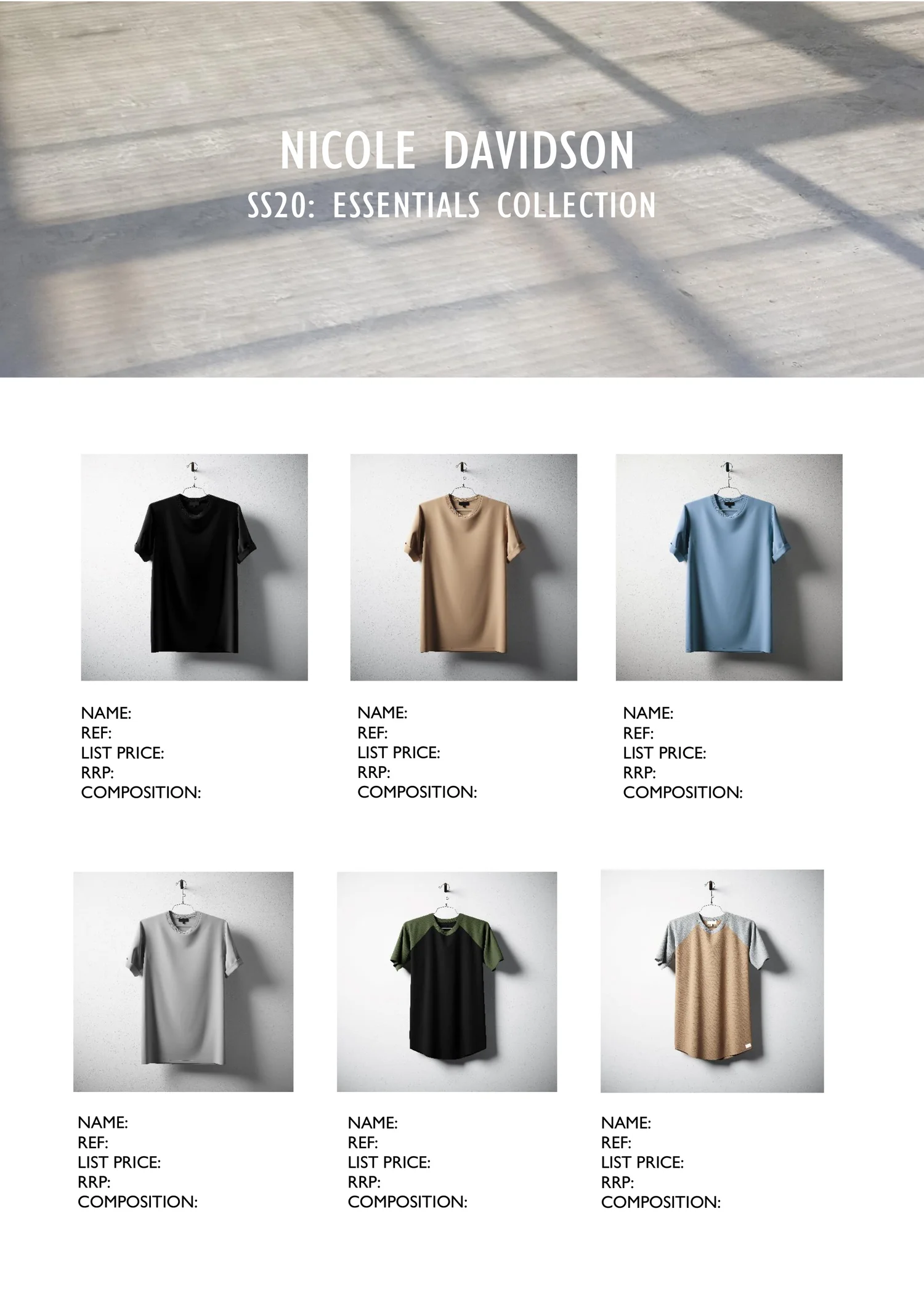
Buyers order from the image first. A product photograph against a white or neutral background, showing the garment’s silhouette, construction and surface detail clearly, is the image a buyer uses to assess whether the style suits their store’s customer. A lifestyle photograph is appropriate for a lookbook. A line sheet needs a product image that lets a buyer assess the garment’s commercial merits: shape, construction, proportions, and surface quality. Ghost mannequin images, where the garment is photographed on a shaped form that doesn’t appear in the final image, are standard for most contemporary wholesale line sheets. Flat lay images work for some categories. The test is whether the image gives the buyer enough information to decide whether to stock it.
3. Style number and product name
Every style needs a unique reference code. The style number is what the buyer puts on their purchase order, what the manufacturer uses for the production run, and what the delivery note references when the goods arrive. A line sheet without style numbers requires a follow-up email to identify which styles were ordered, adding a step between the buyer’s decision and the confirmed order. The style number system can be as simple as a sequential code (SS26-001, SS26-002) or as specific as a code that encodes the category and season. The only requirement is that every style has one and that the code is consistent across your line sheet, order form, and communication with the manufacturer.
4. Wholesale price and MSRP
These are two different numbers, and both belong on the line sheet. The wholesale price is what the buyer pays you for the units they order. The MSRP, or manufacturer’s suggested retail price, is the price the buyer is expected to sell the garment to customers. The buyer uses the relationship between the two to calculate their gross margin on the style: a buyer who cannot see both numbers cannot assess whether your pricing model works for their store’s margin requirements without sending you another email. Buyers calculate their margins immediately. If they cannot do that calculation from your line sheet, they move on to a brand whose line sheet makes it possible.
5. Available sizes and colourways
The size range tells the buyer how much of their customer base the style can serve. A womenswear style available in UK sizes 8 to 18 covers a different commercial proposition from the same style available in UK sizes 8 to 12. The colourway list tells the buyer which options they can choose from when building their order. Both need to be listed clearly for every style on the sheet. Where colourways have names rather than codes, include both: a buyer who loves ‘Midnight’ but needs to write it as a colour code on their purchase order needs that information on the document.
6. Minimum order quantity
The MOQ is the smallest number of units a buyer can order for a given style to make the order valid. This is the number that determines which buyers can realistically work with you. State it per style on the line sheet, not as a general note in the terms section at the back. A buyer building an order who doesn’t know each style’s minimum until they reach the terms page may build an invalid order and have to rebuild it. The MOQ should be visible at the style level, not the document level.
7. Lead time and delivery window
Buyers plan their floor sets six to twelve months ahead. A line sheet without a delivery date is incomplete, because the buyer cannot assess whether your goods will arrive in time for the season they are buying for. The delivery window should state the earliest and latest dates goods can ship or arrive, using the correct reference point: ex-works (goods leave the factory), FOB (goods are loaded onto the vessel), or delivered duty unpaid or paid (goods arrive at the buyer’s facility). Buyers read an unstated Incoterm as the worst case, meaning they assume you are quoting the earliest point in the shipping process and add their own buffer for freight, customs, and final delivery. State the Incoterm explicitly to avoid that calculation working against you.
8. Payment terms and wholesale contact
Net 30 is the standard payment term for established wholesale accounts: the buyer has thirty calendar days from invoice date to pay. New supplier relationships typically require a deposit on order, with the balance due before shipping. State your terms on the line sheet. A buyer whose accounts team needs to know payment terms before approving a new supplier will not ask for them if you have provided them; they will approve the order or flag a query quickly. A buyer whose accounts team encounters an unstated payment term will assume their standard terms and create a reconciliation problem later. Avoid the problem by stating the terms up front. The wholesale contact, the name and email address of the person who handles buyer enquiries, belongs at both the top and bottom of the document. That way, it is findable no matter how the buyer navigates the sheet.
Pricing Accuracy Is Non-Negotiable
A line sheet with incorrect pricing can’t close a deal. If a buyer places an order based on an incorrect wholesale price, one of two things happens: the brand either honours the incorrect price and loses margin, or the brand revises the price and loses the buyer’s trust. Neither outcome is recoverable in the short term. Set pricing on a line sheet after the production cost is confirmed with the manufacturer, after freight and import duties are factored into the landed cost calculation, and after the margin calculation is done at the correct wholesale price, not a provisional estimate.
The line sheet is the commercial commitment that precedes the purchase order. Every number on it must be one the brand can stand behind when the order arrives. Pricing built on assumptions produces a line sheet that cannot survive contact with an order form.
Format, File Type and How to Send It
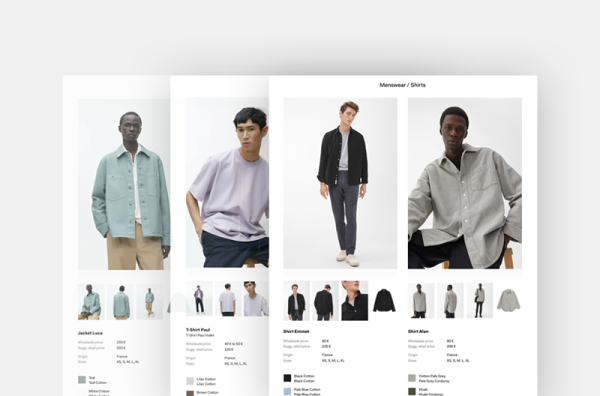
The PDF remains the standard format for wholesale line sheets. It is a file the buyer can download, print, share with their buying team and annotate without requiring any particular software. A digital line sheet on a branded platform has advantages, including the ability to update pricing and availability without reissuing the document. Still, PDF works across all buyer contexts without friction. Most wholesale outreach still happens via direct email, and buyers expect a file they can access offline.
The file should be named logically: Brand Name, Season, Line Sheet. A file called ‘Line Sheet Final v2 USE THIS ONE.pdf’ tells the buyer that the brand’s version control is not reliable. The file name is the first signal of commercial organisation that the buyer receives, before they open the document. Keep the file under 5MB so it moves through email without being blocked by attachment limits.
Include an expiry date for the pricing and availability information on the line sheet. A line sheet sent in October 2026 for a spring/summer 2027 season delivery should state that pricing is valid until a specific date, typically the order deadline for the season. This prevents a buyer from submitting an order in March 2027 based on October pricing that is no longer accurate.
After You Send It
As Omiren Styles has established in its buyer requirements analysis, follow-up after sending a line sheet matters as much as the document itself. A buyer who received your line sheet and has not placed an order within five business days is not a buyer who is not interested. They are a buyer who hasn’t yet answered their own internal questions: Does this work for our customer? Does our margin calculation work? Can we receive the goods within the delivery window? A follow-up email that offers to answer any questions and confirms your order deadline is the commercial communication that moves the conversation forward.
Track the questions that come back after each line sheet is sent. If three consecutive buyers ask the same question about your delivery window, add a clearer answer directly to the line sheet. If buyers consistently ask about your return policy on faulty goods, add it to the terms section. The line sheet improves each season because the questions it generates show what the document still hasn’t answered.
The gap between African fashion’s visibility and its revenue closes one buyer conversation at a time. A line sheet that gives a buyer everything they need to place an order without sending a follow-up email is the commercial document that makes each of those conversations as short and as productive as possible. Build it correctly once. Update it each season. Send it before the buyer asks for it. That commercial practice turns show coverage into wholesale orders.
ALSO READ
- A Line Sheet a Buyer Can Act On: The Information That Belongs Beside the Image
- What Buyers Need Before They Place an Order
- Could a Buyer Order This Collection? A Transparently Fictional Document Test
- African Fashion Has Visibility – But Where Are the Buyers?
- The Global South Made Fashion. It Just Never Got Credit.
Line Sheet Checklist
Brand identity and contact
- Brand name and logo at the top of every page
- Season and collection name (e.g., Spring/Summer 2027)
- Wholesale contact name and email address
- Order deadline date and pricing expiry date
Per style, for every style in the collection
- Product photograph (white or neutral background, clearly shows silhouette and construction)
- Style number and product name
- Available colourways with colour names and codes
- Available sizes stated in the correct size system for the target market
- Fibre composition (percentage breakdown)
- Wholesale price (in the buyer’s currency where possible)
- MSRP, or suggested retail price
- MOQ per style, stated at style level, not in the terms section only
- Delivery window with Incoterm stated explicitly
Terms section
- Payment terms (deposit percentage, balance timing, accepted payment methods)
- Return policy (faulty goods only is the standard in wholesale)
- Cancellation policy
- Reorder availability and lead time for reorders
- Country of manufacture and care label compliance statement