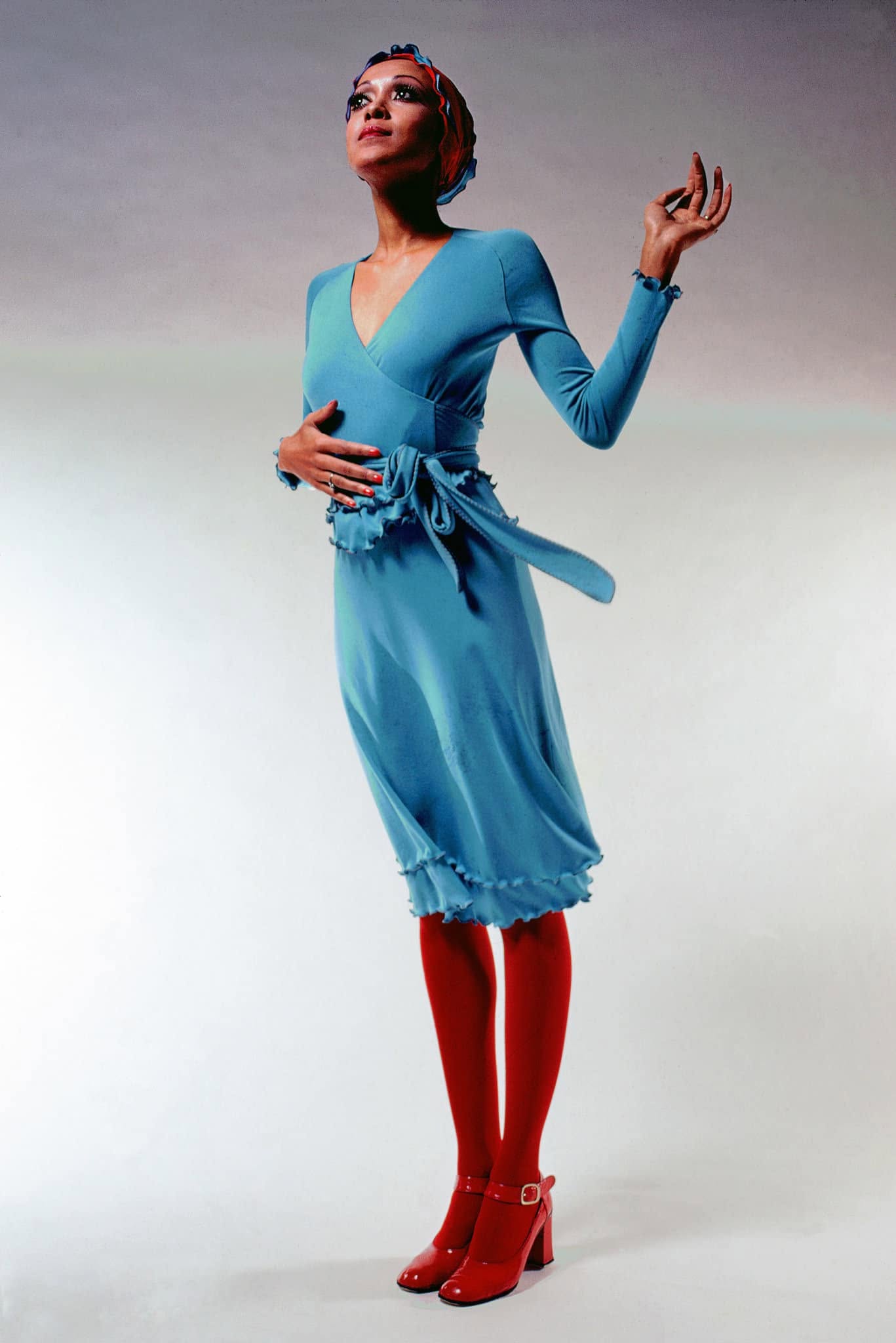
Blue sits above yellow, pink and black. An orange sash gathers the waist. The one-shouldered tunic and tiered skirt establish a composition in large areas of colour. Still, their boundaries introduce a smaller, more restless rhythm: rippling hems, with red stitching against the blue and black fabric. The ensemble is by Stephen Burrows. Summer Lee’s garment analysis for FIT’s Fashion History Timeline identifies the Museum at FIT example as circa 1973, made from polyester chiffon, accession 99.15.1, a gift of Mrs. Savanna Clark. Although titled Evening dress, it consists of a tunic, skirt and sash.
Its edges provide a precise way to examine Burrows’s design language. The lettuce finish changes the fabric’s outline; contrast thread makes selected outlines more conspicuous. Together, they ensure that the construction detail participates in the overall colour arrangement rather than disappearing beneath it. FIT’s analysis identifies lettuce edging and contrast stitching among Burrows’s signatures. Looking closely at this ensemble shows what that designation means in practice.
A circa-1973 Burrows ensemble reveals how rippling edges and contrast stitching became part of his design language, alongside an attributed origin story.
A Finish That Reappears Across the Outfit
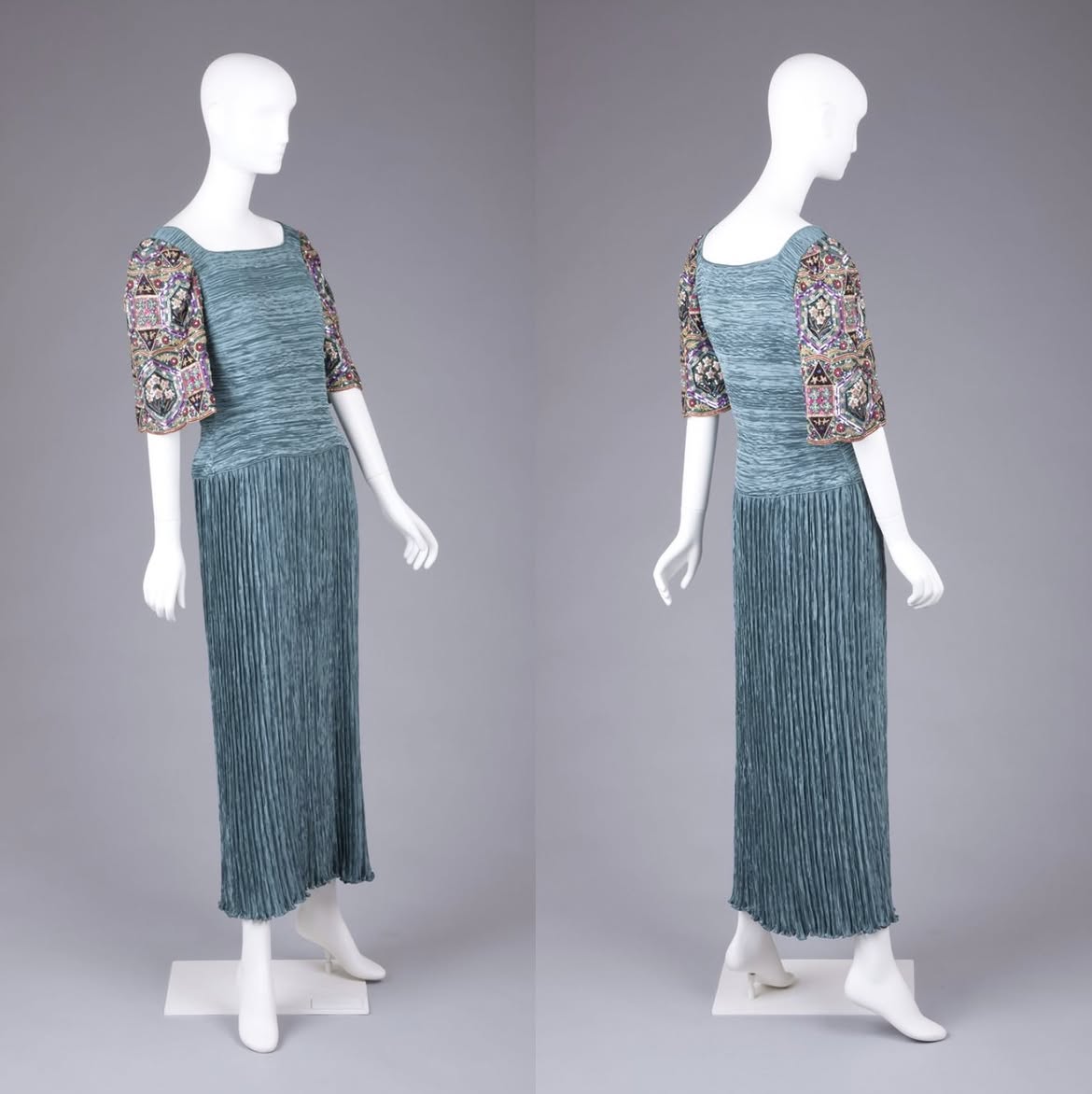
The tunic’s asymmetric neckline creates a clear diagonal across the upper body. Below the sash, the skirt divides into successive coloured tiers. Lettuce edging introduces another kind of line: a wavering boundary rather than a straight division. Because the design is layered, the effect is not restricted to the lowest point of the skirt. Several edges become visible within the outfit. Each offers another place where colour ends, overlaps or separates from the section beneath it. This relationship makes the finish consequential. The large colour blocks organise the composition at a distance. The rippling edges complicate that order at closer range.
The hem is therefore neither incidental nor independent of the rest of the design. It works through repetition. A single wavering edge might register as a decorative flourish; repeated within this layered arrangement, it helps connect the components. Lee’s analysis of the ensemble places that combination within Burrows’s broader practice of vivid colour and soft, body-conscious clothing. The argument is not that an edge alone explains his work, but that it belongs to a recognisable set of decisions.
Burrows Remembered a Sample-Room Mistake
Burrows gave a concise account of the finish’s beginning in an interview with Alex Joseph published by FIT’s HUE.
“It was a mistake that a sewer made in a sample. I liked it and kept it. I called it lettuce ’cause it looked like lettuce!”
The recollection locates the unexpected result within garment production. A sewer made the sample; Burrows recognised something worth retaining. The account does not identify the worker or date the garment, but it does distinguish the accident from the subsequent design decision. That distinction is important to the history. The unexpected result did not have to remain a mistake. Burrows chose to make it intentional. His recollection also resists a simplified story in which an invention arrives fully formed from the designer alone. Making supplied the possibility. Selection gave it a future within the work.
The name was equally direct: it described the edge’s appearance. Burrows did not explain it through an elaborate conceptual programme. The visible resemblance was enough.
Jersey Was Part of the Material Background
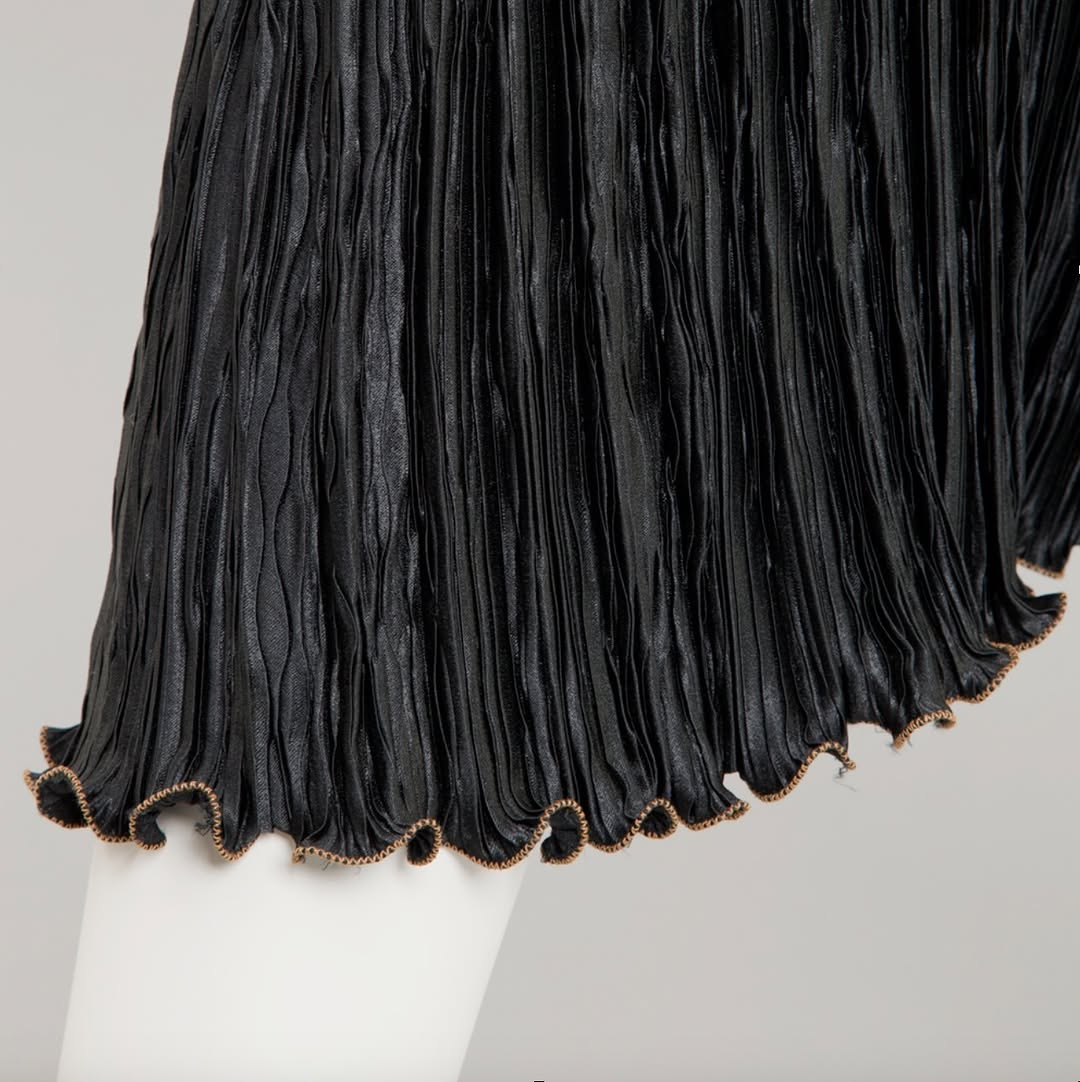
In the same HUE interview, Burrows recalled his partner introducing him to a matte jersey in 1969. He preferred knits because they fit the body and because the clothes he described did not require linings. These are statements about his material preferences and practice, not universal rules for every knit. They help explain why a finish associated with stretching could fit into his work. His account of colour was similarly practical. He recalled choosing from at least 30 fabric colours available at Jasco and putting them together instinctively. He wanted the clothes bright and humorous, describing them as “adult toys.”
Material, colour and finish were therefore connected interests. Soft cloth supported one approach to the body; saturated combinations established another visual energy; a rippling edge gave their boundaries a distinctive character. The interview does not identify the fabric of the original mistaken sample. That means the broader jersey context should not be converted into a complete technical record of that first garment.
What Technical Evidence Can Explain
A modern demonstration helps clarify how to produce a lettuce effect without claiming to recreate Burrows’s sample room. In a June 2020 BERNINA lesson, sewing educator Jaime David demonstrates a narrow rolled hem on an overlocker, also called a serger. Adjusting the machine’s differential feed stretches a jersey sample; controlled stretching during stitching intensifies the lettuce edge. The lesson notes that this works best with knits that stretch and recover. The principle is a deliberate change to the edge’s behaviour during finishing. Instead of seeking a flat result, the process encourages a wave.
That technical account supports an explanation of one contemporary knit method. It does not establish the machinery, settings or handling used for Burrows’s original sample, or for the polyester-chiffon ensemble. The distinction keeps the history useful. Readers can understand the physical principle without being offered an invented reconstruction. A recognisable effect may recur across garments even when the precise means of producing it require object-specific examination. Nor does every rolled hem automatically become a lettuce edge. In David’s lesson, the ripple depends on further manipulation, not the narrow finish alone.
The Chiffon Garment Must Be Read on Its Own Terms
The Museum at FIT ensemble is documented in Lee’s analysis as polyester chiffon, not silk chiffon and not jersey. That identification belongs in any caption or discussion of this particular object. Its importance here is visual and historical. It shows the lettuce edge operating within a different material setting from the knit demonstration, alongside layered construction and contrasting colour. Lee describes the historical effect as involving overstretching and overstitching. Her article does not provide a stitch diagram or a complete technical examination of the museum garment. The closer construction account should therefore remain limited to what the source records.
There is still much to examine. The tunic ends above several skirt layers, so the viewer encounters multiple boundaries within one silhouette. The edge treatment makes those boundaries more active. It gives each coloured section a distinct termination while helping the whole ensemble hold together visually. The garment clearly demonstrates the design consequence, even where its exact manufacturing sequence remains undocumented in the published analysis.
Red Thread Adds Another Scale of Colour
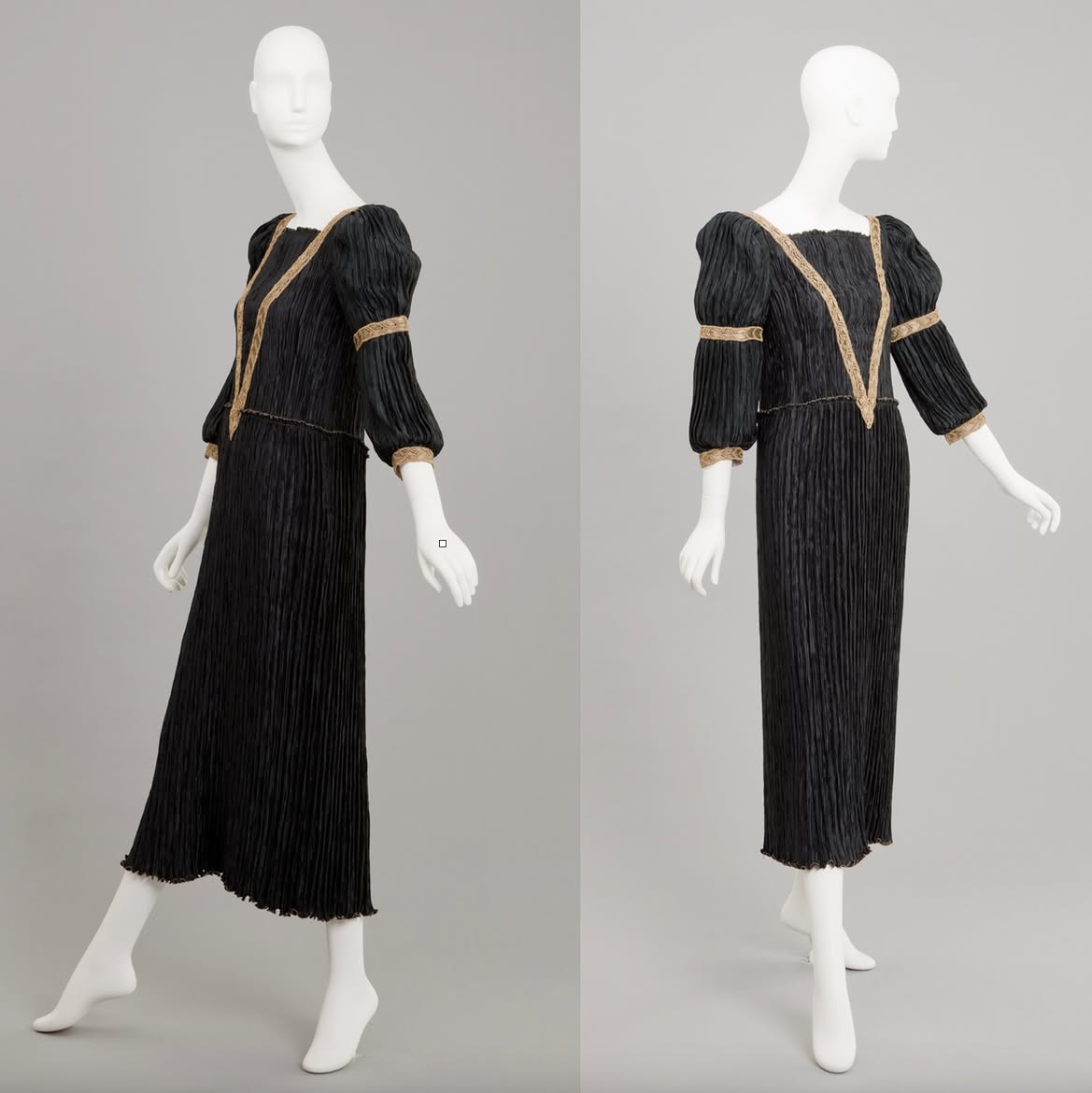
The red stitching on the blue and black hems deserves attention separate from the ripple. FIT’s analysis identifies that contrasting thread as another Burrows signature. Its role differs from that of the orange sash. The sash creates a broad colour interruption at the waist. The stitching supplies a much narrower line, tracing selected boundaries. The distinction between shape and emphasis is useful. The lettuce effect alters the outline. Red thread draws attention to the finish itself. Together, those choices make the edge difficult to treat as merely an unobtrusive necessity. It becomes something the eye can follow.
That is one way construction communicates beyond assembly. Omiren’s guide to how a seam becomes a statement examines construction as an expressive part of clothing. Here, the specific subject is an edge finish rather than a seam joining two pieces, but the underlying question is related: when does the making become part of what the garment says?
What Makes It a Signature?
The designation “signature” rests on more than a memorable naming story. It depends on recurrence and on the finish’s relationship to the designer’s other choices. Lee’s FIT analysis identifies lettuce edges and contrast stitching as recurring features of Burrows’s 1970s designs. In the HUE interview, Joseph also quotes fashion scholar and curator Richard Martin discussing colour blocking and lettuce edging together as hallmarks of the work. This pairing matters. A technique becomes more recognisable when it repeatedly belongs with particular colours, silhouettes and material effects. The circa-1973 ensemble supplies one closely documented example of that relationship. Its contribution is not to prove every stage of the finish’s development, but to show how the detail operates within a complete design.
A lettuce edge on an unidentified garment is therefore not sufficient evidence of Burrows’s authorship. Recognising a technique and attributing an object remain separate questions.
Keep the Museum Examples Distinct.
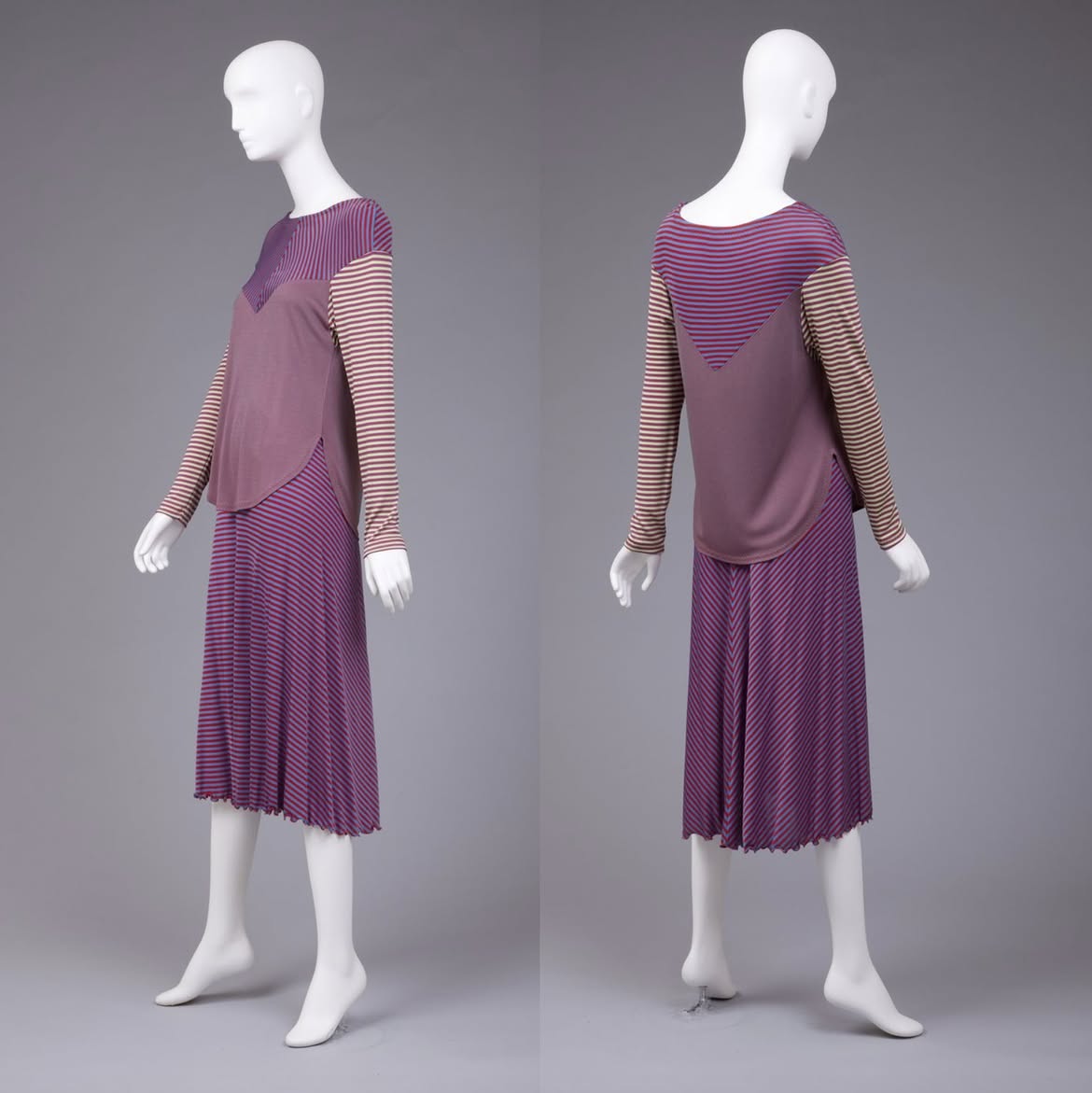
FIT’s analysis also illustrates a separate Metropolitan Museum of Art example, dated November 1973 and identified as accession 1985.379.4a, b, a gift of Mrs Anne Markley Spivak. It should not be confused with the Museum at FIT object or its circa-1973 dating and donor credit. The article places the design within Burrows’s November 1973 collection and the wider context of the Battle of Versailles. That connection does not, by itself, supply an individual wearing history for every surviving example. Versailles is important context, but it need not dominate this discussion. The edge can be examined before the celebrated event becomes the garment’s explanation.
The more specific history lies in the relation between the material, the layered colours, the repeated boundaries and the contrasting stitches.
The Omiren Argument Burrows made the edge an active part of the design. Its ripple changed the outline; contrast thread emphasised selected boundaries; repetition connected the finish to the larger arrangement of colour and cloth.
His sample-room recollection explains recognition. The surviving ensemble shows what followed: an unexpected effect made purposeful through placement, colour and repetition.
That is a more useful account than reducing the story to an accident becoming an invention. The distinctive achievement lies in making the effect belong, so that finishing the garment also helped define its appearance.
Also Read:
- The Return: Why the African Influence on Black American Fashion Is Not a Discovery, It Is a Homecoming
- New York’s African Diaspora Fashion Week: What It Means and Why It Matters
- How Thoughtful Tailoring Shapes African Workwear
- The Return of High Glamour: Inside Africa’s New Couture Capitals
Frequently Asked Questions
What is a lettuce hem?
A lettuce hem is a rippling-edge finish. BERNINA’s technical lesson demonstrates one method on an overlocker, using a narrow rolled hem and adjusting the differential feed to stretch a jersey sample during stitching. It works best with knits that stretch and recover, and the lesson does not claim to recreate Burrows’s original sample.
How did Burrows describe its origin?
He told FIT’s HUE that a sewer made a mistake in a sample, which he liked, kept and named lettuce because it looked like lettuce. The interview does not identify the worker, date the sample or specify its material, so the story explains how he recognised the effect rather than the technical origin of the finish.
Is the ensemble discussed here made from silk?
No. FIT’s published analysis identifies the circa-1973 Museum at FIT ensemble as polyester chiffon, accession 99.15.1, not silk chiffon and not jersey. It is a separate object from the sample in Burrows’s origin recollection, and from the Metropolitan Museum of Art example dated November 1973, which has a different accession number.
Was the finish only used at the lowest hem?
No. In the Museum at FIT ensemble, lettuce edging appears within a layered design, creating several visible boundaries rather than a single finish at the bottom. Red contrast stitching on the blue and black hems adds a narrower line, so the edge changes the outline, while the thread draws attention to the finish itself.