Here is a question fashion media rarely asks: who made this image? Not who is in it. Not what they are wearing. But who decided the light, built the set, pressed the shutter, chose the garment, did the hair, and did the nails? The credit block at the bottom of a fashion editorial answers that question. Most readers skip it. This article does not.
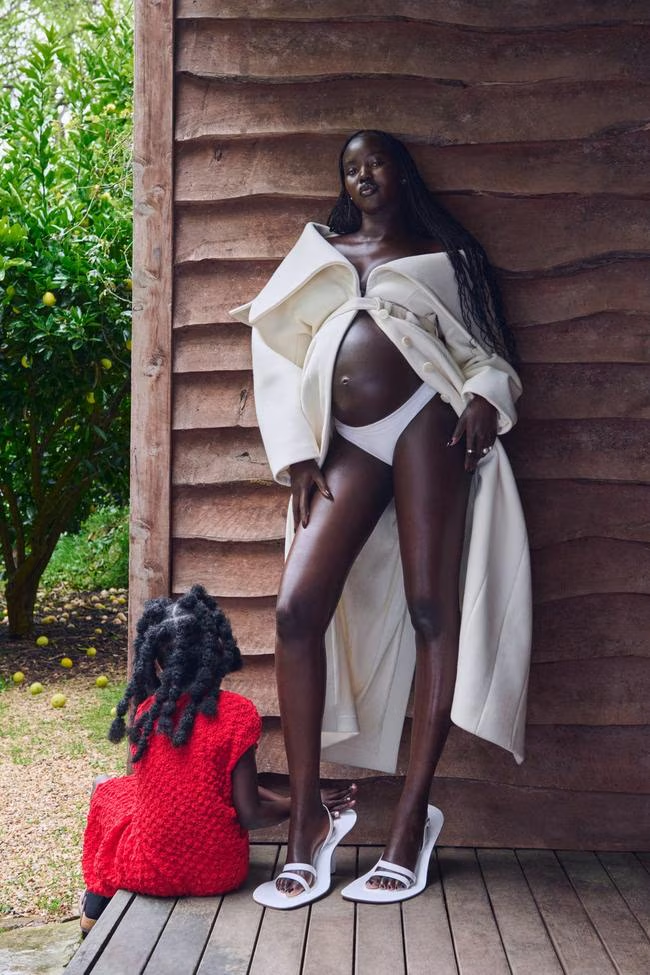
The November 2025 cover of Vogue Australia shows Adut Akech cradling her daughter Kiki. Six named people made the image, and what those six names collectively represent, in terms of cultural identity, creative contribution, and institutional position, is the most interesting thing about the cover. Not Versace. Not the jewellery from Cartier, Tiffany & Co and Van Cleef & Arpels. Not even the fact that this is Adut’s ninth Vogue Australia cover. The most interesting thing is who made it.
Vogue Australia’s November 2025 cover lists six names in the credit block: photographer, stylist, hair, makeup, manicurist, and set design. This article reads those credits as a document about who actually makes a fashion image and what the credit block cannot capture.
The Credit Block, Read in Full
Confirmed credits for the Vogue Australia November 2025 cover:
Photographer: Campbell Addy
Styling: Kaila Matthews
Hair: Laura Mazikana
Makeup: Victoria Baron
Manicurist: Indy Vellis
Set design: Bby Njoya
Model: dut Akech
Cover garment: Versace; jewellery: Cartier, Tiffany & Co, Van Cleef & Arpels
Six people credited with creative or craft roles. One model. Let’s go through what each role actually means.
Campbell Addy: The Photographer Who Also Conducted the Interview
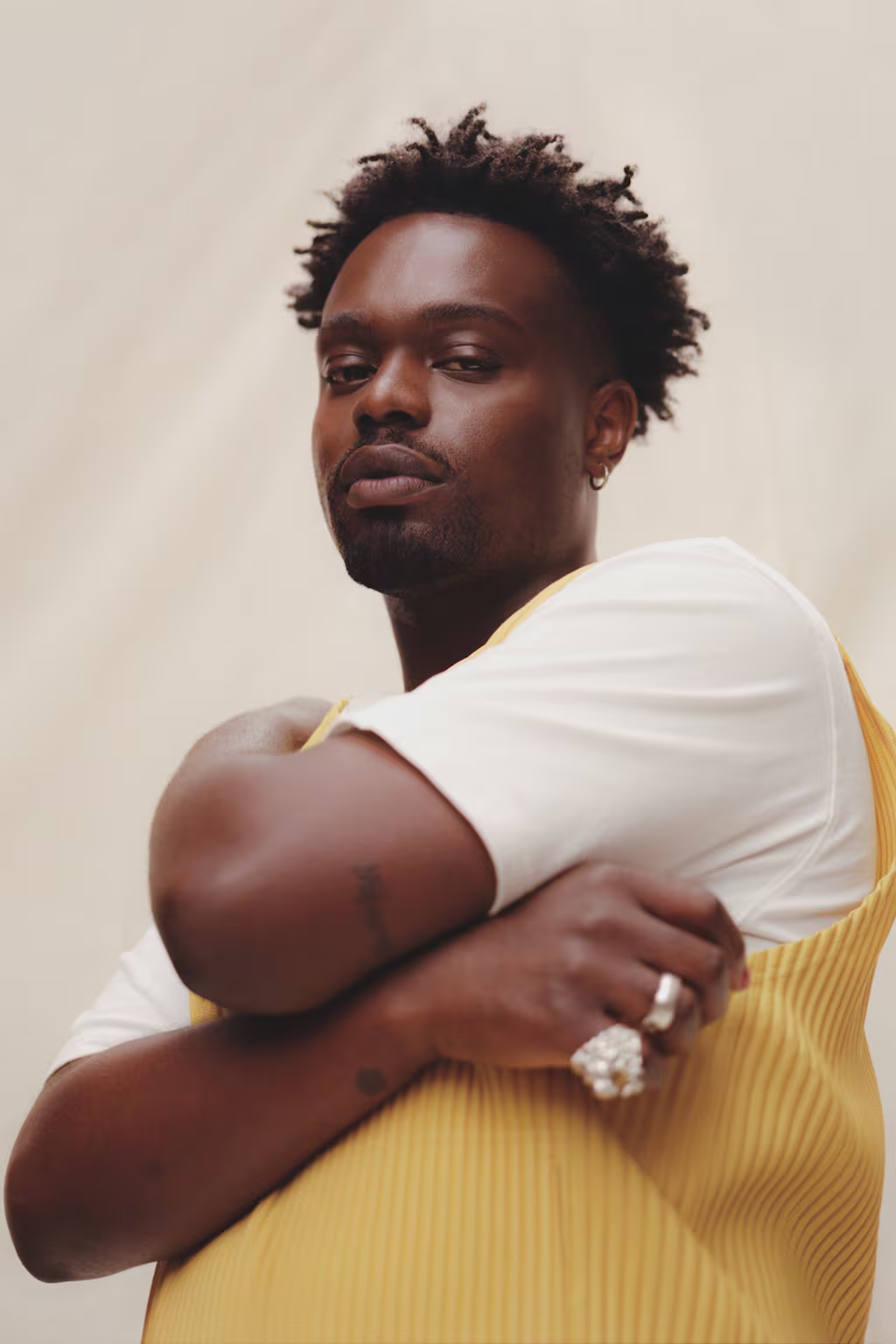
Campbell Addy is a British-Ghanaian photographer, filmmaker, artist and publisher born in 1993. He studied fashion communications at Central Saint Martins and graduated in 2016. His practice has consistently been described as centred on representing Black and queer identities. He has received the British Fashion Awards’ New Wave award in 2018 and 2019, the Forbes 30 Under 30 in 2021, and the Isabella Blow Award for Fashion Creator at the British Fashion Awards in 2023.
His first monograph, *Feeling Seen: The Photographs of Campbell Addy*, published in 2022, opens with a foreword by Edward Enninful, then editor-in-chief of British Vogue. The book features a conversation with curator and writer Ekow Eshun. Contributors include Naomi Campbell and Nadine Ijewere, reflecting on the first time they felt seen in their industry. The book’s title is not a stylistic choice. It is Addy’s stated operating principle.
He discovered photography as a teenager, finding the work of Nick Knight, Norman Parkinson and Irving Penn while stacking books in his school library during detention. He left home at sixteen. His 2023 solo exhibition, *I ♥ Campbell* at 180 Studios, included photography, painting, and film shots in Ghana, a return to his roots that the exhibition treated as both personal and artistic material.
Wddy’s presence on this cover is significant not only because he took the photographs. He also interviewed the subject. A photographer who interviews his subject changes the nature of the encounter. The image and the conversation come from the same person, the same session, and the same relationship. What Addy asked Adut, and what she said, was shaped by the fact that the person asking was the same person who had been looking at her through the lens. That is a different kind of interview from the one that happens in a separate room with a separate journalist.
The odds were stacked against me, but I had fun with it, and I worked hard. – Campbell Addy, The Face, 2022
Reports from coverage of the November 2025 issue confirm that Addy asked Adut what advice she would give to her daughter Kiki when she grows up. A photographer who has built his practice around the experience of being seen asks a model cradling her daughter on the cover of a magazine she has now appeared in nine times. It is the kind of question that only makes sense when the person asking it has spent the session inside the same frame.
Adut Akech: What Nine Covers Mean
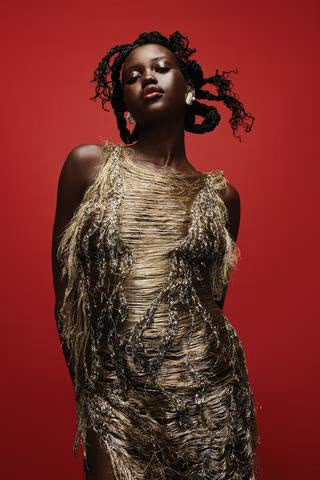
Adut Akech was born Adut Akech Bior on 25 December 1999 in South Sudan. She was raised in Kenya and moved to Australia at age six with her mother and five siblings as South Sudanese refugees. Within the fashion industry, she uses her birth name, Adut. She was named Model of the Year at the British Fashion Awards in December 2019. Time included her in its 25 Most Influential Teens in 2018.
The November 2025 cover is her ninth for Vogue Australia. That count matters because it records sustained institutional investment in one model’s presence by one publication. Nine covers over years is not an occasional nod to diversity in casting. It is a publishing record that says, ‘This person is one of our faces.’ For a South Sudanese-Australian woman, that record is not simply a modelling career statistic. It is evidence of a relationship between a model and a publication that has grown over a decade and, in November 2025, produced a cover featuring her with her daughter.
The daughter’s presence on the cover is not incidental. Kiki is being named in the credit block implicitly through Adut’s own role. The cover image is of a mother holding a child. The shoot editorial title is ‘A Plus’. The cover is about addition: what Adut’s life now contains that it did not contain when she first appeared on a Vogue Australia cover, and what the magazine is choosing to make visible by putting a South Sudanese-Australian mother and her daughter on its front page.
Kaila Matthews: The Stylist Who Has Dressed Both Covers
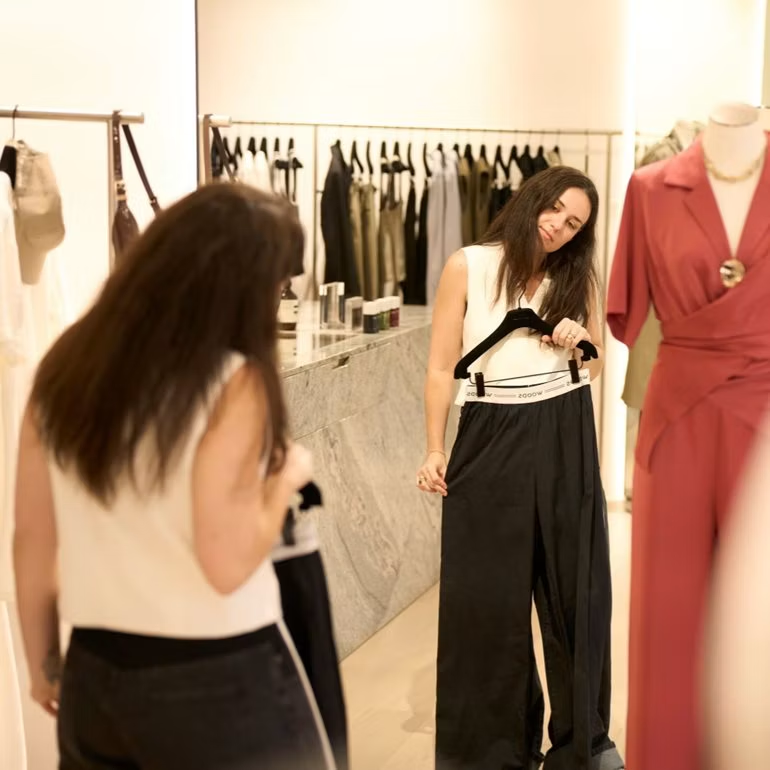
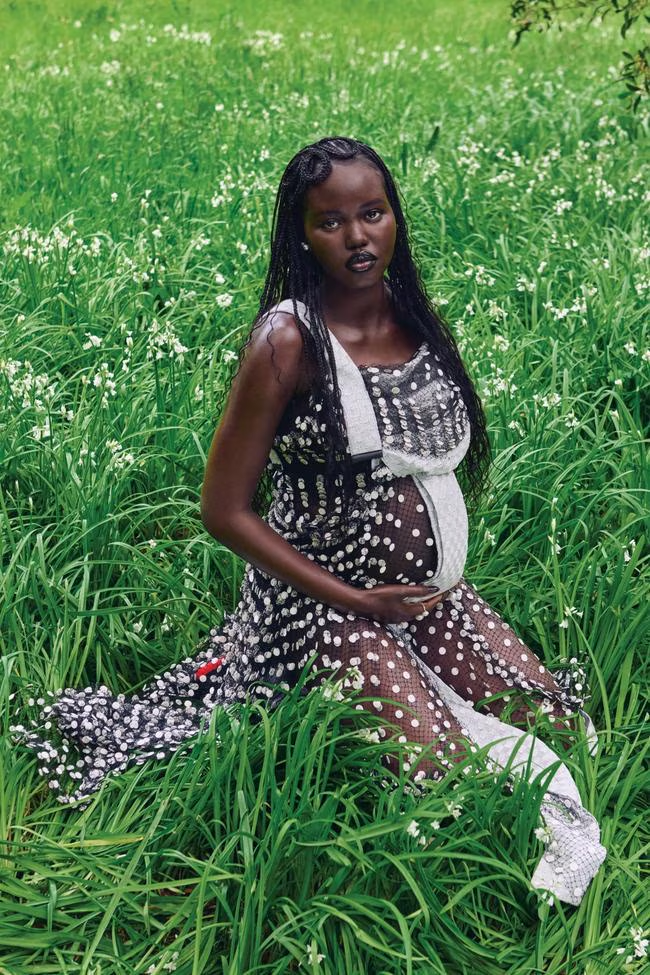
Kaila Matthews styled the November 2025 cover. She also styled the November 2024 cover, the pregnancy issue, in which Adut appeared surrounded by wilderness in the Adelaide Hills, wearing Chanel, Roísín Pierce, and Marc Jacobs. Two consecutive November Vogue Australia covers by Adut, two consecutive Kaila Matthews styling credits.
A stylist selects, sources, and dresses the garments that appear in the image. On a cover shoot, the stylist also decides what the model wears in the hero image, the single most commercially significant styling decision of the shoot. The cover garment for November 2025 was Versace. The cover garment for November 2024 blended Chanel and Roísín, Pierce. Those are different fashion arguments: one is a single house, one is a collision of houses. Both were Matthews’s calls.
The consistency of Matthews’s credit across both covers is worth pausing on. In an industry where the stylist’s relationship to the model and the publication often determines a shoot’s visual language, two consecutive covers by the same stylist and the same model suggest a working relationship rather than an occasional arrangement. It shows trust on both sides and a specific aesthetic dialogue between Matthews and Adut that the magazine is returning to.
Laura Mazikana, Victoria Baron, Cindy Vellis, Ibby Njoya
The remaining four credited roles are hair, makeup, nails and set design. Most credit hierarchies list them below the photographer and stylist, and they receive less public attention. They are not less consequential.
Laura Mazikana is credited for hair on the November 2025 cover. She was also credited for hair on the November 2024 cover: two consecutive credits, same model, same publication, same hairstylist. What Mazikana does on a cover shoot is not simply dress the hair for the camera. She creates a total image: how the hair interacts with the garment, the light, the model’s movement, the set, and she does it consistently across multiple sessions. A hairstylist credited twice in a row on consecutive November covers of the same magazine is a collaborator, not a day’s hire.
Victoria Baron is credited for makeup on both the 2024 and 2025 Adut covers. The same observation applies. Baron’s makeup on the November 2025 cover is part of the image’s visual argument. It is not a background element.
Cindy Vellis is credited as a manicurist. A manicure credit appears because the image features hands in close range, and the nails are a deliberate part of the overall look. The decision to include a manicure credit is itself meaningful: it confirms that the hands and nails in the image were designed, not incidental. Ibby Njoya is credited for set design. The set is the environment within which the image takes place. Njoya designed that environment.
What the Credit Block Captures and What It Cannot
As Omiren Styles has established through its work on maker credit, the credit block in a fashion image documents acknowledged contributions. It records who was in the room and what role they occupied. It does not record what any of those people earned, what their contract looked like, what the working conditions were, how long the shoot took, or who made which creative decisions. A photographer credited on a cover may have had complete creative control or minimal say over the final image. A stylist credited on a cover may have proposed the garment or been told which house to dress the model in. The credit tells you the role, not the degree of agency within it.
This is not a criticism of the credit block. It describes what it is and what it is not. The credit block is the fashion industry’s primary mechanism for acknowledging creative labour. It is a better instrument than no credits at all, which is what most commercial imagery provides. It is a less complete instrument than a full account of how the image was made, which is rarely available and rarely sought.
This credit block names a British-Ghanaian photographer, a South Sudanese-Australian model, and four other named collaborators. It puts their collective work on the front cover of one of Australia’s most-read fashion publications in November 2025. That is a set of facts worth reading carefully rather than scanning past on the way to the editorial content.
The Omiren Argument
African fashion has never needed external validation to know its own value. The same is true of African and African diaspora image-makers. Campbell Addy has not needed the fashion industry’s approval to build his practice. He built the practice, and the practice generated the approval. His position at the Vogue Australia November 2025 shoot, as photographer, interviewer, and the person responsible for both the image and the conversation, reflects a body of work built over less than a decade since graduating from Central Saint Martins.
Adut Akech has not needed Vogue Australia to define her career. She has nine covers. The ninth one shows her daughter. The credit block on that cover names six people, two of whom have now worked with her on consecutive November covers of the same publication. That is a record of sustained creative collaboration in a medium that often treats its crew as interchangeable. The fact that these credits are publicly available, in a forum thread on thefashionspot.com and in the coverage that followed the cover’s release, doesn’t make them any less worth reading. It makes them worth reading now.
People make fashion images. The names in the credit block are those people. Reading the credits is the minimum form of attention the image deserves.
ALSO READ
- The Maker-Credit Test: What a Heritage Fashion Product Page Should Clarify
- Can Textile Provenance Protect the People Who Make the Cloth?
- African Fashion Has Visibility – But Where Are the Buyers?
- The Global South Made Fashion. It Just Never Got Credit.
Frequently Asked Questions
Who photographed the November 2025 Vogue Australia cover with Adut Akech?
Campbell Addy, a British-Ghanaian photographer born in 1993, photographed the November 2025 Vogue Australia cover. Addy graduated from Central Saint Martins in 2016 and has received the British Fashion Awards’ New Wave award (2018 and 2019), Forbes 30 Under 30 (2021) and the Isabella Blow Award for Fashion Creator (2023). He also gave an interview to Adut Akech in the November 2025 issue.
Who styled the November 2025 Vogue Australia cover?
The November 2025 Vogue Australia cover was styled by Kaila Matthews, who also styled the November 2024 Vogue Australia cover featuring Adut Akech. The cover garment for the November 2025 issue was Versace, with jewellery from Cartier, Tiffany & Co and Van Cleef & Arpels. Other labels in the associated editorial included Ashi Studio, Courreges, Dior, Jarrod Reid and YSL.
What are the full credits for the Vogue Australia November 2025 cover?
Photographer: Campbell Addy. Styling: Kaila Matthews. Hair: Laura Mazikana. Makeup: Victoria Baron. Manicurist: Cindy Vellis. Set design: Ibby Njoya. Model: Adut Akech. Cover garment: Versace; jewellery: Cartier, Tiffany & Co., and Van Cleef & Arpels.
How many times has Adut Akech covered Vogue Australia?
The November 2025 cover is Adut Akech’s ninth cover for Vogue Australia. The previous Vogue Australia cover, from November 2024 and photographed by Jesse Lizotte, was her seventh. Her eighth was also in 2025 before the November issue.
Who is Campbell Addy?
Campbell Addy is a British-Ghanaian photographer, filmmaker, artist and publisher. He graduated from Central Saint Martins in 2016 and has built a practice centred on representing Black and queer identities. His first monograph *Feeling Seen: The Photographs of Campbell Addy* (2022) opens with a foreword by Edward Enninful. His 2023 solo exhibition *I ♥ Campbell* at 180 Studios featured photography, painting and film shot in Ghana. New School represents him worldwide.
What is the editorial argument of the November 2025 Vogue Australia cover?
The editorial title for the Adut Akech shoot in the November 2025 issue is ‘A Plus’. The cover image shows Adut cradling her daughter Kiki. The credit block names a British-Ghanaian photographer who also conducted the interview, a stylist who has now worked with Adut on two consecutive November Vogue Australia covers, and four other named collaborators. The cover is Adut’s ninth for the publication and the first to feature her daughter.