The figure appears at the edge of the forest. It has no face that the uninitiated can see. It has no arms, no legs visible beneath the dense cascade of blackened raffia that falls from its wooden crown to the earth. It moves, but not the way a person moves. It swells. It contracts. It collapses to the ground and rises again. Children step back. Elders step forward. The spirit has arrived.
This is the raffia costume of Liberia, and it belongs to no single tradition. The Sande society, the Poro society, and the Dan people each deploy raffia in sacred masquerades, and in each case, the logic is the same: the costume does not dress a person. It conceals one. What the audience sees is not a performer in costume. What they see is the spirit that the costume has been built to house. The raffia is the architecture of a threshold. It marks the boundary between the human world and the world from which the spirit comes.
This article documents the raffia costume as it functions across three distinct Liberian traditions. It names the people who make it, describes what it does, and explains why it is not and has never been simply a dress. Raffia, a costume material in Liberia, is a sacred material. It is the most architecturally specific textile tradition in West Africa, and it operates entirely outside the register of fashion.
In Liberia, raffia is not worn by people. Spirits wear it. Learn how the Sande, Poro, and Dan use raffia costumes to make the invisible visible in sacred ceremonies.
The Sande Society and the Sowei Raffia Costume
The Sande society is the most widely documented female initiation institution in West Africa. Found among the Bassa, Gola, Kissi, Kpelle, Loma, Mano, and Vai of Liberia, it also extends across Sierra Leone, Guinea, and the Ivory Coast. Its practices have been documented since 1628, when a first-hand account was published by Dutch geographer Olfert Dapper in 1668 describing the society as it existed in the Cape Mount region of Liberia. As the Brooklyn Museum’s permanent collection notes, the Sande society represents the women of each town, binding them together as a powerful social and political force. It is one of the most influential patrons of the visual arts in West Africa.
At the centre of the Sande masquerade is the sowei, the masked dancer who embodies the society’s water spirit. The sowei wears a carved wooden helmet mask placed over the head, and beneath it a full costume of blackened raffia that conceals the face and body entirely. The raffia is not decorative. It is functional in the most precise sense: it makes the human inside invisible. The sowei masker is known by different terms across communities. Among the Gola, she is called zogbe. Among the Vai, she is zooba. Among the Mende, she is ndoli jowei, the expert leader who dances. Each masker has an individual name and identity. Each must be a virtuoso dancer, because the spirit she embodies is active, present, and watching.
The Sande masquerade is activated during the initiation period for young women entering adulthood. When the sowei appears, she moves through the community teaching female initiates about morality and proper ways of living. The raffia costume serves as the visible sign that the teaching comes not from a senior woman but from the spirit world itself. The blackened colour of the raffia, achieved through indigenous plant sources, references the water spirit’s origin at the bottom of rivers and lakes. The costume is built to make that origin legible. Everything about the construction, the darkness, the total coverage, the weight of the material in movement, communicates that what is inside the costume has come from elsewhere.
The Poro Society and the Gbetu Raffia Masquerade
The Gbetu is the male Poro society’s primary raffia masquerade, performed among the Gola, Vai, Mende, De, and southern Kpelle peoples of Liberia. The Anacostia Community Museum of the Smithsonian Institution, which holds photographic documentation of the Gbetu performed in Monrovia by a Liberian government cultural troupe, records its costume in precise terms: three skirts of raffia worn around the waist, chest, and neck, creating an ensemble that resembles, in the words of the Smithsonian documentation, a haystack without arms or legs.
The Gbetu’s raffia costume is designed for extreme physical performance. The masker advances in broad swishing motions. It can rise to a considerable height and then suddenly collapse until it is nearly flush with the ground. The Brooklyn Museum’s object record for the Gola Gbetu helmet mask, which holds an early to mid-20th-century example measuring 93 by 48 inches, including its full raffia costume, describes the masquerade as making full use of the head-to-toe raffia covering in highly energetic, acrobatic movements. The Gbetu can also perform the extraordinary feat of appearing to give birth to small dancing figures that emerge from beneath its raffia skirt, perform independently, and return to its folds. These smaller figures often wear only raffia, with no wooden mask, underscoring that the raffia alone is sufficient to signal spirit presence.
The Gbetu is considered feminine despite being owned and performed by men, precisely because of this birth capacity. The costume houses a generative force. The Gola claim that the Gbetu originated with them and was adopted by the Vai and the Mende. Across all communities where it appears, the function remains the same: the raffia is not clothing. It is the body of the spirit.
The Dan Gle and the Raffia of the Forest Spirit
The Dan people of Liberia hold one of the continent’s most complex masquerade traditions. The Dan refer to their masks as Gle or Ge, terms that describe both the physical mask and the invisible supernatural force that inhabits it during performance. As documented in scholarship on Dan mask traditions, Gle spirits live in the forest and can enter the village only through the masquerade. For a Gle to manifest, an initiated member of a Dan men’s society must receive it in a dream: the spirit reveals its exact nature, its intended function, its dance, and its music. The council of elders then decides whether to commission the masquerade ensemble.
The wooden mask is accompanied by a full-body costume constructed of raffia, feathers, and fur. Each Gle has its own personality, its own name, its own speech pattern, and its own dance. The wearer does not perform. The wearer gives up their own being so that the spirit identity can take over. An attendant always accompanies the Gle masquerader to control the spirit and interpret its speech, because the spirit, having come from the deep and mysterious realm of the forest, is unpredictable. The raffia in the Dan tradition is not uniform. It is specific to the spirit it houses. A deangle Gle, the gentle, nurturing spirit associated with the circumcision camp, wears different material and moves differently from a bu gle, the war spirit named after the sound of a gunshot. The costume is not a generic masquerade outfit. It is the particular body of a particular spirit, commissioned through a dream and approved by elders.
Why Raffia and Not Cotton or Woven Cloth
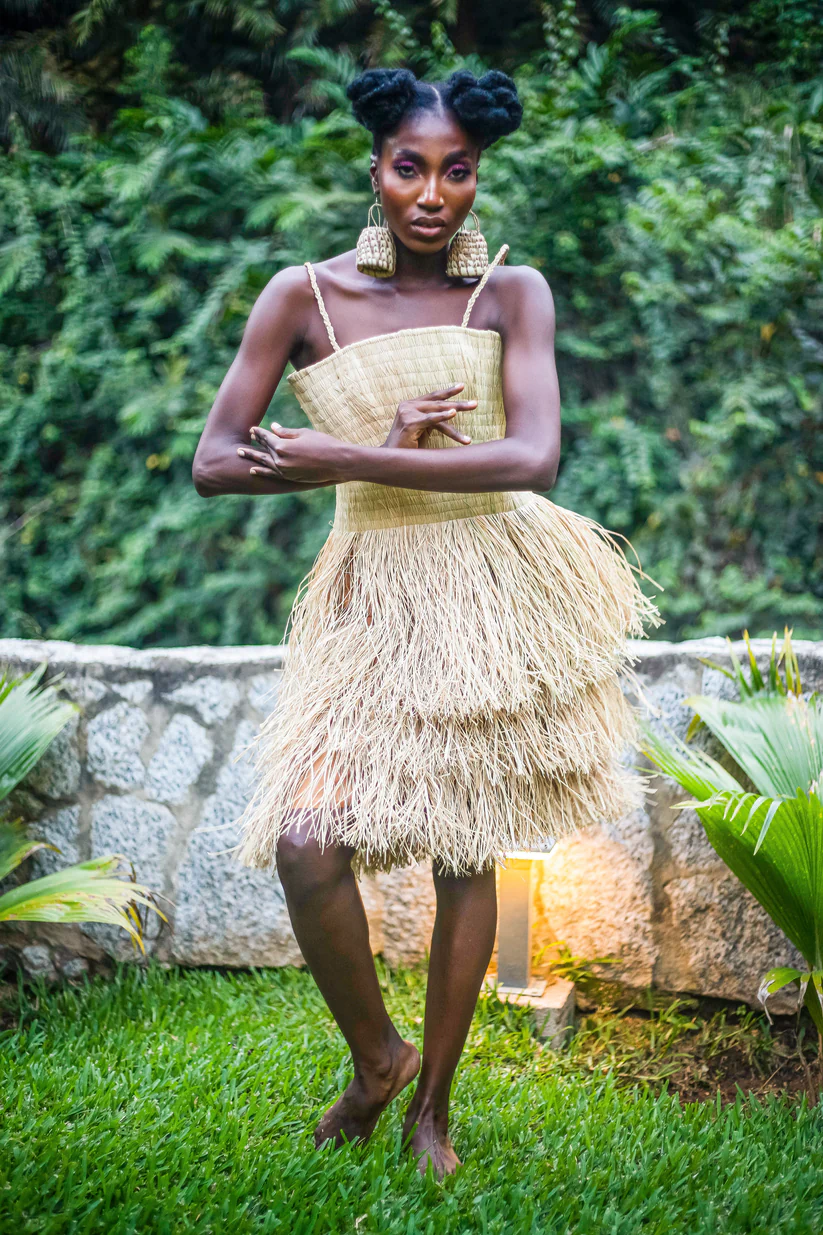
The choice of raffia as the primary material for sacred masquerade costumes across all three of Liberia’s major ritual traditions is not arbitrary. Raffia is a plant fibre harvested from the raffia palm, processed into strips and assembled without weaving on a loom. It is a forest material: it grows in the same environment the spirits are believed to inhabit. This connection between the material and the spirit’s original world is not incidental to its use. The blackened raffia of the Sande sowei costume references the water world. The dense raffia of the Gbetu references the bush. The raffia of the Dan Gle costume references the deep forest. In each case, the material conveys geographic and spiritual information about where the spirit originates. Cotton cloth, woven on a loom, is a human product. It belongs to the village world. Raffia belongs to the forest world. Using raffia to make the costume is not a practical decision. It is a cosmological one.
This understanding of raffia as a boundary material between worlds has parallels elsewhere in African textile culture. As Omiren Styles has documented in its coverage of African sacred textiles, including Kuba raffia cloth and barkcloth, raffia-based textiles across the continent consistently carry sacred and ceremonial meanings that distinguish them from woven cotton cloth. In Liberia, that distinction is absolute. Cotton is for people. Raffia is for spirits.
The Political Power of the Raffia Costume
The Sande and Poro societies are not simply cultural institutions. They are governance structures. Sande and Poro societies have been protected by official Liberian government regulations since 1924. Their leaders sit on the National Council of Chiefs and Elders and play an advisory role in the national government. As Omiren Styles has explored in examining how African dress functions as cultural authority, the most politically charged dress forms in any culture are those that regulate access to power. The raffia costume is exactly that. Politicians vying for power in Liberia have historically sought initiation into the Poro society to gain legitimacy. Former President W.V.S. Tubman formally brought the Poro under the Ministry of Local Government in the mid-20th century, giving it legal standing. The Sande zoes, the senior women who wear the raffia costume and sowei mask, hold power that no electoral process can override in rural communities. When the spirit appears in its raffia costume, it is not only a sacred event. It is a political one.
The raffia costume, therefore, occupies a position in Liberian political life that has no equivalent in any other textile tradition on the continent. Country cloth can be given as a gift to a diplomat. Wax print can be worn to a rally. But the raffia costume cannot be adopted, replicated, or repurposed without severing its connection to the institution it belongs to. Its power is inseparable from its context. It is the most closed dress system in Liberia, and that closure is not incidental. It is the source of its authority.
Also Read:
- Akwete, Kuba Cloth, Barkcloth, and Kete: The Sacred Textiles the World Is Finally Discovering
- From Ritual to Runway: How African Tribal Makeup Shapes Haute Beauty
- Country Cloth: How Liberian Men Have Worn Power Since Before the Republic
- Why Culture Is the Foundation of Style in African and Global Fashion
Raffia Costume in 2026: Sacred Continuity
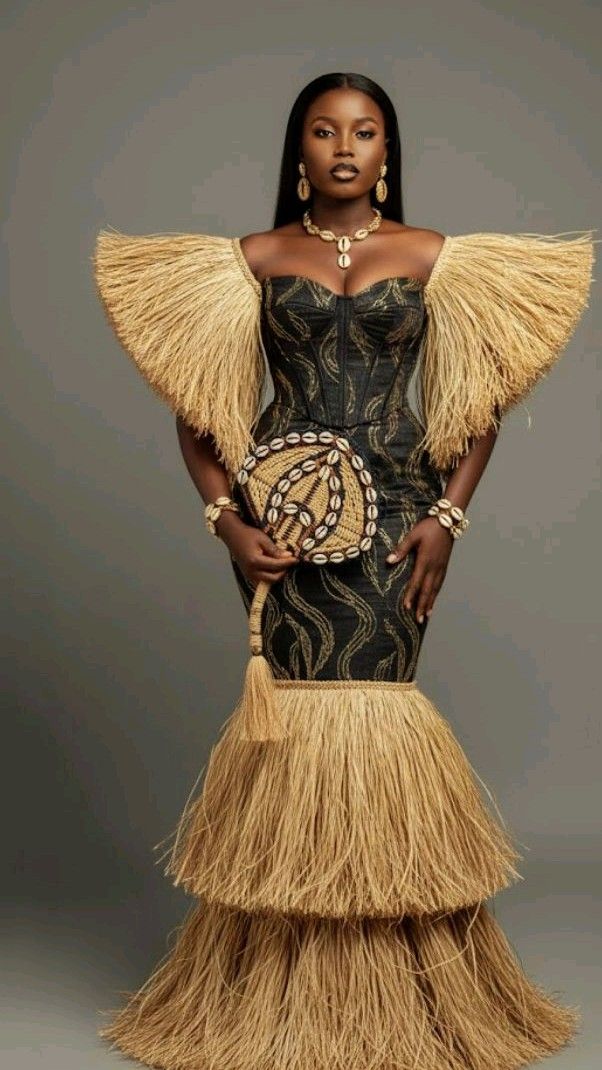
Unlike country cloth, which has found a contemporary market in diaspora fashion and sustainable textiles, raffia costume has not entered the mainstream fashion conversation and shows no sign of doing so. This is by design. The societies that produce and govern raffia masquerade are secretive by nature and institution. The knowledge of how to assemble, activate, and perform in a raffia masquerade ensemble is initiates’ knowledge. It is not published, not taught in schools, and not available for appropriation. This is a different situation from the general concern that African aesthetics are reduced to surface-level trends, which Omiren Styles has addressed by examining ritual-based African beauty traditions. In the case of the raffia masquerade, the protective mechanism is built into the tradition itself. The Sande and Poro societies have maintained secrecy as a governance principle for centuries. The costume is their instrument. The secrecy is their method.
In Liberian communities where Poro and Sande remain active, the raffia masquerade still appears at initiations, at the close of bush school periods, at community ceremonies, and in some urban contexts during public cultural events. The Smithsonian’s documentation includes a Gbetu performance filmed in Monrovia by a government cultural troupe. The societies adapt. The tradition continues. The raffia costume remains what it has always been: the visible body of something that cannot otherwise be seen.
The Omiren Argument
Every textile culture on the African continent produces cloth that carries social meaning. Status, ceremony, identity, allegiance: these are the usual registers. Country cloth declares authority. Kente announces the occasion. Wax print marks belong. But the raffia costume of Liberia operates in a category entirely its own, because it does not dress the wearer. It erases them. The specific function of raffia in Liberian sacred masquerade is erasure: the complete visual removal of the human being inside, so that what remains for the audience to engage with is not a person in costume but the spirit the costume was commissioned to embody. This is not a metaphor. The Brooklyn Museum, which holds a Gola Gbetu helmet mask and a full raffia costume in its permanent collection, states plainly that the masquerade represents a spirit, not a performer. The SFO Museum’s permanent exhibition on Liberian helmet masks from the Phoebe A. Hearst Museum collection confirms that the Sande spirit must be completely covered by mask, clothing, and raffia so that no part of the human is visible. No other textile tradition in Liberia is built on this principle. The raffia costume is the only Liberian dress form whose entire purpose is to negate the body it covers.
This is the argument Omiren Styles makes here: the raffia costume deserves to be understood not merely as ceremonial dress but as a distinct category of material culture, one that precedes fashion, operates outside it, and cannot be absorbed into it without losing what it fundamentally is. To put raffia in a fashion article alongside lappa and wax print, as though it were simply another Liberian textile, is to misread the object entirely. Raffia in Liberia is not a fabric. It is a threshold. It is the material through which a spirit crosses into the human world, and the communities that produce it have understood it in exactly those terms for centuries. That understanding deserves to be stated with precision, not dissolved into generic discourse about African textile heritage.
Raffia in Liberia is not a fabric. It is a threshold. The material through which a spirit crosses into the human world.
Frequently Asked Questions
1. What is the raffia costume in Liberia, and who wears it?
The raffia costume in Liberia is a sacred masquerade ensemble used by the Sande society, the Poro society, and the Dan people. It is worn during initiation ceremonies, ritual gatherings, and community events. In each tradition, the costume functions to conceal the human performer entirely, so that what is visible to the audience is the spirit the masquerade is built to embody, not the person inside.
2. What is the Sowei mask, and how does raffia fit into the Sande costume?
The sowei is the helmet mask worn by senior leaders of the Sande women’s initiation society among the Gola, Vai, Mende, and related peoples of Liberia and Sierra Leone. The mask is carved from wood and placed over the head. A full costume of blackened raffia fibres and cloth covers the rest of the body, completely concealing the masker’s identity. The blackened raffia references the water world from which the spirit is believed to emerge. The Brooklyn Museum holds a Sowei mask in its permanent collection. It documents the tradition as one of the rare examples in Africa of a masquerade tradition controlled entirely by women.
3. What is the Gbetu, and how is its raffia costume different from the Sande sowei?
The Gbetu is the Poro men’s society masquerade performed among the Gola, Vai, Mende, De, and southern Kpelle peoples of Liberia. Its raffia costume consists of three skirts worn around the waist, chest, and neck, creating a full-body covering without visible arms or legs. Unlike the sowei costume, which is built for composed, dignified movement, the Gbetu costume is designed for extreme acrobatic performance. The masker rises to great heights, collapses to the ground, and appears to give birth to small dancing figures that emerge from beneath its raffia skirt.
4. How does the Dan Gle masquerade use raffia differently from the Sande and Poro?
The Dan Gle masquerade begins with a dream. An initiated member of a Dan men’s society receives a dream in which a forest spirit reveals its exact nature, function, and the masquerade through which it will manifest. The council of elders approves the commission, and the wooden mask is carved. The mask is then accompanied by a full-body costume of raffia, feathers, and fur specific to the spirit’s character. Each Gle has its own personality, name, dance, and speech pattern. The Dan tradition is distinctive in that the costume is spiritually unique to each spirit rather than being a standardised form shared across a society.
5. Can raffia masquerade costumes be reproduced outside their ritual context?
No. The raffia masquerade costumes of Liberia’s Sande, Poro, and Dan traditions belong to institutions governed by secrecy and initiation. The knowledge required to assemble, activate, and perform these costumes is restricted to initiates. The societies that hold this knowledge have maintained it through structured governance for centuries. Raffia masquerade costume is not available for reproduction, adoption, or reinterpretation outside its institutional context. Its power is inseparable from the tradition that produces it.