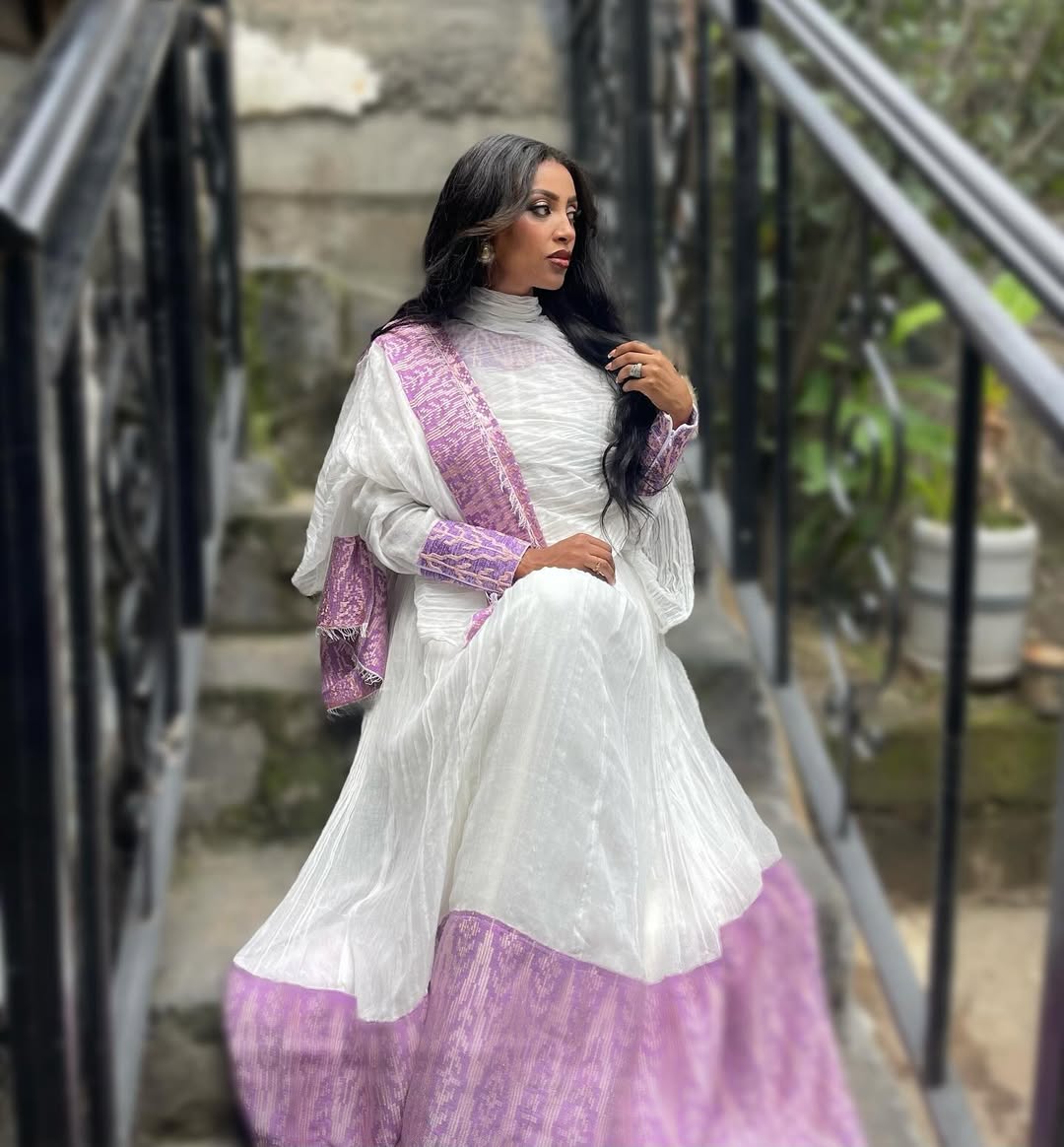
For millennia, Amharas have grown, spun, and woven cotton, making it one of the oldest and most deeply rooted textile fibres among Amhara communities. The Amhara region is the traditional heartland of Ethiopia’s cotton production. The region accounts for 76% of all small-scale cotton farmers in the country, which provides the essential cotton for the Habesha kemis production. Generations of women spun cotton by hand using inzirt (Amharic: እንዝርት), and generations of weavers transformed it into cloth on narrow looms, creating a textile tradition that is both ancient and continuous. To this day, this handwoven cotton, known as ‘shemma’ (Amharic: ሸማ), serves as the vital foundation of Amhara dressmaking. More than just a fabric, the shemma is essentially the DNA of the Habesha kemis.
Habesha kemis (Amharic: ሀበሻ ቀሚስ) is an Amharic term used by Amharas to refer to their women’s cultural clothing. Amhara culture is not monolithic; Habesha kemis is actually a collection of distinct regional variations, such as Shewa, Gondar, Gojjam, and Wollo, each with unique embroidery patterns (tibeb) and silhouettes.
The Habesha kemis exists because the fabric dictates its shape. Since the traditional Amhara loom is very narrow, a weaver can only make long, thin strips of cotton. You can’t just cut a modern pattern out of that. Instead, Habesha kemis were made by stitching those narrow strips together side by side to create a wide, flowing gown. In short, you don’t just “make” a Habesha kemis; you assemble it from the shemma. Without that specific narrow-strip weaving style, the iconic silhouette of the Amhara dress wouldn’t exist.
At the heart of this textile language is the relationship between tilet (Amharic: ጥለት), tibeb (Amharic: ጥበብ) and Tilf (Amharic: ጥልፍ).
- Tilet refers to the traditional border and its placement on the dress, whether it circles the hem, runs vertically down the front, or sits only at the back. It is the border that frames the dress. It also represents a wider, single-coloured red or green strip that has been used historically for centuries.
- Tibeb is the intricate, multicoloured woven pattern, integrated directly into the fabric’s border during weaving. It is detailed artistry that gives each border its character. Tibeb is more than decoration; it is a coded visual vocabulary. Each pattern, colour, and arrangement carries regional identity, aesthetic lineage, and the weaver’s artistry.
- Tilf, unlike Tibeb, refers to hand embroidery added to the finished fabric. If a woven border is subsequently enhanced with embroidery, it is called Tilf Tibeb.
Tilet, tibeb, and tilf are added mostly to the neckline, sleeves, and hem of garments. Combined, these elements form the visual signature of Amhara dressmaking. They communicate regional identity and social status. It is through tibeb that the Shewa Amhara dress expresses culture, meaning, and memory.
The Shewa Amhara dresses: Origins, fabrics, weaving traditions, and rise from Shewan culture to Ethiopia’s national attire.
Weavers Who Built a Capital Through Cloth
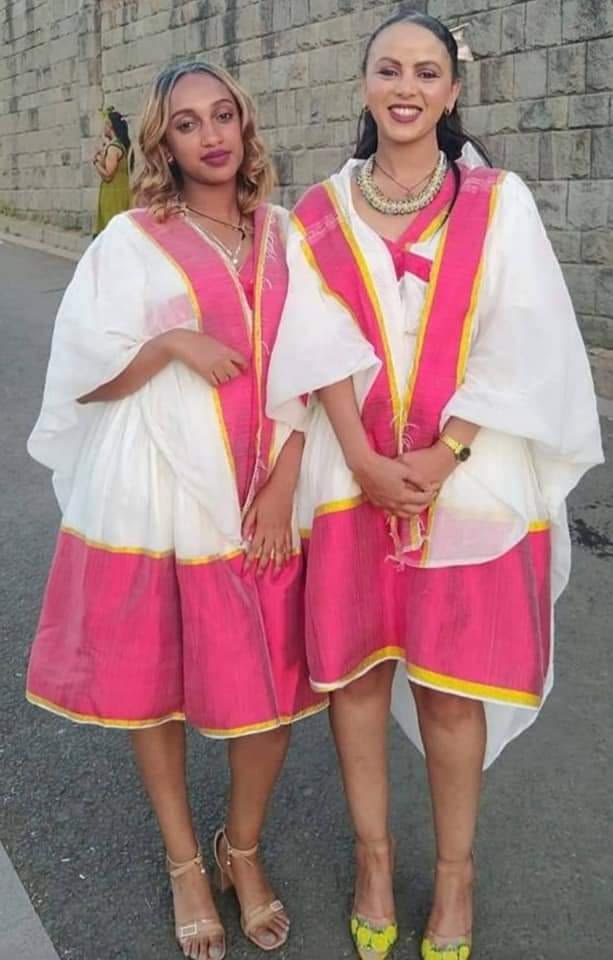
In the highlands of central Ethiopia, where the Shewa Amhara people have lived for centuries, clothing has long served as a quiet but enduring expression of identity. Among the most recognisable garments in Ethiopia today is the white cotton Shewa Amhara dress edged with bold woven borders. It is a silhouette that began as an everyday Shewan dress and rose to become the country’s national dress. Known as the Habesha kemis, this garment is not a relic of aristocracy but a living textile language shaped by domestic weavers, regional aesthetics, and the migration of artisans into the capital during the formative years of Addis Ababa.
When Emperor Menelik II moved his royal encampment to the hot springs of Filwouha in the late nineteenth century, the settlement that would become Addis Ababa was still a loose collection of tents and temporary dwellings. Among the earliest permanent settlers were Amhara master weavers with their labour force from Ankober, the former capital of the Shewa kingdom. These master artisans established weaving workshops near the palace (in what is now Shiro Meda), producing shemma, a hand-woven cotton cloth, for the royal household, the nobility, and the rapidly growing urban population. Their presence transformed the area into a vibrant textile hub.
The narrow-loom technique they brought allowed for the production of long, continuous strips of cotton bordered with intricate woven patterns known as ‘tibeb’. These palace-adjacent weaving quarters became the birthplace of Addis Ababa’s textile culture, supplying garments for the court and meeting the needs of a city expanding almost overnight.
Weavers from other Amhara towns, including Menz, Debre Berhan, and Bulga, soon followed, contributing their own regional styles and techniques. Together, these groups formed the professional backbone of the capital’s material culture. Their work shaped clothing worn in the palace, churches, and the emerging urban neighbourhoods. As Addis Ababa grew into a political and cultural centre, the dress associated with its people, particularly the Shewa Amhara, rose with it.
The Three Fundamental Styles of Shewa Amhara Dress
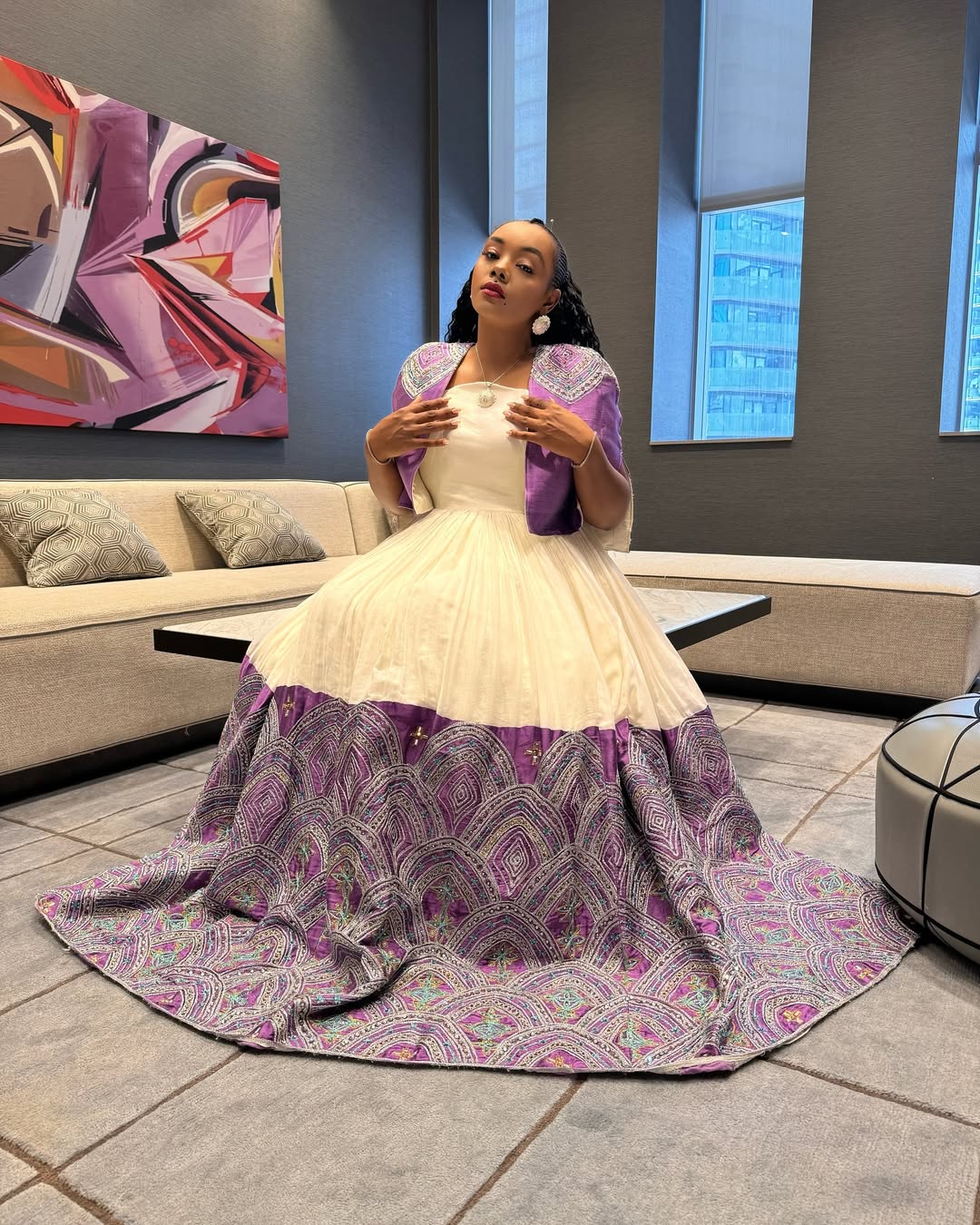
As Addis Ababa gained prominence, the Shewa Amhara dress became increasingly visible in state ceremonies, diplomatic events, photography, and early Ethiopian cinema. By the mid-twentieth century, it had evolved into Ethiopia’s most recognisable attire. Within this tradition, the dress is recognised through three characteristic border (tilet) arrangements, each reflecting a long-standing way of placing the woven border.
- The most iconic is the Zuria Tilet (Amharic: ዙሪያ ጥለት), named for the circular border encircling the dress’s bottom hem. This bold, continuous band creates a striking frame that moves with the wearer. When people outside Ethiopia imagine the “Ethiopian dress”, they picture the Zuria Tilet.
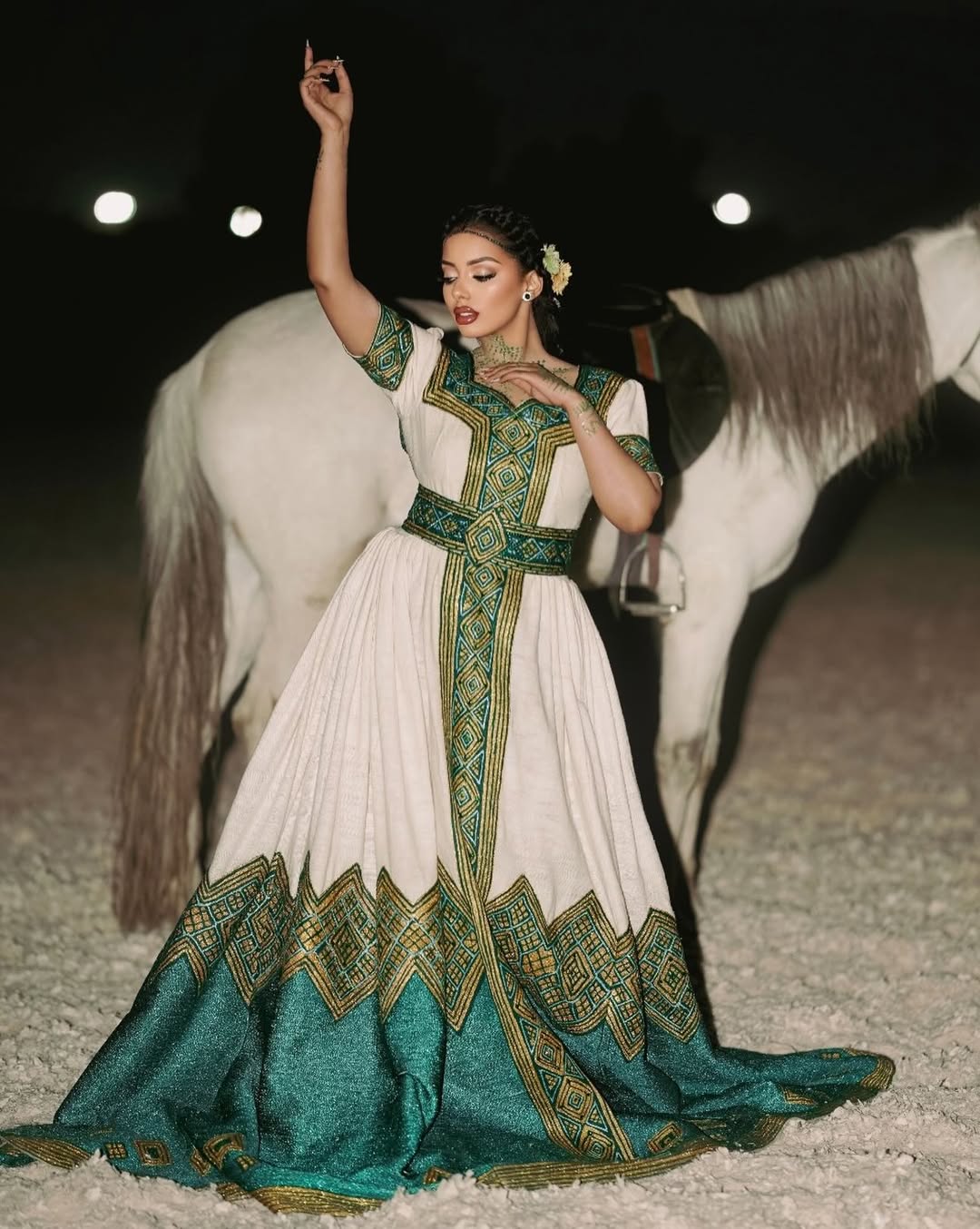
- The second style, Weraj Tilet (Amharic: ወራጅ ጥለት), meaning “border that runs down”, features a vertical tibeb strip that runs from the chest down to the bottom hem, elongating the silhouette and drawing the eye downward. It is often chosen for more formal or structured garments.
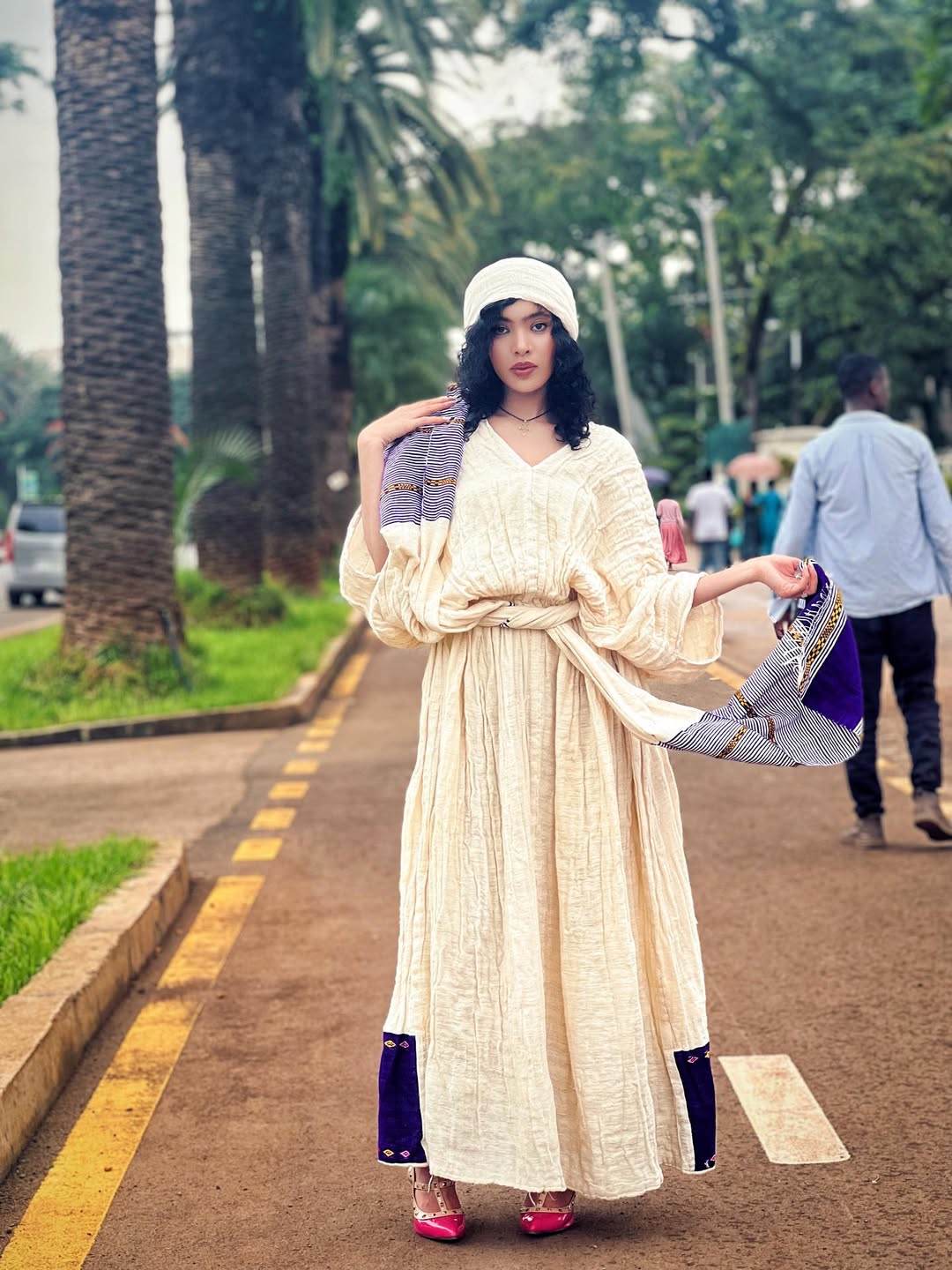
- The third style, Gemash Tilet (Amharic: ግማሽ ጥለት), meaning “half border”, places the border only on the lower half of the dress’s back. Subtle and understated, it is commonly worn for everyday occasions or as part of minimalist designs.
Though distinct in form, all three styles are united by the use of tibeb, the decorative woven or embroidered work that carries regional identity and aesthetic lineage.
Among the most distinctive borders are the vibrant green border symbolising Shewa’s lush landscape and the festive red jano representing power and high status, primarily worn by members of the aristocracy and high-ranking officials.
The Fabrics That Define Shewa Amhara Dress

The beauty of the Shewa Amhara dress lies not only in its design but also in the fabric (shemma) used to construct it.
- The most foundational variety of shemma is fetel (ፈትል), a hand-spun and hand-woven fabric with a soft, breathable texture similar to gauze. Fetel is prized for its durability and its ability to hold tibeb borders without distortion. Fetel is the fundamental variety of shemma used for all Amhara dresses, including Shewa Amhara dresses.
- The second fabric, menen (መነን), holds a special place in the Shewa Amhara textile tradition. It is a type of schema specific to Shewa, Amhara. The first menen shemma was produced in the 1890s in the sheds of what is now Shiro Meda by Amhara master weavers. The Ankober weavers who settled in Addis Ababa developed a finer, softer, and more meticulously woven shemma specifically for garments used by the royal court. Its rise to prominence, however, is closely tied to the era of Empress Menen Asfaw, consort of Emperor Haile Selassie. The menen dress was popularised during her time in the royal court. Because Empress Menen was widely admired for her elegance, modesty, and dignified presence, the fabric quickly gained prestige. It came to be known as Menen shemma, directly named in her honour. As the royal household embraced this elevated textile, Addis Ababa’s urban Amhara community championed it as a marker of sophistication and modernity.
The menen dress stands out as the signature dress of Addis Ababa’s Amhara community, a refinement of Shewa tradition shaped by the city’s artisans and courtly influences. Today, whether worn in the capital, in the countryside, or by admirers from other backgrounds, the dress retains its identity. It is, at its core, a fundamental Shewa Amhara garment, defined by Amhara craftsmanship, aesthetics, and textile heritage.

- The third fabric, saba (ሳባ), is a shiny, premium textile woven from fine, colourful cotton, often blended with rayon or silk threads. It is part of a broader hierarchy of Amhara royal attire. This fabric was a primary marker of the aristocracy. Today, saba fabric is no longer restricted to royalty. It is a signature fabric specifically used in authentic Shewa Amhara dresses. Saba is also woven into the menen dress borders as tibeb embroidery. Saba fabric is known for its lustrous finish, intricate colour combinations, and high thread count, which add depth and brilliance to the dresses they adorn.
Two-Piece Set With Matching Pants
Another defining feature of Shewa Amhara dress culture is that the dresses are also traditionally designed as a two-piece set called Bale Albo kemis (ባለአልቦ ቀሚስ), consisting of the dress and matching embroidered cotton trousers. These trousers are not an afterthought but a practical and cultural component of Highland life. The Shewa region’s cold climate, especially in the early mornings and evenings, made the additional layer necessary for warmth and comfort. To accommodate these trousers, the dress length varies. It can be designed as a short or knee-length garment, a look particularly popular as the Addis Ababa Amhara style, or it can extend to the ankles, which remains the customary length throughout the broader Shewa region. Women wear trousers when the weather calls for them or for modesty during daily tasks, and go without them during warmer hours. This two-piece structure, adaptable in length but consistent in purpose, remains a quiet but enduring hallmark of Shewa Amhara dressmaking.
Ethiopian Airlines and the Global Visibility of the Shewa Amhara Dress
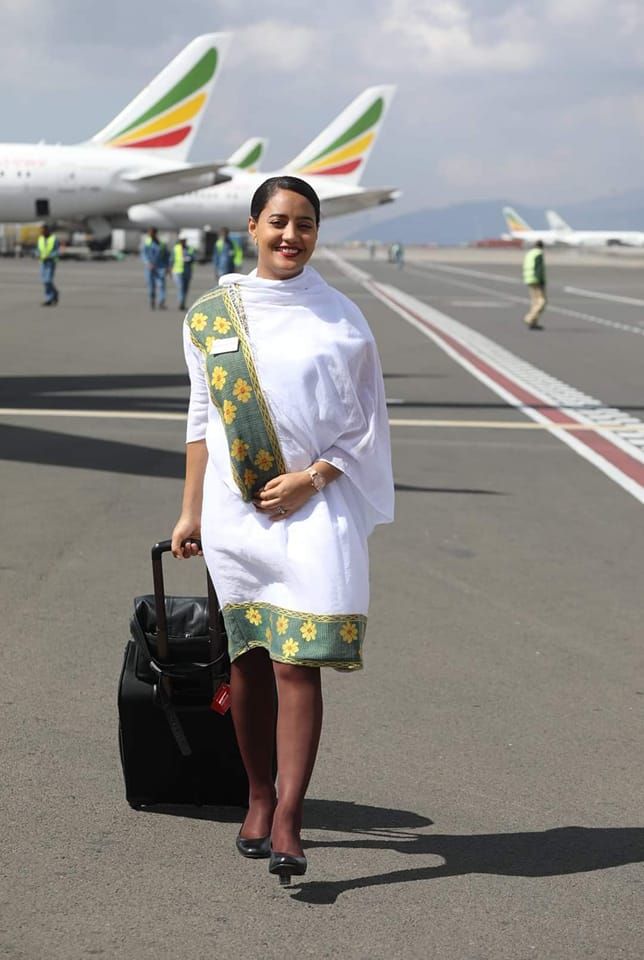
One of the most defining moments in the modern visibility of the Shewa Amhara dress came when Ethiopian Airlines selected the Zuria Tilet dress as the uniform for its cabin crew. The airline did not choose a generic “Ethiopian” garment; it chose a distinctly Shewa Amhara dress, with fundamental elements including the white Menen shemma base, the circular tilet, the refined tibeb, and the Menen silhouette. When flight attendants walk through international airports, they are wearing a garment that is recognisable and fundamentally Amhara.
This decision carried cultural weight. Ethiopian Airlines became the vehicle through which the world encountered the Shewa Amhara dress. The uniform projected Amhara textile heritage onto a global stage. The Zuria Tilet became internationally iconic precisely because it remained true to its origins: a Shewa Amhara creation defined by Amhara craftsmanship, aesthetics, and weaving traditions.
ALSO READ
- Afar Women’s Traditional Dress: Identity Woven in Colour and Climate
The Itsekiri Wrapper: How a Niger Delta Textile Encodes Social Rank - Kente and Its Keepers: Why Akan Weaving Is Not a Symbol but a Statement
- From Ceremony to Streetwear: How African Textile Traditions Survive Modernisation
THE OMIREN ARGUMENT
The Shewa Amhara dress became the world’s image of Ethiopian elegance because Amhara craftsmanship is precise enough to travel. Calling it simply “Ethiopian” is not a celebration. It is a subtraction.
When a garment crosses borders, the story that travels with it is rarely complete. The Habesha kemis reached international airports, diplomatic receptions, and global fashion conversations carried by Ethiopian Airlines, a state institution with the reach to make one regional silhouette synonymous with an entire nation. That visibility was real. What it left behind was also real: the name of the people who built it.
The Shewa Amhara dress is not a generic national garment that happened to originate somewhere. It is the product of a specific loom, a specific cotton tradition, and a specific aesthetic lineage developed by Amhara weavers in the highlands of central Ethiopia over centuries. The narrow loom determines the strip width. The strip width determines the construction. The construction produces the silhouette. Remove Amhara weaving knowledge from that sequence, and the dress does not exist. There is no version of the Habesha kemis that is culturally neutral because neutrality was never part of its making.
What complicates attribution is not malice but momentum. As Addis Ababa grew into a political capital, the dress of its dominant weaving community became the dress of the city, and then the dress of the state. Each layer of adoption smoothed over the layer beneath it. By the time the Zuria Tilet appeared on international flight routes, it had already been folded into a national identity that made the question of origin seem secondary. It was not secondary. It was the whole point.
Omiren Styles holds that the Shewa Amhara dress deserves to be named correctly every time it is discussed, styled, or sold. Non-Amhara women who wear it for weddings and ceremonies are not doing anything wrong. Admiration across communities is legitimate. But admiration is not the same as attribution, and the fashion and cultural media that continue to describe the Habesha kemis as simply “traditional Ethiopian dress” without naming its Shewa Amhara origin are making an editorial choice, whether they recognise that or not. Precision is not gatekeeping. It is the minimum the dress is owed.
A Dress Admired by Many, Rooted in Amhara Identity
As Addis Ababa grew into a political and cultural centre, the Shewa Amhara dress became increasingly visible across Ethiopia and the diaspora. Non-Amhara women across Ethiopia and Eritrea began wearing it for weddings, holidays, and formal occasions; not because it has become a shared national garment, but because its beauty, refinement, and craftsmanship were widely admired. Its defining elements, however, the shemma base, the Menen fabric, the fetel weave, the characteristic tilet, and the distinctive Saba tibeb embroidery remain unmistakably Amhara.
A Living Tradition
Today, the Shewa Amhara dress continues to evolve. Designers experiment with new cuts, colours, and fabrics, but the core elements remain handwoven shemma, tibeb borders, and the three signature styles of Zuria, Weraj, and Gemash borders. Shiro Meda remains a centre of weaving, though modernisation has introduced machine looms and synthetic threads. Still, many families continue to produce fetel, Menen, and Saba by hand, preserving the techniques passed down for generations.
The Shewa Amhara dress is more than clothing. It is a textile archive, a cultural emblem, and a national symbol. It is a garment that carries the history of a people, the craftsmanship of generations, and the identity of a nation stitched into every border. And at its centre stands the Zuria Tilet dress, the Shewa Amhara dress that truly captivated the world.
FAQs
1. What is the Shewa Amhara dress?
The Shewa Amhara dress, known as the Habesha kemis, is a handwoven cotton gown produced by Shewa Amhara weavers using a narrow-loom technique. It is constructed by stitching long strips of handwoven cotton fabric called shemma side by side, then bordered with tibeb, an intricate woven pattern that carries regional identity. The dress exists in three main border styles: Zuria Tilet, Weraj Tilet, and Gemash Tilet, each suited to different occasions and aesthetics.
2. What is the difference between shemma, fetel, Menen, and Saba?
Shemma is the overarching name for the handwoven cotton cloth used in Amhara dress culture. Fetel is the foundational variety: hand-spun, hand-woven, and used across all Amhara dress traditions. Menen is a finer, more meticulously woven type of shemma developed by Ankober weavers in Addis Ababa and named after Empress Menen Asfaw. Saba is a premium fabric blended with rayon or silk threads, originally reserved for the aristocracy and now used as a marker of occasion and elevated style in authentic Shewa Amhara dresses.
3. Why does Ethiopian Airlines use the Shewa Amhara dress as its cabin crew uniform?
Ethiopian Airlines selected the Zuria Tilet dress, the most iconic of the three Shewa Amhara border styles, as its cabin crew uniform because it was the most recognisable garment associated with Addis Ababa’s cultural identity at the time. The airline’s choice projected the dress onto an international stage. Structurally, the uniform uses the white Menen shemma base, the circular tilet border, and the refined tibeb embroidery. It is a Shewa Amhara garment, and remains so regardless of how broadly it has been described.
4. What is tibeb, and why does it matter?
Tibeb is the intricate, multicoloured woven pattern integrated directly into the shemma fabric during weaving. It is not surface decoration applied after the fact. Tibeb is produced on the loom, which means the pattern and the cloth are made simultaneously. Each tibeb arrangement carries regional, social, and aesthetic coding: the colours, width, and placement of the border communicate the wearer’s community, occasion, and the weaver’s lineage. In Shewa Amhara dressmaking, tibeb is the primary visual language of cultural identity.
5. Is the Habesha kemis worn only by Amhara women?
No. Non-Amhara women across Ethiopia and Eritrea wear the Habesha kemis for weddings, religious holidays, and formal occasions. Its craftsmanship and elegance have made it widely admired across communities. However, admiration and adoption do not alter the garment’s origins. The Habesha kemis remains a Shewa Amhara creation in its fabric, construction, visual grammar, and naming. Wearing it across communities is a form of cultural appreciation. The breadth of its following does not erase the dress’s roots in the Amhara weaving tradition.