The football jersey is a specific object. It carries allegiance: to a team, a nation, a city. When it leaves sport and enters fashion, it does not shed that allegiance. The jersey retains the idea of belonging, of identifying with something collectively, of being part of a group that the garment makes visible. What a brand does with that residual meaning determines whether the fashion jersey is merely a reference to sport or does something more interesting.
Daily Paper’s SS19 Ghana campaign, released in July 2019, is one of the more considered examples of what that something more interesting can look like. The Amsterdam-based brand took its summer football jersey capsule to Accra and shot it with Ghana’s emerging musicians. Not to borrow the musicians’ cultural credibility as decoration for a product. To make an argument about the music scene, the jersey’s relationship to African culture, and the collective image a group of individual artists can create when photographed together in the same garment.
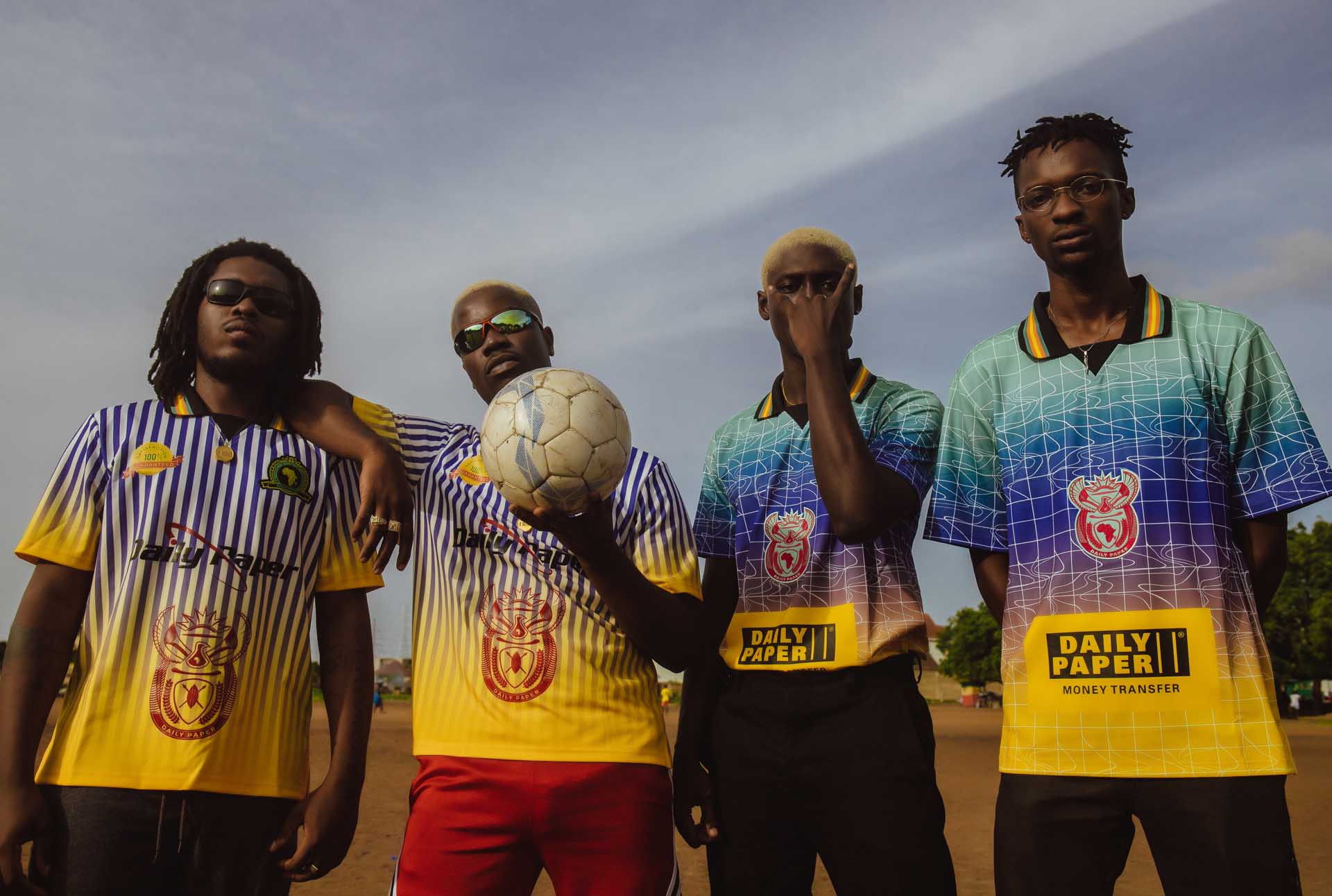
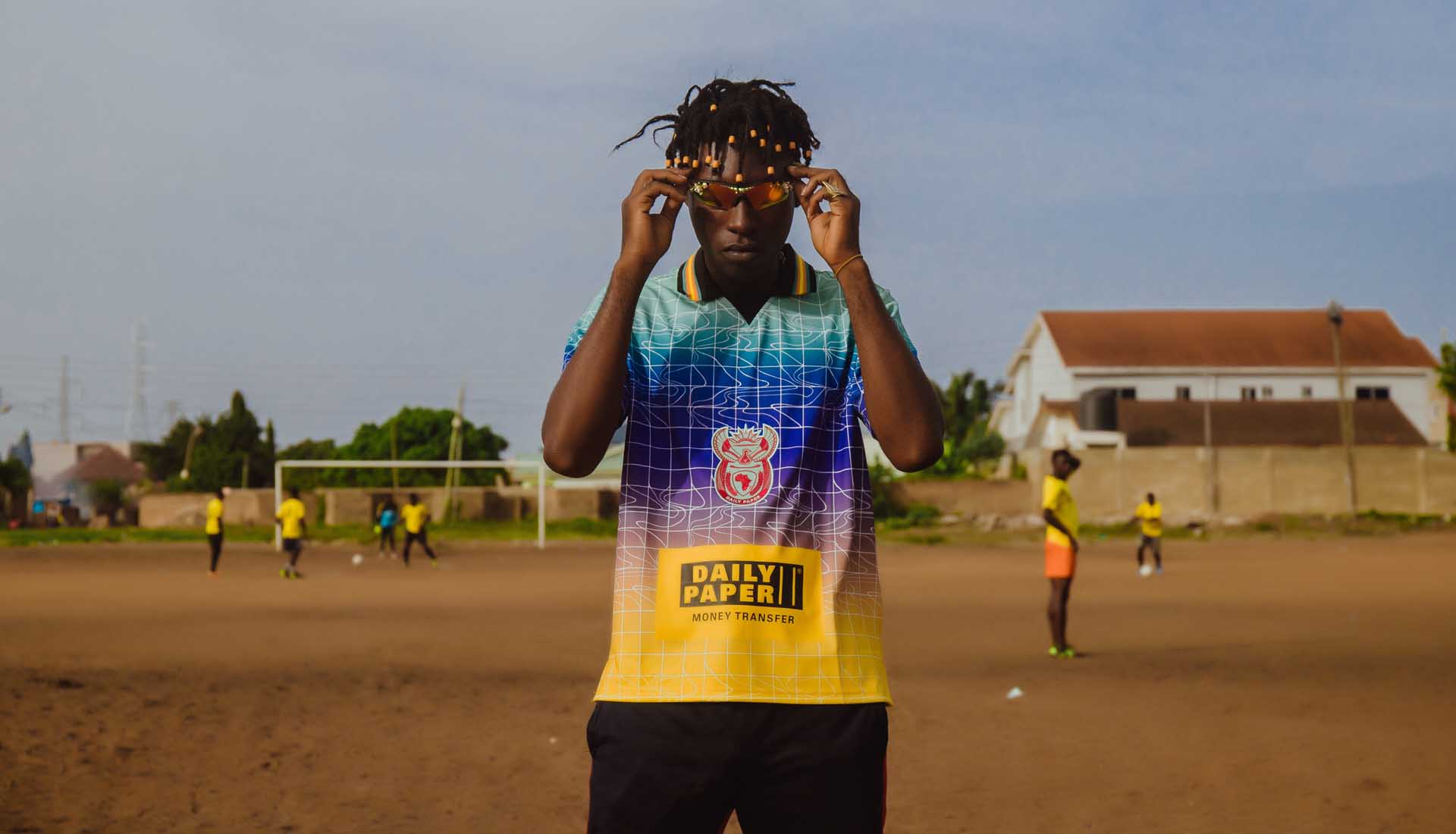
The campaign featured King Promise, Joey B, KillBeatz, Kwamz and Flava, and members of La Meme Gang, including Darko Vibes, RJZ, $pacely and Kiddblackrapgod. TSE, a Lagos-born photographer, shot the photographs in Ghana. The garments were Daily Paper’s football jerseys for SS19: oversized shapes, a gradient stripe design, the brand’s characteristic colour handling.
Daily Paper’s 2019 Ghana campaign put King Promise, Joey B, KillBeatz and La Meme Gang in football jerseys and shot them in Accra. This analysis examines what the campaign did, how it built a collective image, and why the model has continued.
What the Campaign Was Saying
Isaac Tremaine Kimbugwe, Daily Paper’s head of culture, explained the campaign’s position in a statement that is worth reading carefully: ‘In Ghana, there is an openness to explore new sounds, while daring and talented artists are navigating a shifting musical landscape thanks to their devotion and enthusiasm. We are big fans of African music and have been particularly in tune with Ghanaian Afrobeats, dancehall, and hip life. All of these artists are part of a new school of African artists who are cruising a shifting musical landscape on their own terms.’
That statement does several things. It positions Daily Paper as a brand with specific cultural knowledge rather than a general interest in African aesthetics. It names the music genres (Afrobeats, dancehall, hiplife) rather than describing the scene generically. It frames the artists as navigating a changing landscape on their own terms, not defined by external validation. It uses the phrase ‘new school’ to position these artists not as heritage or tradition, but as the current, forward-moving edge of something.
The photographer, TSE, described his aim in the campaign in terms that reinforce the argument for a collective image. ‘I want to document our peculiarities and show the world we are one, but we’re also our own elements.’ That formulation – one but also our own elements – is the exact tension the campaign is designed to hold. The jersey is the shared element: every artist is wearing Daily Paper. The individuality lies in the photographic handling: each subject is distinct, bringing a different energy to the same garment. The campaign works because it makes the jersey feel like a collective statement rather than a uniform.
The Jersey as the Collective Object
The football jersey’s specific semiotic value is that it already belongs to a language of belonging. A shirt that a group wears produces, in the image, a shared identity that a shirt worn by one person cannot. When a campaign dresses eight musicians in the same garment and photographs them together, it creates a visual statement about those musicians as a group. That group may not have formally existed before the campaign. The campaign makes the group legible.
This is what makes the Daily Paper Ghana campaign more than a product shoot with celebrity talent. King Promise, Joey B, KillBeatz, Kwamz, Flava, and the La Meme Gang members aren’t positioned as Daily Paper’s brand ambassadors endorsing a product. They are positioned as a scene: a collectively legible group of artists who share a musical moment and, through the jersey, a visual identity. The jersey doesn’t make them a group that wasn’t a group. But it creates an image of that group that the music alone could not.
The campaign also positions Daily Paper within that group. A brand that shoots its jersey with eight of Ghana’s emerging musicians in Accra is not describing African culture from the outside. It claims membership in a cultural network that extends from Amsterdam to Accra, including the musicians, the Lagos-born photographer, and the brand itself. Whether that claim is accurate depends on how deep the relationships are. Regardless of those relationships, the campaign image visually evidences a network.
What TSE’s Framing Adds
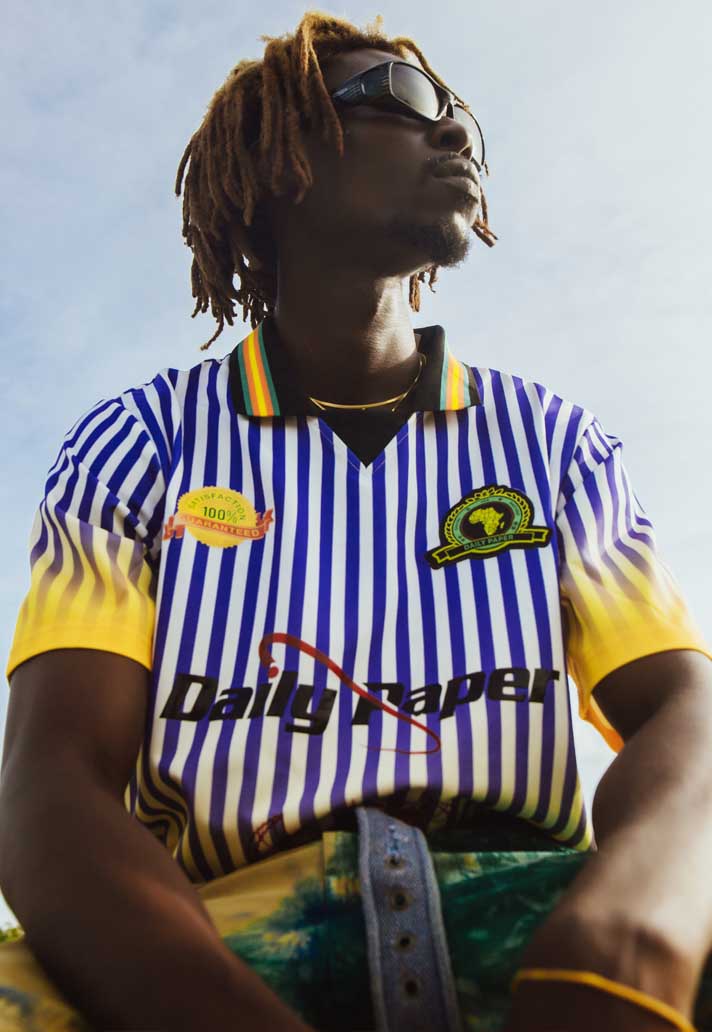
The choice of photographer matters for how this campaign argument is made. TSE is Lagos-born, so his presence behind the camera supports the campaign’s claim about cultural geography. The campaign is not a European brand arriving in Africa with European visual sensibility. It is a European brand arriving with a photographer from within the African creative network to photograph Ghanaian artists. The line from Lagos to Accra to Amsterdam is the network the campaign images trace.
TSE’s framing of his own practice, documenting peculiarities and showing the world we are one but also our own elements, describes the specific challenge collaborative African image-making faces. A campaign that presents African creative figures as a unified scene risks reducing their diversity to a single representational image. A campaign that insists on each individual’s distinctiveness risks not conveying the scene at all. TSE’s formulation holds both simultaneously, and the campaign images apparently do the same: the jersey creates the collective; the individual subjects maintain their own energy within it.
I want to document our peculiarities and show the world we are one, but we’re also our own elements. – TSE, photographer, Daily Paper Ghana Campaign, 2019
How the Model Has Continued
The Daily Paper Ghana campaign was produced in 2019. The model it used, Ghanaian musicians as campaign anchors for sportswear-adjacent fashion with a strong cultural frame, has since been adopted by campaigns at a significantly larger scale. In March 2026, Puma released the Ghana Black Stars 2026 World Cup kits, unveiled in a street festival in Brooklyn with Ghanaian musician Black Sherif as the campaign face, alongside visual art by Ghanaian artist Prince Gyasi. The jersey is cultural, and the musician proves it: the same structural argument Daily Paper made in Accra in 2019.
The Puma campaign operates at a different scale – a World Cup kit is global sportswear at the level of national identity, not a capsule collection from an independent brand. But the visual logic is continuous. The Ghana jersey is designed not only as sportswear but as a cultural document: the 2026 home kit carries a cobweb motif inspired by Kwaku Ananse, the spider figure in West African folklore; the away kit references Makola Market in Accra. The musician in the campaign image is not simply a famous face lending the garment recognition. The musician and the garment both express the same cultural argument.
Campaign analysis often defers the question of who gets credit in that argument, whose cultural knowledge the jersey draws on, whose image the campaign trades on, and what each party in the network receives in return. The Daily Paper campaign’s cultural framing, and Kimbugwe’s quoted explanation, is more explicit than most brands provide. It names the genres, names the artists, and positions the brand’s cultural attunement as something developed over time rather than arrived at opportunistically. Whether that framing reflects the actual terms of the creative relationships is a question that the campaign images cannot answer.
What the Collective Image Does
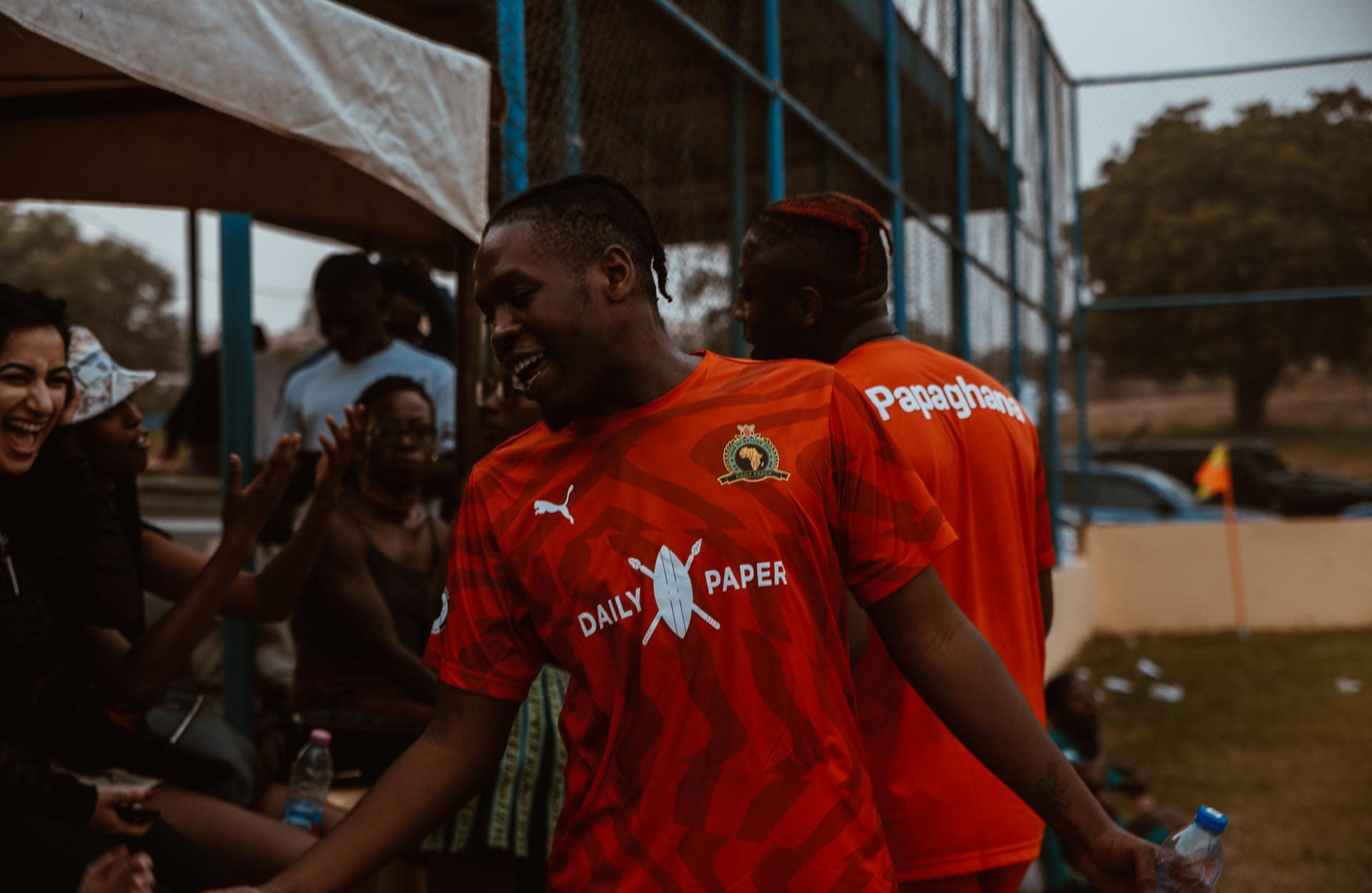
A campaign that produces a collective image – multiple subjects, same garment, shared setting – is making a claim that none of those subjects could make individually. It says, ‘This group exists, this group is coherent, and this group shares something.’ The jersey is the physical evidence of the shared thing. The photograph records the group. The viewer receives not eight separate product shots. It is a scene.
For an Amsterdam brand making jerseys with African cultural influence, a scene shot in Accra with Ghanaian musicians locates the cultural argument where the culture lives, rather than in a studio in Amsterdam, where it would be abstraction. The Ghanaian backdrop, the Ghanaian artists, the Lagos photographer – each is part of the argument’s geography. The jersey travels from Amsterdam to Accra because that is where the cultural reference is, and the campaign image records that journey.
Campaigns that build collective images from African creative scenes are part of a wider image-making practice that insists on placing the cultural argument in the context of the people who hold it. The Daily Paper Ghana campaign did that in 2019. The Puma Ghana 2026 campaign did it at a larger scale. Each campaign leaves open the question of whether the collective image it builds persists beyond the campaign season or disappears after the campaign ends.
What the Analysis Cannot Confirm
This article has read the Daily Paper Ghana SS19 campaign from its publicly available coverage: The Fader, SoccerBible and Versus UK. None of those sources provides the following: the specific terms under which the musicians participated, whether any of the campaign’s revenue was shared with the Ghanaian creative community, how the campaign was received by the musicians and the Accra creative community at the time, or whether any of the relationships the campaign made visible resulted in ongoing collaborations. The campaign images and available press coverage do not answer those questions.
Reading campaign images is a different practice from reading what the campaign produced for the people in it. The collective image is real. What it represents about the terms of the collaboration is separate from what it shows.
ALSO READ
- The Global South Made Fashion. It Just Never Got Credit.
- The Material File: ‘Threads of Heritage’ Connects Nigerian Textile Practice to Atlanta
- Who Made This Fashion Image? Reading Adut Akech’s Vogue Australia Cover Credits
- The Back of the Look: What a Front-Facing Runway Photograph Leaves Out
Frequently Asked Questions
What was the Daily Paper Ghana campaign?
Daily Paper’s Ghana campaign was a summer 2019 (SS19) campaign for the Amsterdam-based brand’s football jersey capsule collection, shot in Ghana by Lagos-born photographer TSE. The campaign featured Ghanaian musicians King Promise, Joey B, KillBeatz, Kwamz, and Flava, as well as members of La Meme Gang, including Darko Vibes, RJZ, $pacely, and Kiddblackrapgod. It was released in July 2019.
Who were the musicians in the Daily Paper Ghana campaign?
The campaign featured King Promise, Joey B, KillBeatz (also credited as Killbeatz), Kwamz and Flava, and members of La Meme Gang: Darko Vibes, RJZ, $pacely and Kiddblackrapgod. Daily Paper’s head of culture, Isaac Tremaine Kimbugwe, described them as part of a new school of African artists navigating a shifting musical landscape on their own terms, working across Afrobeats, dancehall, and hiplife.
Who photographed the Daily Paper Ghana campaign?
TSE, a Lagos-born photographer, shot the campaign. TSE described his approach as wanting to document his subjects’ peculiarities while showing the world they are one, but also their own elements, conveying both collective identity and individual distinctiveness through the same images.
What does Daily Paper as a brand do?
Daily Paper is an Amsterdam-based fashion brand that describes itself as African culture-infused and has built its identity around African creative culture and music. The brand has partnered with artists, including Wizkid, for the Ghana campaign. Its football jersey capsule collections have repeatedly served as a format for cultural collaborations. The brand’s head of culture at the time of the Ghana campaign, Isaac Tremaine Kimbugwe, articulated the brand’s position as being specifically attuned to Ghanaian Afrobeats, dancehall and hiplife.
How has the model of using Ghanaian musicians in jersey campaigns developed since 2019?
In March 2026, Puma released the Ghana Black Stars 2026 World Cup kits using a similar model at a significantly larger scale: Ghanaian musician Black Sherif fronted the campaign alongside visual art by Ghanaian artist Prince Gyasi. The jerseys featured cultural references, including a cobweb motif inspired by the Kwaku Ananse folklore figure and a yellow away kit referencing Makola Market in Accra. The article’s structural argument, that Ghanaian musicians serve as cultural evidence for a culturally grounded jersey design, mirrors the Daily Paper 2019 approach, applied to a World Cup kit.
What does the article not confirm about the Daily Paper campaign?
This article reads the campaign from publicly available press coverage. It does not confirm the specific terms of the musicians’ participation, whether the campaign shared any revenue with the Ghanaian creative community, how the musicians and the Accra creative scene received the campaign, or whether the relationships the campaign made visible led to ongoing collaborations. Those questions remain outside what the available campaign coverage can establish.