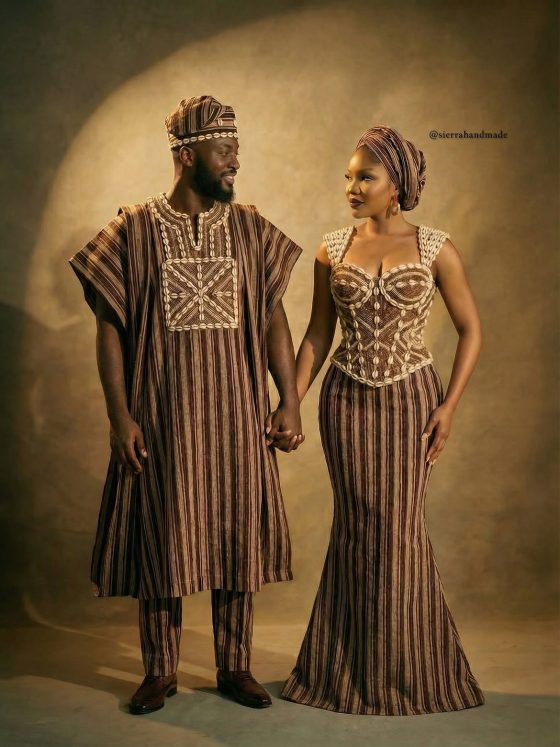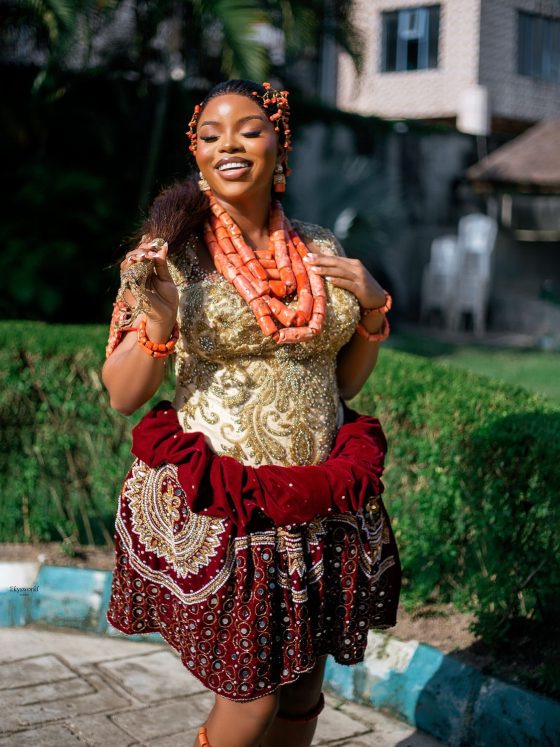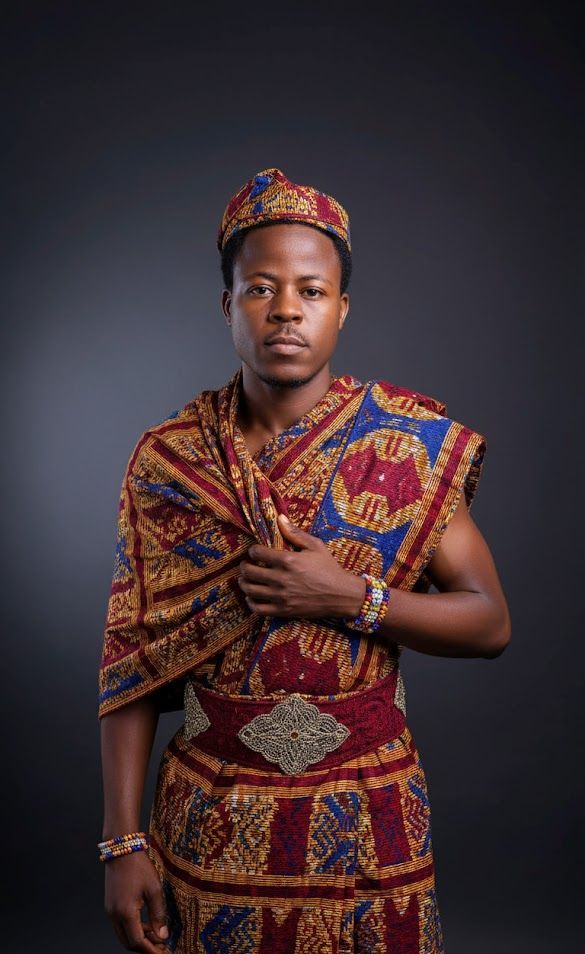
Cameroonian Toghu menswear has been present in the Grassfields of Northwest Cameroon since at least 1919, and within that region’s communities for far longer. The African fashion market is worth 31 billion dollars, and Toghu represents one of the most precisely governed textile traditions within it: a garment in which every motif is a statement of social position, every animal design is a declaration of rank, and every stitch is applied according to rules that predate any contemporary fashion market by several centuries. The diaspora communities wearing it across Europe and North America are not adopting a trend. They are maintaining an authority system at a distance, in the only medium that travels without losing its original instruction.
Toghu, also written as Atoghu, originates from three villages of the Mezam division in Northwest Cameroon: Bafut, Mankon, and Nkwen. These Grassfields communities developed the garment within a political system governed by the Fon, the traditional chief whose authority over his chiefdom is total in ceremonial and spiritual terms. The Toghu is the textile expression of that system. What the garment says about who is wearing it, and under what authority, is legible to everyone in the community present. When the same garment appears at a wedding in London or a cultural event in Washington, it carries the same instruction for those with the knowledge to read it.
Toghu is not embroidery on velvet. It is a complete authority system from the Grassfields of Cameroon, encoded in stitch, worn across the diaspora, and still arriving.
The Origin and Authority of Cameroonian Toghu Menswear
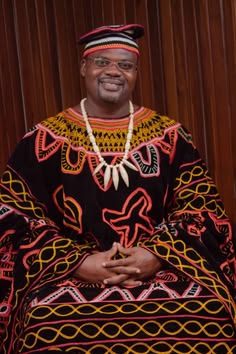
The documented origin of Toghu in its current form traces back to around 1919, when a Portuguese trader introduced the black velvet cloth to the Grassfields region. As Embroydica’s documented history of the garment confirms, the original cloth carried 63 motifs. The people of Mankon selected specific motifs from among these and used them to create the Mankon Toghu, which became their traditional dress. Over time, Grassfields communities in the Northwest developed their own distinct embroidery styles, giving the garment an indigenous identity that moved well beyond its imported material base. The velvet was the Portuguese trader’s contribution. What the Grassfields communities did with it was entirely their own.
Before 1919, the Grassfields communities had existing textile traditions using raffia, bark cloth, and locally woven cotton. The velvet base arrived and was adopted precisely because its weight and texture suited the visual language of authority that the Toghu needed to project. Heavy, resistant to wear, with a surface that takes embroidery in relief rather than flat: the velvet communicates formality before a single motif is applied. What the Bafut, Mankon, and Nkwen communities recognised in the Portuguese trader’s cloth was a surface adequate to the message they had been encoding in other materials for generations.
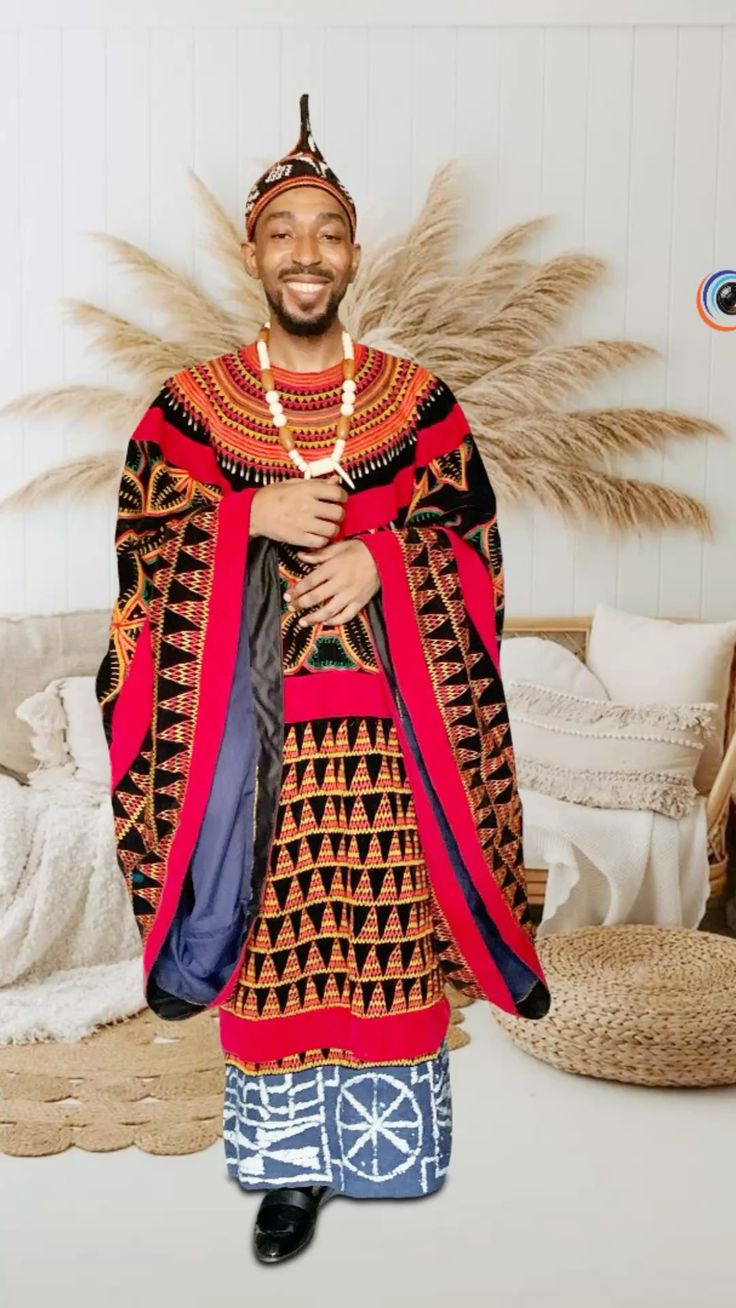
The authority encoded in the motifs is the governing principle of the garment. As documented research on the Bafut tradition confirms, the lion and the tiger are worn only by the Fon, the traditional chief of the Northwest. Animal skin designs appear only on the Toghu of first-class nobles. The gong motif, embroidered at a prominent position on the tunic, represents traditional Bafut authority directly: the gong is the instrument sounded during traditional ceremonies, and by a change of rhythm alone it announces whether war, a palace ceremony, or a community dance is coming. The gong on the Toghu is not decorative. It is the instrument itself, rendered in stitch, declaring that the wearer carries the authority of the palace.
In Bafut tradition, the Fon alone wears the lion and the tiger on his Toghu. A change of rhythm on the gong embroidered at the chest announced whether a ceremony, a dance, or war was coming. The garment was not clothing. It was governance.
What the Embroidery Says: A Reading of Toghu Motifs

The motif vocabulary of Toghu is one of the most thoroughly governed in West and Central African textile traditions. A 2023 peer-reviewed study published in the journal Art and Design Review on the identification of symbols used as motifs in Toghu production documented that the criteria for selecting motifs are not aesthetic but semantic: the motifs communicate wisdom, unity, social distinction, cultural values, and cross-cultural exchange. The study established that each motif selection is a deliberate encoding of social and cosmological meaning, not an aesthetic choice made at the discretion of the wearer or maker.
The confirmed motif vocabulary includes moons, gongs, animals, diamonds, stars, and geometric shapes. The plant of peace, a recurring element across Grassfields communities, is the traditional symbol of peace, love, and unity throughout the region. The original colours used were black for the velvet base, with white, red, and multicoloured thread for the embroidery. Contemporary production uses vivid acrylic yarns in yellow, orange, ochre, red, and white, applied first by chalking the motif outline onto the velvet and then stitching by hand or by machine. The raised texture of the embroidery against the heavy velvet creates the visual authority the garment requires: the motif stands up from the surface, visible across a ceremony hall, declaring its meaning at a distance.
Different sizing and shaping of the same motifs mark different cultural categories: designs specified for children, males, and females differ in their proportions and placement. As Afroculture’s documentation of the garment confirms, in strict traditional etiquette, Toghu is male attire. The traditional dress for women in Grassfields communities is the blouse and loincloth. The Toghu that women now wear at ceremonial occasions represents an evolution from this strict original protocol. The garment has moved, as all living textile traditions do, but its original governance system was male, hierarchical, and precise.
Toghu and Its Global Trajectory: From Palace to Diaspora
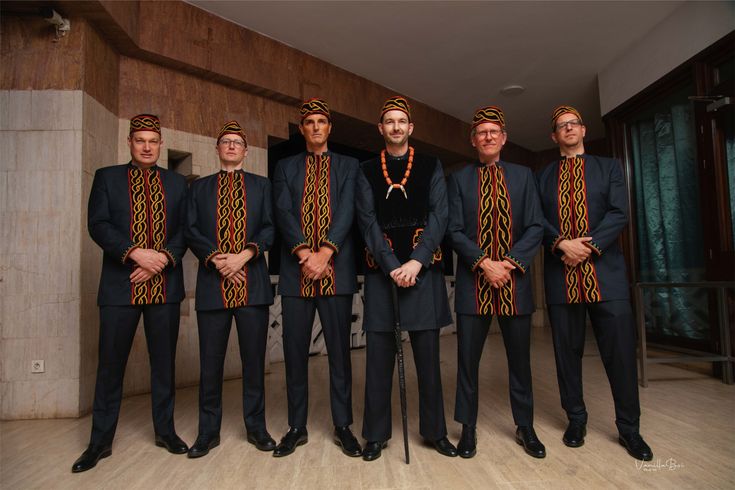
Two events placed Toghu in front of international audiences in ways that domestic ceremonial life had not. In 2012, the Cameroon Athletics team wore Toghu at the London Olympics, a national dress choice at the world’s most-watched sporting event, reaching an audience measured in hundreds of millions. The second was the work of designer Kibonen Nfi, credited with showcasing Toghu internationally across fashion contexts where African heritage dress had not previously been visible. Both events did the same thing: they placed a Grassfields governance textile in front of audiences who had no prior knowledge of what its motifs meant, but who could see immediately that it carried authority.
Blair Underwood, the African-American actor, had his DNA tested and traced his origins to Cameroon. He subsequently wore Toghu. The encounter captures the diaspora dynamic exactly: a person of African descent, disconnected from the specific community whose governance system Toghu encodes, finds the garment through genetic return and wears it as an identity statement. The motifs he wore communicate specific things within the Grassfields cosmological system. He wore them because they were his. The gap between those two truths is where the diaspora Toghu conversation lives.
For Cameroonian communities in Europe and North America, Toghu appears most visibly at weddings, cultural events, independence celebrations, church services, and family gatherings. As Bella’s Kreation’s documentation of the garment’s contemporary trajectory confirms, the embroidery designs reflect symbols of fertility, prosperity, protection, and ancestry, the full range of what Grassfields communities have always encoded in the garment. In the diaspora context, those meanings travel intact. The community that can read the motifs is present at the ceremony. The garment communicates to them exactly what it was designed to communicate. It communicates to everyone else something simpler and equally important: that the person wearing it knows who they are.
Contemporary Toghu Production and the Craft Economy
A 2026 study published in the Art and Design Review journal on tools, equipment, and materials in contemporary Toghu production documented how the craft is transmitted and sustained in the Grassfields region. The production chain involves tailors who cut and construct the velvet base, embroidery specialists who apply the motifs by hand or machine, and textile businesses that supply the materials. The skills pass between generations through apprenticeship, and the garments are made to order for specific occasions rather than mass-produced for general retail.
The challenge of mass-produced imitation is the most acute pressure facing Toghu production. Embroidery can be replicated by machine at a fraction of the time and cost of hand production, and the visual similarity between a handmade Toghu and a machine-produced imitation is not immediately apparent to a buyer without knowledge of the original. For artisans whose livelihoods depend on the authority their craft carries, the imitation market is an economic threat and a cultural one: if the motifs that communicate specific meanings are reproduced without the knowledge of what they mean, the garment’s governance system is hollowed out while its visual form survives.
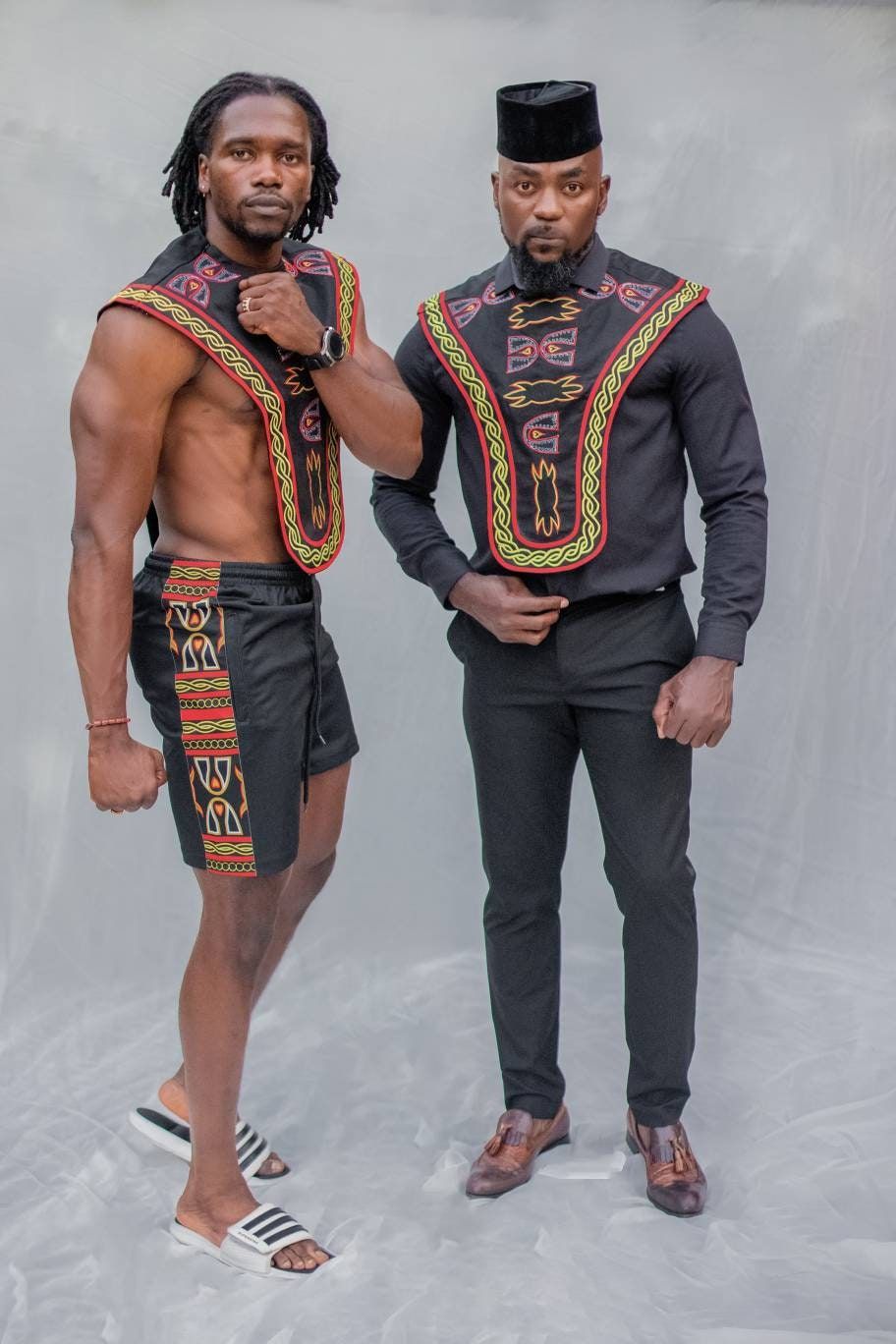
The contemporary menswear adaptations of Toghu, including embroidered jackets, fitted blazers, formal shirts, and two-piece suits, address a different pressure: the demand for garments that carry Toghu’s visual identity without the full ceremonial weight of the traditional outfit. These pieces circulate in the diaspora and among younger Cameroonian men who want to wear the cultural identity of Toghu in contexts where the full tunic, matching trousers, and embroidered cap would be considered formal or ceremonial overstatement. The adaptation is not dilution. It is the same logic that has always governed how heritage dress moves across contexts: the essential communication survives in a modified form adequate to the new occasion.
The Omiren Argument
Cameroonian Toghu menswear is the most rule-governed sartorial system in Central African fashion, and its documentation in international fashion editorial is almost entirely absent. A peer-reviewed study on Toghu motif selection was published in 2023. A second study on Toghu production tools and materials was published in 2026. The academic record is ahead of the editorial record. In the Grassfields of Northwest Cameroon, the Fon alone wears the lion and the tiger. First-class nobles alone wear animal skin designs. The gong motif announces palace authority. The plant of peace announces unity across the entire region. Every motif selection is a governed choice with a documented social consequence. The garment that communicates this system was present at the 2012 London Olympics. It is being worn at weddings in London and Washington by people whose families left the Grassfields one, two, or three generations ago. The African fashion market is worth 31 billion dollars. Toghu’s contribution to that figure is made by tailors and embroidery specialists in Bafut, Mankon, and Nkwen who are transmitting a governance system through stitch. That is what Omiren Styles is here to document.
The diaspora wearing Toghu at a wedding in East London is not simply wearing heritage dress. They are wearing a complete authority system that survived the distance because it was encoded in a medium that travel cannot erase. The motifs that communicate wisdom, unity, social distinction, and cultural values, confirmed by peer-reviewed research, do not lose those meanings when the garment crosses from Bamenda to Brixton. They carry them forward. The argument Omiren Styles makes here is not that Toghu is gaining diaspora attention because African fashion is gaining global attention, though that is also true. The argument is that Toghu was always this precise, this hierarchical, and this semantically complete, and that the fashion editorial record is only now beginning to say so.
Also Read
- Beninese Bridal Fashion: Fabric, Ceremony, and the Ancestors Whose Blessing the Marriage Requires
- The Evolution of Bridal Fashion in Nigeria: From Tradition to Statement
- Lesotho’s Basotho Blanket: The Story of a Colonial Trade Good That Became a Symbol of Sovereignty
Frequently Asked Questions
What is Cameroonian Toghu menswear and where does it come from?
Cameroonian Toghu menswear, also known as Atoghu, is a traditional embroidered garment originating from three villages of the Mezam division in Northwest Cameroon: Bafut, Mankon, and Nkwen. These are communities in the Grassfields region, governed by the Fon, the traditional chief whose authority is expressed through the garment’s motif system. The garment is made from heavy black velvet and decorated with hand-embroidery in vivid thread colours including yellow, orange, ochre, red, and white, applied according to a governed motif vocabulary in which every design communicates a specific social position, rank, or cosmological meaning. Historically reserved for the Fon, nobles, and dignitaries, Toghu is now worn across ceremonial and cultural occasions by Cameroonian communities globally.
What do Toghu motifs and embroidery patterns mean?
Toghu motifs are not decorative. They are semantic. A 2023 peer-reviewed study in the journal Art and Design Review confirmed that Toghu motifs communicate wisdom, unity, social distinction, cultural values, and cross-cultural exchange. The confirmed motif vocabulary includes moons, gongs, animals, diamonds, stars, geometric shapes, and the plant of peace, which is the symbol of peace, love, and unity across all Grassfields communities. The gong motif specifically represents traditional Bafut authority: the gong announces palace ceremonies, dances, or war by its rhythm alone, and its presence on the Toghu declares that the wearer carries that authority. Animal motifs are restricted by rank: the lion and tiger may only be worn by the Fon. Animal skin designs appear only on the Toghu of first-class nobles.
Why do Cameroonian diaspora communities wear Toghu?
Cameroonian communities abroad wear Toghu at weddings, cultural events, independence celebrations, church services, and family gatherings as a way to maintain the cultural and authority systems of the Grassfields tradition at a distance. For many wearers, Toghu communicates cultural identity to the community present. Those who can read the motifs receive the full governance message the garment encodes. For those without that specific knowledge, the garment communicates that the wearer knows who they are and where they come from. Both communications are intentional. The garment was designed from the beginning to carry authority visibly, and in diaspora contexts that visibility does not diminish.
Who invented Toghu and how old is the tradition?
Toghu in its current velvet form dates to around 1919, when a Portuguese trader introduced black velvet cloth to the Grassfields region. The original cloth carried 63 motifs. The Mankon community selected specific motifs and developed the Mankon Toghu as their traditional dress. Over time, communities across the Northwest developed distinct embroidery styles that gave the garment an indigenous identity independent of its imported material. Grassfields communities had existing textile traditions before 1919, and the governance logic encoded in Toghu motifs predates the velvet base. The Portuguese trader supplied the surface. The Bafut, Mankon, and Nkwen communities supplied the text.
What makes Toghu different from other African menswear traditions?
Toghu is distinguished from other African menswear traditions by the specificity of its governance system. Where garments like the agbada or kaftan carry general signals of status and occasion, Toghu operates according to a motif system in which specific designs are legally restricted to specific ranks. The Fon alone may wear lion and tiger motifs. First-class nobles alone may wear animal skin designs. The gong motif carries a specific declaration of palace authority. This level of encoded restriction is unusual in African dress traditions and marks Toghu as a complete sartorial legal system rather than a prestigious garment category.