In the equatorial rainforest of the south-west Central African Republic and the Republic of the Congo, the Aka people have developed one of humanity’s most technically complex vocal traditions: a form of contrapuntal polyphony built on four voices, mastered by every member of the community, and performed without written notation through spontaneous improvisation that allows each singer to vary their voice in real time during performance. The result is music that sounds continuously evolving because each performance is different from every previous performance of the same song, shaped by the voices, moods, and ritual conditions of the moment.
The African fashion and beauty market is worth $ 31 billion. The Aka polyphonic tradition is not a fashion practice but a dress and body practice, and the article’s framework is precisely its integrated character: for the Aka, music, dance, dress, and forest knowledge are not separable cultural domains. They are a single system of ecological and social intelligence, expressed simultaneously in different media. As UNESCO’s Representative List inscription for Aka polyphony confirms, music and dance are integral parts of Aka rituals, including ceremonies related to the inauguration of new encampments, hunting, and funerals. The songs perpetuate essential knowledge that fosters group cohesion and preserves community values.
The Aka of Central Africa have developed one of humanity’s most complex vocal traditions. UNESCO recognised it in 2003. Here is what the tradition actually consists of.
The Aka: Who They Are and Where They Live
The Aka (also named BaAka or Ba’Aka) are a semi-nomadic hunter-gatherer people of the Central African equatorial rainforest. Their primary territory spans the south-west of the Central African Republic and the northern parts of the Republic of the Congo, within the dense forest ecosystem of the Congo Basin. They are among the forest peoples of the Congo Basin, collectively described in academic and policy literature as Pygmy peoples, a term that the communities themselves do or do not use depending on context and generation.
Their relationship to the forest is not metaphorical. The forest is their food source, their pharmacy, their construction material, their spiritual landscape, and their social geography. The hunting knowledge encoded in their ritual songs is not a symbolic reference to a past relationship with the forest. It is active operational knowledge whose loss would be materially dangerous for the community’s survival. The music and dance that accompany hunting expeditions are not decoration added to the activity. They are part of the activity’s structure, expressing and consolidating the knowledge that makes the hunt possible.
The Polyphony: What It Is and How It Works
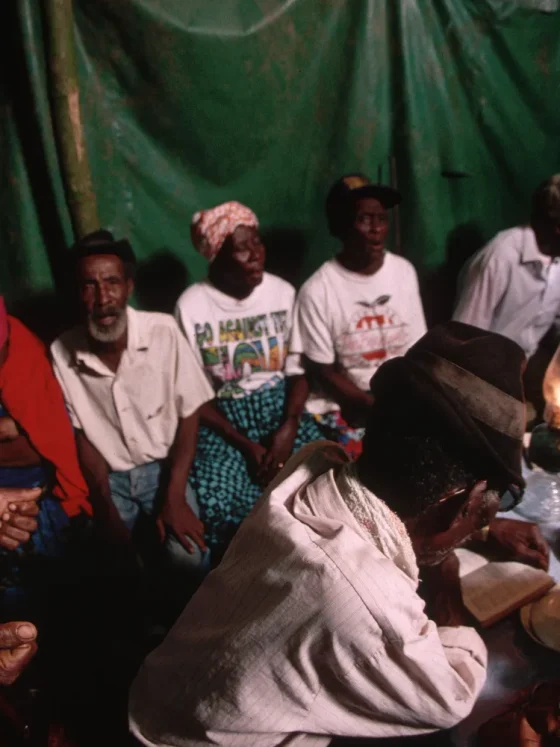
Aka polyphony is a form of contrapuntal singing in which four independent voices overlap and interlock without relying on written notation or fixed harmonic rules. As Grokipedia’s documentation of Central African forest people musical traditions confirms, the tradition is defined by several specific techniques: hocket, in which notes alternate rapidly between different singers to create a single melodic line no individual singer could produce alone; yodeling, in which singers shift between chest voice and falsetto to create tonal shifts that Western notation cannot easily represent; and echo-like repetitions in which phrases are passed between voices in overlapping sequences. Empirical analyses document tritonic intervals, polyrhythmic layering, and pentatonic tendencies in the structure of Aka performances, producing a complexity that professional ethnomusicologists have described as among the most sophisticated vocal systems in the world.
What makes the Aka tradition distinctive is the distribution of this complexity throughout the community. Every member of the Aka community masters the polyphony. Not as a requirement of formal music education, because no formal music education exists: the polyphony is transmitted entirely through oral methods and learned through participation in ritual from early childhood. A child who grows up in an Aka community grows up inside the polyphony. It is learned the way walking is learned: by doing it in the presence of people who have already learned it, adapting through imitation and adjustment until the knowledge is embodied.
Every member of the Aka community masters the polyphony. Not every member performs it as a soloist, but every member holds it. It is not a specialised skill reserved for a class of musicians. It is a communal knowledge specialised and distributed across the whole community and encoded into the daily, ritual, and ecological life of the forest.
Ritual Contexts: What the Music Marks
The polyphonic tradition is performed within specific ritual contexts, each with its own songs, dance forms, and dress requirements. The inauguration of a new encampment requires specific songs that mark the community’s relationship to the new forest space it is entering. Hunting expeditions require songs addressed to the forest and to the spirits associated with hunting success. Funerals require songs that address the transition from the living community to the world of the ancestors. Each context has its own musical requirements, and the polyphony is the form through which those requirements are met.
The Djengi ritual is among the most significant. Djengi is the forest spirit that the Aka understand as the animating presence of the forest itself: not a spirit separate from the forest but the forest’s own spirit form. The Djengi ritual involves specific songs, specific dances, and specific physical presentation requirements. Performers may use mpindi, a white clay-based body paint, applied in specific patterns for the Djengi context. Leaf garments and assemblages of natural forest materials constitute the ritual dress for specific ceremonies, connecting the dressed body directly to the forest material from which the community draws its sustenance.
Dance: Form, Context and the Body in Motion
The dances that accompany Aka polyphonic performance are not uniform across contexts. Some dances are performed only by men, reflecting the specific ritual context of hunting or initiation. Couples perform others. Others feature solo dancers, male or female, performing within the collective sound context created by the group’s polyphony. The vibrant hand-cymbals serve merely as a simple rhythmic device; they are a form of percussion that the whole community can participate in simultaneously, creating a physical connection between audience and performers that mirrors the participatory structure of the polyphony itself.
The body in Aka dance is not a display surface. It is an instrument within a larger sonic and social ensemble. The dancer’s movement is calibrated to the polyphony in the same way that a singer’s voice variation is calibrated to the other voices in the ensemble: responsive, improvisatory, and shaped by the specific moment of the specific performance. A recorded Aka performance and a live Aka performance are therefore fundamentally different objects. The recording captures a trace. The live performance is the actual thing, which includes the specific forest location, the specific group, the specific ritual occasion, and the specific improvisatory decisions made by specific people on a specific day.
Dress, Adornment and the Forest Body
Daily Aka dress is adapted to the conditions of forest life: minimal, practical, and sourced from available materials. The specific adornment practices that accompany ritual contexts are materially distinct from those of daily life and serve communicative functions within the community that require cultural knowledge to interpret. Body paint used for specific rituals employs mpindi (white clay) and other natural pigments, whose patterns and application sites are not decorative choices but ritual requirements. As Omiren Styles’ documentation of the Uli tradition of the Igbo, an ephemeral body art, confirms, body art whose marks disappear is not body art that fails to be permanent. It is body art whose ephemerality is part of its function: the mark exists for the ritual and disappears with it, leaving its record in the community’s memory rather than on the skin’s surface.
The community’s memory rests in the material assemblage of the skin’s surface. Aka ceremonies are similarly ephemeral: assembled from materials available in the immediate ritual environment, worn for the duration of the performance or ceremony, and then dispersed. They are not costumes in the theatrical sense: they are not maintained, stored, or standardised. Each iteration is constructed from the forest’s current offering, shaped by the specific context, and worn by a specific person for a specific purpose. The craft knowledge required to assemble these garments is part of the forest knowledge system, inseparable from the hunting and plant knowledge that allow the community to live within the forest rather than merely survive in it.
Transmission and Threat
The Aka polyphonic tradition has been transmitted entirely through oral methods and community participation for generations without any external documentation system. Its survival depends on children being present in rituals from an early age and learning by immersion what cannot be written down. As Minority Rights Group’s April 2024 documentation of the Aka’s vulnerability confirms, the scarcity of game resulting from deforestation, the rural exodus, and the folklorisation of their heritage for the tourist industry are the principal factors contributing to the gradual disappearance of many of their traditional customs, rituals, and skills. The UNESCO inscription itself noted that the Aka lifestyle has been drastically disrupted by changes in the Central African Republic, including the ongoing armed conflict that has displaced communities and made the continuity of ritual life structurally difficult to maintain.
Between 2004 and 2008, UNESCO funded an Action Plan for the Safeguarding and Revitalisation of the Implementedal Tradition of the Aka Pygmies of the Republic with a budget of US$200,348, funded through the Japan Funds-in-Trust. The project included field research, the creation of a database of the oral tradition, a sub-regional festival of Aka music and dance, and training seminars with radio and national television programmes. From April 2024 to October 2025, a pilot inventory of the intangible cultural heritage of the communities in the Lobaye forest prefecture was conducted with a budget of US$99,997, confirming that active institutional engagement with Aka heritage documentation continues. These projects matter. They are also insufficient on their own: institutional documentation preserves a record of a practice. What preserves the practice itself is the community’s ability to continue living in the conditions that make the practice possible.
The Omiren Argument
The Aka polyphonic tradition is a distributed intelligence. Every member of the community holds it. It is transmitted through childhood presence rather than through formal instruction. It is performed through improvisation rather than through notation. It encodes knowledge that is simultaneously musical, ecological, spiritual, and social. The African fashion and beauty market is worth $ 31 billion. The Aka are not a fashion community in the way that Omiren Styles usually documents fashion communities: they do not produce garments for commercial markets, they do not have designers whose labels can be stocked, and their dress practices are adapted to forest conditions that most of the international fashion press has never encountered. What they have is something the international fashion press consistently claims to value yet consistently fails to protect: a complete aesthetic system in which music, dance, dress, and ecological knowledge are inseparable from one another and from the specific forest environment that makes them one another. The folklorisation that UNESCO and Minority Rights Group both warn against is exactly the process that extracts the surface aesthetic from the knowledge system that produced it and sells the aesthetic back to audiences who do not have access to the knowledge; it is also what happens to textiles, African beadwork, and African dress practices across the continent. The Aka are one example, very clearly seen in a forest, of what all these traditions share: they are complete systems, and the part that travels internationally is rarely the whole.
Also Read:
- West African Dress as a Living Record: What Oral History Reveals About Cloth
- Hair, Combs and Adornment: How Suriname’s Maroon Communities Made Beauty Material
- Who Should Define Cultural Authority in Fashion? Start With the Makers
- Afar Men’s Hair Traditions: Asdago, Dayta and the Politics of Buttered Hair
Frequently Asked Questions
What is the Aka polyphonic tradition?
The Aka polyphonic tradition is a form of contrapuntal singing practised by the Aka people of the south-west of the Central African Republic and the Republic of the Congo. It involves four independent voices that overlap and interlock through techniques such as hocket (rapid alternation of notes between singers), yodelling (shifting between chest voice and falsetto), and echo-like repetition. Unlike most complex polyphonic music, it is performed without written notation and is transmitted entirely orally. Every member of the community masters the tradition, which is learned through childhood participation in rituals rather than through formal instruction. UNESCO proclaimed it a Masterpiece of Oral and Intangible Heritage in 2003 and inscribed it on the Representative List in 2008.
Why is Aka singing UNESCO recognised?
UNESCO recognised Aka polyphonic singing in 2003 and inscribed it on the Representative List of the Intangible Cultural Heritage of Humanity in 2008 because it represents an extraordinary form of collective musical intelligence: a complex four-voice contrapuntal system mastered by all community members, transmitted entirely through oral methods, performed through spontaneous improvisation rather than notation, and embedded within the ritual and ecological life of a forest community. UNESCO also noted the tradition’s vulnerability to disruption from deforestation, rural exodus, and the folklorisation of Aka heritage for the tourist industry, making its inscription a safeguarding measure at our time as a recognition.
What instruments do the Aka use?
The Aka use instruments alongside their vocal polyphony. The enzeko is a local type of drum. The geedale-bagongo is a harp-like string instrument. The mbela is a single-string musical bow. Each instrument is played for specific occasions rather than as general accompaniment. Hand-clapping also functions as a percussion instrument, with the whole community participating in dance performances, creating a physical connection between performers and community members that mirrors the participatory structure of the polyphonic vocal tradition.
What is the Djengi ritual?
Djengi is the forest spirit central to Aka spiritual life: understood as the animating presence of the forest itself rather than as a spirit separate from the forest. The Djengi ritual involves specific songs, specific dances, and specific physical presentation requirements. Performers may use mpindi (white clay-based body paint) applied in ritual patterns. Assemblages of leaf garments and natural forest materials constitute the dress for the Djengi ceremony, connecting the dressed body directly to the forest environment. The Djengi ritual is one of several Aka ceremonies in which music, dance, dress, and forest knowledge operate as an integrated system rather than as separate practices.
What threats do the Aka of the Central African Republic face?
The Aka of the Central African Republic face multiple interconnected threats to their cultural traditions and physical wellbeing. Deforestation reduces the forest territory within which the community’s hunting-based livelihood and ritual life operate. Rural exodus draws younger community members away from forest encampments into towns, reducing participation in the oral transmission system that sustains the polyphonic tradition. The folklorisation of Aka heritage for the tourist industry extracts surface aesthetic elements from the tradition without maintaining the community conditions that produce and sustain them. The ongoing armed conflict in the Central African Republic has displaced communities and disrupted ritual life. UNESCO’s safeguarding projects and Minority Rights Group’s documentation both acknowledge these threats as active and serious.
Explore More
Read the full Culture > Heritage & Identity section for Omiren Styles’ documentation of African cultural traditions in which music, dress, dance, and ecological knowledge constitute integrated systems rather than separable aesthetic practices.
Discover travel and heritage intelligence across Central Africa at Rex Clarke Adventures.