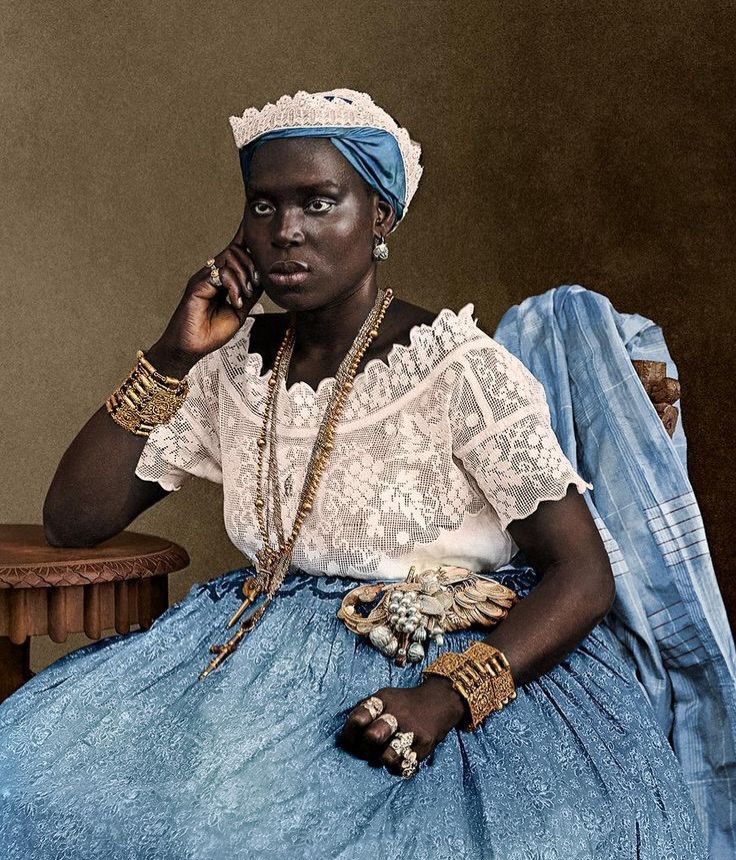
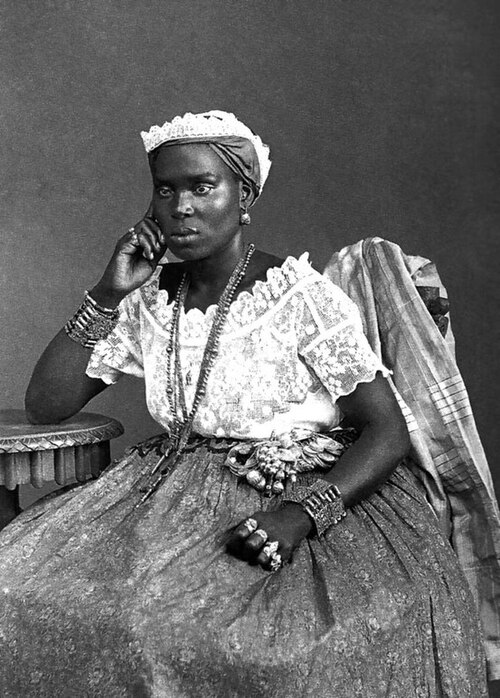
A pale detail runs along a fold in the sitter’s headwrap. Below it, a cross pendant stands out against her blouse. It would be easy to stop there: The contrast makes the pendant one of the clearest details in the portrait. But the photograph shows more of the outfit than just the head and shoulders. At the waist, several ornaments hang together. Lower still, the skirt fills much of the frame. Follow the clothes that far and the portrait begins to read differently. The cross is no longer an isolated detail. It is one part of an arrangement that continues below the neckline.
Wikimedia Commons lists the photograph as Negra da Bahia and dates it to 1885. In her essay Sewing the Past, fashion curator Hanayrá Negreiros dates the portrait to circa 1885 and credits the Gilberto Ferrez Collection at Instituto Moreira Salles. Both sources name Marc Ferrez as the photographer. The title attached to the Commons file locates and describes the sitter in broad terms. It does not give us her personal name.
A close reading of Marc Ferrez’s Bahian portrait, from the sitter’s headwrap to the ornaments at her waist, and what the photograph leaves unknown.
What the frame lets us compare
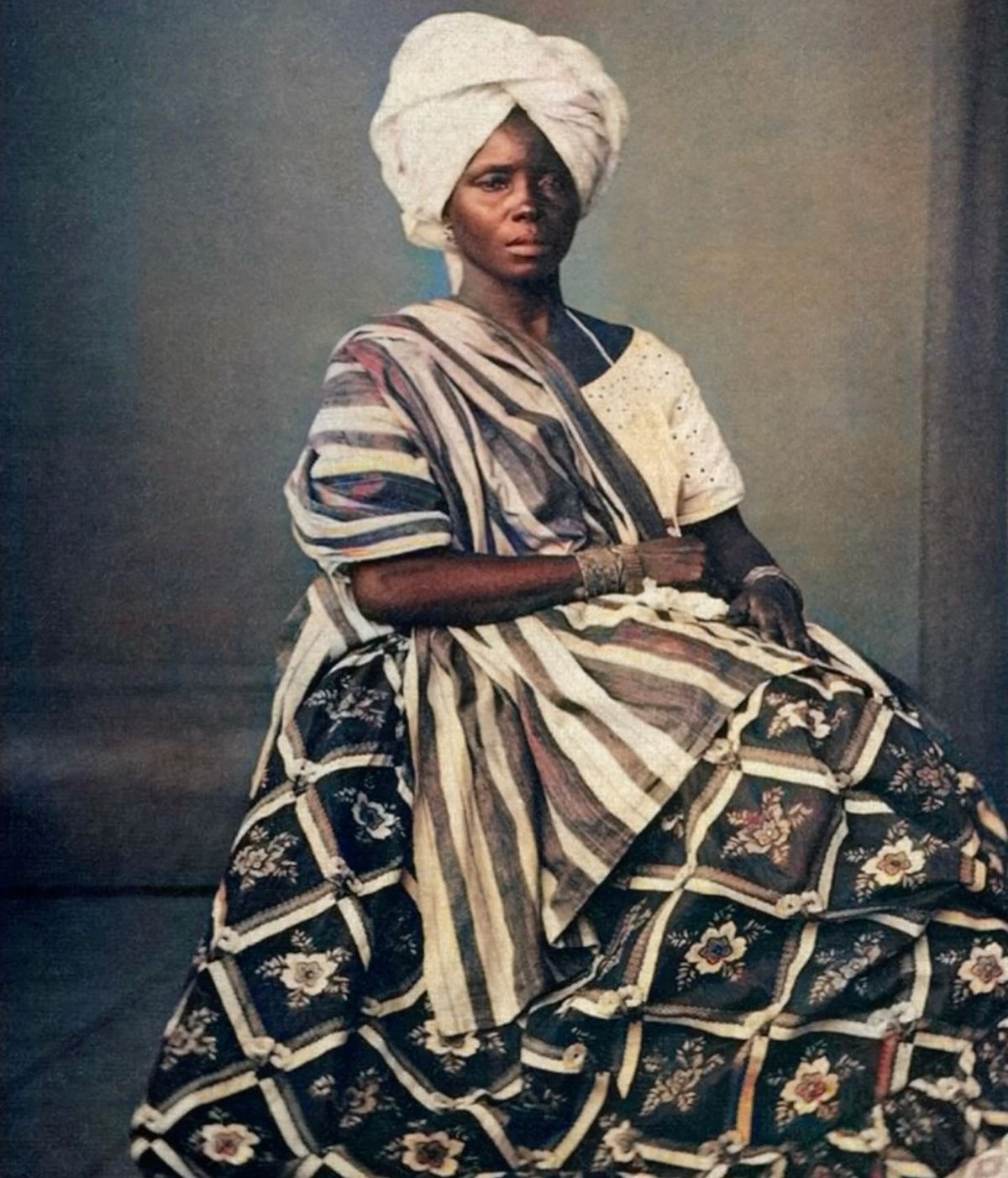
The Commons reproduction keeps the sitter’s headwrap, waist and much of the skirt in the same vertical frame. That is a consequential choice of scale for a reader studying dress. A portrait ending at the shoulders would still give us the headwrap and the cross, but it would lose the cluster at the waist and the breadth of fabric below it. Here, the skirt gives the waist ornaments somewhere to sit in the composition. We can see where they hang in relation to the blouse rather than trying to reconstruct that placement from a caption.
The boundary of the reproduction is worth distinguishing from Ferrez’s intention. We can describe what the digital file includes without claiming that its edges match those of the original negative or that Ferrez deliberately meant to draw attention to one accessory over another. What matters to this reading is what survives together in this version. The upper part of the portrait lets us compare the headwrap and neckline. The lower part lets us ask how the jewellery is distributed across the dressed figure, rather than assuming the most legible ornament is the most important one.
A fold is easier to see than a stitch.
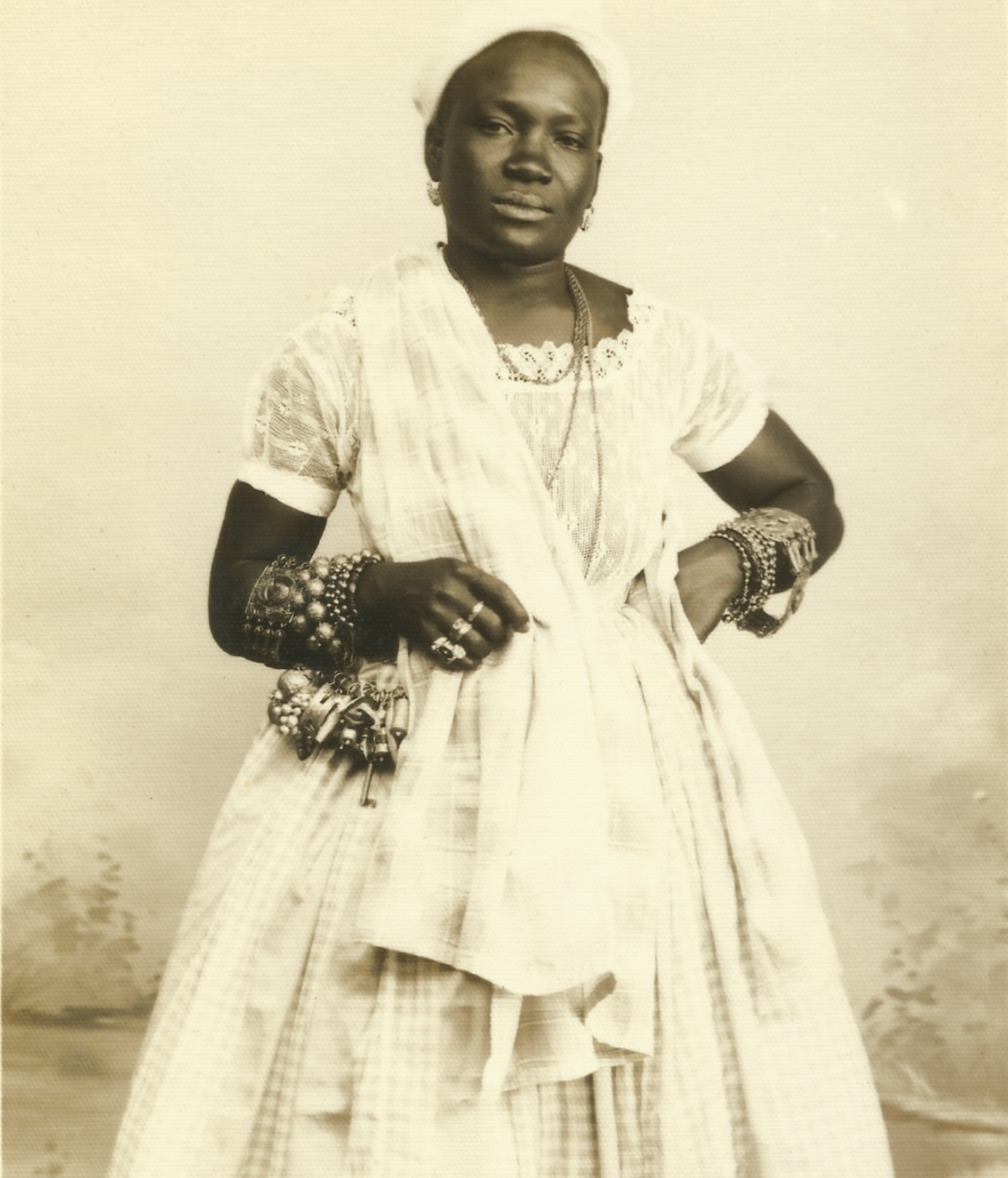
Negreiros describes the headwrap as slightly shiny and its pale detail as resembling fine white lace embroidery. The qualification matters. In the Commons reproduction, the light detail is easier to follow as an edge than to resolve as a textile technique. We can see it marking the fold. We cannot inspect individual stitches closely enough to say how the decoration was made or whether it was worked into the cloth or attached to it. Naming the material more confidently would make the description sound richer while making it less accurate.
The fold still gives us something to write about. We encounter the cloth wrapped on a person, not laid flat for examination. The pale detail becomes prominent because of where the cloth turns and how the edge is presented to the camera. Its placement is visible even when its construction is uncertain. That is a useful distinction in dress history: a photograph may tell us more about how a textile was worn on one occasion than about how it was made.
What Negreiros sees at the waist
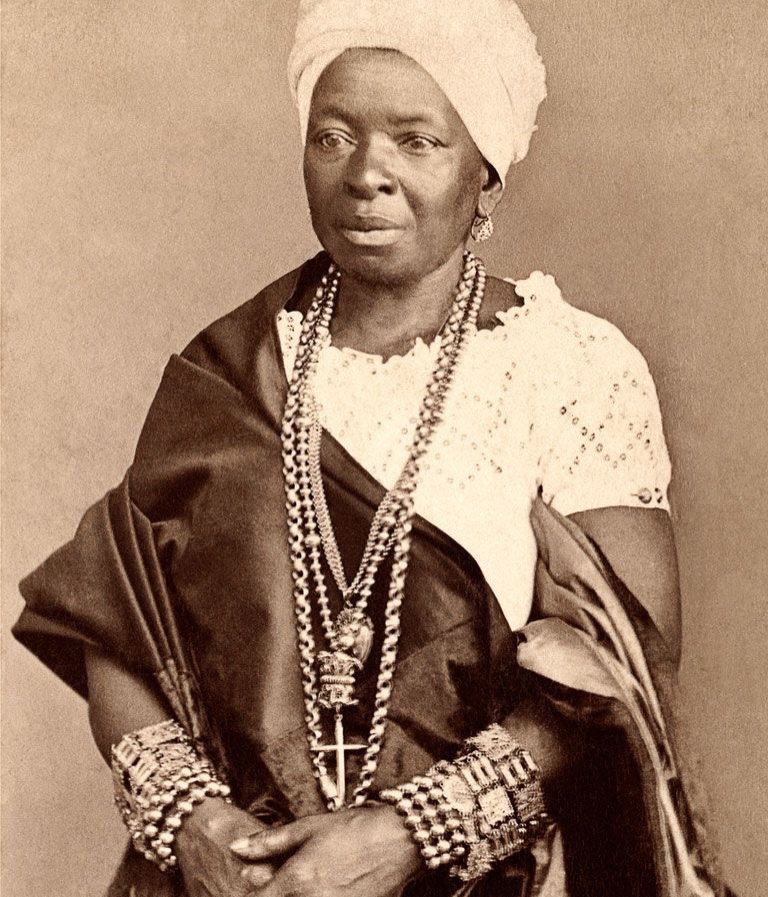
Negreiros identifies the cluster at the sitter’s waist as a penca de balangandãs: a piece of jewellery made up of several pendants gathered on a larger holder. The placement and grouping are what the photograph lets us check most readily. The ornaments hang together at the waist, distinct from the cross suspended at the neckline. Negreiros’s identification gives the group a name and a construction to look for. It doesn’t make every pendant legible in the digital file. We can follow her reading without pretending to recognise each individual charm.
In the essay, Negreiros recalls a teacher sounding out the word balangandã to evoke the tinkling of the pendants. It is a striking way to think about an object in a still photograph. The group is fixed in place for us, but the parts she describes could move against one another as the wearer moved. That observation comes from understanding the jewellery’s construction, not from evidence of how this woman walked or sounded. Negreiros also discusses the protective meanings associated with such ornaments. The history of the object gives us a fuller vocabulary for describing it; it does not tell us what meaning this sitter gave hers.
The cross presents the same distinction in a simpler form. Its outline is easier to recognise than the individual shapes in the cluster, but that does not make it better evidence of the sitter’s beliefs. One ornament is familiar enough to name from its silhouette; the other benefits from a curator explaining what to look for. Neither supplies a personal account of why it was worn.
One portrait, not a regional uniform
Negreiros reads the clothes in relation to histories of traje de baiana, or Baiana dress. That gives the combination of cloth and jewellery a context beyond this sitting. It also explains why a portrait that might be filed under a broad geographic label deserves attention as a record of fashion. But recognising elements of a dress tradition is different from treating the image as a template. The photograph cannot tell us how widely these pieces were worn together, whether the sitter wore them regularly or what she did for a living.
The distinction matters because the image was made in imperial Brazil, before slavery was abolished in 1888. Negreiros argues that photographs of Black Brazilians from this period have too often been read almost exclusively through slavery, leaving their significance for fashion history underexamined. Taking the clothes seriously does not require setting that history aside. It means refusing to make the historical setting stand in for a biography the photograph cannot supply. We can ask how the dress is assembled and what the ornaments contribute without inferring the sitter’s legal status or turning her into an example of a single occupation or social type.
The Omiren Argument
The photograph gives us more detail about the fold in her headwrap than about the circumstances in which she wore it. The waist ornaments show what we gain by looking beyond that fold. They give the outfit another point of emphasis and give us a reason to read the full frame rather than extract the face, the headwrap or the cross as a shorthand for the whole portrait. Negreiros’s essay helps us name what hangs there. The image lets us check its position without making the sitter’s reasons for wearing it any easier to recover.
Ferrez’s name survives in the photographer’s credit. There is no equivalent credit in the records used here for the person who made the blouse, arranged the headwrap or selected the jewellery. That doesn’t mean no one made those decisions, or that the sitter had no part in them. It means the surviving image records their result more clearly than it records their authorship. Credit Ferrez for the photograph. Look closely at the work visible in the clothes. Leave open whose hands brought the arrangement together.
Also Read:
- Jimma Oromo Women’s Dress: A Civilisation in Leather and Beads
- Amílcar Cabral’s Field Dress and Guinea-Bissau’s Liberation Memory
- The Afro Carib Fashion Show: Two Women, One Runway, and the Diaspora Platform Nobody Else Is Building
- Porto-Novo After Hours: Fashion at the Edge of History
Frequently Asked Questions
Who photographed the portrait, and when?
Marc Ferrez took the photograph. Wikimedia Commons dates it to 1885; Hanayrá Negreiros’s essay in Harvard’s ReVista dates it to circa 1885. The SEO title uses “around 1885” to reflect that qualification. Both sources name Ferrez as the photographer, and Negreiros credits the Gilberto Ferrez Collection at Instituto Moreira Salles.
Do we know the sitter’s name?
The Commons record does not give a personal name. Negreiros discusses a postcard she believes depicts the same woman, but that comparison does not establish the sitter’s personal identity. This article focuses on what is documented for the Ferrez portrait.
Where can I see the exact photograph discussed here?
See the Wikimedia Commons record for Negra da Bahia, 1885. Foto de Marc Ferrez.jpg. To follow the article’s reading, look at the waist and skirt as well as the headwrap and neckline. The record dates it to 1885 and titles it Negra da Bahia; it does not give the sitter’s personal name.
What is a penca de balangandãs?
Hanayrá Negreiros identifies the cluster at the sitter’s waist as a penca de balangandãs: a piece of jewellery made up of several pendants gathered on a larger holder. The photograph shows where the ornaments hang, but not every pendant is legible in the digital file, and the history of the object does not tell us what meaning this sitter gave it.