Just above the centre of the lower border of a kanga in the British Museum’s collection is a line in Kiswahili: HAMWISHI KUNIZULIA. The museum translates it as “your problem is that you can’t stop backbiting”. There is a clear accusation and an implied “you”, but no name. The catalogue tells us what the words say and where they sit on the cloth. It does not tell us whether anyone wore it to address a particular person, or how that person understood it.
That distinction is central to reading kanga. The words are fixed in the design, but a person can select, give or wear the cloth in circumstances the printer did not determine. An inscription that looks like a general observation to one reader may sound pointed to another. It may also have been chosen for reasons other than its wording. A saying gives people something to read; it does not guarantee they will agree with what is said, or even that the wearer intended to say anything through it.
How do Swahili sayings on kanga cloth carry meaning? Two museum objects show what the printed words establish and what depends on who wears or reads them.
Where the words sit on the cloth
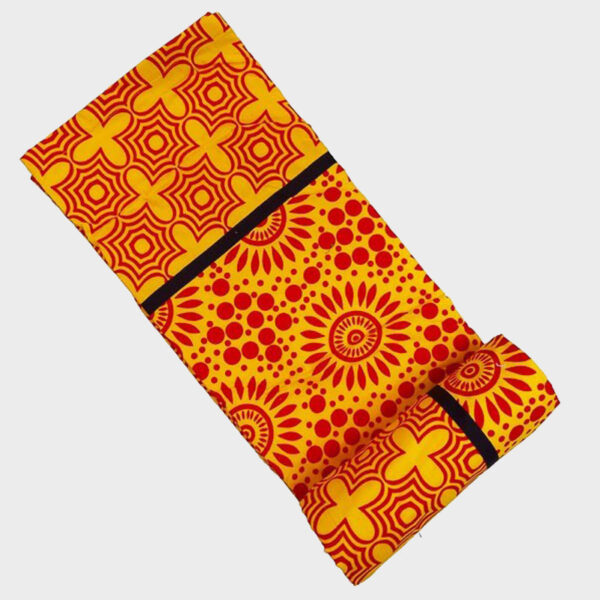
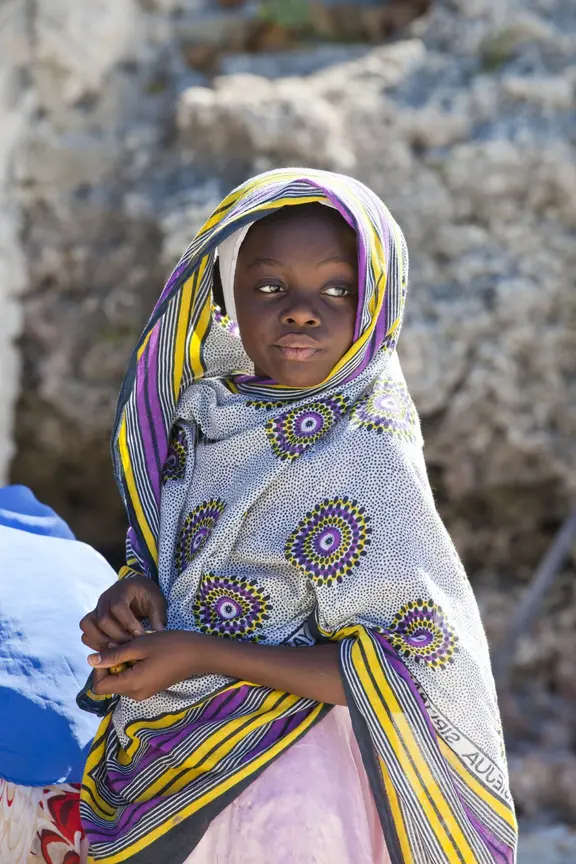
Kanga is a printed wrap cloth associated with East Africa and the Swahili coast. A characteristic layout brings together a border, a central design and a line of text. Textile historian MacKenzie Moon Ryan uses pindo for the border, mji for the central field or design, and jina for the inscription. The SOAS collection guide uses ‘msemo’ for the saying. These terms help describe the design, but the layout is not a rule every kanga must follow. On the back-binding cloth, for example, the words sit above the lower border. That is more precise than saying the inscription is always printed inside the pindo.
The distinction between the central image and the inscription matters because they can do different things. A second British Museum example shows a mango tree with a ladder against its trunk. Beneath the image, just above the lower border, the museum translates the words “MWEMBE TAYARI” as “The mangoes are ready.” The image supplies a literal scene for the words: a tree, fruit and a means of reaching it. That relationship is visible in the design. Whether the sentence carried another meaning in a particular encounter is a separate question, and the image alone cannot settle it.
For readers comparing the words used for these design elements with those used for other textiles, Omiren’s African Textile Glossary is the terminology route through the archive. The distinction to carry into a reading of Kanga is straightforward: the border frames, the central field holds a design, and the inscription supplies words. Identifying those elements begins interpretation, not its conclusion.
What changes when a saying is worn?
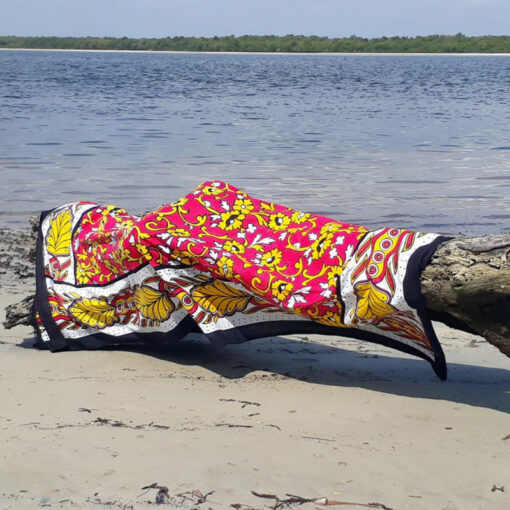
The backbiting inscription shows how a message can have a clear subject without a clear recipient. A reader can understand the accusation without knowing whom it concerns. Researcher Rose Marie Beck makes that uncertainty part of the analysis in Ambiguous Signs: The Role of the Kanga as a Medium of Communication. Her study approaches communication as a social interaction, not simply as a message encoded in the fabric and decoded the same way by everyone who sees it.
Consider what happens if two people both recognise the words on the cloth but know different things about the wearer. One may read a general reproach; the other may connect it to a recent exchange. The wording has not changed. What differs is the context each reader brings. This illustrates how the inscription might work, not a reconstruction of what happened with the museum’s cloth. Without an account from someone connected to that object’s use, it would be a mistake to turn its printed accusation into a story about a quarrel.
The distinction also sharpens an observation in Heritage Oni’s earlier Omiren feature, Kanga Chronicles: choosing a cloth can itself be an act of expression. Tobi Arowosegbe’s subsequent coverage develops that point alongside the cloth’s composition and history. Both pieces reach for the agency involved in putting an available set of words into circulation. The wearer did not necessarily write those words, and the person who sees them may interpret them differently. But a person can still choose which words to bring into a setting without having to compose or speak them.
That is also why it is worth keeping women’s use of kanga at the centre where the evidence supports it, without reducing every instance of wearing the cloth to coded speech. A person can choose it for its colours, give it as a gift, wear it as a wrap or put it to practical use. Those uses do not cancel its communicative possibilities. They keep us from assuming that the printed words explain every choice a wearer makes.
When the person named in the message is clear

The British Museum catalogues another kanga with the inscription Hongera Barack Obama, translated as “Congratulations Barack Obama”. This time there is no need to infer whom the words ‘congratulate’ refer to. The name is part of the design. The cloth offers a useful contrast to the backbiting inscription: one line prints its addressee; the other leaves its “you” unnamed.
But even an explicit inscription does not fully account for the cloth’s use. The Obama example establishes whom the printed words congratulate. It does not, on its own, tell us why a particular person acquired the cloth, whether they wore it, or what they wanted someone else to take from it. The two objects therefore show different limits. With the backbiting cloth, the inscription leaves the intended target open. With the Obama cloth, the addressee is explicit, but a wearer’s or giver’s purpose still cannot be read straight off the fabric.
The Obama example also shows why “proverb cloth” is useful shorthand but incomplete as a description. A line of text can be a saying, a rebuke or a direct congratulation. What unites those examples is not that they all belong to one literary form. It is that words form part of the design and can travel with the cloth into settings different from the one in which it was made.
How to read a Kanga inscription without overreading it

Start with the object. Record the wording as it appears, identify where it sits in relation to the border and central field, and credit the person or institution supplying the translation. Then look at what the image adds. A tree and ladder may reinforce the literal reading of a line about mangoes; a name can identify the person a congratulatory message addresses. An object record gives you a firmer basis for those observations than a general claim about what a colour or motif means everywhere.
Next, separate the inscription from the evidence of use. A catalogue can preserve a translation without recording an exchange between two people. A study of a documented encounter can show how someone interpreted a cloth without making that interpretation universal. If no source identifies who wore a particular piece or why, leave the question open. That does not diminish the object. It allows the article to distinguish what is visible in the design from what would require testimony. Omiren’s guide to reading museum records makes the same distinction more broadly for dress.
The Omiren Argument
A kanga inscription makes a line of language public without necessarily making its use public. The backbiting cloth makes the accusation readable but leaves its “you” unnamed. The Obama cloth names the person it congratulates, yet still leaves open what wearing or giving it might have meant to a particular person. That is why a good reading begins with the text and the design but does not stop there. It asks what the text documents about the relationships and circumstances in which the cloth was used.
The phrase “the fabric that speaks” gets us part of the way. It draws attention to the fact that words are printed on the cloth. It can also make the cloth sound as though it speaks for itself. The sharper point is that a printer supplies a design, a person can select or wear it, and others can read it. Those are different roles. Taking them seriously lets us recognise people’s agency without assigning them an intention the record does not establish.
Also Read:
- The African Fabric Market Guide: From Balogun to Kariakoo
- Woven by Monsoon Winds: Our Omani Legacy in Swahili Silhouettes in Zanzibar and Mombasa
- Ankara Has Never Been Just a Fabric
- Top 5 Shuka Styles for Maasai Women in 2026
Frequently Asked Questions
What is Kanga cloth?
Kanga is a printed wrap cloth associated with East Africa and the Swahili coast. A characteristic design has a border, a central field and an inscription, often in Kiswahili. That arrangement describes a familiar format, not every example, and the words used for each part differ between sources such as Ryan and the SOAS guide.
What are the three parts of a Kanga design called?
In the terminology used by textile historian MacKenzie Moon Ryan, the border is the pindo, the central field or design is the mji, and the inscription is the jina. The SOAS guide uses ‘msemo’ for the saying. These accounts do not use mji for the inscription.
Is every Kanga inscription a proverb?
No. The British Museum records sayings such as KILA LENYE MWANZO LINA MWISHO, translated as “Whatever begins must come to an end”, as well as direct messages such as Hongera Barack Obama. “Inscription” is the more useful term when discussing both kinds of text.
Can you tell what a wearer meant by reading the inscription?
Not reliably from the wording alone. A translation tells you what the text says. To establish what wearing or giving the cloth meant in a particular instance, you need evidence about the people, the occasion or the exchange. A catalogue can preserve a translation without recording an exchange between two people.