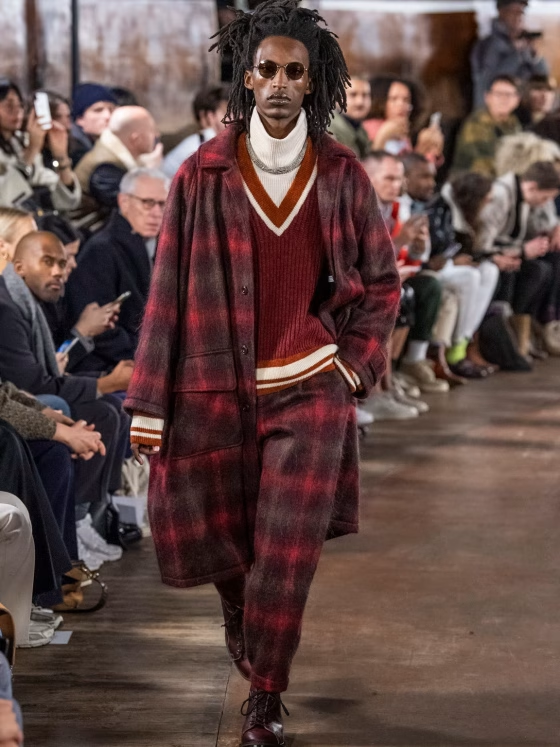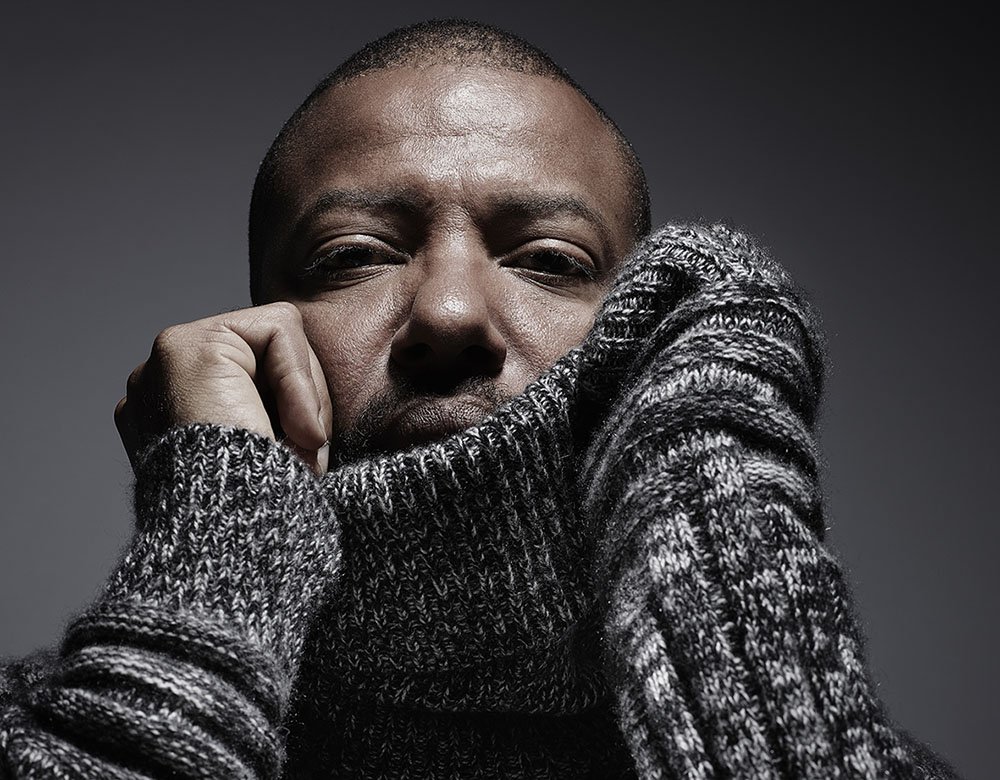
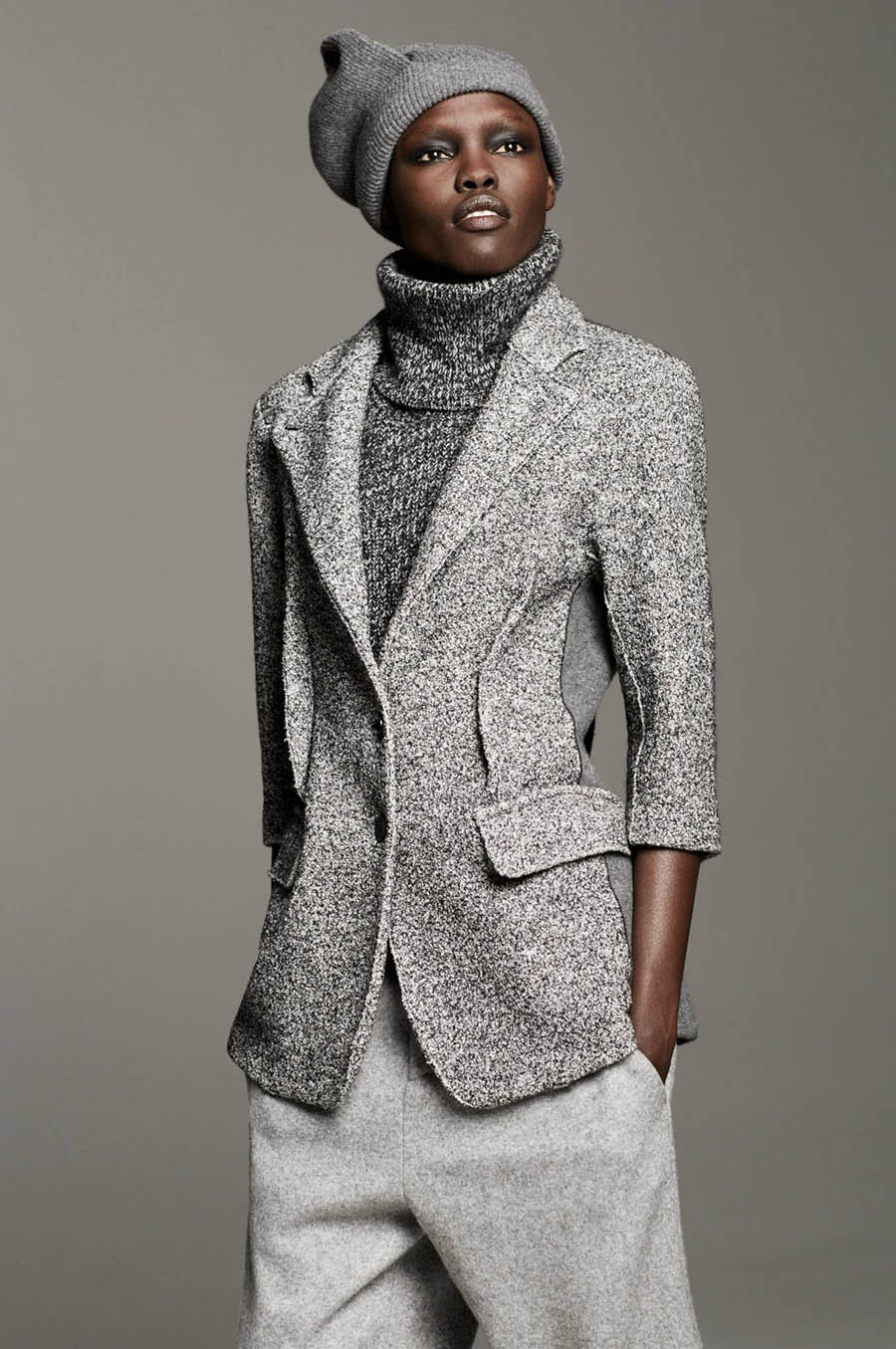
At Sansovino 6’s autumn/winter 2017 presentation, Marcelo Burlon wore a long jacket with grey sleeves and a softly graduated monochrome check body. Beneath it sat an oversized grey cardigan; loose charcoal trousers continued the relaxed line. Luke Leitch’s contemporary Vogue review records an outfit built through overlapping pieces and closely related colours rather than a single spectacular garment. The combination is a useful introduction to Edward Buchanan’s approach. Jacket, cardigan and trousers remain recognisable categories. Their interest comes from how they coexist: the repetition of grey, the interruption of check and the refusal to make one layer subordinate to a rigidly defined silhouette.
Buchanan’s work does not require knitwear to look unfamiliar to be inventive. His starting point is often something a person already understands: a garment they value, or one they can’t find. The design question follows: what changes when that object is reconsidered through knitting?
At Sansovino 6, Edward Buchanan translates familiar wardrobe pieces into knitwear through technical collaboration, layering and an emphasis on the wearer.
Before the Collection, Two Questions
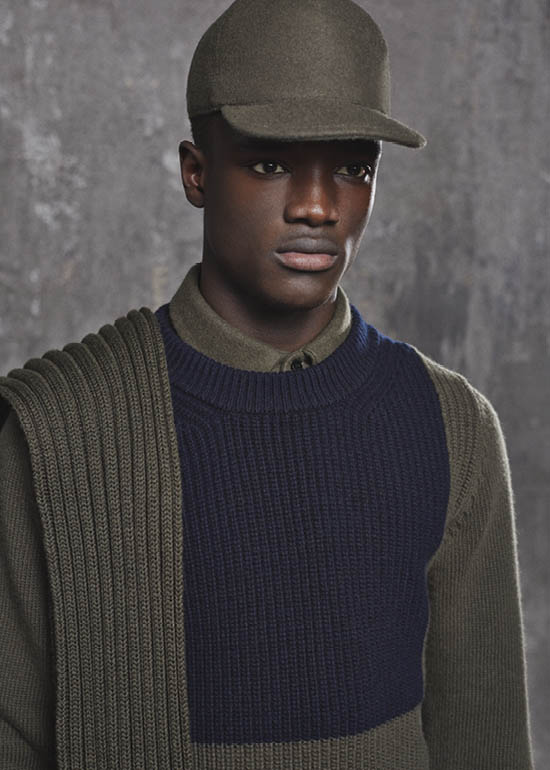
Buchanan has described Sansovino 6’s beginnings through conversations with people outside fashion. He asked what they treasured in their wardrobes and what they felt was missing. From the responses, he selected six pieces. He developed the label through a partnership with a Milanese factory and a former colleague, Silvana, who contributed technical expertise alongside his creative direction. The process begins with use rather than a customer image. A treasured garment has already earned its place. A missing one represents an unresolved problem. That does not make the resulting clothes purely practical. It gives experimentation something to work against. The designer can preserve a garment’s recognisable purpose while reconsidering its material, proportion or construction.
The distinction also changes the relationship between the collection and the wearer. The wardrobe exists before the designer enters it. New pieces must find a role among clothes acquired elsewhere. That remains central to Buchanan’s stated position. In his 2016 Metal interview, he rejected the idea that a designer should dictate complete outfits. Customers might combine one of his pieces with inexpensive trousers or vintage clothing. His presentation establishes a proposal, not an obligation.
Familiarity Is Part of the Experiment
In the same interview, Buchanan named T-shirts, well-fitting jeans, and parkas among the garments people said they wanted. He responded by considering how to translate such staples into knitwear. The familiar form matters. If the original garment disappears entirely, translation becomes harder to perceive. Recognition gives the altered version a point of comparison. A parka reconsidered in knitwear is interesting not simply because knitting is technically demanding, but because the material may change the expectations attached to that type of clothing. The design begins within a known category and opens it to another interpretation.
Buchanan’s account describes an intention; it does not supply a technical specification for every Sansovino 6 garment. Not every piece should therefore be assumed to share one knitting or assembly method. The account does establish the breadth of his interest. Knitwear is not confined to a list of conventional products. It is a medium through which he can revisit a wardrobe.
What the 2017 Layers Achieve
The grey outfit clearly expresses that position because it does not depend on an elaborate origin story. Its constituent parts are ordinary enough to make their relationships legible. The jacket carries the check, while the cardigan extends the grey beneath it. The trousers deepen the tonal range. Instead of using strong colour contrast to distinguish each layer, the look lets differences in pattern, scale, and position do the separating. Its restraint is important. Several oversized pieces can become visually indistinct when worn together. Here, the checked body provides an organising element within the tonal grouping.
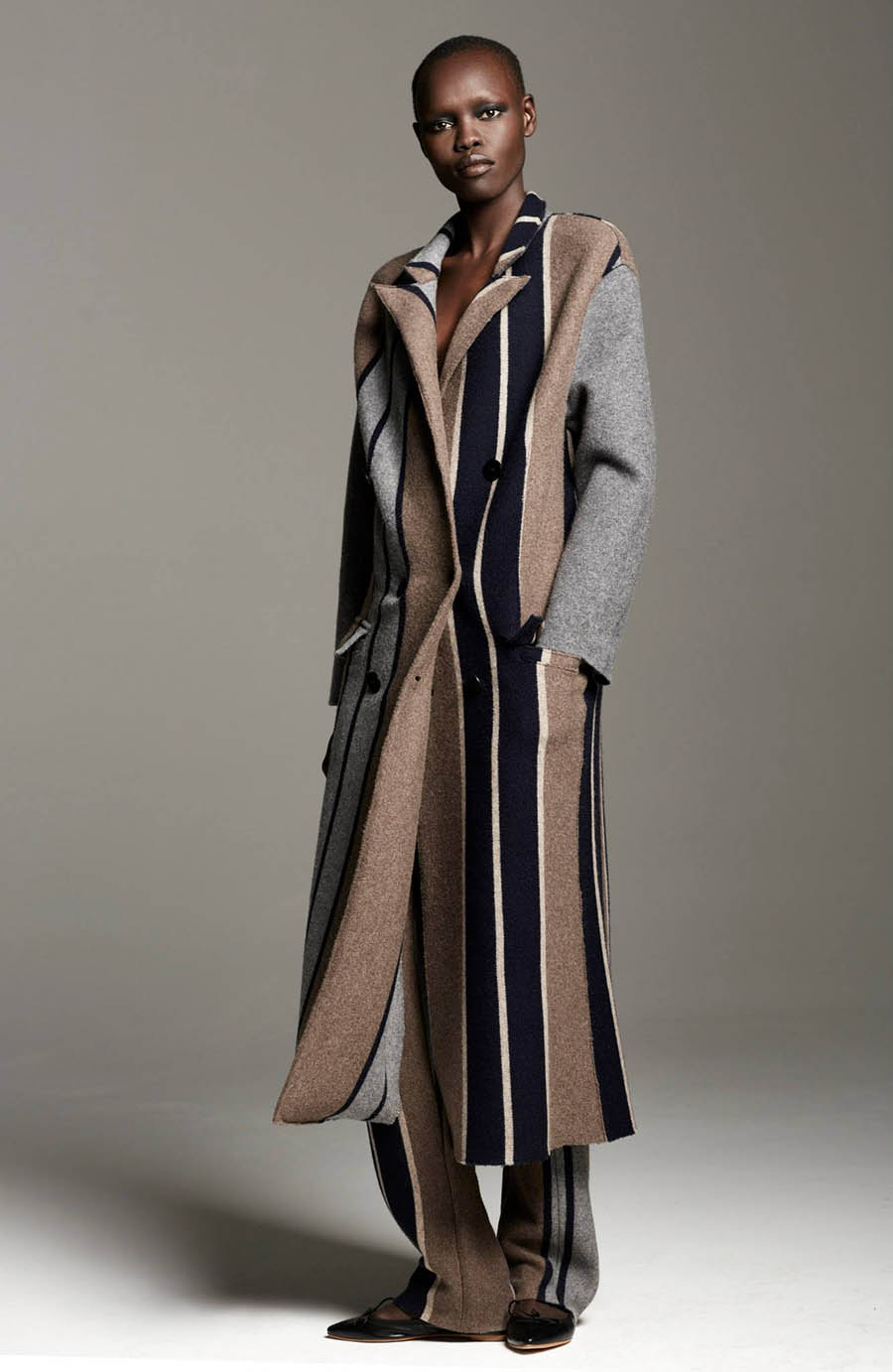
Elsewhere in the collection, oversized checked blazers appeared over skirts with pointed hems. Brighter, woven-looking wraps and frayed, checked knits interrupted the darker wardrobe. These alternatives show two ways to avoid repetition. One changes the lower outline beneath a familiar upper garment. The other introduces a more forceful colour passage. The grey combination is the more immediately coherent proposition: its parts remain distinct without competing for attention. The brighter pieces offer greater visual interruption, but they rely more heavily on their place within an outfit. This is a judgement about the documented styling and arrangement, not a claim about the garments’ feel or construction. Those qualities require closer material examination than a written review can provide.
A Wearer Does Not Need the Whole Look
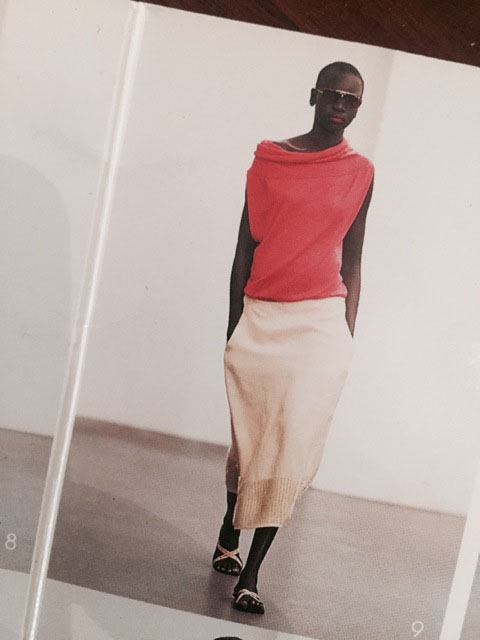
Courtesy of Edward Buchanan
Buchanan’s interest in overlap should not be mistaken for a demand that the customer reproduce his styling. A long jacket can be presented over an oversized cardigan to establish softness and volume. It can also leave that combination and enter another wardrobe. The styling demonstrates a relationship without exhausting the garment’s possibilities. This helps explain the label’s approach to gender. Buchanan has described finding that the same blazer could work on different people and questioning why he should prescribe who wears it. The proposition is not that bodies are interchangeable. It is that a garment can be offered without its interpretation being completely settled in advance.
That requires enough formal clarity for the piece to survive a change of context. A successful design should not depend entirely on one casting choice or one carefully assembled outfit. The wardrobe-led approach is therefore demanding, not modest. It asks the garment to be distinctive enough to matter and adaptable enough to remain useful beyond the designer’s presentation.
Another Way to Reorganise the Garment
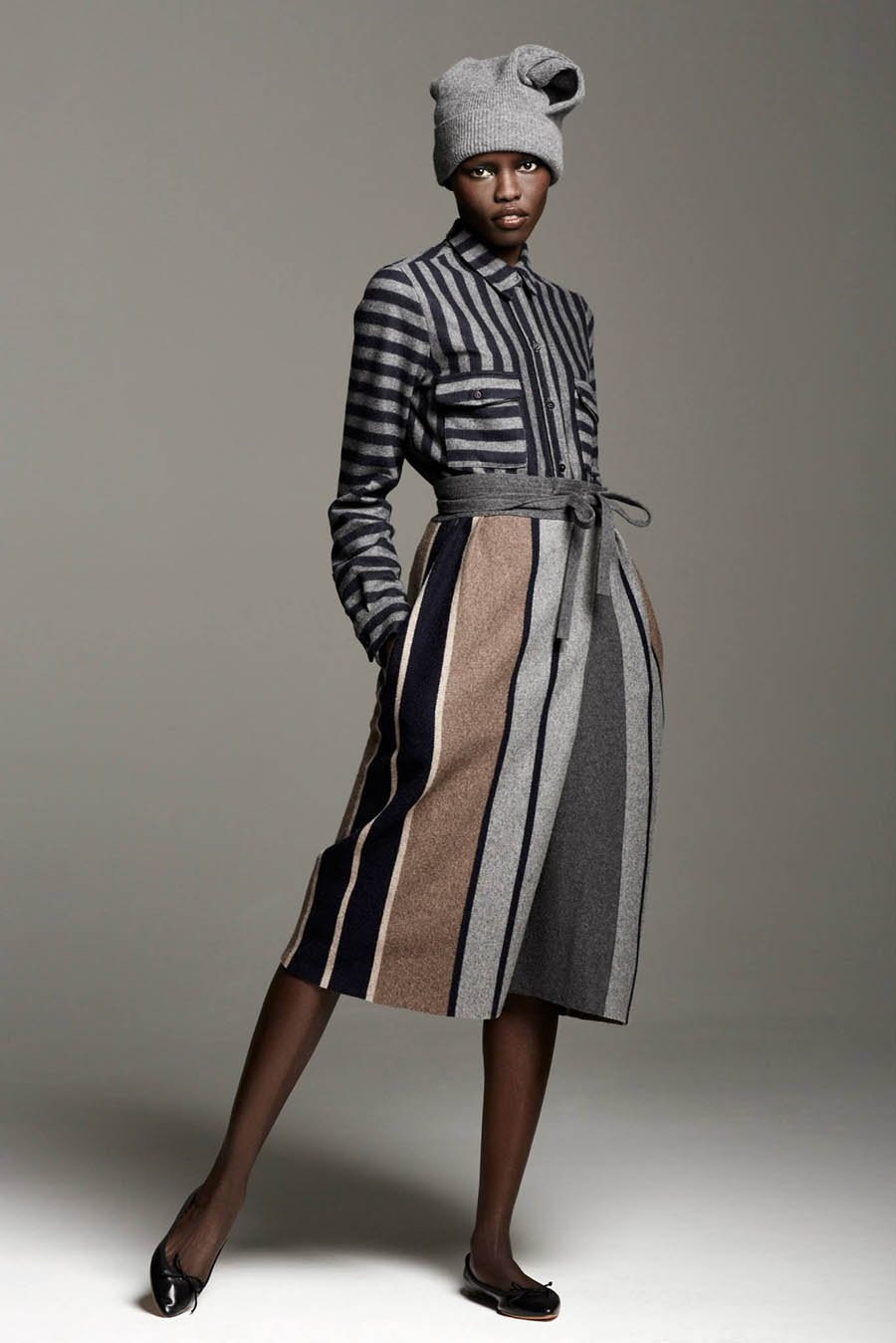
The autumn/winter 2019 collection approached transformation through different means. WWD documented cashmere, alpaca, wool and cashmere-silk blends across coats, capes, dresses and separates. Patchwork, fringes and small ties contributed to the collection, while some pieces were assembled from jacquard scarves bearing messages of empowerment. The scarf-derived work changes the level at which the transformation happens. In the wardrobe-staple proposition, knitwear reconsiders a familiar garment. Here, an existing textile object becomes material for another piece. Its message does not disappear, but it acquires a new relationship to the body. What was once a separate accessory becomes part of a larger composition.
The available review notes tie in intended alterations to silhouettes, but not which sections they adjusted. Inferring a particular mechanism from that description alone would be inaccurate. The stronger documented comparison is between the collections’ visual organisation. The 2017 grey look depends on distinct layers working together. The scarf pieces begin by combining material within the garment itself. Neither method is automatically more advanced. The first offers immediate clarity through recognisable components. The second potentially makes the object more complex, because textile, message and shape have to remain in balance.
Technical Knowledge Is Not Background Work
The collaboration with Silvana places an important limit on the myth of individual authorship. Buchanan trained as a designer and illustrator, not initially as a specialist knitwear technician. He has described discovering that yarn’s possibilities suited the kind of clothing he wanted to make. That attraction needed technical exchange to become a practice. The division between creative direction and specialist knowledge is not a division between authorship and execution. Technical decisions can determine which ideas are possible, how they are realised and what must change. The founding account does not fully document Silvana’s role or identify every later collaborator. It should nevertheless prevent the finished garment from being described as the product of imagination alone.
The value lies in the conversation between an intended effect and the means of achieving it. The material may resist the original idea. The specialist may propose an alternative. Design continues through that negotiation.
Bottega Veneta: Clothing Around an Existing Identity
Buchanan’s earlier Bottega Veneta work presented another kind of translation problem: developing ready-to-wear for a house already known through accessories. In a first-person essay for Perfect, he recalls an initial capsule of drawstring nappa-leather separates and fine-gauge cashmere racerback tanks. Vogue Business’s later reporting places his Bottega period in 1995–2000. The capsule is relevant because of its relationship to an existing product world. Leather moves into clothing, while cashmere supplies another register close to the body. The task was not simply to design isolated garments, but to establish how apparel could belong within the house.
His historical credit should remain exact. Buchanan states that he carried creative-director responsibilities without holding that formal title. He also names the colleagues and leadership involved. That distinction strengthens the account. Recognition does not require inflating a title or erasing collaborators. It requires a clear description of responsibility and work.
An Archive Beside the Active Practice
The contemporary development is The Situation, Buchanan’s Milan space in NoLo. Vogue Business’s September 2026 report describes an office and design archive upstairs, with a studio-gallery intended for residencies and presentations below. At the time of that interview, selection arrangements for the programme were still being developed. Buchanan intended the archive (including material from Bottega and consultancy work) to become available for others to use. The documented achievement is establishing the space and gathering the work. Its future value as a teaching resource will depend on access, organisation and actual use.
It is a relevant coda rather than proof of a completed legacy. For now, Buchanan’s design method is more securely demonstrated in his stated questions and published collections than in outcomes the new programme has yet to establish.
The Omiren Argument
Edward Buchanan’s strongest proposition is not that knitwear can imitate the rest of a wardrobe. It is that familiar garments can be reconsidered without losing the qualities that made people want them.
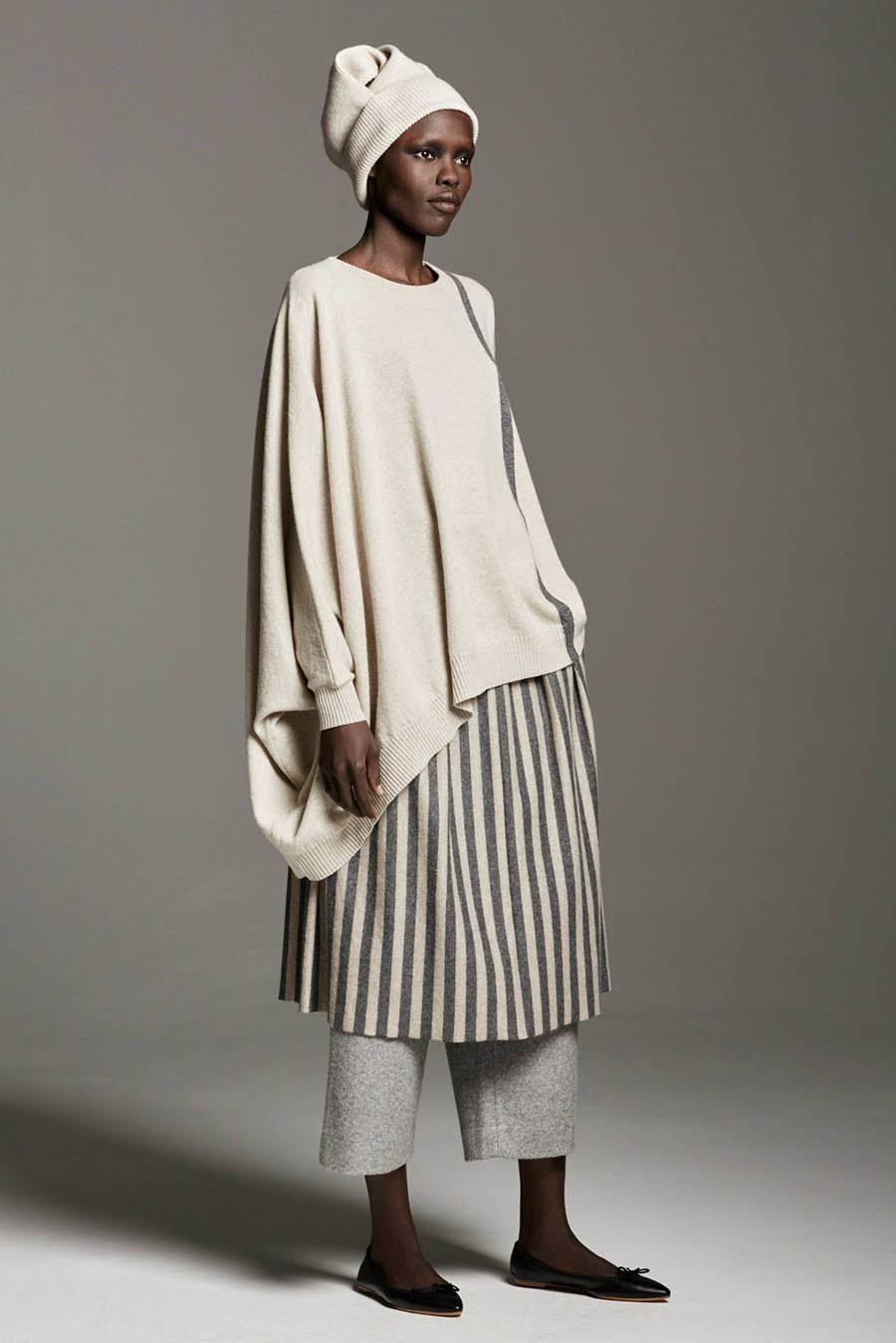
The 2017 layered looks make that argument most clearly: recognisable pieces establish a distinctive relationship while remaining open to other combinations. The 2019 work introduces a more complex transformation, assembling new garments from message-bearing scarves.
Across these examples, invention does not require abandoning use. It begins by taking the wearer’s existing wardrobe seriously.
Also Read:
- Wales Bonner’s Research Practice: From Central Saint Martins to Hermès
- KikoRomeo: The Nairobi Brand That Turned Kenyan Craft Into Global Fashion Authority
- Trevor Stuurman: The Visionary Creative Director Shaping Modern African Style
- Why Global Fashion is Moving Towards Intellectual Luxury
Frequently Asked Questions
Who is Edward Buchanan?
Edward Buchanan is an American designer based in Milan. His career includes developing Bottega Veneta ready-to-wear, founding the knitwear label Sansovino 6 and working as a knitwear specialist. He trained as a designer and illustrator, and in his own account, he held creative-director responsibilities at Bottega without the formal title.
What is Sansovino 6?
Sansovino 6 is Buchanan’s independent knitwear label. He describes its beginnings through conversations with people outside fashion, asking what they treasured in their wardrobes and what they felt was missing. From those responses, he selected six pieces, and he developed the label with a Milanese factory and a former colleague, Silvana.
What characterises his design approach?
His stated method is to translate familiar clothing types, such as T-shirts, jeans and parkas, into knitwear and to let wearers combine pieces in their own ways. Published collections show layering in the 2017 grey look and, in autumn/winter 2019, garments assembled from jacquard scarves bearing messages of empowerment.
What is The Situation in Milan?
The situation is Buchanan’s space in Milan’s NoLo district. Vogue Business’s September 2026 report describes an office and design archive upstairs, with a studio-gallery for residencies and presentations below. Selection arrangements were still being developed at the time, so its value as a teaching resource is not yet established.