The grey trousers and navy blazer did not seem right. When leaders at Crystal Bridges Museum of American Art discussed what their staff should wear, they wanted something more closely connected to the institution than a conventional uniform. They chose Korto Momolu, the Liberian-born designer based in Little Rock, Arkansas. Her response was not a single outfit. It was a coordinated wardrobe: a trenchcoat dress, layered separates, shirts, knitwear and accessories, with different pieces for different roles. Staff could combine some of the garments with their own clothes.
A January 2012 report in the Northwest Arkansas Democrat-Gazette, drawing on interviews with Momolu, museum leadership and an employee, records how that assignment developed. Read as a historical design case, it reveals a useful distinction: making employees recognisable did not necessarily mean making them dress identically.
Revisit Korto Momolu’s Crystal Bridges commission: a coordinated museum wardrobe designed around different roles, bodies and clothing combinations.
A Brief That Grew Beyond a Scarf
Museum executive director Don Bacigalupi knew Momolu’s work through her appearance on Project Runway in 2008. The newspaper’s account identifies museum employee Virginia Germann as the person who approached her during a department-store appearance featuring her accessories, jewellery and handbags. The early discussions were narrower than the finished wardrobe. The parties considered a crest before settling on a signature print for a scarf, with the possibility of using it for other merchandise. Once that design had been developed, the conversation expanded to garments for guest-services representatives and gallery attendants.
A separate report published by Ladybrille in January 2012 dates the initial approach to 2010 and describes staff already wearing the resulting designs. Together, the accounts place the commission’s development before its contemporary coverage; they do not provide a precise first-wear date for each garment. For Momolu, the growing assignment presented a different challenge from designing a dress for a single appearance. The clothes would need to be worn repeatedly, by people of different heights and body types. Her stated aims included comfort, function, year-round use and opportunities for personal expression through layering, accessories and combinations with employees’ own garments.
That brief made the relationship between pieces important. A scarf could connect an outfit to the museum; a cardigan could provide another layer; alternative garments could give employees more than one way to assemble their working clothes.
A Print Drawn From the Grounds
Momolu visited the museum site during different stages of construction, while museum representatives also visited her Little Rock studio. The landscape became a direct source for the signature print. “I picked up berries and leaves that were on the grounds,” she told the newspaper. “And that’s what you see on the scarf.” The reference was specific to where the clothes would be worn. Rather than beginning with a generic idea of art or museum dress, Momolu looked at the wooded setting around the building. She also connected the khaki trenchcoat dress to what she described as a “hidden safari” feeling during her visits. Her explanation concerned the experience of discovering the wooded site within Bentonville. It was her account of the design’s origin, rather than a technical description of the finished garment.
Colour supplied another connection to the institution. Momolu said the vibrant green used for staff scarves and men’s neckties matched the museum’s logo motifs. The accessories therefore brought together two sources of identity: the existing institutional colours and a print developed through her observation of the grounds. She chose not to place her signature within the print, although her label remained on the scarf. She said the museum should have its own print. That choice placed the commission ahead of conspicuous designer branding. The motif was intended to identify its setting, not simply its author.
Different Garments, Related Choices
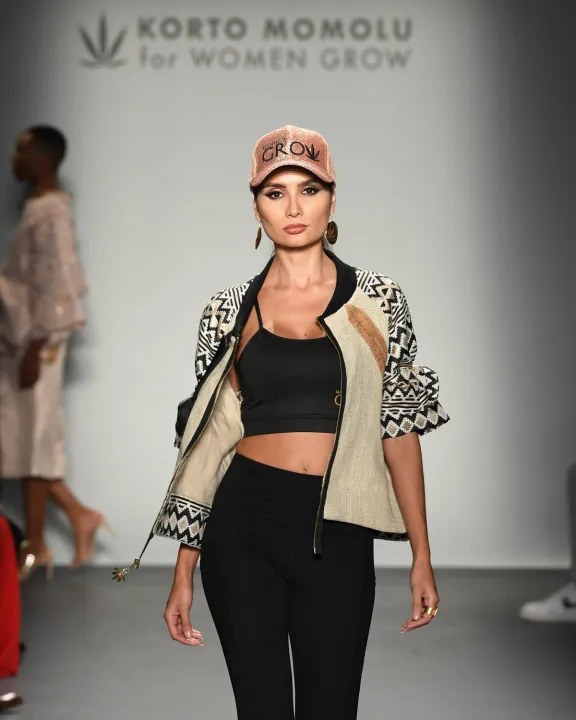
The reported women’s wardrobe offered two main routes: a khaki trenchcoat dress with three-quarter-length sleeves, or blouse-and-cardigan separates that could be layered and paired with an employee’s own black trousers or skirt. Momolu also designed a shirt, vest and cardigan for men, a denim shirt for outdoor workers and an apron for catering staff. These descriptions establish a set of options rather than a repeated silhouette. They also show the brief extending beyond the museum’s front desks and galleries to other kinds of work. The garments were not expected to perform identical functions. An outdoor-work shirt and a catering apron addressed different roles from a dress or cardigan worn by a guest-services employee. Their inclusion made the commission a broader exercise in institutional clothing, not only a look for the most publicly visible staff.
Within the guest-services wardrobe, employees also had choices about combinations. Carol Roberts described wearing a wraparound shirt supplied with the cardigan outfit or substituting her own white shirt. Employees could tie the scarf and shirt in different ways. Momolu’s approach therefore located continuity across several elements, colour, print and selected garments, while leaving some room for variation. The available account documents those options; it does not establish that every role had the same degree of choice. Fit was also part of development. Momolu said museum employees, friends and models tried on the clothes, and she tested them on herself.
“I’m 5-4 and very curvy,” she explained. That is not a technical fit study or evidence of universal accommodation. It is a concrete account of the designer checking the garments on people beyond a single model. Alongside the alternative outfits, it shows how differences between wearers entered the process.
The Everyday Test: Care and Repetition
Roberts’s testimony brings the discussion from design intention to use. As a guest-services employee, she valued the ability to mix and match while still feeling part of a team. She also described the clothes as easy to wash and care for. “I like the fact that we can change it up,” she said. “It takes all the work out of figuring out each day what you’re going to wear.” Her account offers a specific point of agreement with Momolu’s brief. The designer wanted flexibility and repeated use; Roberts reported appreciating the combinations, care and convenience of the wardrobe.
Those observations concern one wearer, not the entire staff. Nevertheless, they introduce criteria essential to work clothes. A garment has to move beyond its first fitting or first appearance. It must be available again after washing, work with the other pieces an employee uses and remain manageable within a daily routine. Roberts’s comments also reveal a balance that can be lost when uniforms are discussed only as restrictions. For her, having a defined wardrobe reduced the effort of getting dressed while still allowing changes within it. The options did not remove the structure; they made the structure more adaptable.
The historical record does not tell us how long each piece remained in service. What it preserves is a designer’s intended approach and an employee’s contemporary experience of wearing it.
The Omiren Argument
Momolu’s commission treated the uniform as a wardrobe, not one compulsory look. The distinction is visible in the documented brief: alternative garments, shared accessories, layering and the incorporation of employees’ own clothing. Recognisability was intended to come from relationships between pieces rather than complete sameness. Roberts’s account suggests that, for her, those choices supported both variation and a sense of belonging to the team. The site-derived print added another relationship. It linked staff clothing to the museum’s grounds, while the green connected the accessories to its existing identity. These were specific responses to a particular institution, not a standard uniform with a new label.
Most importantly, repetition was part of the assignment. The clothes were intended to be washed, recombined and worn to work again. That everyday requirement was not separate from their design value. It was one of the problems the design had to address.
Also Read:
- Traditional Clothing in Liberia: Culture, History, and Identity
- Liberian Designers Influencing African and Global Fashion
- Modern Women’s Workwear: Professional Style on Your Own Terms
- Marcus Garvey’s UNIA Uniforms and the Politics of Black Power Dressing
Frequently Asked Questions
What did Korto Momolu design for Crystal Bridges?
The contemporary newspaper report describes a signature scarf print, a trench coat dress, women’s separates, a shirt, vest and cardigan for men, a denim shirt for outdoor workers and an apron for catering staff. Staff could combine some garments with their own clothes, so the wardrobe offered options rather than one compulsory look.
What inspired the signature print?
Momolu said she picked up berries and leaves on the museum grounds, and that is what appears on the scarf. She linked the vibrant green used in staff scarves and men’s neckties to the museum’s logo motifs, and chose not to place her signature within the print, although her label remained on the scarf.
How did the commission begin?
Museum executive director Don Bacigalupi knew Momolu’s work through her 2008 appearance on Project Runway, and employee Virginia Germann approached her during a department-store appearance. Early discussions covered a crest and then a signature scarf print, before expanding to garments for guest-services representatives and gallery attendants. Ladybrille dates the initial approach to 2010.
What did a museum employee say about the clothes?
Guest-services employee Carol Roberts said she valued being able to change combinations while still feeling part of a team, and described the clothes as easy to wash and care for. Her account concerns one wearer, not the entire staff, and the record does not say how long each piece remained in service.