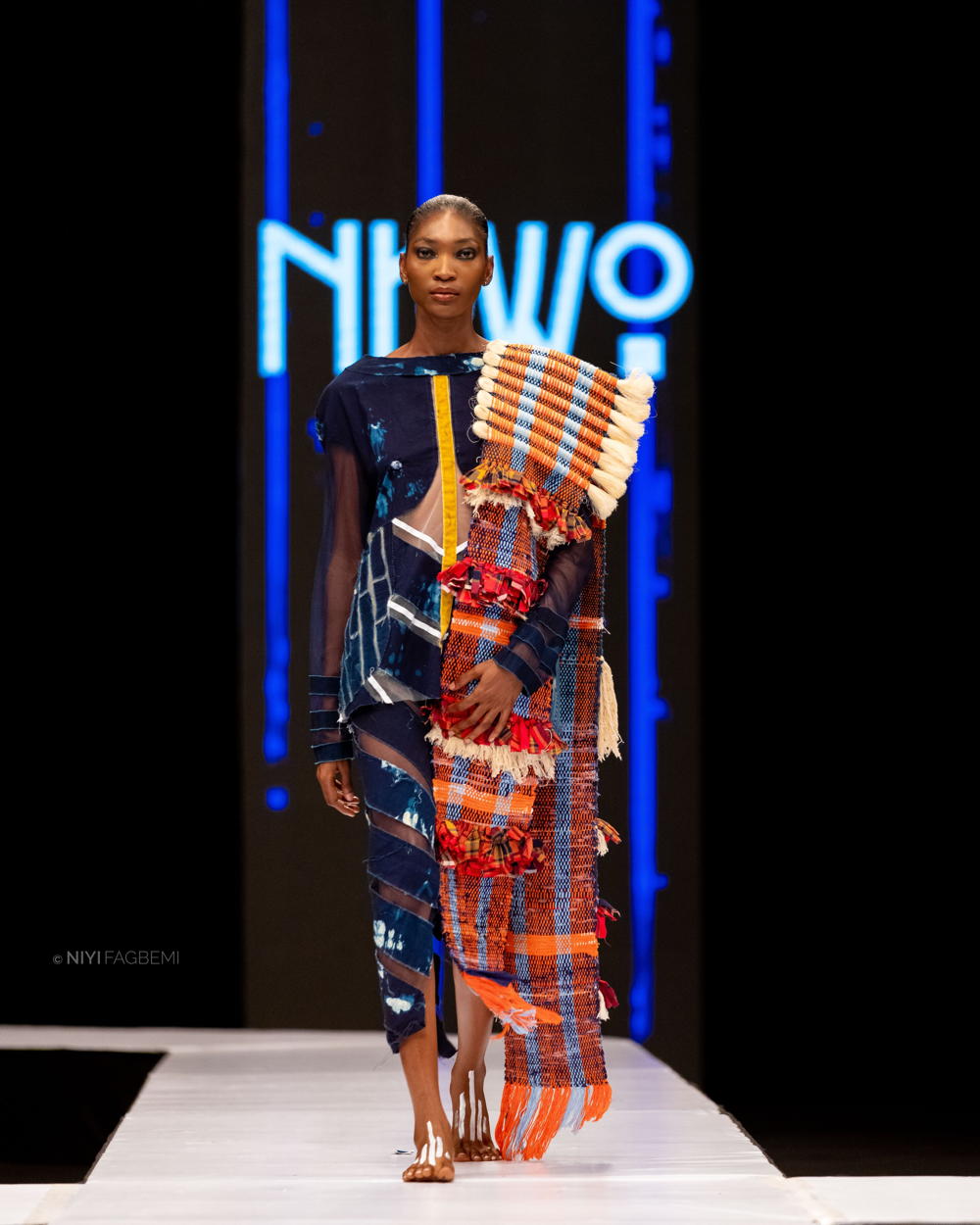
The story of Dakala Cloth begins with absence.
Nkwo Onwuka, the founder and designer of the Nigerian artisanal label NKWO, needed to produce a collection. Her weavers were unreachable. In her studio in Abuja, she had what she had always had: waste fabric, denim scraps, the remnants of previous work and the unwanted outputs of a textile economy that produces far more than it needs and manages very little of what is left over.
She began stripping waste fabric into strips and stitching it back together. When she stepped back, what she saw looked like woven cloth. She knew, in that moment, that she had invented something new.
“The name. I couldn’t reach my weavers one season, so I stripped waste fabric and stitched it back together. From a distance, it looked like woven cloth. I knew I had invented something new.” Nkwo Onwuka, Your Luxury Africa, December 2025
That invention is now in the permanent collection of the Victoria and Albert Museum. It was nominated for the Beazley Design of the Year Award at the London Design Museum. It has been worn by Naomi Campbell and featured in Vogue Arabia. It has been shown at Lagos Fashion Week and presented at the State of Fashion Biennale 2024, in a year whose theme, ‘Ties that Bind,’ turned the lens specifically on the Global South.
The textile is called Dakala Cloth. The name carries two things: the material it began with, denim scraps from waste piles, and the sound of Africa’s long tradition of cloth weaving, the rhythm of the loom, sakala-si, sakala-sa. The name holds both the problem it solved and the craft tradition it connects to, which is characteristic of the way Nkwo Onwuka builds everything: from what is present, not from what is assumed.
Nkwo Onwuka invented Dakala Cloth from waste fabric when she couldn’t reach her weavers. The result is now in the V&A’s permanent collection and proposes a different model of what Nigerian luxury can be.
The Material System
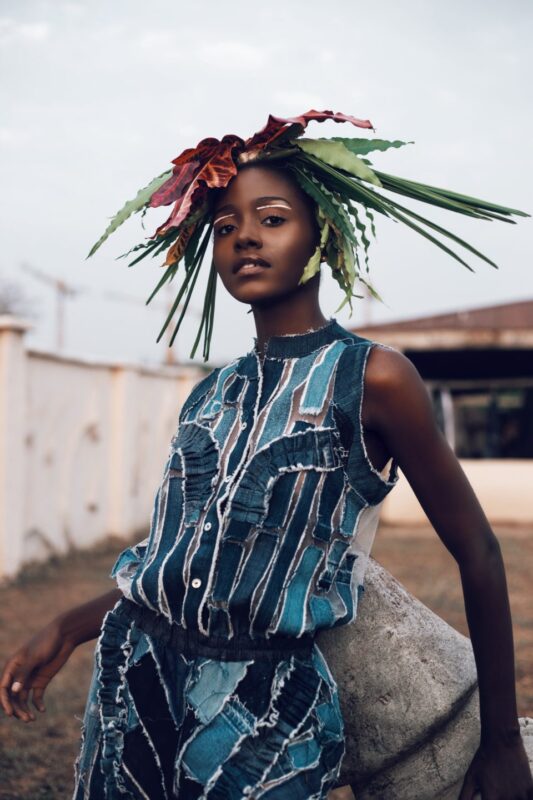
Lagos Fashion Week describes NKWO as an artisanal brand at the forefront of the sustainable fashion movement in Nigeria, with the conservation of natural resources and the environment as the label’s core values. The description is accurate but slightly misleading in one direction: NKWO is not a sustainability brand in the sense that sustainability has become a genre of fashion marketing. It is a material system, a set of decisions about what fabric is, where it comes from, who makes it and what its production philosophy allows.
The material sources are specific. Post-consumer waste: second-hand denim and discarded garments from markets including Katangowa in Lagos, where imported secondhand clothing accumulates in quantities that Nigeria’s waste management systems cannot absorb. Made-in-Nigeria cotton: a locally sourced natural fibre whose use is itself a supply-chain decision, a rejection of the import dependency that characterises most African fashion production at scale. End-of-line fabrics and cutting-table waste: the excess and residue from other production processes, materials that the fashion system generates as byproducts and typically discards without processing.
Each of these sources is in principle a waste problem. NKWO converts them into a material resource through a process of stripping, sewing, and weaving, the physical execution of which takes up to six hours for a single panel of Dakala Cloth. That production time is not a cost to be engineered away. It is the core of what the fabric is: the six hours are when the traditional craft skill enters the material, when the weaver’s knowledge is embedded in the cloth, when the surface that looks like handloom weaving becomes handloom weaving.
As Dazed documented in its 2024 coverage of Global South designers at the State of Fashion Biennale, a single panel of Dakala Cloth, whether stitched, woven or braided, can take up to six hours to make. The skilled labour required to produce it is not a logistical obstacle: it is a social opportunity. Through the brand’s social initiative NKWO Transform, that skilled labour provides opportunities for vulnerable women to learn to weave. The waste problem, the craft preservation problem and the social equity problem are addressed simultaneously by the same production decision.
The Philosophy of Less
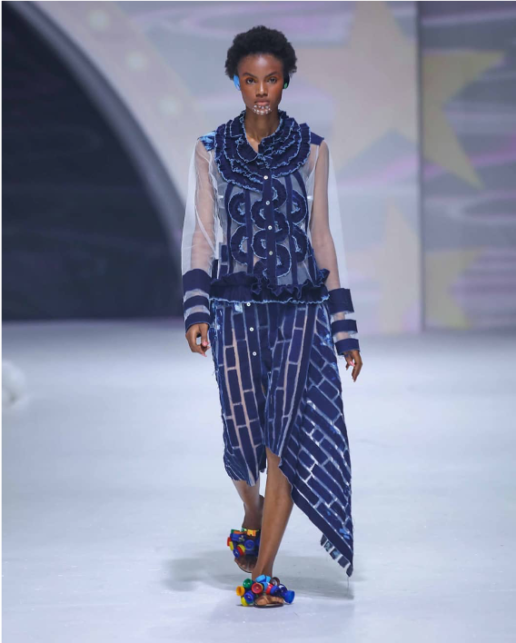
NKWO operates under what it calls the Philosophy of Less: low-impact, limited-edition and one-off pieces, produced from materials that already exist rather than from new production. The philosophy is not a marketing positioning. It is the operational logic of a label that is genuinely constrained by the nature of its material sources.
Post-consumer waste is not a consistent supply. The specific mix of denim and fabric scraps available in any given season is neither predictable, repeatable, nor scalable in the conventional sense. A collection built from waste is a collection whose material palette is shaped by what exists in the world at the time of production, which means no two collections can be identical and no single piece can be exactly replicated. The constraint is real, and the Philosophy of Less is the creative framework that turns it into a design principle.
Limited-edition production is not, in NKWO’s case, a luxury-market strategy to create artificial scarcity. It is the direct consequence of the material system: there is only as much Dakala Cloth as there are waste materials to make it from and weavers with the skill and time to produce it. The scarcity is genuine. The premium it justifies is real, grounded in the production economics of six hours of skilled labour per panel rather than in the marketing economics of limited runs.
As NKWO’s own brand documentation states, the label was relaunched by Nkwo Onwuka in 2012 as a call to action to address both the lack of adequate waste management systems in Nigeria and the fact that many local artisans are the last in their craft lines. The dual crisis, material waste and knowledge loss, is addressed by the same solution: a material system that requires artisan knowledge to function. If the weavers stop, the fabric stops. If the fabric stops, the collection stops. The weavers are not a supplier. They are the fabric.
What the V&A Acquisition Means
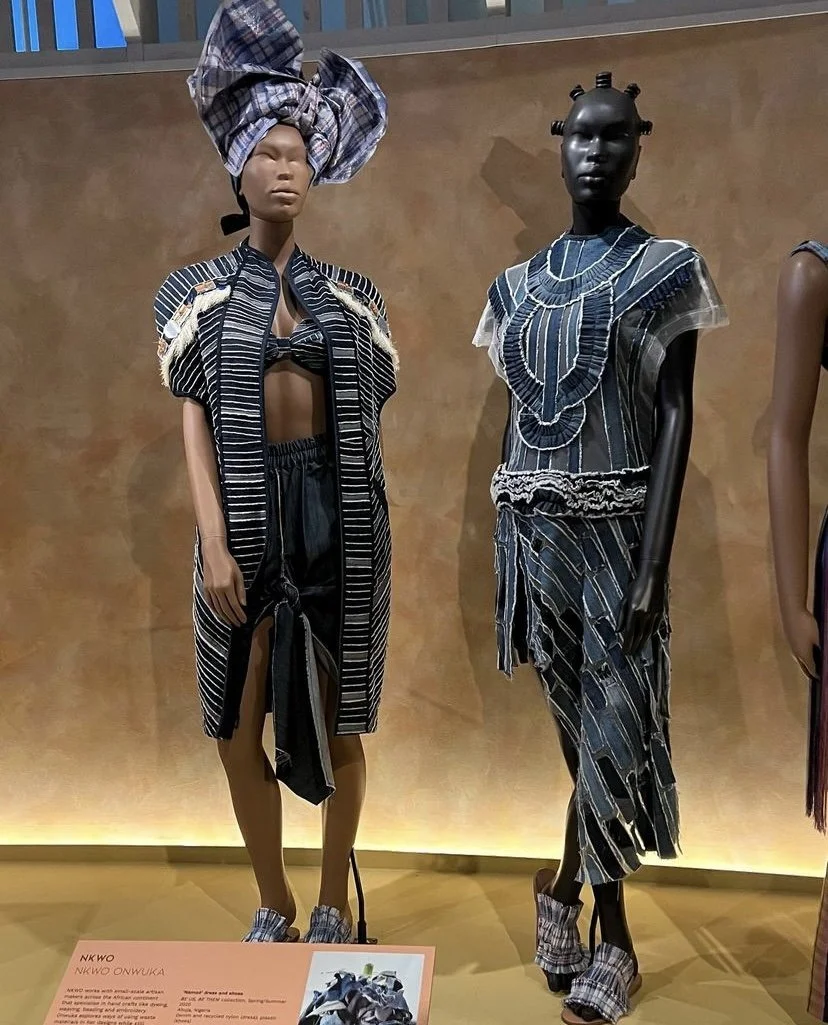
One of Nkwo Onwuka’s iconic Dakala Cloth pieces has been acquired for the V&A Museum’s permanent collection as part of the AFRICA FASHION exhibition, in which she was one of 45 designers from 20 countries. The same piece was nominated for the Beazley Design of the Year Award at the London Design Museum.
The Design Museum’s documentation of the nomination describes Dakala Cloth as a fabric developed by Nkwo Design Studio to reduce textile waste and preserve a traditional craft form, developed through a technique that involves stripping and sewing together waste material. In the language of design heritage institutions, the combination of a V&A permanent collection inclusion and a Beazley nomination represents the most significant form of recognition available to a contemporary design object. It places Dakala Cloth not in the category of interesting sustainable fashion but in the category of objects that represent a meaningful contribution to how human beings make things.
That category is significant for the argument Omiren Styles has been making across this series. The fashion industry’s relationship with African craft and material innovation has historically been one of extraction: borrowing the aesthetic, ignoring the inventor, capturing the premium. The V&A acquisition is a form of documentation that cannot be ignored: it names Nkwo Onwuka as the inventor of Dakala Cloth in a permanent public record held by one of the world’s most authoritative design institutions. The credit has been formally assigned in this case.
What the acquisition does not resolve is the commercial question: whether the international recognition of Dakala Cloth’s significance translates into commercial infrastructure that allows NKWO to operate at the scale that the recognition suggests is merited. The label faces the same challenges that this series has been documenting for African fashion broadly: scaling production of a handmade fabric whose process is inherently time-intensive, managing the inconsistency of a waste-based material supply, and building the international commercial relationships that would allow limited-edition pricing at a level that sustains the production system.
A Different Model of Nigerian Luxury
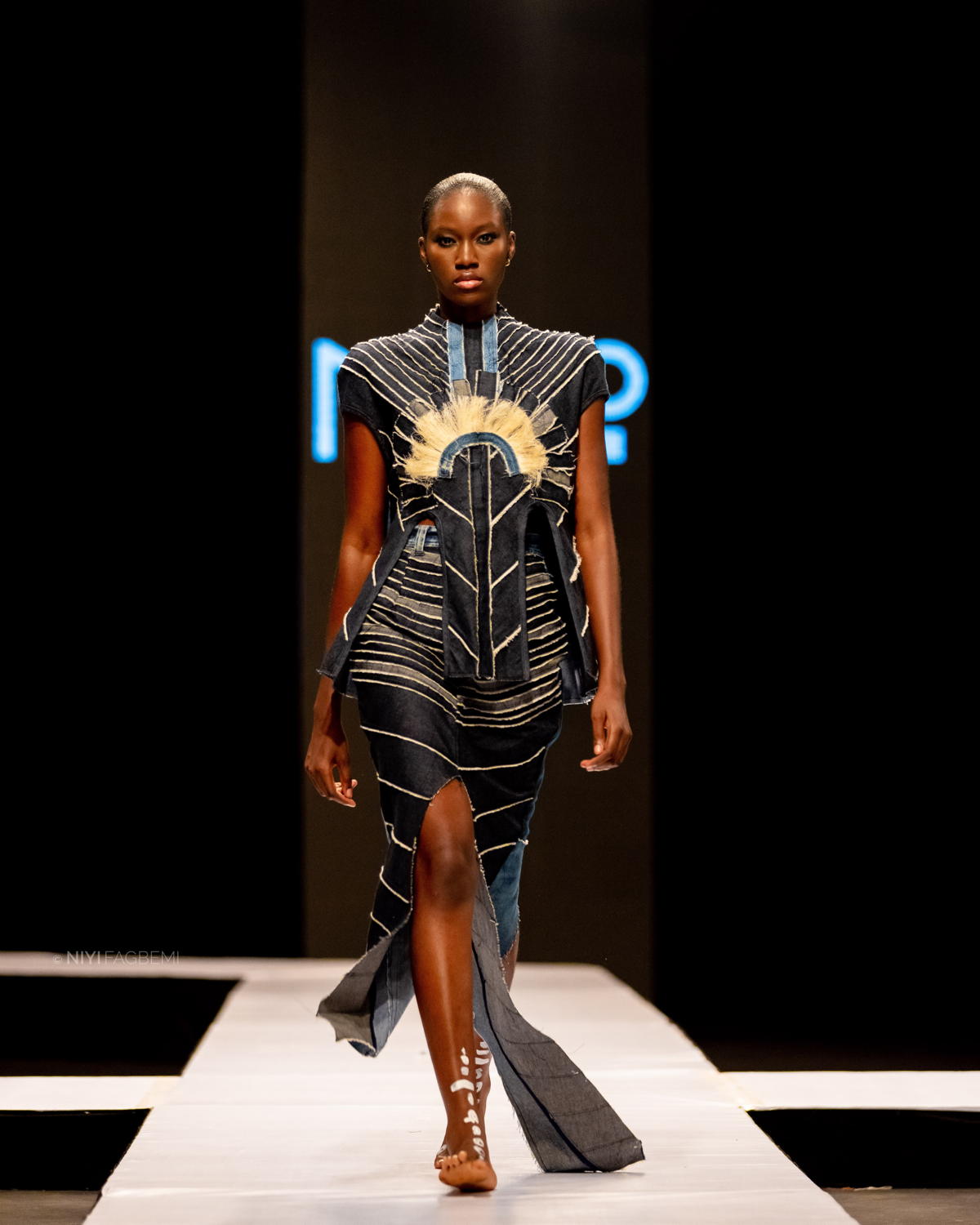
The title of this spotlight describes Dakala as the material system behind a different Nigerian luxury. The distinction from dominant models of luxury in Nigerian fashion is worth naming precisely.
Nigerian luxury fashion has historically been organised around two models. The first is the international luxury import market: global-brand goods, European fashion labels, and aspirational consumption that reflects the global fashion hierarchy. The second is the high-end occasion dress market: the Aso-ebi, the ankara, the fully embellished event dress that communicates status through the visibility of its production labour and the cost of its materials. Both models are legitimate and commercially significant. Neither of them is what NKWO is doing.
NKWO’s luxury is material-system luxury: the premium reflects the rarity of the material (not because it is rare in origin but because it is transformed through a rare process), the embeddedness of skilled craft knowledge in the physical fabric and the limitation of supply that the Philosophy of Less creates. It is closer, in commercial logic, to what Harris Tweed achieves: a geographically and process-specific fabric whose premium is grounded in the irreplicability of its production rather than in the celebrity of its designer or the exclusivity of its branding.
As Omiren Styles has established in its analysis of material intelligence in African fashion, material intelligence is the knowledge system that converts a fabric from a visual reference into a production decision, a cultural relationship, an economic commitment and a sustainability position simultaneously. Dakala Cloth exemplifies material intelligence at its most complete: every element of the material decision, from the waste source to the weaving technique to the social initiative to the Philosophy of Less, is integrated into a single coherent system whose outputs are commercially and institutionally validated.
The Omiren Argument
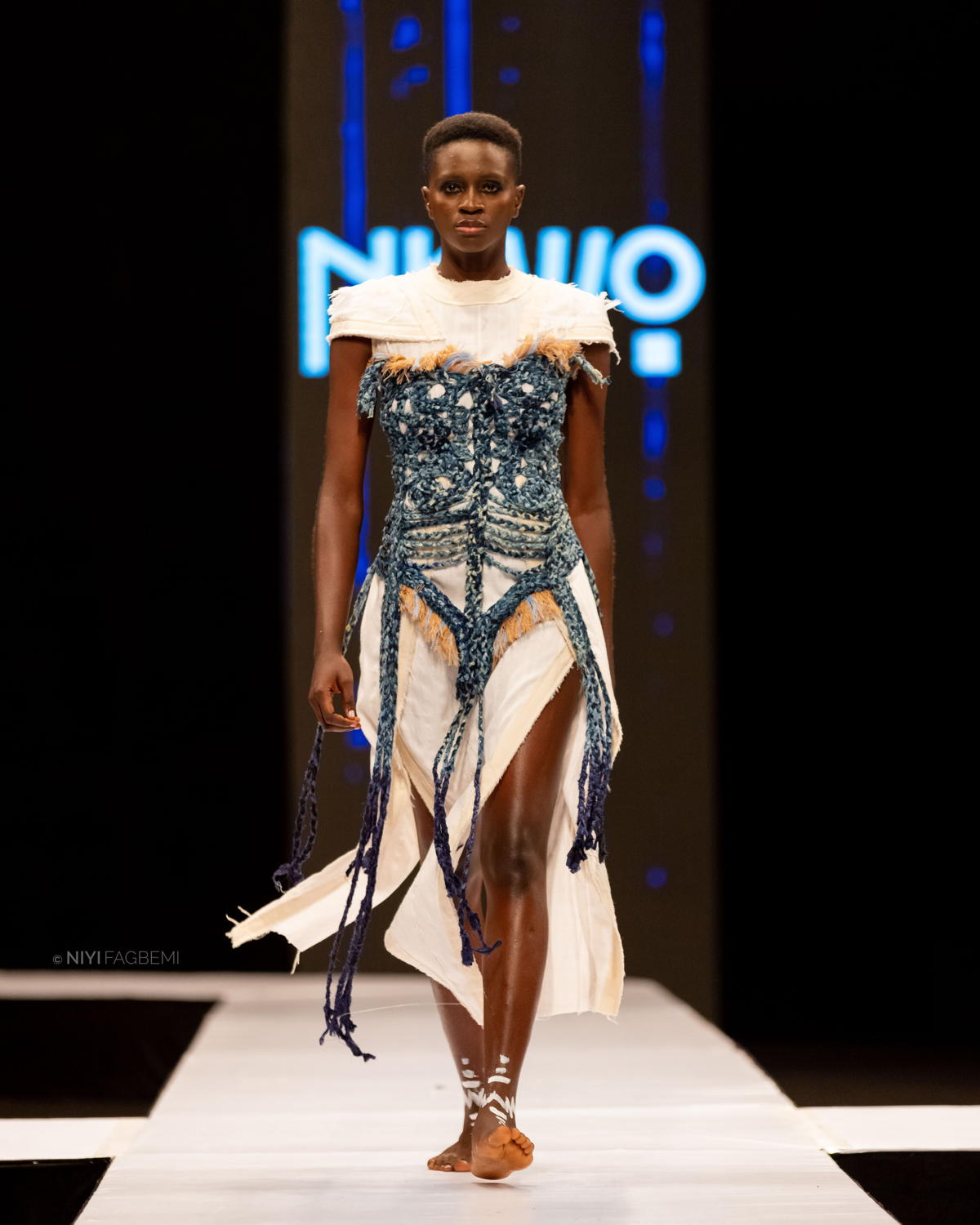
Nkwo Onwuka invented Dakala Cloth from what was already present. The weavers were absent. The waste was there. The craft knowledge, her own and the tradition she was drawing on, was there. The solution was in the material that the problem had already provided.
That is the form of Nigerian luxury that Dakala represents: not the imported premium, not the occasion spectacle, but the object whose value derives entirely from the knowledge embedded in its making and the integrity of the system that makes it. The six hours in a single panel of Dakala Cloth are not a production cost. They are the product.
As Omiren Styles has documented in its analysis of Africa’s repair economies and the sustainability metrics that cannot see a tailor, the most sustainable fashion practices on earth operate outside the certification systems whose metrics determine what counts as sustainable. Dakala Cloth is a precise illustration: a fabric whose circular credentials are embedded in its entire production philosophy rather than certified by any external standard, because the standard would need to be built around the practice rather than the practice built around the standard.
As Omiren Styles has argued throughout this series, the Global South made fashion and never got credit. In Dakala Cloth’s case, the credit has been formally given by the V&A, the Design Museum, Vogue Arabia, the State of Fashion Biennale, and every institution that has recognised that something genuinely new was made. What now needs to be built is the commercial infrastructure that allows that recognition to generate the economic returns for NKWO that the recognition implies the practice deserves. The material system is complete. The market system that would sustain it is still being built.
ALSO READ
- A Fabric Is Never Just a Fabric: Why Material Intelligence Matters to African Fashion’s Future
- Can Heritage Textiles Scale Without Losing Their Meaning?
- Can Africa’s Repair Economies Become Formal Fashion Infrastructure?
- The Global South Made Fashion. It Just Never Got Credit.
EXPLORE MORE
Read the full Fashion Spotlight and Heritage, Textiles and Cultural Interpretation sections at Omiren Styles for ongoing profiles of designers building material systems, craft innovation and a different model of African luxury. Read the companion feature on NKWO at Rex Clarke Adventures and discover travel and heritage intelligence across Nigeria and Africa at rexclarkeadventures.com.