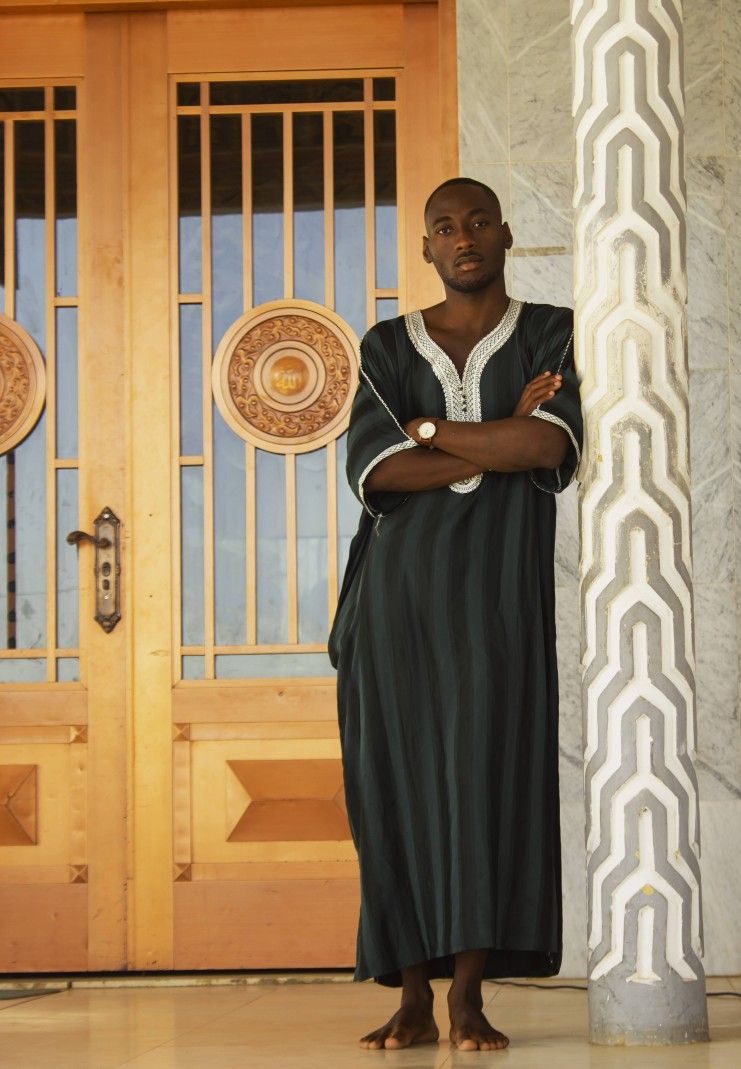
The djellaba has been resolving tailoring problems for a thousand years.
The qob, the pointed hood that is the djellaba’s defining structural feature, is not decorative. It solves a specific environmental problem: shielding the wearer’s head, face and neck from desert sun, wind and sand while remaining detachable enough to let body heat escape. The full-length, full-sleeved silhouette creates a microclimate around the body in extreme heat. The wool version retains heat for cold nights in the same landscape. The same form, in two materials, solves the climate problem that the Maghrebi environment presents without requiring two different garments. That is not heritage tailoring. That is engineering.
Fashion journalism’s habit of framing the North African kaftan family as “traditional dress” that “influences contemporary fashion” has produced a category error that runs in the wrong direction. The djellaba, the jabador, the gandoura and the kaftan are not influencing contemporary menswear. They are contemporary menswear, operating in Morocco, Algeria, and Tunisia as live tailoring systems with active markets, named practitioners, fabric hierarchies, seasonal production calendars, and a consumer base that uses these garments not as heritage gestures but as the primary formal dress in millions of men’s daily lives.
A man leaving a Casablanca office in a white jabador for Friday prayers and returning in a navy djellaba for an afternoon meeting is not performing heritage. He is using a tailoring system his grandfather used, and his son will use—a system with its own rules about when each garment is appropriate, which fabric communicates which level of formality, and what the embroidery vocabulary at the neckline signals about the occasion. That system did not need fashion to validate it. Fashion needs to understand it.
As Omiren Styles has established in its analysis of the kaftan’s movement through African menswear, variations of long, flowing robes moved along the trade routes linking North Africa, the Sahel and the wider Islamic world during the late medieval and early modern periods. By the 11th century, the Almoravid dynasty had begun shaping the garment forms that would become the Moroccan menswear system; the Marinid period (13th to 15th centuries) refined them further; Ottoman influence added new elements that persist in the embroidery vocabulary and fabric associations of Moroccan formal dress today. This is not a short tradition. It is a longer continuous design history than most European luxury houses can claim.
The North African kaftan is not a heritage garment making occasional fashion appearances. It is a fully operational contemporary tailoring system. Designers building on it show the tradition was already modern.
The Garment Vocabulary: Naming What Exists
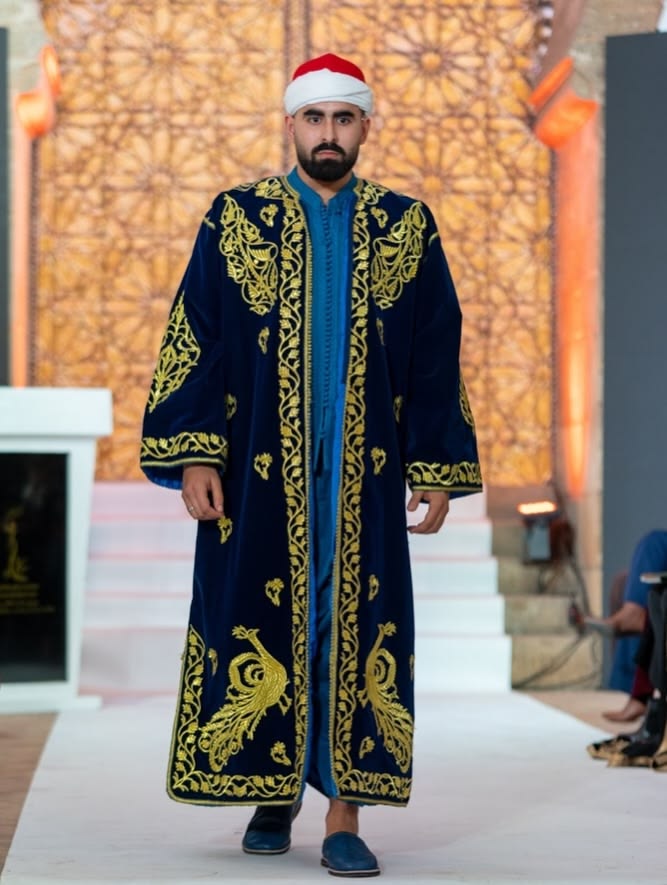
The North African menswear system operates through a vocabulary of distinct garments, each with specific construction, specific occasions and specific fabric associations. Understanding the vocabulary is the precondition for reading the system as a tailoring practice rather than as a national costume.
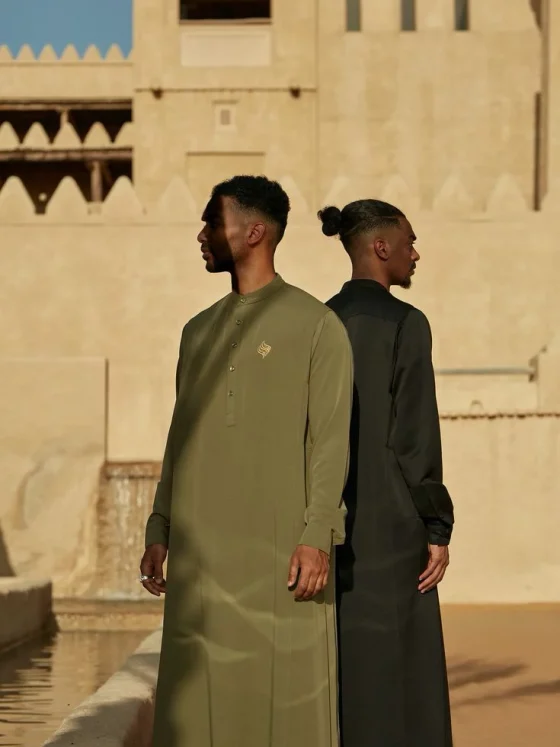
The djellaba (Arabic: جلابة; pronounced ji-LAH-bah) is the foundational everyday and semi-formal garment of the Maghreb. As documented in construction detail, its defining feature is the qob, a pointed hood whose shape evolved to protect the wearer from desert conditions. The word djellaba derives from the Arabic root jalaba, meaning to bring, attract or import: a word that already encodes the garment’s history as a form that arrived through trade and was transformed by the communities it reached. The djellaba is full-length and full-sleeved, made from wool for winter and cotton or microfibre for summer. The distinction between the wool and the cotton djellaba is not merely material. It is seasonal, climatic, and social: the wool djellaba, in a heavier weave, signals different occasions than the lightweight cotton version worn in summer heat.
The jabador is the most precisely tailored garment in the North African men’s system. It is a two-piece ensemble: a short-sleeved tunic worn over matching trousers, more structured in silhouette than the flowing djellaba, with a mandarin collar and a button-down front. As documented in Moroccan tailoring tradition, the jabador features tarz embroidery, the decorative needlework applied by skilled artisans to the collar, cuffs and sometimes the chest placket. Tarz is not decoration. It is a quality signal: the precision, density and design complexity of the tarz work communicates the level of investment and craftsmanship behind the garment to an audience that knows how to read it. Traditional jabadors are crafted from high-quality cotton; silk blends appear for significant occasions. White, cream and pastel colours dominate daywear; navy and burgundy appear for evening. The jabador most directly parallels Western tailoring’s formal suit in its structural logic: a matched two-piece with specific construction requirements and a clear social function at the semi-formal level of dress.
The gandoura (also gandora) is the simplest and most versatile garment in the system: a sleeveless or short-sleeved robe without a hood, typically worn in lighter fabrics for less formal occasions or as an undergarment beneath a djellaba. Its simplicity does not diminish its tailoring logic. The gandoura’s role as the everyday, domestic, and informal register makes the djellaba’s formality legible by contrast. A tailoring system that has a clearly differentiated casual register produces better formal garments because the distinction between formal and informal is built into the system’s structure.
The kaftan (also caftan) in the Moroccan context occupies the highest ceremonial register for both men and women. However, international fashion media overwhelmingly associates it with women’s ceremonial wear. Men’s kaftans in the Moroccan tradition use silk, velvet, and brocade; the embroidery vocabulary is at its most elaborate here, with gold-thread work at the collar, cuffs, and hem communicating royal and aristocratic association. Moroccan men’s kaftans are traditionally reserved for weddings, royal ceremonies and the highest formal occasions. Emerald, deep burgundy, ivory and midnight blue are the classic colour associations of men’s ceremonial kaftans, with metallic embellishment distinguishing the most formal iterations from semi-formal versions.
Together, these four garments form a complete menswear system with everyday, semi-formal, formal, and ceremonial registers, each with specific fabric choices, silhouette requirements, embroidery vocabularies, and social contexts. That is not a costume collection. That is a tailoring system as developed and internally consistent as any European menswear tradition.
The Fabric Hierarchy and What It Communicates
A tailoring system’s sophistication is most precisely read through its fabric hierarchy: the ranked set of materials that communicates different levels of formality, different social occasions and different economic investment through the choice of cloth alone.
The North African menswear fabric hierarchy is organised around several axes. The first is weight: heavier, denser fabrics signal winter formality and higher investment; lighter fabrics signal summer practicality and informal register. The djellaba demonstrates this clearly — the same form in heavyweight wool and in lightweight cotton occupies different positions in the social calendar.
The second axis is material origin and processing. Cotton at the informal end; cotton blends for everyday formal wear; high-quality cotton as the standard fabric for the jabador; silk as the escalation for significant occasions; velvet and brocade for ceremonial kaftans. This hierarchy parallels European menswear’s progression from worsted wool everyday suits through silk ties to velvet evening wear. Still, it operates across different garment forms and social occasions.
The third axis is embroidery. The progression from no embroidery (everyday djellaba) through simple tarz at collar and cuffs (everyday jabador) to complex tarz across the full chest and hem (ceremonial jabador) to gold-thread embroidery on silk or brocade (men’s kaftan) constitutes an entirely separate communication system operating on top of the fabric hierarchy. A man who understands this system can read another man’s garment for fabric quality, embroidery complexity and silhouette precision and form a complete assessment of the social register and economic investment the garment represents, without any additional information.
As Omiren Styles has established in its analysis of the grand boubou as a prestige garment, West African robe traditions carry their own embroidery vocabulary as a prestige signal, with embroidery concentrated at the collar, chest, and sleeves to communicate social standing and occasion formality. The North African system is closely related in logic, while using its own specific regional vocabulary of stitching patterns, colour combinations, and fabric associations.
The Djellaba as Street-Level Contemporary Menswear
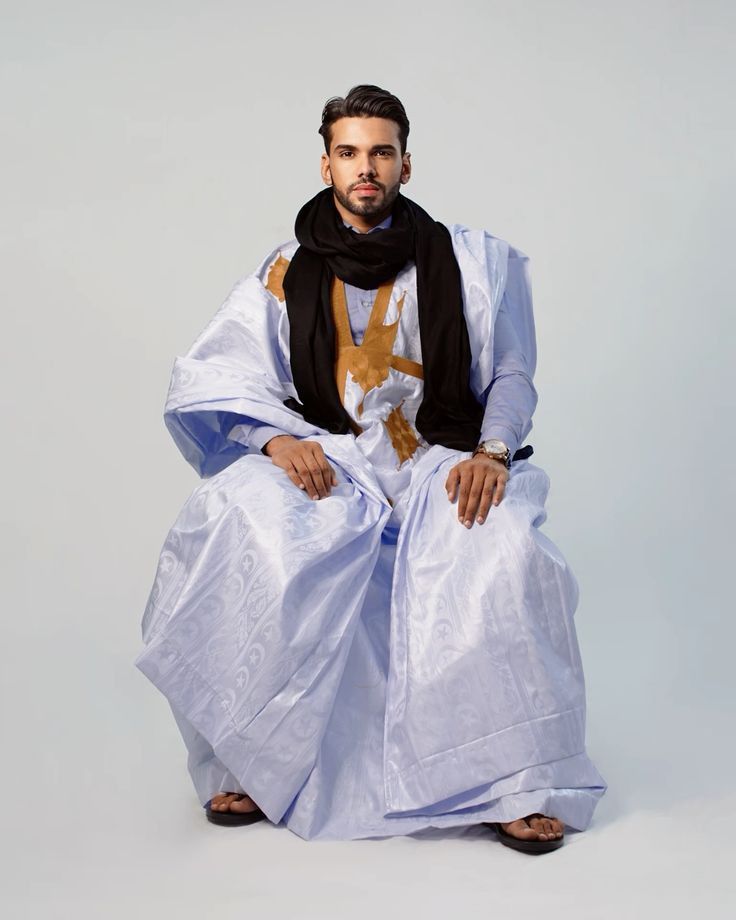
The strongest argument for the North African kaftan system as contemporary menswear rather than heritage dress is not found in luxury retail or international fashion press coverage. It is found in the streets of Casablanca, Tunis, Algiers, Fez and Marrakech, where the djellaba operates as daily dress for millions of men across all age groups and income levels.
Contemporary styling around the djellaba in North African cities shows that the garment is not frozen in a ceremonial register. Young men in Casablanca wear djellabas with white trainers and no hood deployed. University students in Tunis layer the djellaba over shirts and narrow trousers, using the garment as an outer layer in the same way that European men use a long coat. The Friday prayer context produces one djellaba styling register; the afternoon meeting, the wedding, the market, and the evening gathering each produce different configurations of the same garment form.
As Omiren Styles has documented in its analysis of Dakar street style, across the Senegambian region, which shares the djellaba and kaftan tradition through Saharan trade contact, young men pair tailored kaftans with designer trainers, and the combination is read within the community as stylistically sophisticated rather than as a category error between the traditional and the contemporary. The same practice operates in the Maghreb. The djellaba has always been adaptable. Its contemporary styling is not a departure from tradition. It is the tradition doing what tailoring traditions do: adapting to new contexts while retaining structural integrity.
The babouche, the soft leather slipper that traditionally complements the djellaba and jabador, has followed a similar trajectory. Contemporary styling in the Maghreb pairs babouches with rolled-up jeans, contemporary trousers, and sneakers in contexts where the combination reads as coherent rather than incongruous, because the audience has the cultural literacy to read the babouche as one component in a legible styling logic rather than a costume mismatch.
The Tailoring System Across the Maghreb: Regional Variation
The djellaba and jabador are not identical across Morocco, Algeria and Tunisia. Regional variation within the Maghrebi menswear system is evidence of a living tailoring practice rather than a static heritage form: live tailoring traditions develop regional variants in response to local conditions, local materials, and local social conventions.
The Moroccan djellaba is typically distinguished by its qob construction and by the embroidery traditions specific to Moroccan ateliers, particularly those of Fez and Marrakech where craft communities have maintained specific stitch vocabularies across generations. At the ceremonial level, the Moroccan caftan draws on the sfifa embroidery tradition, a technique of decorative braid application historically associated with Andalusian influence on Moroccan court dress brought by the Moorish expulsion from Spain in the 15th century. The sfifa tradition persists in the ateliers of the Moroccan medina as a documented craft practice with named practitioners.
Algerian men’s dress shares the djellaba form. Still, it has developed its own regional embroidery vocabularies and fabric preferences, particularly in the Kabyle Berber tradition of the northern highlands, where handwoven fabrics and specific embroidery patterns constitute a regional menswear identity distinct from the Arab Moroccan tradition. Tunisian men’s dress has evolved under the most intense French colonial influence of the three Maghrebi countries, and contemporary Tunisian menswear therefore represents one of the most fully developed examples of a tailoring tradition that has integrated Western structure with North African form while maintaining the core garment vocabulary.
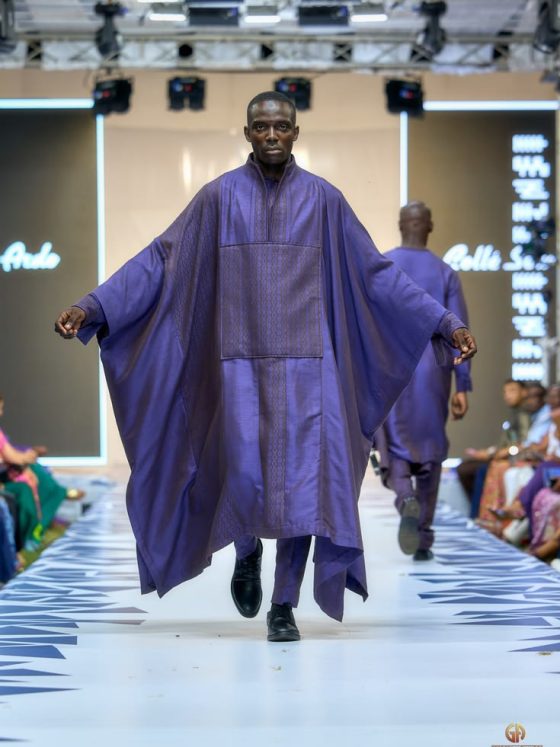
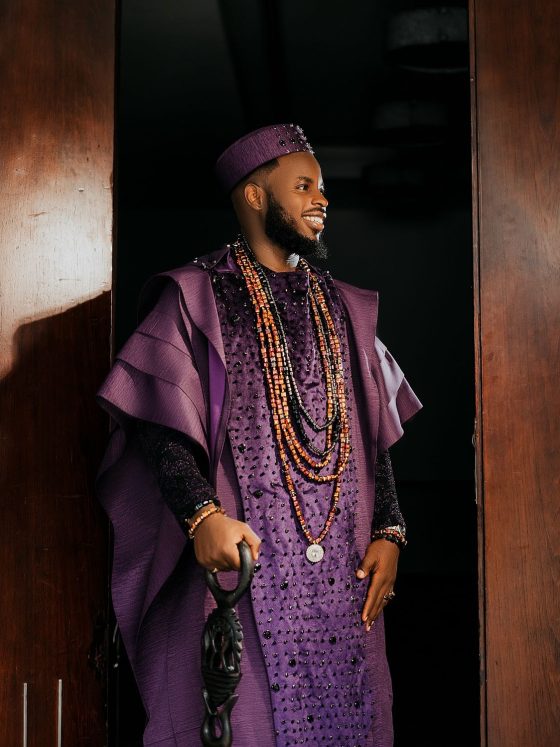
As Omiren Styles has established in its analysis of the African menswear landscape, the djellaba and darra’a of Morocco and Mauritania are named as part of the same family of flowing robe garments that spread along trans-Saharan trade routes, appearing as the grand boubou in Senegal and Mali, the agbada in Nigeria and the kanzu on the Swahili coast. The regional variation of these forms shows the same tailoring intelligence operating across different environmental and social contexts—not a collection of separate traditions but a family of related solutions to the same design problem: how to dress with authority and comfort in a warm climate.
Contemporary Designers Working Within the System
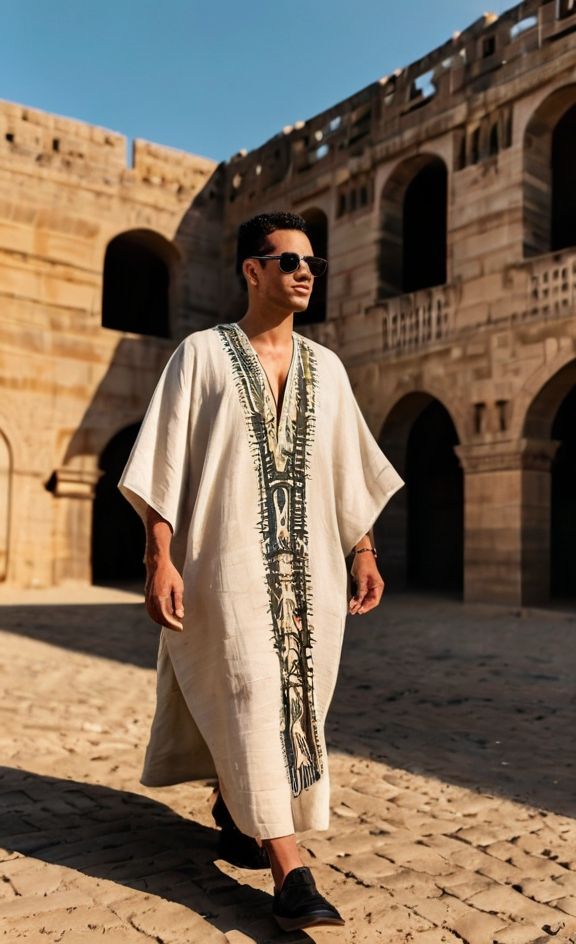
The most significant contemporary engagement with North African kaftan tailoring is not happening in international fashion capitals producing “Moroccan-inspired” collections. It is happening in the ateliers of Fez, Casablanca, Tunis and the medina markets of the Maghreb, where the next generation of tailors and designers is building on the system from the inside.
The principle that distinguishes this engagement from fashion’s external engagement with the tradition is the same principle that distinguishes Kenneth Ize’s use of aso-oke from a European designer’s use of aso-oke: the designer who built their practice within the tradition, who understands the embroidery vocabulary rather than referencing its visual surface, who sources from the artisans who sustain the craft rather than commissioning imitations, is working with the system’s intelligence rather than with its image. The djellaba that a Fez atelier produces for a Moroccan client is not the same garment as a djellaba-inspired piece produced in a European fashion context. The first is the system. The second copies the system’s surface.
The most commercially serious contemporary engagement with North African kaftan tailoring builds on the precision tailoring tradition of the jabador, updating its silhouette proportions for contemporary urban contexts while maintaining the tarz embroidery vocabulary and the fabric hierarchy that give the garment its social function. A jabador with a closer-cut trouser, a higher collar and a simplified tarz in a single thread colour is not a compromise between the traditional and the contemporary. It is the tailoring system doing what the jabador has always done: responding to the social requirements of the specific occasion for which it is commissioned. As Omiren Styles has documented in its analysis of the African men who dress to be remembered, tailored kaftans and agbada-inspired tops are among the forms most actively being redeveloped by young designers across the continent, who are building not as heritage preservationists but as practitioners who understand the design intelligence of the forms they are working with.
The Omiren Argument
The North African kaftan tailoring system does not need fashion’s discovery to confirm that it constitutes contemporary menswear. It is worn today by millions of men in Morocco, Algeria, and Tunisia, in every register from everyday to ceremonial, with a fabric hierarchy, an embroidery vocabulary, and a social function as precisely calibrated as any European menswear tradition.
What fashion journalism’s “inspired by North Africa” framing consistently misses is the precision. The djellaba is not a loose robe that suggests North Africa. It is a garment with a specific hood construction, a specific silhouette ratio, specific fabric choices for specific seasons, specific embroidery conventions for specific occasions and a specific footwear vocabulary that completes the ensemble. The jabador is not a matching tunic-and-trousers set. It is a two-piece with a specific collar form, specific embroidery placement, specific fabric progression from everyday to ceremonial and a specific social function at the semi-formal register that does not duplicate any other garment in the system.
The designers who work within this system are not preserving a tradition. They are doing what tailors always do: solving the problem of how to dress appropriately, comfortably and with authority for a specific social context, using the accumulated intelligence of a tradition that has been refining those solutions for a thousand years. The result is contemporary menswear by definition: it is being worn now, by the men it was made for, in the cities where those men live.
As the Global South made fashion and never got credit, the North African kaftan family is one of the most under-documented major menswear traditions in international fashion media. The documentation that does exist tends to frame it as heritage, national costume, or influence on Western fashion, rather than as a self-sufficient contemporary tailoring system that has operated continuously since before most European luxury fashion houses were founded. This article is part of the documentation it deserves: not as inspiration, not as national costume, not as influence, but as a tailoring practice whose intelligence is worth learning on its own terms.
ALSO READ
- The Kaftan in Menswear Today: How a Classic Survived and Evolved for a New Generation
- The Fugu, the Boubou and the Kanzu: A Guide to African Traditional Menswear Beyond Nigeria and Ghana
- The African Men Who Dress to Be Remembered: Style, Power and the Continent’s Forgotten Dandy Tradition
- Grand Boubou: The Most Prestigious West African Garment
- Meet the African Menswear Designers You Should Know Before the Rest of the World Does
Frequently Asked Questions
What are the main garments in the North African men’s tailoring system?
As documented in Moroccan tailoring tradition, the North African menswear system operates through four primary garments across different registers. The djellaba is the foundational everyday and semi-formal garment: a full-length, hooded robe with the qob, a pointed hood, as its defining structural feature, made in wool for winter and cotton for summer. The jabador is the most precisely tailored garment: a two-piece ensemble of a short-sleeved tunic over matching trousers, with a mandarin collar and tarz embroidery at the collar, cuffs and placket, in cotton or silk blends for semi-formal occasions. The gandoura is a sleeveless or short-sleeved robe without a hood, worn for everyday and informal contexts. The kaftan occupies the ceremonial register, in silk, velvet and brocade with gold-thread embroidery, traditionally reserved for weddings, royal occasions and the highest formal events.
What is the qob and why is it significant in North African tailoring?
As documented in the djellaba’s construction history, the qob is the pointed hood that is the defining structural feature of the djellaba. It is not a decorative element: it evolved specifically to shield the wearer’s head, face and neck from desert sun, wind and sand in the Maghrebi environment. The qob can be deployed or left to hang down the back, depending on conditions, making it a functional, detachable structural component rather than a fixed silhouette element. Its pointed shape concentrates rain runoff away from the face and provides a specific microclimate around the head in extreme heat. The qob is one of the clearest examples in global tailoring of a structural element developed as a precise engineering solution to an environmental problem.
What is tarz embroidery and what does it communicate in North African menswear?
Tarz is the decorative needlework applied by skilled artisans to North African men’s garments, particularly the jabador, at the collar, cuffs and chest placket. It is not decoration in the sense of ornament added for aesthetic appeal. It is a quality signal and a form of social communication: the precision, density, pattern complexity, and thread quality of the tarz work communicate the level of artisanal investment behind the garment to an audience that knows how to read it. A jabador with minimal, single-colour tarz in a simple geometric pattern communicates a different social register from one with complex multi-colour tarz in a historical Moroccan pattern across the full collar and cuffs. The same embroidery vocabulary escalates through the kaftan, where gold-thread work in more elaborate patterns communicates royal or aristocratic association.
How is the djellaba worn as contemporary street style in North African cities?
The djellaba operates as daily dress for millions of men in Casablanca, Tunis, Algiers, Fez and Marrakech, styled across a wide range of contemporary contexts. Young men deploy the djellaba with white trainers and the hood down for casual urban contexts. University students layer the djellaba over shirts and narrow trousers, using it as a long outer layer. Friday prayer contexts produce a more formal styling with the hood deployed and traditional babouche footwear. The jabador is worn for family gatherings, religious celebrations and professional meetings. The contemporary styling practices that have developed around these garments in North African cities show they function as a live tailoring system rather than a heritage costume—adapting to new footwear, new layering contexts, and new body proportions while retaining the structural integrity and social function that make them legible as formal dress.
What is the relationship between North African kaftan tailoring and sub-Saharan African robe traditions?
As Omiren Styles has documented, the djellaba, darra’a and related North African robe forms belong to the same family of garments as the grand boubou of Senegal and Mali, the agbada of Nigeria and the kanzu of the Swahili coast. All of these forms moved along the same trans-Saharan trade routes and Islamic scholarship networks that connected North Africa to the Sahel and the wider African continent from the 11th century onward. Each society adapted the broad form to its own climate, textile traditions and social conventions. Regional variation across these forms shows a shared tailoring intelligence operating across contexts, not separate traditions that happen to produce similar silhouettes.
How does the jabador compare to a Western two-piece suit in its social function?
The jabador occupies the same position in the North African menswear system that the suit occupies in European menswear: it is the primary semi-formal two-piece that communicates professional seriousness and social investment for gatherings at the mid-level of formality. Both are two-piece matched ensembles with specific construction requirements. The jabador’s mandarin collar differs from the suit’s lapelled collar; the jabador’s tunic-over-trouser proportion differs from the suit’s jacket-over-trouser; the jabador’s tarz embroidery communicates craft investment where the suit’s lapel construction communicates tailoring precision. Both distinguish the wearer from casual dress and signal readiness for serious social occasions. The jabador does not need to be compared to a suit to justify its existence. But the comparison clarifies that North African menswear has a fully developed formal system with the same structural logic as European formal menswear, operating through different garment forms and a different embroidery and fabric vocabulary.
EXPLORE MORE
Read the full Fashion and Menswear sections at Omiren Styles for ongoing documentation of North African tailoring traditions, Maghrebi menswear systems and the contemporary designers building on them. Discover travel and heritage intelligence across Morocco, Tunisia, Algeria and the wider North African region at Rex Clarke Adventures.