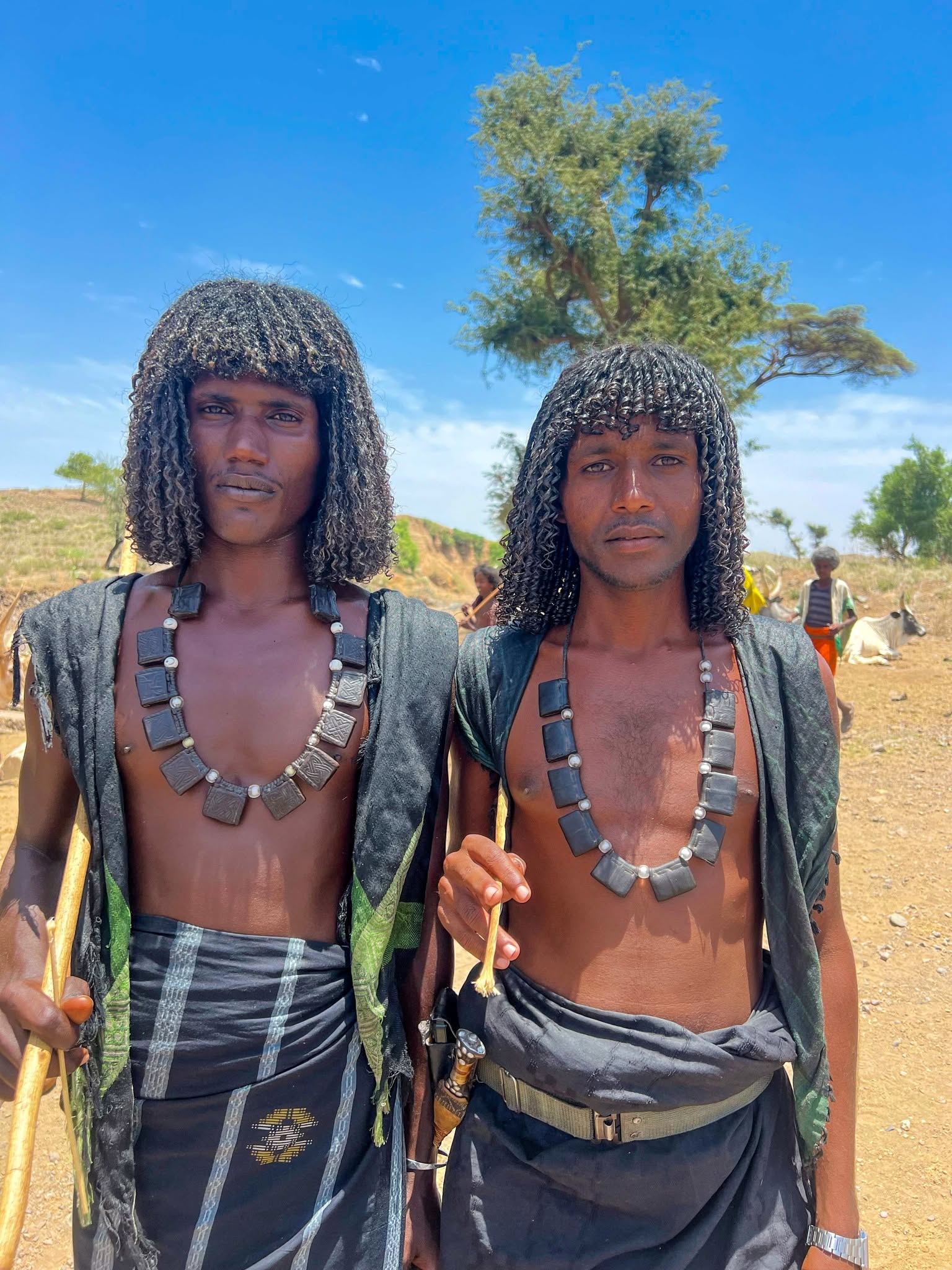
The Afar Triangle is one of Earth’s most inhospitable environments. Temperatures in its naked plains regularly exceed 50 degrees Celsius. The Gara, the Fire Wind, drives heat across the desert and salt flat. Much of the terrain is cracked earth and exposed mineral ground. In this landscape, the Afar people of Ethiopia, Eritrea, and Djibouti have lived as nomadic and transhumant pastoralists for at least two thousand years, maintaining a cultural identity so specific and so resilient that it has survived the borders of three modern states, colonial interference, drought, conflict, and the pressures of the twenty-first century without losing its core.
The African fashion and beauty market is worth 31 billion dollars. Among the Afar, hair is one of the primary expressions of that cultural identity, and for Afar men specifically, the two traditional hairstyles, the Asdago and the Dayta, maintained with butter applied by hand, constitute one of the most visually distinctive hair traditions in the Horn of Africa. As Face2Face Africa’s documentation of the Afar hair traditions confirms, the men of the Afar people are famously known for their stylish and conspicuous-looking Asdago and Dayta buttered hairstyles. The Asdago afro appears fashionably ashy as a result of butter being applied to it. The butter also protects the hair from the sun. The curls of the Dayta, on the other hand, are created with sticks.
The Afar men of Ethiopia’s Afar Triangle style their hair with butter into two distinct forms: the Asdago afro and the Dayta curl. Here is what those choices carry.
Afar Men’s Hair Traditions: The Two Styles and Their Makers
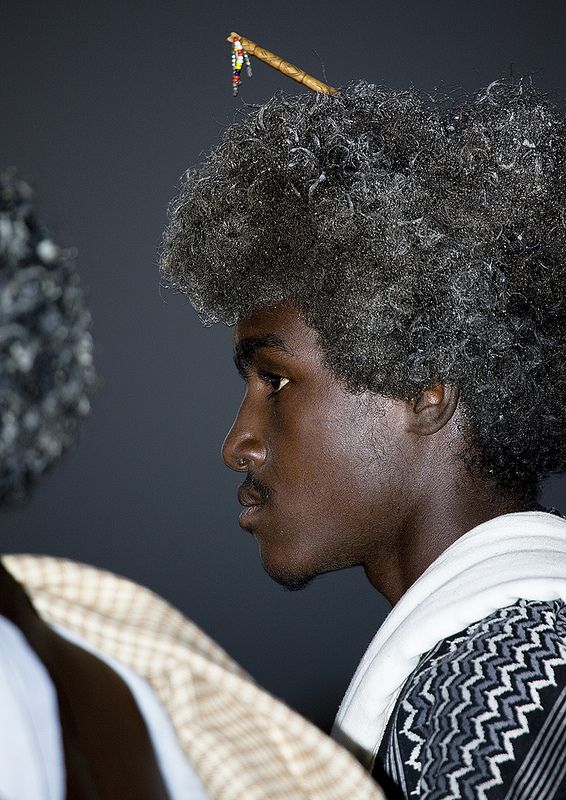
The Asdago is the Afar man’s large Afro hairstyle, grown to volume and maintained with the application of fresh butter. The word describes both the style and the state it is kept in: the butter distributes through the hair during application, giving the Afro its characteristic slightly ashy, matte finish when the fat has been absorbed. This is not an accidental appearance. The ashy quality signals active maintenance, the presence of the butter in the hair rather than on it, distinguishing the Asdago from a hairstyle that has simply been allowed to grow. An Afar man wearing the Asdago in its proper state is wearing evidence of care.
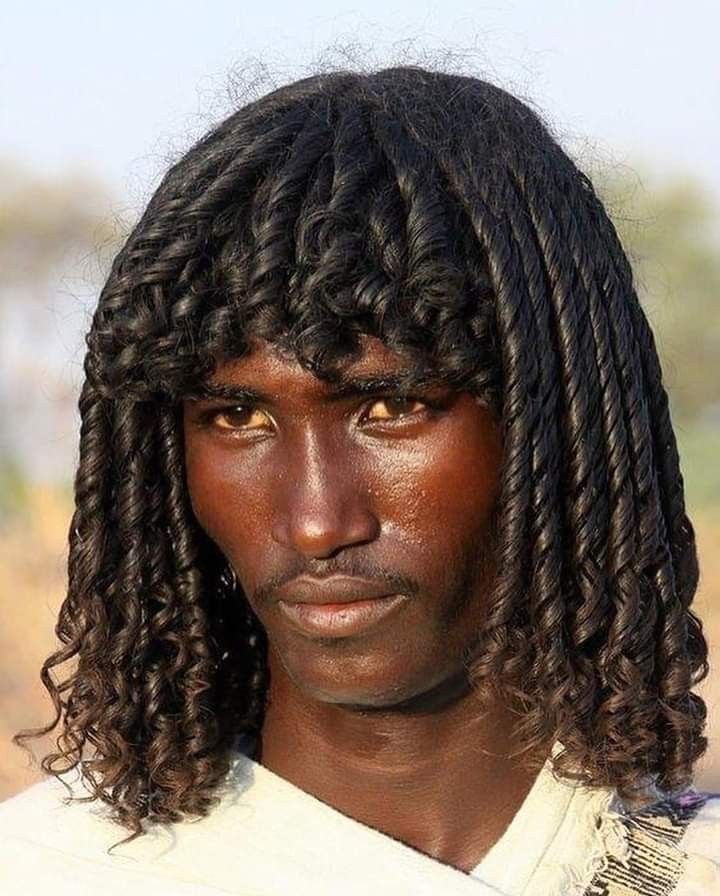
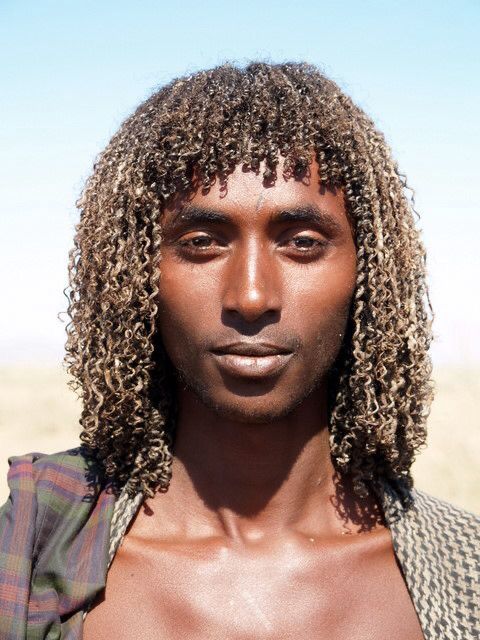
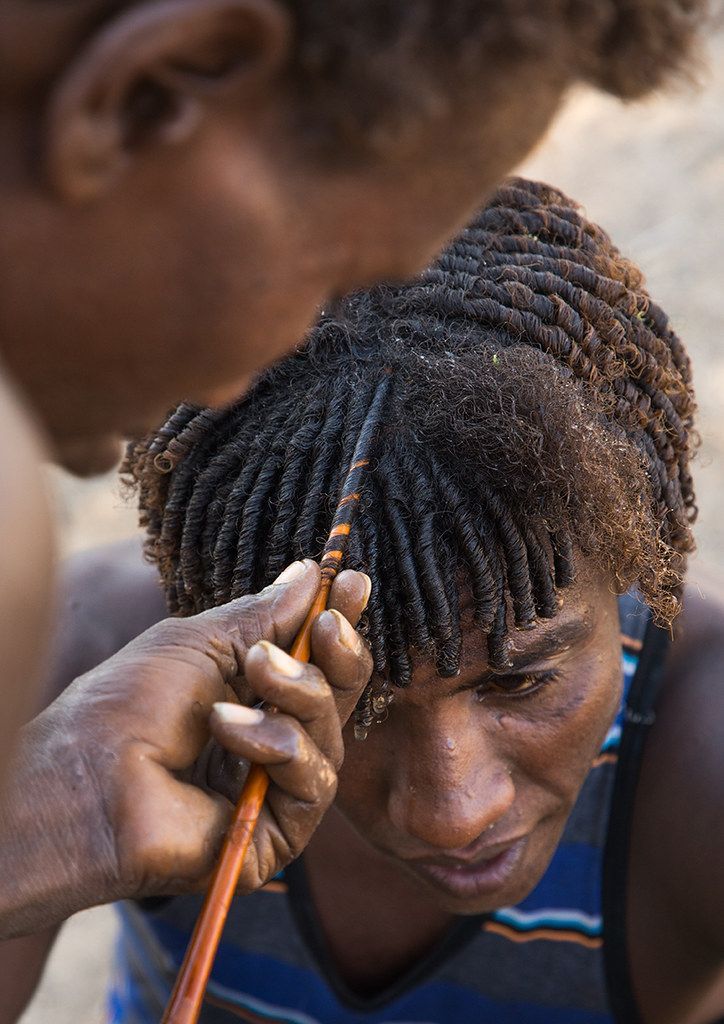
The Dayta is a more elaborate style. It is produced by wrapping sections of hair around sticks, which function as the equivalent of modern hair rollers, creating tight, defined curls. The sticks shape the curl. Butter is then applied to hold it in place for days, protecting the curl from the extreme dryness and heat of the Afar Triangle. The labour investment in the Dayta is significant: the curling process requires both time and skill, and the resulting hairstyle communicates effort, patience, and attention to tradition in a culture that values each of these as markers of a man’s character.
In an environment where temperatures can exceed 50 degrees Celsius and the Gara, the Fire Wind, blows across salt flats and desert, the decision to maintain an elaborate, butter-dressed hairstyle is not vanity. It is a statement about who you are in a landscape designed to erase you. The Afar man’s hair is as much an argument as his dagger.
The Butter: Function and Source
The butter used in Afar hair traditions is not the commercially produced clarified butter sold in markets. Afar women, who are responsible for the production of dairy products within the pastoralist household economy, produce fresh butter by hand from the milk of goats, sheep, and cattle. This is the butter applied to the hair. Fresh, unclarified, made by the women of the community from the animals that the community herds across the Afar Triangle’s shifting grazing territories.
The functional case for butter in this environment is not difficult to make. Butter is one of the most effective naturally available substances for protecting hair against extreme heat and aridity. It seals moisture into the hair shaft, provides a physical barrier against the sun’s desiccation, and keeps the hair supple in conditions that would otherwise leave it brittle and prone to breakage. For the Afar, who live in one of the most solar-intense, arid, and wind-exposed environments on earth, butter in the hair is environmental adaptation as much as cultural practice. The two dimensions are inseparable: the tradition is effective precisely because the environment is hostile, and the tradition carries cultural meaning precisely because it has been sustained for two millennia.
The practice of using butter and animal fat in hair is documented across East African pastoral communities. As Omiren Styles’ documentation of African hair rituals and the knowledge they encode confirms, women across East Africa gather to share knowledge, prepare their hair, and transmit practices that connect them to their communities and heritage. Hair care in these contexts is never purely cosmetic. It is social and ceremonial, carrying accumulated knowledge about materials and their effects that has been refined across generations of practice in specific climates.
The Dagu and Why Appearance Matters
To understand why hair carries so much weight among Afar men, it helps to understand the Dagu. As Worqamba Ethiopian Holidays’ documentation of Afar culture and customs confirms, an important traditional mechanism the Afar use as a replacement for modern communication technology is the Dagu: a means of information exchange through the relay of news about important events from one person to another. Performing Dagu is an obligatory task for every adult Afar, who is culturally compelled to serve as a traditional newsman. When two Afar people meet, they sit down and spend some time, usually about half an hour or more, discussing the major economic, social, and political events that have taken place recently in their respective localities.
The Dagu encounter is a formal social interaction that requires both parties to meet as peers and as representatives of their respective communities. Appearance in the Dagu context is not trivial. An Afar man who arrives at a Dagu encounter with his hair in proper Asdago or Dayta condition presents himself as a man who has maintained his cultural obligations even while moving through a landscape that makes such maintenance difficult. His hair communicates before he speaks.
This is the deeper argument behind the Afar hair tradition. In a nomadic culture where identity must be portable, where there are no fixed buildings or permanent settlements to signal community membership, hair is one of the most consistently available surfaces for displaying that membership. The Afar man cannot hang family banners or community markers. He can wear his hair in the style that his community recognises as its own, maintained in the way that his community understands as correct, and present that recognition to every Afar he encounters across the Afar Triangle’s vast and unmarked terrain.
The Social Classes and the Hair
Afar society is organised into two primary social classes whose names carry colour designations. As the American Afar Diaspora Organisation’s documentation of Afar history and social structure confirms, Afar society is divided into the Asaimara, the Red Men, who are the politically dominant, landowning nobles, and the Adoimara, the White Men, who serve as the lower-class tenant class. Both classes observe traditional hair practices, and the Asdago and Dayta are not class-restricted in the way some other East African hair and dress traditions are. The traditions belong to Afar men across class and clan distinctions.
The jile, the large curved dagger traditionally worn strapped to the waist, is the other most recognisable element of Afar men’s appearance. The combination of the buttered hair and the jile constitutes the complete visual grammar of the Afar man’s public presentation: the hair declares community and cultural continuity; the dagger declares physical capability and the willingness to defend both. Modern young Afar men still wear ornate daggers as a tradition, even though modern rifles have largely replaced them as weapons. The tradition of the ornamented weapon, like the tradition of the buttered hair, is maintained as a declaration of identity rather than as a purely functional requirement.
Hair as Wedding Ceremony
The buttered hair tradition carries specific ceremonial weight at weddings. Among the Afar and other Ethiopian pastoral communities, applying butter to the hair and scalp is part of wedding preparation, understood as both practical grooming and a form of blessing. The application is a communal act: other men may participate in the blessing of the newlywed couple. Butter on the hair in this context is not simply styling. It is the material form of a social wish, transferred to the person through the act of application.
This ceremonial dimension connects the Afar tradition to the broader pattern of African hair practice in which grooming is inseparable from social ritual. The hair is the site at which practical maintenance, cultural identity, and ceremonial blessing converge in a single physical act. The man who sits for the application of butter is simultaneously groomed, identified as a member of his community, and blessed by those around him.
The Afar Women’s Traditions
Afar women have their own distinct hair traditions: intricate frizzed and braided hairstyles that occupy a different visual register from the men’s large Asdago and tightly curled Dayta. Afar women also wear bright coloured bead necklaces, heavy earrings, and brass anklets, and many cover their heads in public as part of Islamic practice. The women’s hair and jewellery traditions, and the men’s Asdago and Dayta, together constitute the visible self-presentation of Afar cultural identity across the full community.
The production of butter that makes the men’s hair traditions possible is itself a women’s domain. Women milk the goats and small ruminants, produce butter and other dairy products, and manage the domestic economy of the nomadic household. The butter that appears in the Asdago of an Afar man is therefore the product of the women’s labour system as well as the men’s grooming tradition. As Omiren Styles’ documentation of the knowledge systems within African braiding and hair traditions confirms, hair knowledge in African communities has always been collective and gendered in complex ways: production knowledge, application knowledge, and style knowledge are distributed across the community rather than held by a single individual. The Afar hair tradition is no different.
The Omiren Argument
The Asdago and Dayta of the Afar man are not stylistic choices in the contemporary consumer sense. They are cultural arguments made in one of the most hostile environments on earth, maintained across two millennia of nomadic life in the Afar Triangle, and transmitted through the same community knowledge system that produced the Dagu, the oral information exchange network that connects Afar people across the borders of three modern states. The African fashion and beauty market is worth 31 billion dollars. The Afar men’s hair traditions belong to a world that preceded fashion markets and will outlast fashion cycles. Butter, made by hand from the milk of animals herded across salt flats in 50-degree heat, applied by tradition to hair grown to Asdago volume or shaped by sticks to Dayta curls, is simultaneously a functional adaptation to an extreme climate, a declaration of community membership, a vehicle for ceremonial blessing, and a visible argument for the persistence of a specific identity against the specific conditions of an environment designed to dissolve it. Omiren Styles documents these traditions here because their sophistication, their ecological intelligence, and their social function deserve to be understood on their own terms rather than encountered as exotic visual references in a mood board.
Also Read:
- Gullah Geechee Women’s Headwrap Traditions, Still Practised Today
- Traditional Styles of Fulani Women: A Complete Guide to Their Fashion Heritage
- From Ritual to Runway: How African Fashion and Ceremony Are Inseparable
Frequently Asked Questions
What is the Asdago hairstyle?
The Asdago is the traditional large Afro hairstyle worn by Afar men in the Afar Triangle region of Ethiopia, Eritrea, and Djibouti. It is maintained with the application of fresh butter, which gives the hair a characteristic slightly ashy, matte finish as the butter is absorbed. The butter protects the hair and scalp from the extreme heat and sun of the Afar Triangle, keeps the hair supple, and holds the Afro in shape. The Asdago is one of two traditional hairstyles of Afar men, the other being the Dayta.
What is the Dayta hairstyle?
The Dayta is the second traditional hairstyle of Afar men, produced by wrapping sections of hair around sticks to create tight, defined curls. The sticks function as the equivalent of modern hair rollers. Butter is applied to hold the curls in place for days and to protect the hair from the dryness and heat of the Afar environment. The Dayta requires more labour than the Asdago and communicates investment in the tradition through the time and skill its production demands.
Why do Afar men use butter in their hair?
Afar men use butter in their hair for both functional and cultural reasons. Functionally, butter is one of the most effective naturally available substances for protecting hair in the extreme heat, aridity, and solar intensity of the Afar Triangle, where temperatures regularly exceed 50 degrees Celsius. Butter seals moisture into the hair shaft, provides a barrier against desiccation, and keeps the hair supple. Culturally, the application of butter to the hair is part of a grooming tradition that connects Afar men to their community and expresses cultural identity. At weddings, the application of butter to the hair carries a ceremonial dimension, understood as a form of blessing.
What is the cultural significance of hair for Afar men?
For Afar men, hair is one of the primary surfaces for the display of cultural identity in a nomadic society where there are no fixed buildings or permanent settlements to signal community membership. The Asdago and Dayta are specifically Afar styles that an Afar man carries with him as he moves across the terrain of the Afar Triangle. In the context of the Dagu, the traditional Afar information-exchange encounter in which two Afar people meet and spend time relaying news about their communities, hair in proper traditional condition communicates cultural maintenance before words are exchanged. The buttered hair is a portable declaration of identity.
Where do the Afar people live?
The Afar people, also known historically as the Danakil (now considered an offensive term they reject), inhabit the Afar Triangle: a region of the Horn of Africa divided between northeastern Ethiopia (the Afar Region), northern Djibouti, and southern Eritrea. The Afar Triangle is one of earth’s hottest and driest environments, with temperatures regularly above 50 degrees Celsius and much of the terrain consisting of desert and salt flats. The Afar are traditionally nomadic and transhumant pastoralists who have occupied this homeland for at least 2,000 years. They regard themselves as among Ethiopia’s oldest ethnic groups.
Explore More
Read the full Culture > Heritage & Identity section at omirenstyles.com for Omiren Styles’ documentation of African hair traditions, pastoral dress cultures, and the communities whose material practices carry centuries of ecological intelligence and cultural argument.