There is a version of fashion entrepreneurship that begins with a mood board. A trend report. A gap in the market someone else identified first. Naadu Tetteh did not build Naadu Ghana that way. When she launched the brand in 2012, she was not chasing an aesthetic or answering a trend cycle. She was designing for a woman she had already spent years dressing as a stylist: confident, working, elegantly put-together, and profoundly underserved by the ready-to-wear options available to her in Accra. The African fashion market is worth 31 billion dollars. The specific gap Tetteh identified inside it was not a niche. It was a failure of attention. Accra had the woman. It did not yet have the wardrobe she deserved.
That distinction matters more than it first appears. Most fashion brands define their customer after they have designed the product. They work from fabric and silhouette outward, then reverse-engineer a customer profile for the lookbook. Naadu did the opposite. The customer came first. The refined, elegant, and tenacious modern woman, as the brand describes her, was not marketing language invented after the fact. She was the starting point. The designs followed her.
Naadu Tetteh built Naadu Ghana from the customer out, not the garment in. Since 2012, that approach has produced one of Accra’s most coherent premium womenswear brands.
Naadu Ghana: What the Brand Is and How It Was Built
Launched in 2012, Naadu Ghana is a premium ready-to-wear and bespoke label positioning itself as contemporary Ghanaian luxury. As the brand’s Facebook presence confirms, its identity has been consistent from the beginning: classy. Chic. Effortless. An African, unique ready-to-wear brand. Those four phrases describe not just an aesthetic but a commercial position: a brand that does not compete on volume, novelty, or trend responsiveness, but on the sustained quality of what it delivers to a specific kind of woman.
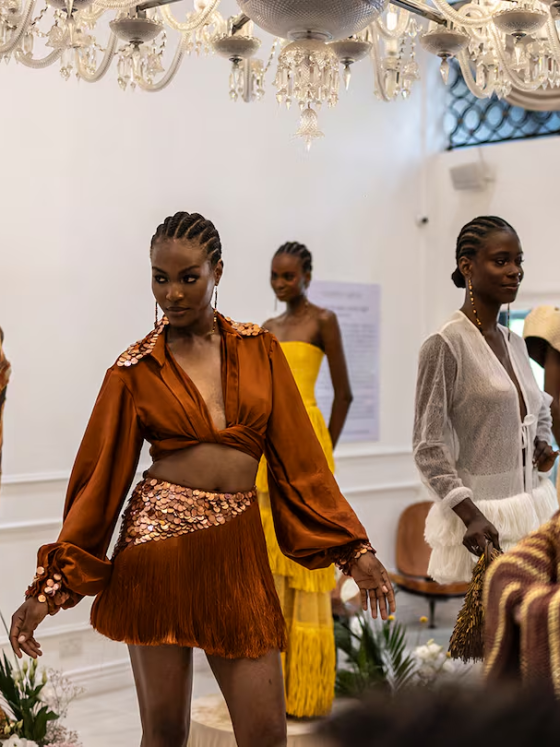
The brand’s product range, which spans brocade corseted dresses, draped two-piece ensembles, tailored separates, and bespoke commissions, is built around what might be called functional elegance: clothing that performs its social role without drawing attention to the effort involved. The garments are not asking the wearer to adapt to them. They are designed to meet her where she already is, across a week that includes board meetings, social events, and everything in between.
Most fashion brands define their customer after they have designed the product. Naadu Tetteh did the opposite. The refined, elegant, tenacious modern woman was not marketing language invented after the fact. She was the starting point. The designs followed her.
The Stylist’s Advantage
Naadu Tetteh came to design through styling, and that trajectory shaped everything about how the brand operates. A stylist’s job is fundamentally about the wearer, not the garment. Before a stylist makes a single decision, they must understand the person standing in front of them: her body, her life, where she is going, what she needs the clothing to do. That discipline of thinking from the wearer outward is embedded in how Tetteh approaches design.
It also gave her something most designers who move from fashion school to atelier do not have: an intimate knowledge of what does not work. After years of dressing clients and discovering what was missing, what fit poorly, what did not translate from hanger to body, Tetteh understood the gap in the market from the inside. She was not theorising about what Ghanaian women wanted. She had watched women struggle to find it. That knowledge is not something market research produces. It is something you earn through sustained attention to specific women with specific lives.
Building Premium in a Price-Sensitive Market
Launching a premium womenswear brand in Ghana in 2012 was not a straightforward proposition. As Statista’s Ghana women’s apparel market data confirms, the total Ghanaian apparel market was valued at approximately $3.21 billion in 2025, with women’s apparel representing the largest segment at an estimated $1.32 billion. But premium and luxury together represent only a fraction of that figure, with data indicating that 99% of Ghanaian apparel sales fall within the non-luxury category. The market is dominated by imported second-hand clothing and low-cost alternatives from Asia, both of which have made it difficult for local brands to hold a premium price point.
In that context, building a brand like Naadu required not just good design but a clear argument for why a Ghanaian woman should choose it over cheaper alternatives. Tetteh’s answer was not to compete on price or volume. It was to compete on specificity. She designed for a customer with enough purchasing authority to choose quality, and enough cultural fluency to recognise it when she saw it. A generation of Ghanaian women has rejected the export-only model, choosing to invest in locally made, culturally specific clothing that reflects the sophistication of their lives rather than the assumptions of mass-market retail. Naadu Ghana is positioned exactly at that intersection.
The Virna Michel Collaboration: Brand Clarity Made Visible
In 2023, Naadu Ghana partnered with Virna Michel, wife of award-winning Ghanaian actor Majid Michel and one of Accra’s most visible style figures, for a new collection campaign. As YEN.com.gh’s coverage of the collaboration confirms, Tetteh explained specifically why she chose Michel, making the partnership feel less like celebrity dressing and more like a statement of brand identity. The decision was not made casually. It was a deliberate choice about who Naadu Ghana is for and the world she moves through.
The collection itself demonstrated the brand’s design range. Michel wore a corseted dress constructed with rich brocade fabric and see-through lace for the three-quarter sleeves, alongside a two-piece outfit with a front drape design styled with drop earrings. Both looks were occasion-ready without being theatrical: exactly the register that Naadu targets. The campaign worked because the woman wearing the clothes and the woman the brand was designed for were recognisably the same person. This is what genuine brand clarity looks like in practice. The campaign did not need to explain the brand’s positioning. The casting did it.
What Naadu Ghana Is Really Selling
Naadu Ghana is not selling excess. It is selling confidence. As the brand’s profile on the Ananse marketplace confirms, Naadu presents itself as a premium Ghanaian RTW fashion brand for the high-achieving global woman. That positioning is consistent with its design language, product range, and audience strategy. The brand’s appeal lies in the balance between structure and ease, refinement and wearability, occasion and everyday relevance.
That makes Naadu especially compelling within the growing conversation around contemporary African womenswear, where the strongest labels are those that know exactly who they are dressing. The brand does not dress a fantasy. It dresses a reality: a Ghanaian woman who walks into a boardroom and a social event in the same week, who values quality over volume, and who expects her clothing to hold up to both her schedule and her standards. The most durable Ghanaian fashion brands of the past decade share a common characteristic: they are not trying to be internationally legible at the cost of being locally specific. They are deeply rooted in a Ghanaian understanding of elegance, occasion, and social presentation, and they trust that rootedness to travel.
The Larger Ambition
Tetteh has stated that her ambition is to represent Ghana on international runways and to style top A-list celebrities. That ambition is not disconnected from the brand she has built in Accra. It is a direct extension of it. As UNESCO’s report on Africa as a new global fashion leader confirms, a 42% increase in demand for African haute couture is expected over the next ten years, driven by a growing middle class, a youthful continent-wide demographic, and increasing global interest in African creative output.
Naadu’s positioning as a premium, craft-focused ready-to-wear label places it in exactly the category of African brands that international fashion media has begun paying attention to, if unevenly and belatedly. The structural conditions for a brand like Naadu to expand beyond Ghanaian borders are forming. What the brand already has is something that cannot be built quickly: a clear customer, a coherent aesthetic, and more than a decade of operating in one of West Africa’s most competitive fashion markets.
The Omiren Argument
Naadu Ghana is worth watching because it understands something many brands learn too late: a premium label is not built by inventing a customer, but by recognising one. Naadu Tetteh did not design a brand and then search for a woman to wear it. She knew the woman first, then built around her. That is the discipline that survives trend cycles. The African fashion market is worth $ 31 billion. The Ghanaian women’s apparel segment is worth $1.32 billion. Premium and luxury occupy a fraction of that figure, which means the brands that hold that space do so not through scale but through unwavering specificity. Naadu Ghana’s corseted brocade dresses and draped two-piece ensembles are not the result of trend research. They are the result of more than a decade of paying close attention to a specific kind of woman with specific standards. Omiren Styles documents it here because that kind of attention is the foundation every serious African fashion brand is built on. And not nearly enough brands have it.
Also Read:
- Top Ghanaian Fashion Designers Shaping Africa’s Global Fashion Narrative
- Accra Fashion: How Women in Ghana Are Redefining Personal Style in 2026
- What Accra Street Style Is Actually Arguing in 2026
Frequently Asked Questions
What is Naadu Ghana?
Naadu Ghana is a premium ready-to-wear and bespoke womenswear brand founded in Accra, Ghana in 2012 by Naadu Tetteh. The brand describes itself as contemporary Ghanaian luxury, designing for the refined, elegant, and tenacious modern woman. Its product range includes corseted brocade dresses, draped two-piece ensembles, tailored separates, and bespoke commissions. The brand ships globally and has an active presence on Instagram as @naadugh (15,000 followers) and on Facebook as naadu.
Who is Naadu Tetteh?
Naadu Tetteh is the founder and designer of Naadu Ghana. She came to fashion design through a career as a stylist, which gave her an intimate understanding of what women actually need from clothing: what fits, what translates from hanger to body, and what is missing from available options. That stylist’s perspective shaped how she built the brand: starting from the customer’s life rather than from a design concept. She has stated that her ambition is to represent Ghana on international runways and to dress A-list celebrities.
What kind of clothes does Naadu Ghana make?
Naadu Ghana makes premium ready-to-wear and bespoke womenswear designed for women who need clothing that works across a full range of settings, from boardrooms to social occasions. The brand’s signature pieces include corseted dresses in rich brocade fabric, two-piece sets with draped silhouettes, and carefully tailored separates. The brand describes its design language as classy, chic, and effortless, with a focus on functional elegance: clothing that performs its social role without requiring the wearer to adapt to it.
What is the Virna Michel collaboration?
In 2023, Naadu Ghana partnered with Virna Michel, wife of Ghanaian actor Majid Michel and a prominent Accra style figure, for a collection campaign. Tetteh selected Michel deliberately as a statement of brand identity rather than a celebrity endorsement for its own sake. Michel wore a corseted brocade dress with see-through lace three-quarter sleeves and a draped two-piece set styled with drop earrings. The campaign demonstrated the brand’s design range and worked because Michel was recognisably the kind of woman Naadu was built for.
What is the Ghana premium womenswear market worth?
According to Statista, the total Ghanaian apparel market was valued at approximately $3.21 billion in 2025, with women’s apparel representing the largest segment at an estimated $1.32 billion. Premium and luxury together represent only a small fraction of that figure, with data indicating that 99% of Ghanaian apparel sales fall within the non-luxury category. That context makes building and holding a premium price point in Ghana a significant commercial achievement, requiring a brand to compete not on price or volume but on specificity and craft.
Explore More
Read the full Fashion > Designer Profiles section for Omiren Styles’ documentation of African fashion brands, Ghanaian designers, and the women building premium fashion from Accra, Lagos, Nairobi, and across the diaspora.