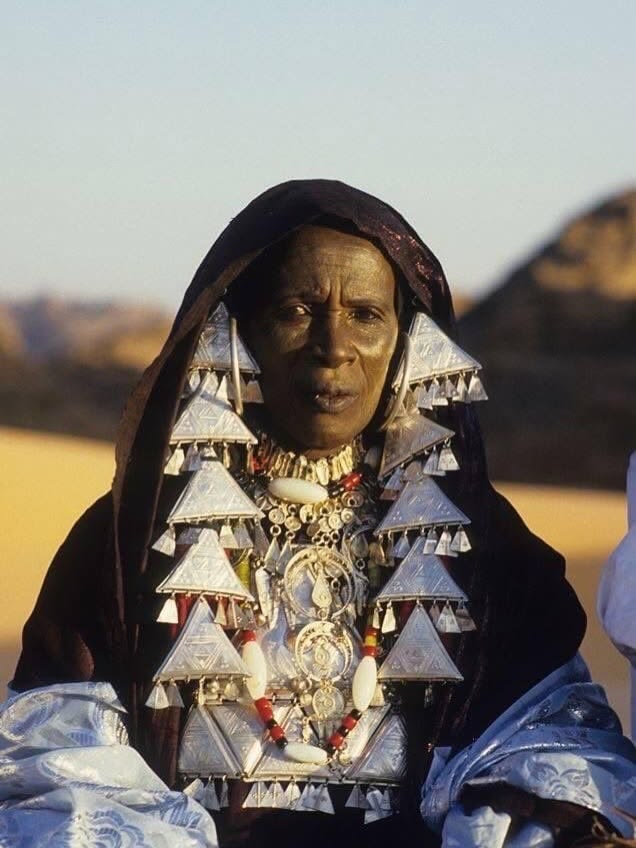
Libya’s Amazigh population is small, specific, and concentrated in one place. The Djebel Nafusa (Nafusa Mountains) region of western Libya, near the borders with Tunisia and Algeria, is home to the largest single Amazigh community in the country. Population estimates differ significantly between sources: the Minority Rights Group gives a range of 236,000 to 590,000, representing approximately 4 to 10% of the national population. The International Work Group for Indigenous Affairs gives a higher estimate of approximately one million, or more than 16% of the total population. Both institutions are authoritative; the divergence reflects the absence of reliable census data on ethnicity in Libya rather than a methodological error in either source. The Tuareg are documented separately by the Minority Rights Group at approximately 17,000 people, or 0.3% of the national population, primarily in the southern Fezzan region.
Silver-only jewellery, Ottoman-influenced embroidery, and an 18-foot desert head wrap: what is documented about Amazigh and Tuareg ceremonial dress in Libya’s Nafusa Mountains, and where the sourcing runs thin.
A Religious Distinction That Shapes the Region’s Identity
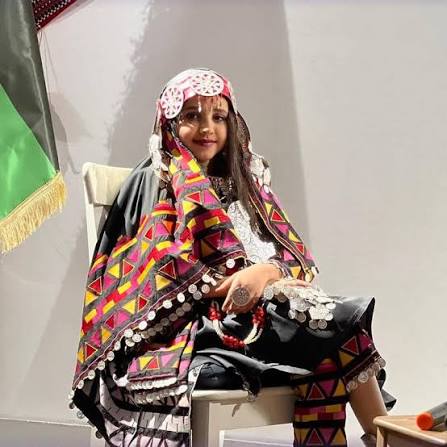
One specific, well-documented fact about the Amazigh population of the Nafusa Mountains is worth noting, as it is rarely mentioned outside specialist sources. Some communities in the Djebel Nafusa follow the Ibadi sect of Islam, distinct from the Maliki school of Sunni jurisprudence practised by the majority of Libyans. The Minority Rights Group’s documentation records that this religious distinction, alongside the retention of the Tamazight language and customs, is a defining marker of Nafusa Amazigh identity. Under Muammar Gaddafi’s rule, Amazigh were prohibited from speaking Tamazight publicly, publishing in Tamazight, forming cultural associations, or registering children with Amazigh names. Ibadi religious rituals were also repressed. Since 2011, a documented cultural renaissance has led to Tamazight instruction in schools, a weekly Tamazight newspaper, and the restoration of old Amazigh houses. Dress and ceremony in this region exist within the broader context of linguistic and religious difference from the national majority, rather than as an isolated aesthetic tradition.
What Ottoman Influence Left Behind
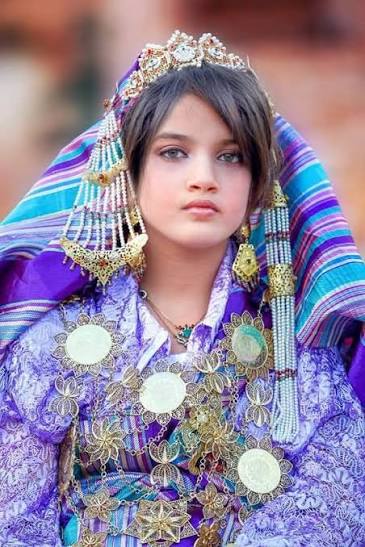
Libyan traditional dress generally carries a documented, specific historical layer from the Ottoman Empire’s presence in the region, most visibly in the embroidered garment called the Farmla. The term and design are directly attributed to Ottoman-era influence, drawing on Libyan traditional costumes. This Ottoman layer sits on top of much older roots: ancient Egyptian temple inscriptions depict garments worn by early Libyans, and the Greek historian Herodotus, writing in the 5th century BCE, described Libyan women’s clothing specifically as decorated leather robes, one of the oldest written descriptions of North African dress in the historical record.
The Ceremonial Textiles of Ghadames and the Nafusa Mountains
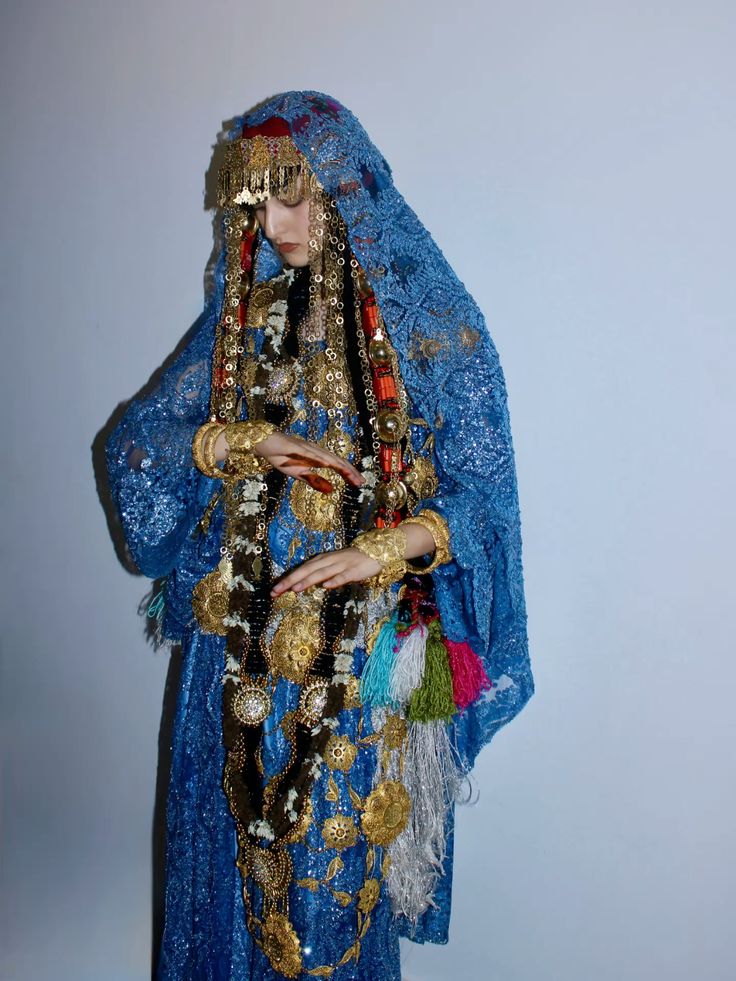
A December 2025 craft-sourcing guide to Libyan artisan production provides the most specific description available for what is actually produced in the Nafusa region today: embroidered panels, scarves, and dress accents characterised by local motifs and metal-thread work, specifically used in ceremonial clothing. The same guide recommends examining stitch density and the use of natural fibres, including cotton and wool, alongside small metal appliqués, as markers of genuine handwork rather than mass-produced alternatives. It names specific purchasing locations: craft stalls in Ghadames itself, artisan villages in the Nafusa Mountains with weekend craft markets, Fezzan markets in Sabha, and Tripoli’s old medina.
What this sourcing cannot provide, and what this article therefore cannot claim, is the naming of individual artisans, cooperatives, or family workshops comparable to the specificity available for Algeria’s Ath Yenni silverwork tradition or Mali’s Ndomo workshop. The craft exists and is produced. Who produces it, under what business or community structure, and at what current scale, given Libya’s post-2011 instability, are questions the available sourcing does not answer.
Tuareg Dress: Distinct From, but Related to, Libya’s Amazigh Tradition
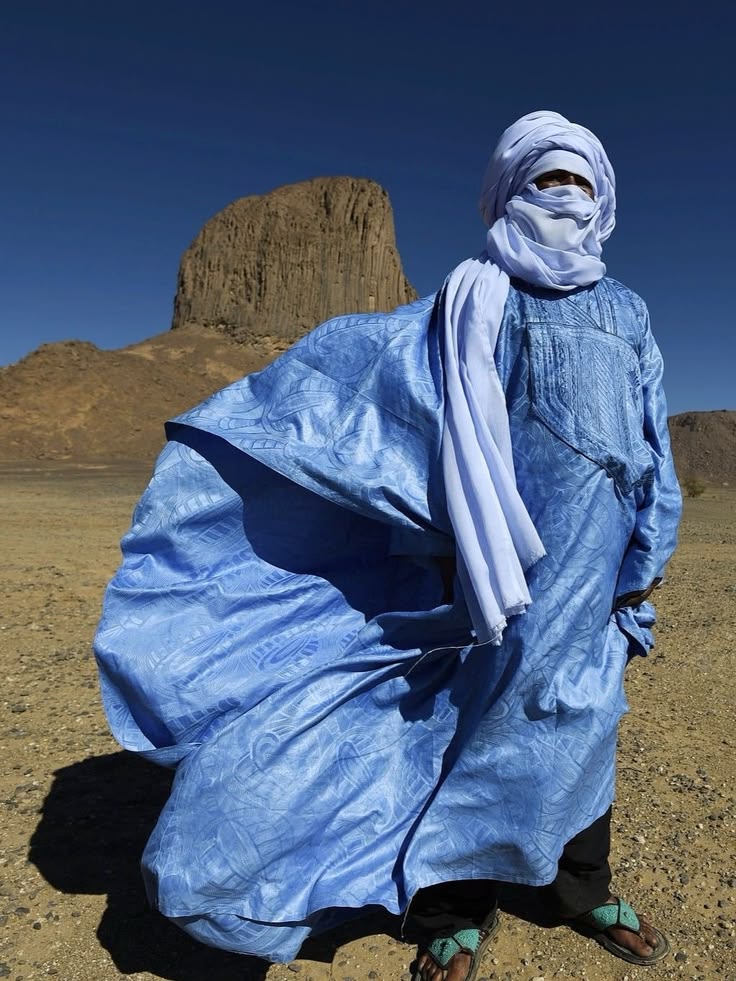
The Tuareg are themselves an Amazigh people, but a specific, historically nomadic Saharan group distinct from the settled Nafusa Amazigh communities. Tuareg populations span several countries beyond Libya, including Algeria, Niger, Mali, and Burkina Faso. Their defining garment is the cheche, a head wrap documented by National Geographic as having fabric that can stretch to 18 feet in length, engineered specifically for desert conditions: protection from sun exposure, reduced water loss through limiting sweat, and a face wrap that, in social encounters, communicates status and relationship through the specific degree to which the face is revealed.
The cheche is also known as the tagelmust or litham, and sources give slightly varying length estimates: National Geographic’s confirmed 18 feet, the Terres Touareg documentation gives 4 to 10 metres (13 to 33 feet), and other sources in the 4 to 8 metre range. The consistency across all sources is the principle: the cloth is significantly longer than a standard scarf or turban, and the length serves a practical desert-engineering purpose rather than a decorative one. The accompanying bubu gowns, flowing garments designed to allow airflow while deflecting heat and blown sand, complete the functional system.
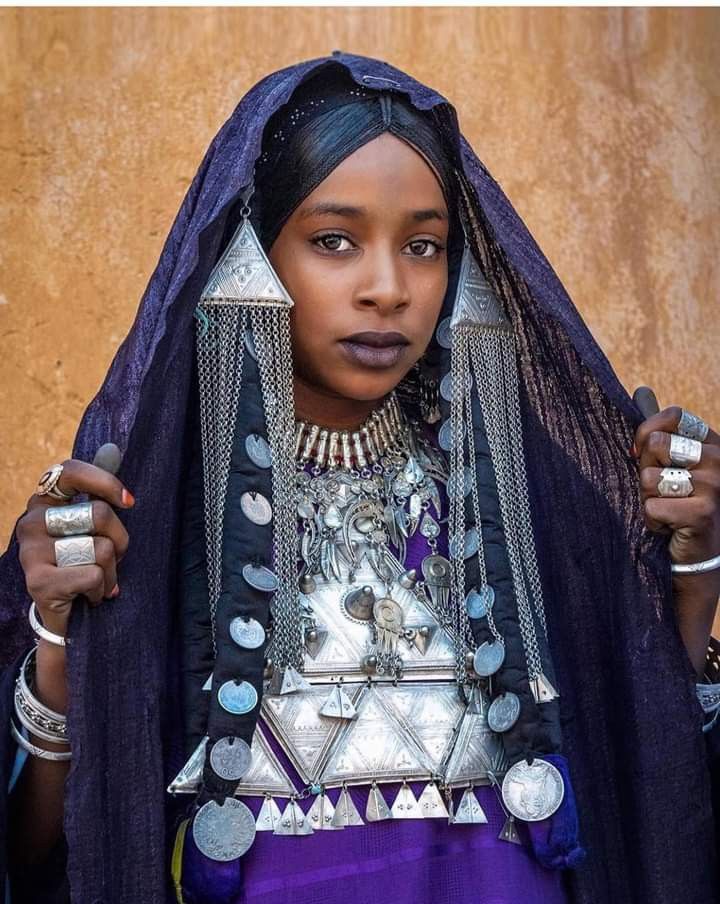
Tuareg jewellery carries a specific, well-documented tradition: as a Berber people, the Tuareg tradition holds that they wear silver exclusively, never gold. This is corroborated by both National Geographic reporting and the December 2025 souvenir guide, which describes Tuareg and Amazigh silverwork from southern Libya as featuring geometric motifs, hammered textures, and bold pendants, priced between 40 and 350 Libyan dinars depending on silver content and craftsmanship. The guide offers a practical authenticity check: hand-hammered silver pieces show an irregular texture. In contrast, uniformly cast pieces or items stamped “silver” without a corresponding weight should be treated as likely plated rather than solid silver.
The Broader Libyan Amazigh Women’s Dress Tradition
General references on Libyan traditional costume describe Amazigh women covering their hair with scarves, with the face covered by a veil called a mandeel, under a larger outer wrap called a haik, worn over ankle-length garments. This description comes from general sources on Libyan traditional costume rather than from sources specifically documenting Nafusa Amazigh ceremonial dress as distinct from everyday wear. As documented for the Amazigh facial tattoo tradition in the same region, Amazigh women’s dress traditions across North Africa encode social information in fabric, arrangement, and adornment in ways that a general description cannot fully capture. The Nafusa-specific ceremonial vocabulary, how a wedding dress in Yefren differs from one in Nalut, and which specific garments mark life transitions are not documented in the English-language sources available for this piece.
What This Piece Cannot Confirm
In line with the editorial standard applied to pieces in this series where sourcing is thin, the following are stated as open rather than settled.
Named artisan producers, cooperatives, or family workshops in the Nafusa region comparable to the level of specificity found for Algeria’s Ath Yenni tradition are not available in the sourcing reviewed. Claims about who produces Nafusa ceremonial embroidery, and under what structure, cannot be made with confidence here.
The general descriptions of Libyan Amazigh women’s dress (mandeel, haik, ankle-length undergarments) come from sources on Libyan traditional costume generally rather than sources specifically documenting Nafusa Amazigh ceremonial dress as distinct from everyday wear.
Given Libya’s post-2011 instability and ongoing conflict, none of the sources reviewed could confirm how consistently these ceremonial dress traditions are currently practised compared with their historical documentation. The craft sourcing guide, dated December 2025, confirms that the craft continues to be sold, but it is market documentation, not cultural practice documentation. That distinction matters.
ALSO READ
- Kabyle Amazigh Wedding Dress Algeria: Thakandorth, Ath Yenni Silver, and the Kabylia Tradition
- Amazigh Women’s Facial Tattoos: Siyala, Jedwel, and the Tradition Near Extinction
- The Afro-Arab Street Fashion Movement Reshaping Global Style
Frequently Asked Questions
Where do most of Libya’s Amazigh people live?
The largest Amazigh community in Libya is concentrated in the Djebel Nafusa (Nafusa Mountains) region of western Libya, near the Tunisian and Algerian borders, with smaller communities in Zuwara, Ghadames, Sokna, Awjila, Al-Foqaha, and Jalu. Population estimates vary significantly between sources: Minority Rights Group gives 236,000 to 590,000 (4 to 10%). In comparison, the International Work Group for Indigenous Affairs estimates approximately one million people or more than 16% of Libya’s population. The divergence reflects the absence of reliable census data on ethnicity in Libya.
Are Tuareg and Libyan Amazigh the same people?
The Tuareg are a specific Amazigh people, but a historically nomadic Saharan group distinct from Libya’s settled Nafusa Amazigh communities. Tuareg populations span several countries beyond Libya, including Algeria, Niger, Mali, and Burkina Faso. The Minority Rights Group estimates Libya’s Tuareg population at approximately 17,000, primarily in the southern Fezzan region. Both the Nafusa Amazigh and the Tuareg speak languages in the Tamazight family, but they represent distinct communities with different cultural practices, dress traditions, and historical experiences.
Why do Tuareg people wear only silver jewellery rather than gold?
This is a documented cultural tradition specific to Tuareg identity as a Berber people, reported consistently across ethnographic and travel sources, including National Geographic’s documentation of Tuareg dress. The specific historical or religious reasoning behind the silver-only convention was not detailed in the sourcing available for this piece. The tradition is confirmed as a consistent feature of Tuareg material culture rather than a modern practice.
What is a Farmla in Libyan traditional dress?
The Farmla is an embroidered garment in Libyan traditional dress that directly reflects Ottoman Empire-era design influences, one of the clearest surviving markers of that period in Libyan clothing. The term and design are directly attributed to Ottoman-era influence in documentation on Libyan traditional costume.
What is the cheche, and how long is it?
The cheche (also called tagelmust or litham) is the Tuareg head wrap, documented by National Geographic as having fabric stretching to 18 feet in length, and by other specialist sources as ranging from 4 to 10 metres (approximately 13 to 33 feet). The length serves practical desert engineering: sun protection, reduced sweat and water loss, and a face covering whose specific arrangement communicates social information. Both men and women wear it, though male and female wrapping conventions differ.