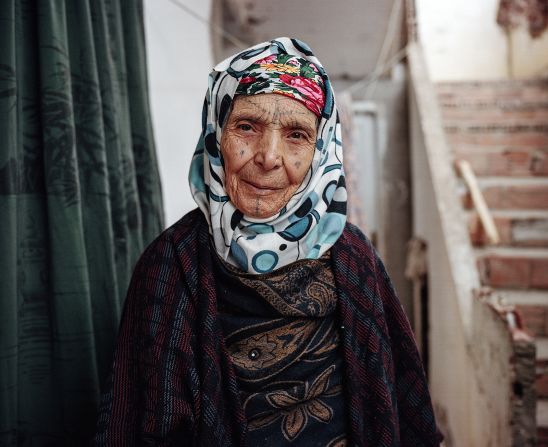
In rural Morocco’s Middle Atlas mountains, in Libya’s Nafusa Mountains, and in isolated communities across Algeria, Tunisia, and Mauritania, elderly women carry facial tattoos whose social, spiritual, and aesthetic meaning has been communicated across generations through practice rather than text. Most of them are in their seventies or eighties. The women who could teach the practice are the same women in whom it is disappearing. This is what the final stage of a tradition’s erosion looks like from the inside.
Siyala and jedwel are Amazigh facial tattoo traditions practised across Morocco, Libya, and Algeria for centuries. The last generation to carry them is in their seventies and eighties.
Who the Amazigh Are
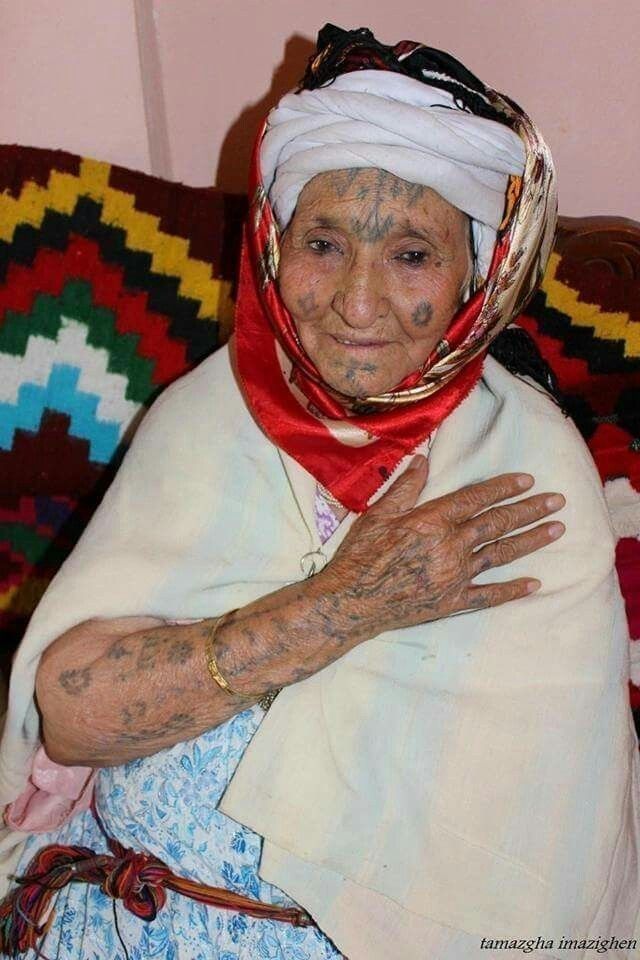
The Amazigh, plural Imazighen, are the indigenous people of North Africa, present across the Maghreb and Sahara from Morocco to Egypt and from the Mediterranean coast to the Sahel. Their language, Tamazight, is now recognised as an official language in Morocco (2011) and Algeria (2016), and the Tifinagh script used to write it is among the world’s oldest writing systems. Imazighen include communities known externally as Berbers, a term that many within the culture reject due to its Roman-era pejorative connotations; the Tuareg of the central Sahara; the Kabyle of Algeria; and numerous other communities across the region. As documented by the United Nations Expert Mechanism on the Rights of Indigenous Peoples, Amazigh communities across North Africa have consistently advocated for recognition of their cultural, linguistic, and territorial rights as indigenous peoples under international law, with considerable variation in how different states have responded to those claims.
What Siyala and Jedwel Mean
Amazigh facial tattoos are not a single practice with a single name across the full geographic range of Imazighen communities. The names, motifs, placements, and social meanings differ significantly between regions, communities, and periods. Two of the most documented terms in the academic literature are siyala and jedwel. Siyala is used in Morocco to describe the facial tattooing tradition more broadly, encompassing a range of geometric marks on the chin, forehead, cheeks, and around the lips. Jedwel (also rendered as jdwel or variants in transliteration) is used in Libya and Algeria and refers specifically to a grid or squared pattern, from the Arabic root for squares or ruled lines, which can be applied to both the tattoo forms themselves and the system of marking. These are translations rather than definitions: the precise meaning of each term within specific communities requires local and generational context that no single glossary can fully capture.
The patterns applied through these practices are not decorative in the Western sense of the term. They encode information such as tribal affiliation, marital status, age, spiritual protection, and, in some documented cases, a woman’s capacity to bear children or her status within a kinship network. As the Journal of Material Culture has documented in several ethnographic studies of North African body art, the social grammar of Amazigh tattoo marks differs across communities, to the point that patterns that carry one meaning in the Middle Atlas can carry a different meaning among the Tuareg or in Libyan coastal communities. Reading them accurately requires knowledge of the community, region, and period in which a mark was applied.
Where the Marks Are Placed and What They Carry
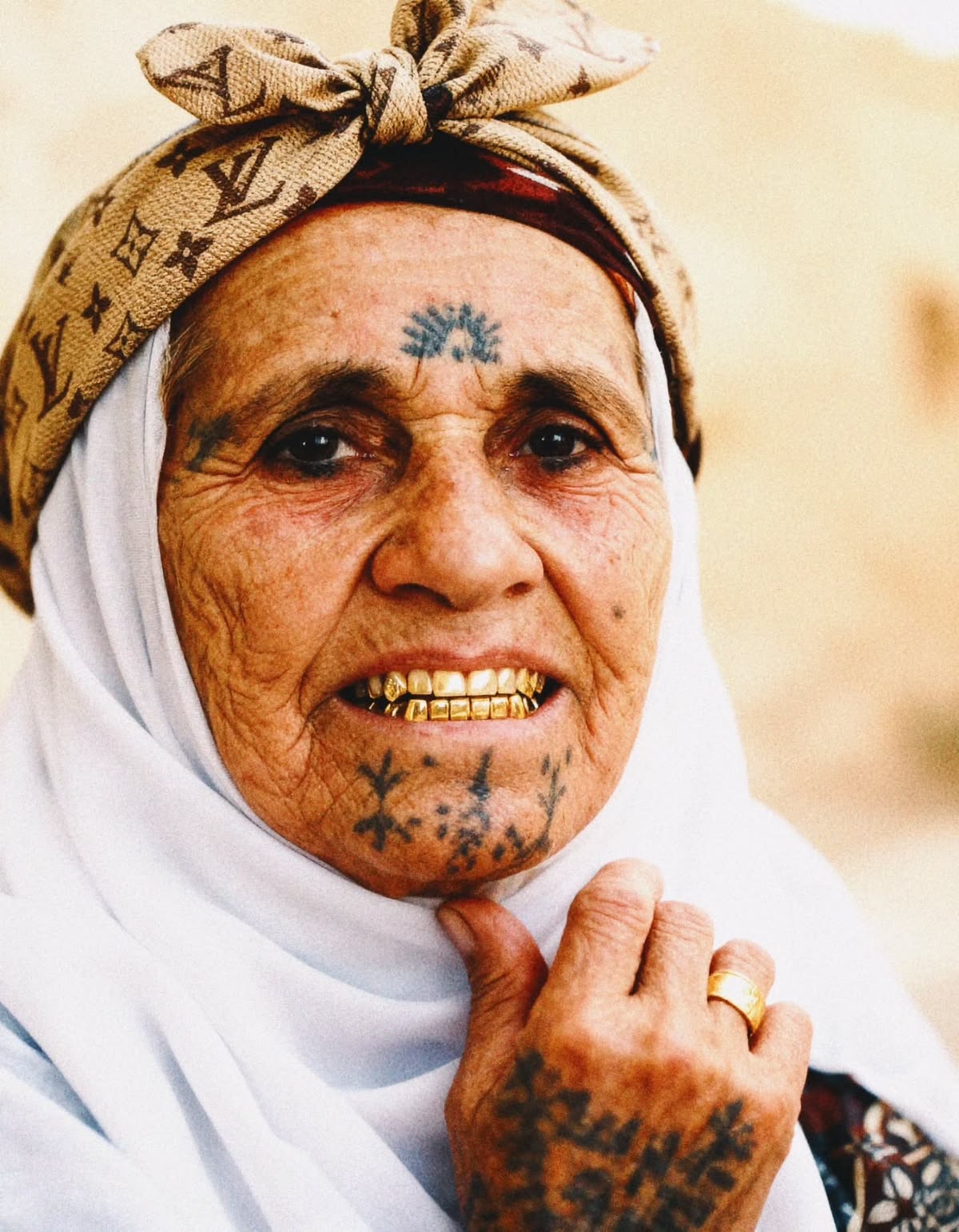
Documentation from fieldwork conducted by researchers at the Institut National du Patrimoine in Tunisia and anthropologists working in Morocco identifies consistent patterns across multiple communities. The most common facial tattoo placements documented are the chin (often with a vertical line or series of dots), the space between the eyebrows, the cheekbones, and the area around the lips. Forehead marks are documented across Libyan and Algerian communities, but are less consistent in Moroccan practice.
The chin mark is the most widely documented. It appears across Morocco, Libya, Algeria, Tunisia, and Mauritania and is the mark most frequently associated with Amazigh female identity in photographic and ethnographic archives. It was typically applied at puberty or around the time of marriage, marking the transition from girlhood to womanhood in a form that could not be removed. The permanence was the point. A woman who carried a chin mark could be identified by her community across her entire lifetime.
Spiritual protection is consistently noted across the academic literature as a primary function. The Amazigh worldview historically included a rich tradition of protective marks, amulets, and symbols intended to ward off the evil eye, safeguard fertility, protect against illness, and maintain the spiritual integrity of the household. The tattoo mark was understood in many communities as a permanent amulet carried on the body itself, inseparable from the person rather than transferable or loseable like a piece of jewellery.
How the Practice Was Applied
The tattooing was traditionally performed by specialist women within the community, not by professional tattooists in any modern sense. The tools were simple by contemporary standards: a needle or a thorned plant, natural dyes derived primarily from plant sources, including kohl (antimony sulphide), plant ash, and, in some documented cases, a mixture involving pomegranate rind and walnut husk. As the Musée du quai Branly’s collection documentation confirms, preserved examples of the instruments and materials used in Amazigh tattooing practices show significant regional variation in both methods and pigment sources.
The process was typically performed on girls in their early teenage years, around puberty. The location, pattern, and extent of the markings were decided by the woman performing the procedure, in consultation with the girl’s family, according to local custom. It was a social event rather than a private one, and the marks applied were understood to represent not only the individual but the family and community to which she belonged.
Why the Practice Is Disappearing
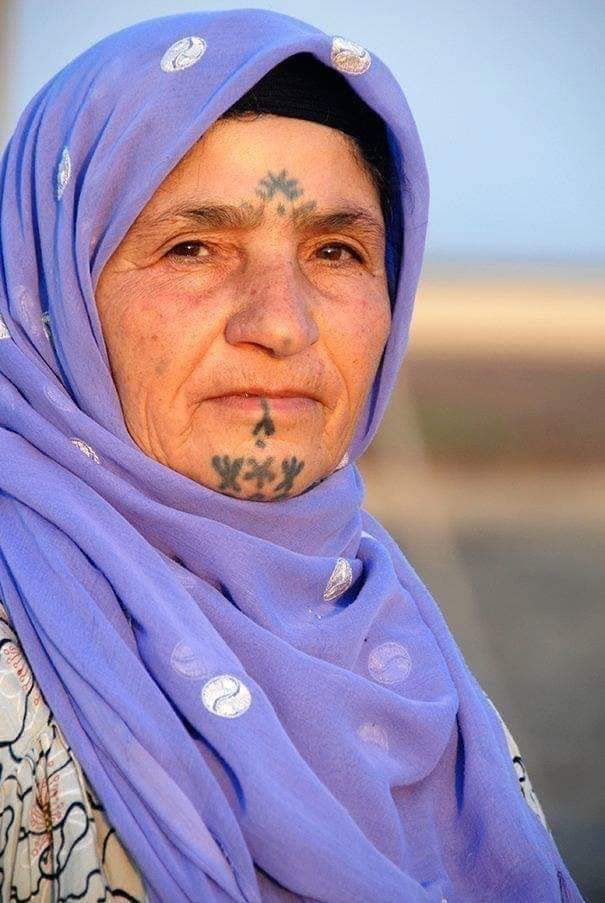
The decline of Amazigh facial tattooing is not a single-cause story. It is the accumulated effect of multiple forces operating over the course of the twentieth century. The spread of Islamic religious authority that regarded tattooing as prohibited (haram) across North Africa from the mid-twentieth century onward created social pressure on families to discontinue the practice. Colonial-era education systems that positioned indigenous cultural practices as backward or primitive reinforced that pressure from a different direction. Urbanisation disrupted the community structures within which the tradition was transmitted: a practice learned by watching and participating is difficult to sustain when families disperse from rural villages to cities where neither the practitioner nor the audience for the practice is present.
As the UNESCO Intangible Cultural Heritage documentation on North African heritage practices confirms, the disruption of intergenerational transmission is the most consistent predictor of a living cultural practice’s disappearance. When the women who carry the knowledge are elderly, and no younger women are learning, the practice does not gradually decline. It ends with a generation. Research conducted by the Amazigh Cultural Association in Morocco has found that fewer than 5% of Amazigh women under the age of forty have facial tattoos, compared with the majority of women over seventy in some rural communities. The gap between those two figures represents a tradition whose transmission has already effectively broken down.
“When the women who carry the knowledge are elderly, and no younger women are learning, the practice does not gradually decline. It ends with a generation.” — UNESCO Intangible Cultural Heritage documentation, on intergenerational cultural transmission.
What Documentation and Revival Efforts Look Like
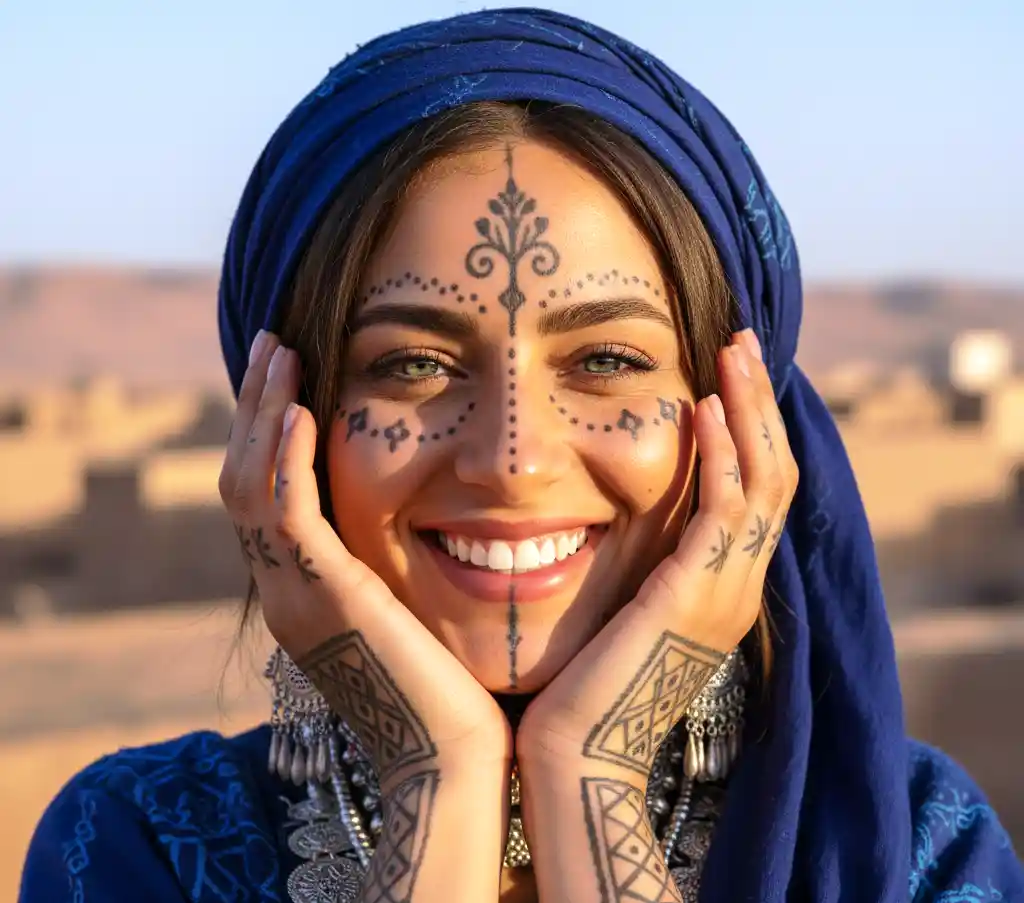
Several institutions are working to document what remains before it disappears entirely. The Institut Royal de la Culture Amazighe (IRCAM) in Morocco, established in 2001 by Royal Decree, has undertaken documentation projects on Amazigh material culture, including body art and tattoo traditions, and has produced published research on the patterns, regional variations, and social meanings of these practices. Photographers and anthropologists, including Mouna Mekouar and researchers affiliated with Moroccan universities,s have produced photographic archives of living practitioners, creating visual records of the patterns being carried by women who may be the last generation to do so.
Contemporary Amazigh artists and designers have engaged with the visual vocabulary of the tattoo tradition in work that does not reproduce the practice itself but draws from its geometric grammar. Graphic artists working with Tifinagh script and Amazigh visual culture have incorporated the same geometric patterns into contemporary design, textile, and digital work, creating a form of aesthetic continuity that sits alongside the disappearance of the original practice. As Omiren Styles has documented in its analysis of African women’s fashion archives, the most significant repositories of African cultural knowledge are rarely the institutions that claim to hold them. They are the women who have been carrying that knowledge in their bodies, their wardrobes, and their daily practices for generations. The Amazigh facial tattoo is, literally, the most embodied form of that principle the continent holds.
The Omiren Argument
A tradition disappears twice. The first time, the practice stops. The second time, the memory of what it meant stops. The Amazigh facial tattoo is currently between those two losses. The practice has effectively already ended among younger generations across most of North Africa. The women who carried it are alive, in their seventies and eighties, in rural communities in Morocco, Libya, Algeria, Tunisia, and Mauritania. They carry on their faces a permanent record of a knowledge system that has not been fully transmitted to anyone who will survive them.
What is at stake is not a style choice. It is a visual language built across centuries, encoding tribal identity, spiritual protection, marital status, and the social geography of North African women’s lives in a form that required permanent commitment and community consensus. The global fashion industry constantly borrows Amazigh geometric patterns for textile prints, runway collections, and surface design, sourcing the visual output of a knowledge system while the knowledge system itself disappears without documentation, compensation, or serious institutional attention. As Omiren Styles has argued in their analysis of African designers and global luxury contracts, the extraction of aesthetic value from African cultural knowledge without engaging the knowledge holders is not incidental. It is structural.
The women who carry Amazigh tattoos are not displaying heritage. They are the last holders of a living archive. The time to document, record, and engage with what they know is now, not after it has already become archaeology.
ALSO READ
- African Women Have Been Keeping Fashion Archives for Generations. Museums Are Just Catching Up.
- African Designers Are Not Getting Fair Deals From Global Luxury. Here Is What the Contract Should Say.
- The Herero Dress of Namibia: How a Colonial Imposition Became a National Symbol
- The Afro-Arab Street Fashion Movement Reshaping Global Style
Frequently Asked Questions
What are Amazigh facial tattoos called?
The most widely documented terms are siyala, used in Morocco to describe the facial tattooing tradition broadly, and jedwel (also spelt jdwel), used in Libya and Algeria to refer more specifically to grid or squared patterns. Both terms are community-specific and regional rather than universal names for a single practice. Other terms exist across Tamazight dialects and regional communities. The patterns, meanings, and placement also vary across communities, so no single term accurately captures the full range of Amazigh facial tattooing traditions across North Africa.
What do the tattoo patterns mean?
The patterns encode social and spiritual information specific to the community in which they were applied: tribal affiliation, marital status, age, capacity for fertility, and spiritual protection against the evil eye. The chin mark, the most widely documented pattern, was typically applied at puberty or around marriage, marking a woman’s transition to adulthood in a permanent, publicly legible form. The specific meaning of each pattern varies by region, community, and period, making accurate interpretation dependent on local and generational knowledge.
Why are Amazigh facial tattoos disappearing?
Multiple forces converged over the twentieth century to end the practice. The spread of Islamic religious authority, that considered tattooing prohibited, created social pressure to stop. Colonial-era education positioned indigenous cultural practices as backwards. Urbanisation disrupted the community structures within which the practice was transmitted. Research documented by the Amazigh Cultural Association in Morocco found that fewer than 5% of Amazigh women under forty carry facial tattoos, compared to the majority of women over seventy in some rural communities. The transmission has effectively already broken.
Are Amazigh facial tattoos still practised today?
Rarely and only among elderly women in isolated rural communities. No documentation confirms that the practice of applying facial tattoos is being actively continued among younger generations of Amazigh women anywhere in North Africa. The women who carry the marks are typically in their seventies and eighties. The Institut Royal de la Culture Amazighe in Morocco and affiliated researchers have been working to document the tradition before the last practitioners are no longer alive.
What is the IRCAM, and what has it done for this tradition?
The Institut Royal de la Culture Amazighe (IRCAM), established in Morocco in 2001 by Royal Decree, is the primary state institution dedicated to preserving, documenting, and promoting Amazigh cultural heritage. It has undertaken documentation projects on Amazigh material culture, including body art and tattoo traditions, producing research on the regional variations, social meanings, and visual grammar of the practice. The institute’s work represents the most significant institutional documentation effort underway for Amazigh tattoo traditions, though researchers have noted that the pace of documentation does not match the rate at which the last generation of practitioners is ageing. More information is available at ircam. ma.