In 1897, British colonial forces marched into Benin City, looted the royal palace, destroyed the capital of one of West Africa’s most sophisticated kingdoms, and shipped several thousand works of art to London. Among the objects taken were the Benin Bronzes, cast brass relief plaques that had lined the pillars of the Oba’s audience hall since the sixteenth century. When the looted objects arrived in Europe, scholars who examined them struggled to explain what they were looking at. The casting technique was sophisticated. The compositional skill was accomplished. The detail was extraordinary. More than one European commentator suggested, in the colonial register of the time, that the objects could not have been made in Africa. They must, he assumed, have come from somewhere else. From a lost European civilisation. From Atlantis.
They came from Benin City. They had always been in Benin City. And what they showed, cast in brass across hundreds of plaques produced between the fifteenth and nineteenth centuries, was one of the most sophisticated dress cultures anywhere on earth: a royal court whose regalia system encoded spiritual authority, political hierarchy, and diplomatic relationship in garments of coral, ivory, leopard skin, and fine cloth that European fashion, at the same moment, was nowhere near producing.
Fashion history has a standard narrative. It begins in Renaissance Italy, moves through the French courts, arrives at the British Industrial Revolution, and ends at Paris Fashion Week. Africa, if it appears at all, arrives as a footnote, an influence, an aesthetic curiosity. This article is not a footnote. It is the main argument: that pre-colonial African kingdoms were operating fashion systems of extraordinary sophistication at the precise moment fashion history claims Europe was setting the pace, and that the erasure of those systems from the global fashion record is one of the most consequential lies the industry has ever told.
In the sixteenth century, while Europe was still arguing about how wide a ruff collar should be, the Oba of Benin was conducting state affairs in coral beaded regalia worth a kingdom’s ransom. Omiren Styles reads the bronze plaques, the Kente histories, and the warrior uniforms and argues that fashion history has never been properly told.
What Europe Was Wearing When Benin Was Dressing Its Kings
To make the comparison honest, it requires saying precisely what Europe was wearing at the same time. In the sixteenth century, European fashion was characterised by thick, voluminous layers, contrasting fabrics, slashes, embroidery, and surface ornamentation. The defining garment of the period was the ruff, a separate collar of fine linen shaped into crisp folds with starch and heated irons. The women’s silhouette was conical at the hips, achieved through hooped undergarments. Men wore padded doublets, codpieces, and increasingly elaborate hats. Queen Elizabeth I of England was said to have collected three thousand gowns by the time of her death. The chief centres of fashion moved between Italy, Burgundy, Spain, and France, with each court attempting to outshine the others in the display of luxury textiles.
This was not yet a global fashion system. It was a European court competition, conducted in silk, velvet, and lace, driven by the desire to project power through display. It was sophisticated. It was also happening simultaneously with something in West Africa that has never, in the mainstream fashion record, been paired with it.
The Oba of Benin: Wearing a Theology
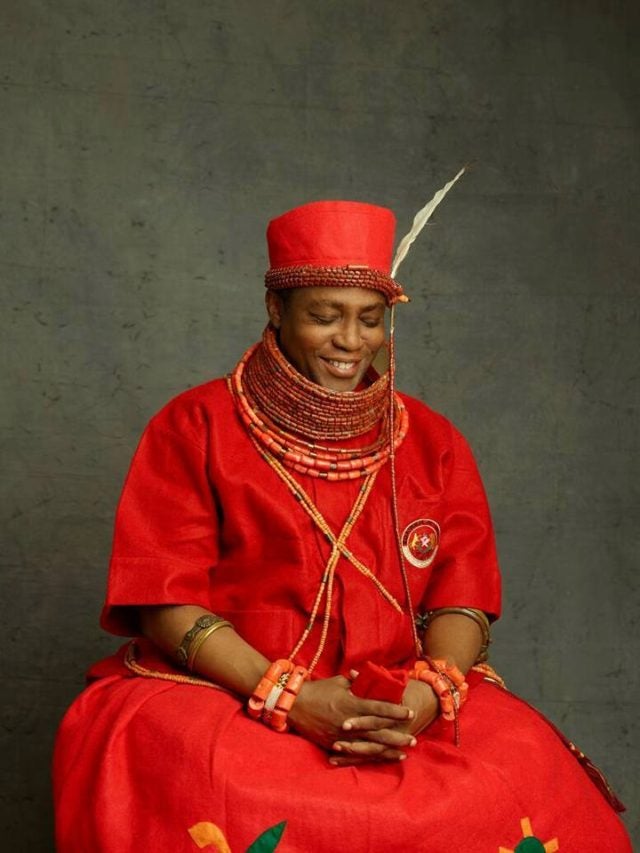
The Kingdom of Benin, located in what is now Edo State, Nigeria, produced one of the most thoroughly documented royal dress systems in pre-colonial African history, recorded not in text but in brass. The Benin Bronzes, created from the fourteenth century onwards by specialist guilds working for the royal court, show in extraordinary detail what the Oba and his court wore, how they wore it, and what each element meant.
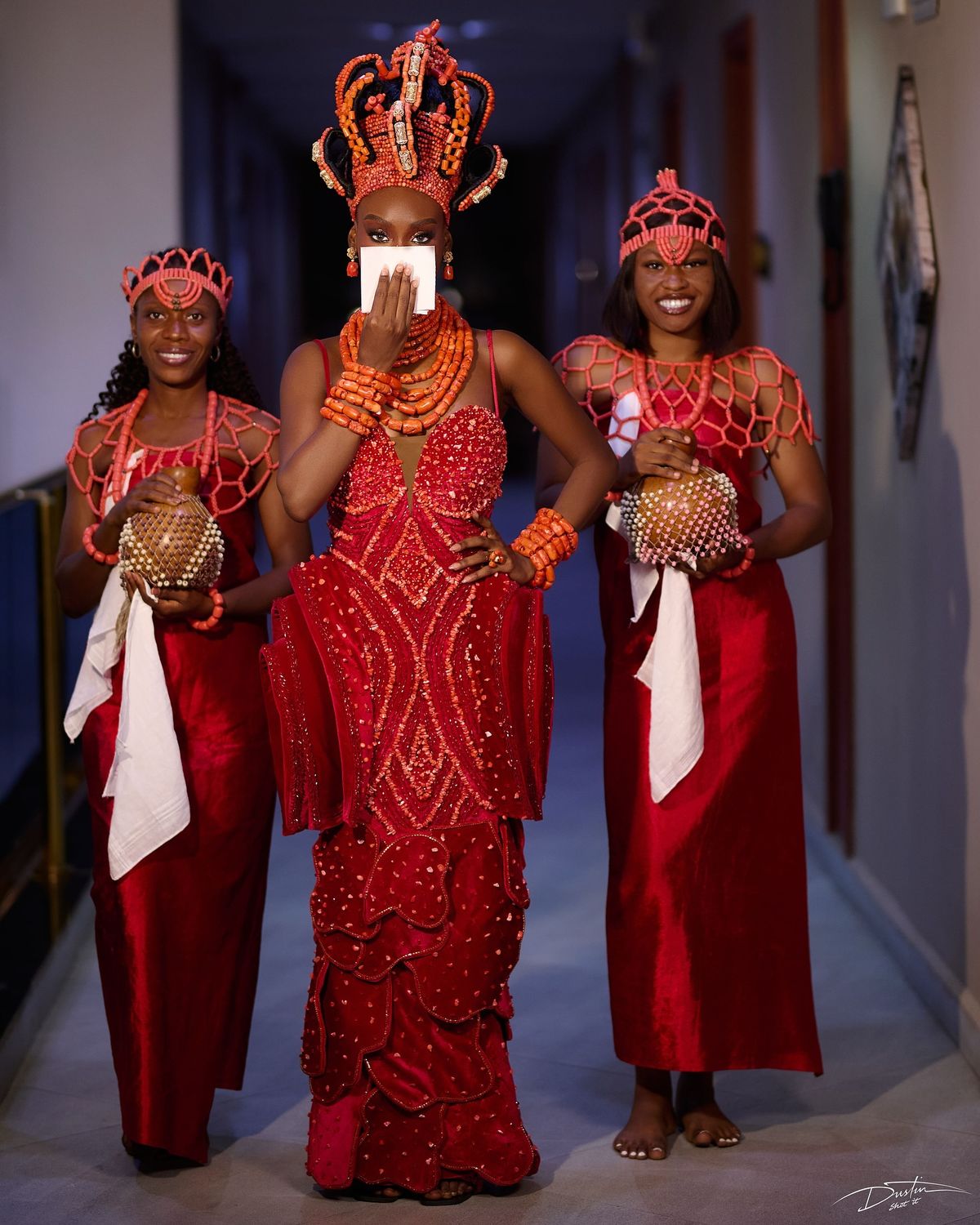
The Oba’s formal dress drew attention to his head. A tall collar of coral beads encased the neck—a coral cap with dangling strands of coral hung from the shoulders. Beaded sashes crossed the chest. Beaded bands encircled the wrists and ankles. Coral was a precious material in Benin, imported from the Mediterranean Sea across the Sahara Desert through trade with the Portuguese from the late fifteenth century onwards. Its value was not purely commercial. Coral and red stones such as jasper and agate were filled with supernatural energy, or ase, as were elephant ivory and brass, the other primary materials of royal regalia. The Oba did not merely dress well. He dressed as a theologian.
Only the Oba could grant permission to wear coral. It was not available in the market. It could not be purchased. The king granted it as a mark of distinction, and the removal of the right to wear it was a punishment for disloyalty that carried political and spiritual weight simultaneously. When Oba Ewuare the Great, who reigned from 1440 to 1473, introduced coral beads and red flannel cloth to Benin court dress, he founded the Iwebo palace association specifically to manage the royal regalia. That association still exists. The regalia system it administers is six hundred years old and unbroken.
The bronze plaques show courtiers in coral beaded regalia from head to toe: coral crowns, special high collars called odigba that signal elite rank, beaded sashes across their chests, and beaded bands around their wrists and ankles. The court of Benin at its sixteenth-century height was not a court of individuals expressing personal style. It was a court dressed in a hierarchical system as precisely codified as any language, in which every element of every garment communicated rank, spiritual standing, and relationship to the Oba. The plaques are the fashion archive. They were produced between the fifteenth and nineteenth centuries and constitute the most detailed pre-colonial visual record of court dress in West Africa.
Queen Mother Idia, mother of Oba Esigie, who reigned from 1517 to the 1550s, invented the ukpe-okhue, a distinctive forward-projecting headdress of red coral beads that became exclusive regalia for all subsequent queen mothers. A woman designed the crown. That crown was immediately institutionalised as the permanent mark of the Iyoba’s authority, appearing in ivory carvings, brass altar pieces, and commemorative heads from the sixteenth century onwards. In the same decade, Queen Elizabeth I of England was being dressed in gowns by male courtiers managing a wardrobe of power for a female monarch. In Benin, a woman was designing the specific headwear that would carry female royal authority for the next five hundred years.
The Alaafin of Oyo: Where Cloth Was Currency
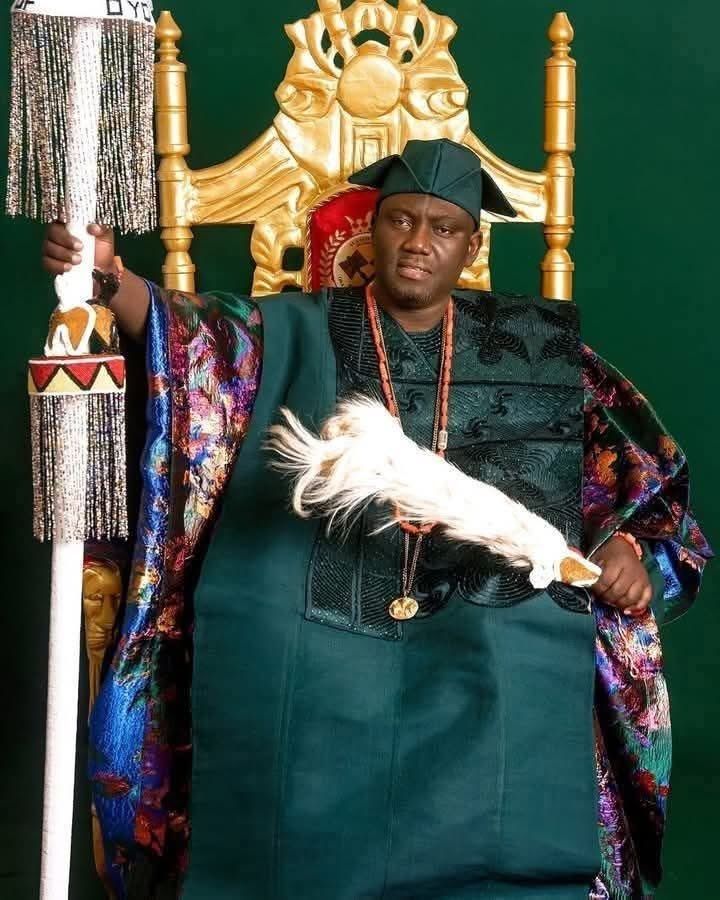
The Oyo Empire, at its height one of the most powerful states in West Africa, produced a court dress culture built around the prestige textile traditions of the Yoruba. The Alaafin, considered semi-divine, served as both political and spiritual leader of an empire that controlled trade routes across the region and extracted tribute from vassal states,s including the Kingdom of Dahomey.
At the court of Oyo, cloth was not merely a dress. Cloth was money. Specific textiles circulated as currency across West Africa’s trade networks. The Alaafin’s wardrobe was an instrument of political power. A documented episode records that a visiting dignitary arrived at the Oyo court carrying a succession of robes that matched each of the Alaafin’s changes of garment for garment. The exchange was a political competition conducted entirely through dress. The Alaafin was finally only able to outshine his visitor by instructing his weavers to produce a unique robe from the fibres of a silk-cotton tree. The creation of a new garment resolved the diplomatic encounter. Prestige in Oyo was measured in cloth.
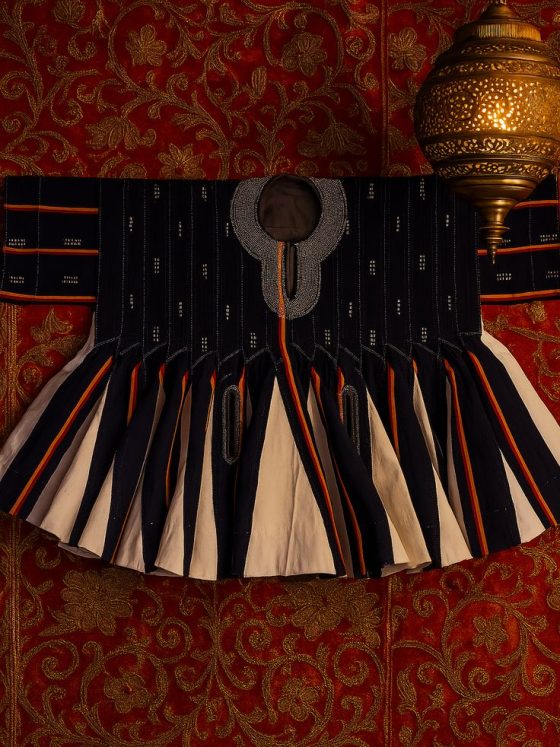
The Yoruba textile tradition that supplied the Oyo court centred on Aso-Oke, a handwoven prestige fabric produced in towns including Iseyin, Oyo, and Ilaro and worn for over four centuries. Three classic varieties existed: Etu, a deep indigo design; Sanyan, a beige silk woven from wild Anaphe silk; and Alaari, a crimson or magenta silk variant. Each carried specific connotations of dignity and occasion. The agbada, a flowing gown, the buba blouse, the iro wrapper, and the gele headtie formed a coordinated dress system in which every garment’s fabric, colour, and arrangement communicated the wearer’s status and the nature of the occasion. This was not fashion in the Western sense of seasonal change driven by commercial interest. It was fashion as a stable, codified social technology with deep roots in spiritual and political meaning.
The Agojie of Dahomey: Uniform as Military Statement
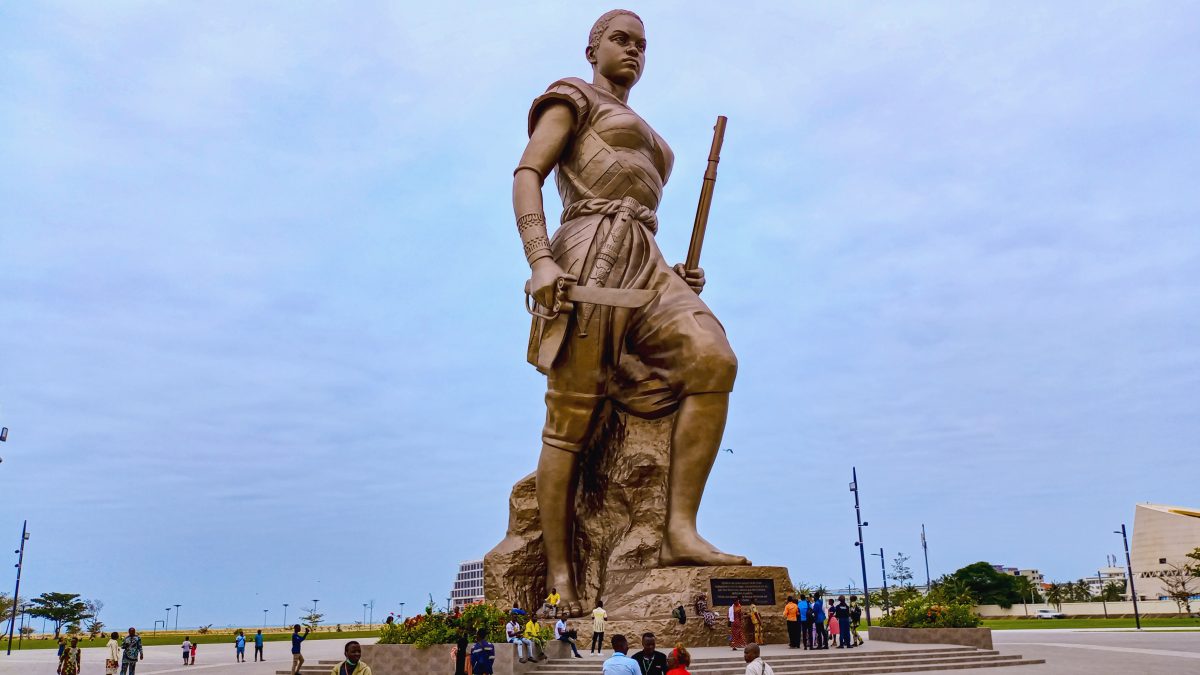
The Kingdom of Dahomey, located in present-day Benin Republic, produced one of the most extraordinary military dress traditions in world history. The Agojie, the all-female military regiment of Dahomey that existed from the seventeenth century until the late nineteenth century, wore uniforms that set them apart from almost every other military force on earth.
By the mid-nineteenth century, the Agojie numbered between one thousand and six thousand women, approximately a third of the entire Dahomey army. Each regiment had different uniforms, weapons, and commanders: huntresses, riflewomen, reapers, archers, and gunners, each distinguished by their dress. The fact that the Agojie and their male counterparts wore uniforms set them apart from most other African military forces of the time, establishing the Dahomean military as an organised, highly visible fighting force with a deliberate public identity.
Their dress consisted of tunics and long shorts during combat, practical, movement-permitting garments designed for actual warfare rather than ceremonial display. By the 1800s, contemporary accounts noted that their uniforms were so similar to those of their male counterparts that enemies fighting against them did not realise they were women until they were engaged in hand-to-hand combat. The uniform was a tactical decision. It was also a statement about the nature of the institution: the Agojie were not ceremonial guards or female auxiliaries. They were soldiers, dressed as soldiers, fighting as soldiers, dying as soldiers.
In 1861, the Italian priest Father Francesco Borghero watched three thousand armed and uniformed Agojie stage a mock assault for King Glele of Dahomey. He described the scene in his diaries. What struck him was not just the courage or the numbers but the precision of the uniformed formation, the deliberateness of the spectacle. Dahomey was using dress as diplomatic communication, staging a military fashion show for a European audience. The king was dressing his army to be seen and feared. The uniform was foreign policy.
The Asantehene’s Kente: A Cloth That Was Law
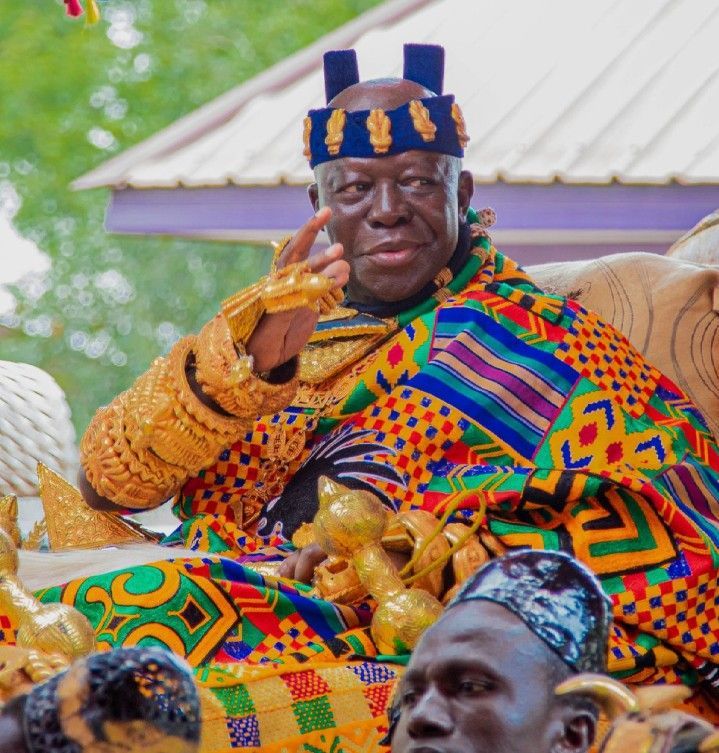
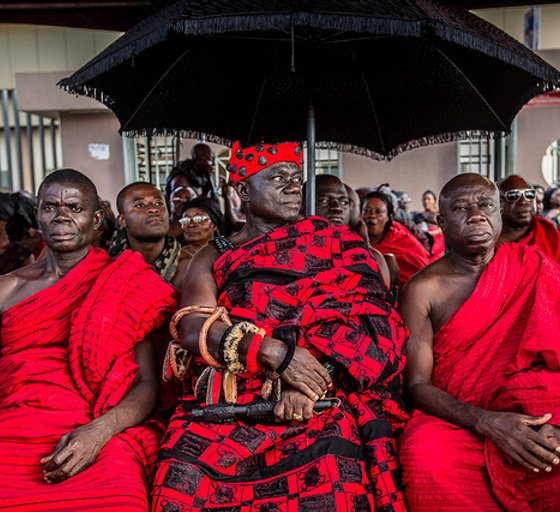
In the Asante Kingdom of Ghana, the most elaborately codified dress system of all was built around a single cloth. Kente weaving traditions date to the eleventh century, with textile production among the Akan and Ewe peoples documented from as early as 1000 BCE. By the seventeenth century, the Asantehene had adopted Kente as a royal cloth and established rules governing its use that functioned as law.
Only the Asantehene could initiate new Kente designs for royal occasions. Each Asante king created a new design during his reign in close consultation with master weavers, and that design would be permanently associated with him. Wearing a finer cloth than your superior in the Asante court was considered bad manners, and the Asantehene had a special assistant whose sole responsibility was to select, store, and repair his official wardrobe. The royal wardrobe was a managed political instrument.
Each colour in Kente carried a specific meaning: gold for status and spiritual purity, yellow for fertility, green for renewal, blue for harmony, red for passion and sacrifice, and black for union with ancestors and spiritual awareness. Each pattern had a name encoding a proverb, a historical event, or a philosophical principle. The cloth was not textile. It was text. It was woven literature, sartorial philosophy, mobile political statement. In 1817, British visitor Thomas Edward Bowdich recorded that Asante weaving had progressed to the point that cloths were made in all varieties of colour and pattern and were of incredible size and weight. This was not a cottage industry. This was a fashion system of extraordinary sophistication, operating at the peak of its power precisely when European fashion history was congratulating itself on discovering luxury textiles.
In December 2024, UNESCO recognised Kente cloth as an Intangible Cultural Heritage of Humanity. That recognition came roughly six hundred years after the tradition it was recognising had established itself as one of the most sophisticated textile systems on earth.
Also Read
- Cornrows Were a Map: The African Intelligence Behind Diaspora Braiding
- Indigo: How West African Dyeing Became the Blueprint for Global Denim
- The African Origins of Carnival Costume: Feathers, Beads, and the Masquerade Tradition
- The Pollera, the Wob Dwiyet, and the Baiana: The African Women Who Dressed the Americas
What the European Traders Saw and Did Not Say
Portuguese traders arrived in Benin in the late fifteenth century. The first Europeans to arrive in Benin were, by all accounts, very impressed with the wealth and advancement of the kingdom. Dutch trader Olfert Dapper described Benin City in 1668 as comparable in scale and organisation to Amsterdam. The Oba’s court was described as magnificent. The roads were broad. The palace was enormous. The textiles, the coral, the brass, the ivory: all of it was noted.
What was not done was to place these observations alongside European fashion history and draw the obvious conclusion: that the kingdoms of West Africa were running dress systems of comparable sophistication to those of Europe, with the added dimension of a coherent spiritual and political grammar encoded in every garment that European fashion, for all its luxury, did not possess.
The Portuguese traded with Benin for pepper, cloth, and stone beads, and in return supplied the coral that became central to Benin’s royal regalia. The trade was mutual. The intellectual exchange that should have followed, the honest comparison of two sophisticated dress cultures operating simultaneously, was not mutual. European fashion history kept its own account. African fashion history was not invited to contribute.
The Omiren Argument
Fashion history has a founding myth: that fashion, as a serious cultural practice, begins in Europe. That Africa’s dress traditions, however beautiful, are ethnic, ceremonial, or anthropological rather than fashionable in the full sense of the word. The courts of Europe, with their changing silhouettes and their seasonal trends, were the centres of the fashion world in the fifteenth and sixteenth centuries.
The Benin bronze plaques say otherwise. They show a royal court, operating from the fourteenth century, in a dress system of extraordinary sophistication, in which materials carried spiritual meaning, in which permission to wear specific garments was a political instrument, in which a guild of specialist craftsmen produced regalia for the king and his ancestors, in which a queen mother designed a headdress that became institutional regalia for five hundred years. These plaques were looted by British forces in 1897 and distributed across European and American museums, where they sit today as objects of aesthetic admiration rather than as documents of fashion history.
The Kente cloth of the Asante says otherwise. It shows a royal fashion system in which cloth was currency, patterns encoded philosophy and history, the king’s wardrobe was a managed political instrument, and the right to wear specific designs was governed by law. That system is older than any Paris fashion house by six centuries.
The Agojie uniforms of Dahomey say otherwise. They show a military kingdom that dressed its soldiers with deliberate precision, that staged military dress displays for diplomatic purposes, and that used uniform as both a tactical and a political communication. The Agojie’s uniform predated the modern concept of military dress as identity and strategic communication by at least two centuries.
Vogue’s fashion history does not begin in Benin City. Elle’s editorial record of African court dress is essentially non-existent. GQ has never published a feature on the Alaafin’s textile diplomacy. These are not oversights. They are the structural consequence of a fashion history built on the assumption that sophistication in dress belongs to Europe, and that African dress, however striking, is tradition rather than fashion. Omiren Styles does not accept that distinction. The Oba dressed in a fashion system. The Asantehene dressed in a fashion system. The Agojie wore a uniform designed to be seen. The fashion industry’s failure to place these alongside their European contemporaries is a failure of honesty, not a failure of evidence.
The Benin Bronzes are currently held in museums across Europe and North America. Calls for their return began in the mid-1930s and have not stopped. When the plaques are finally returned to Benin City, they will come home as what they always were: a fashion archive. A visual record of a court that dressed with extraordinary intelligence for at least four centuries. A document that fashion history has been avoiding for over a hundred years. Reading them honestly is where the correction begins.
Frequently Asked Questions
1. What do the Benin Bronze plaques tell us about pre-colonial African fashion?
The Benin Bronze plaques, produced from the fourteenth century onwards for the royal court of the Kingdom of Benin in present-day Nigeria, constitute one of the most detailed pre-colonial visual fashion archives in the world. They show a hierarchical dress system in which coral beads, ivory, brass, leopard skin, and specific garment forms communicated rank, spiritual standing, and relationship to the Oba. The king granted permission to wear coral, which could be revoked as punishment, making dress a direct instrument of political power. The plaques were looted by British colonial forces in 1897 and are currently held in museums across Europe and North America, where ongoing repatriation discussions continue.
2. What was Kente cloth in the Asante Kingdom, and how did its royal fashion system work?
Kente cloth is a woven textile tradition of the Asante Kingdom of Ghana with roots in Akan textile production dating to around 1000 BCE and sophisticated court production documented from the seventeenth century. In the Asante Kingdom, Kente was initially reserved exclusively for the Asantehene, the king, and the use of it by others required royal permission. Each Asantehene commissioned a new design during his reign in consultation with master weavers, and that design became permanently associated with him. The cloth’s colours and patterns encoded philosophical, historical, and social meaning, making it as much a woven text as a textile. In December 2024, UNESCO recognised Kente as an Intangible Cultural Heritage of Humanity.
3. What did the Agojie warriors of Dahomey wear, and why does it matter for fashion history?
The Agojie, the all-female military regiment of the Kingdom of Dahomey that operated from the seventeenth century to the late nineteenth century, wore regimental uniforms that distinguished different military units by dress. Contemporary accounts from the mid-nineteenth century describe tunics, long shorts, and regiment-specific dress that made the Dahomean military one of the most deliberately uniformed forces in West Africa. The Agojie’s uniforms were used for diplomatic display as well as for combat, with military-dress performances staged for visiting Europeans. Their significance for fashion history lies in demonstrating that Dahomey used dress as a sophisticated instrument of political communication and military identity, a practice that fashion history typically attributes to European military traditions.
4. Why is pre-colonial African court fashion absent from mainstream fashion history?
Mainstream fashion history has been constructed primarily around European court dress, treating African royal and court dress traditions as ethnographic or ceremonial rather than as fashion in the full sense of the word. This reflects the broader pattern of colonial historiography, which framed African cultural production as tradition while reserving the category of culture for European output. The evidence for sophisticated African court fashion systems is extensive and well documented, held by institutions including the British Museum, the Metropolitan Museum of Art, the Smithsonian Institution, and Smarthistory. The omission is a structural editorial choice, not a gap in the historical record. Omiren Styles exists specifically to make that argument.