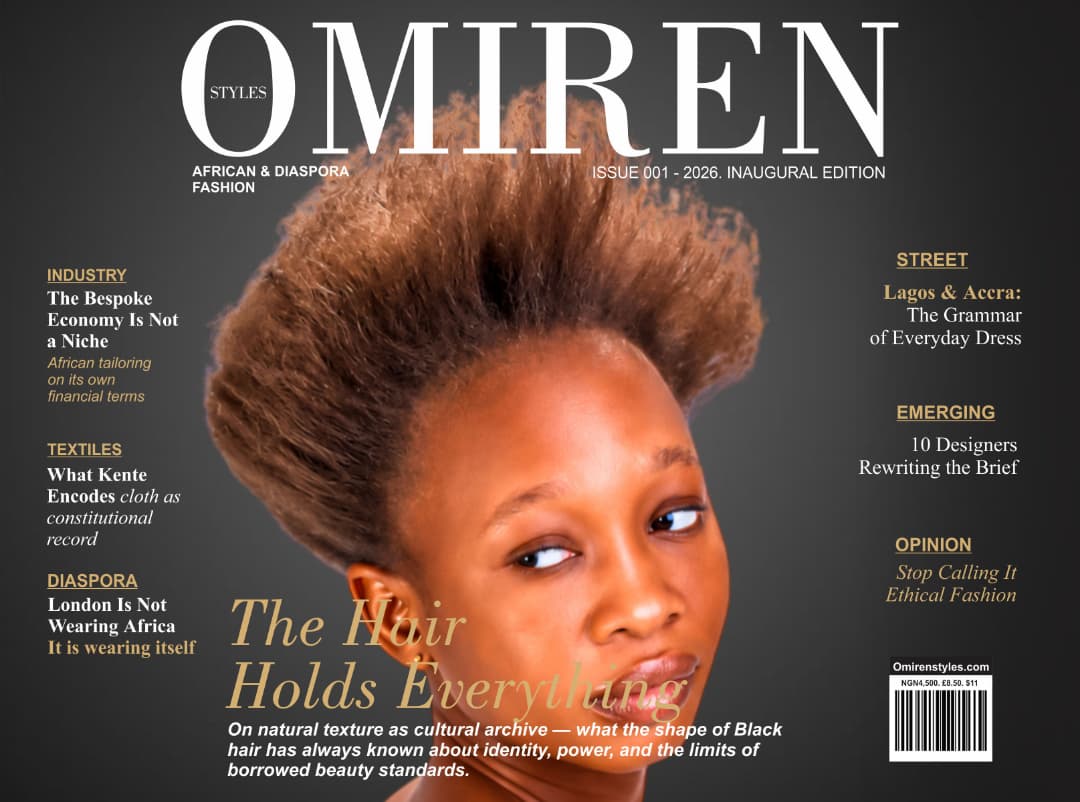
On natural texture as cultural archive
Before the dress. Before the shoes. Before the question of what to wear, there is the question of what to do with the hair.
This is not a trivial question. Ask anyone who has sat in a salon chair at six in the morning before a job interview, weighing whether to go in natural or to straighten it for the room. Ask the schoolgirl sent home because her afro was deemed a “distraction”. Ask the woman who spent twenty-two years relaxing her hair before she stopped, not because she read something, but because she looked at her daughter and could not find the words to explain why. The hair question is never only about hair.
Our cover model wears her afro as a crown, swept high, shaped by intention, and unambiguous. There is nothing accidental about this image. We shot it this way because we wanted the first thing you saw when you picked up Issue 001 to be a statement, not a suggestion. Natural texture is not a trend. It is not having a moment. It has always been here, carrying history in its coils, its kinks, its density and its geometry.
The afro was never just a style; it was a political geometry that the West tried to measure and could not.
What the shape of Black hair has always known, what it has been holding all this time, is the story of a people who were told, systematically and over generations, that they were not the standard. That their features required correction. That beauty, in its truest form, looked like something else. Hair was the most visible sign of that argument. It was also the most visible site of resistance.
We see that resistance to corporate grooming policies banning locs in professional settings remains contested in courts in 2024. We see it in runway seasons, where afros appear as a costume on non-Black models, then disappear again as the trend moves on. We see it most clearly in the natural hair movement, which began not as an aesthetic but as a refusal, and has now produced a generation of designers, stylists and photographers who are building an entirely different visual language. One that does not wait for mainstream validation before deciding that something is beautiful.
This feature traces that arc. From legislation to liberation. From erasure to archive.
The hair holds everything. It always has. We are finally just writing it down.