Hamed Ouattara’s Afrikya is not adequately explained by saying that an oil drum has become furniture. Its material origin is documented, but so is a second transformation: a projecting, spiked surface brings architectural references into an object intended for an interior. The industrial metal is not simply retained as evidence of reuse. It becomes part of a new formal language. Friedman Benda records the work as Afrikya (Africia), dated 2022, made from engine oil drums and sheet metal. Its listed dimensions are 120 × 180 × 45 centimetres, and it is offered as an edition of five under reference FB36945. A contemporary STIR report identifies it as a cabinet and discusses its projecting metal spikes; another captions the work as an “Afrikya Console.” Those descriptions place it within functional furniture while acknowledging a sculptural presence.
The useful question, then, is not whether discarded metal can be repurposed. Ouattara’s work establishes that proposition. The more demanding question is what the furniture gains through its particular treatment of material, surface and form, and whether its origin story helps explain the design rather than replacing it.
Hamed Ouattara’s Afrikya brings oil-drum metal, architectural references and workshop-made parts into furniture that goes beyond its recycled origins.
The Material Is a Beginning

Ouattara works in Ouagadougou, Burkina Faso. His gallery describes a practice that uses barrels and cans in response to the materials and conditions of his immediate environment. His own statement places the workshop within a longer account of metalworking, including the making of utensils and agricultural equipment. He presents contemporary furniture as a continuation and development of that work, not an activity detached from it. That context gives the oil drum a specific role. It is an available industrial material encountered within the designer’s working environment. In his published account of the collection, Ouattara also describes an ambition to update the workshop and explore the boundary between the functional and the conceptual. Reuse is therefore accompanied by a desire to extend what the workshop can make.
The material should not be made to carry every claim about the object. The gallery record identifies both engine oil drums and sheet metal. It does not provide a panel-by-panel provenance map. Calling Afrikya an oil-drum cabinet is useful shorthand, but it should not imply that every visible element survives unchanged from one identifiable container.
The Surface Projects Outwards
The spikes are important because they move the discussion beyond colour and patina. A STIR account specifically identifies Afrikya among the cabinets with large metal projections and relates them to wooden elements in Sudano-Sahelian architecture. The feature presents that architectural connection as part of the collection’s design explanation. The distinction is both formal and referential. A coloured or marked metal surface can be encountered as a plane. A projecting element extends that plane into space. It gives the object a more pronounced boundary and invites consideration from more than one direction. The material is not merely a skin carrying evidence of its previous use; it participates in the object’s spatial character.
This is the strongest documented feature for assessing Afrikya. The projections give the transformation a particular direction. The cabinet is not simply a conventional furniture form made from an unconventional sheet material. Its exterior introduces an additional relationship between the object and the space immediately around it.
Architectural Memory, Not a Literal Building
Ouattara’s own collection statement identifies historical cities including Timbuktu, Djenné and Bobo-Dioulasso among his sources. He also describes an architectural influence reaching back to childhood. These are his stated references, not proof that every element of Afrikya reproduces one particular building. In his accompanying essay, writer and curator Glenn Adamson describes the collection as an extension of Ouattara’s earlier formal vocabulary. Alongside the broad curvature associated with barrels, Adamson identifies hand-hammered sheet metal and spiked embellishments as part of the newer work. His interpretation connects a change in material treatment with a change in design language.
The architectural reference is most productive at that level. It helps explain why a surface might acquire projections and why furniture might be approached as a constructed presence rather than a neutral container. It doesn’t require calling the cabinet a miniature façade or assigning ritual meaning to each spike. Translation gives the design room to develop without pretending to reproduce an entire architectural tradition.
Colour Has a History, but Not Every Mark Has a Biography
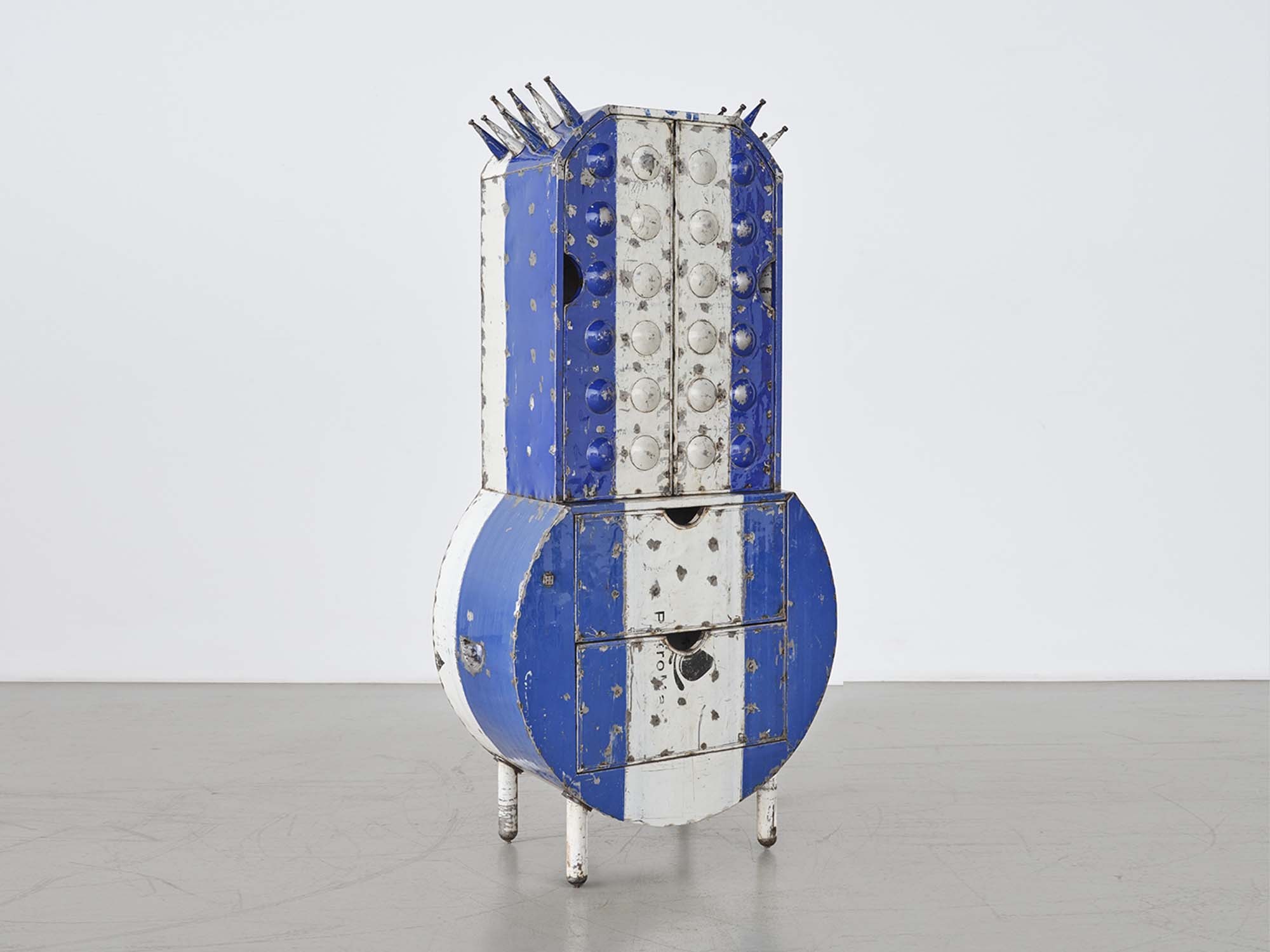
Adamson’s essay discusses the colours already present on Ouattara’s appropriated materials, along with collision marks and occasional fragments of lettering. STIR’s account of the 2023 Design Miami/Basel presentation likewise describes retained barrel colours and patina within the exhibited Bolibana work. These are published accounts of the material treatment, not a detailed history of every surface on Afrikya. The distinction matters because reused metal can encourage overly confident storytelling. A mark may be visible without its cause being known. A colour may originate on a container, be altered during making or belong to another intervention. Without item-specific documentation, an individual scratch should not become evidence of a particular journey.
What the reporting does support is a design approach that does not necessarily erase existing surface character. The furniture can retain a relationship with industrial material while also being reshaped. That creates a productive tension between what arrives at the workshop and what the workshop decides to make from it.
The Workshop Is a Collective Author

Ouattara is explicit about the people behind the collection. “This is a collective work,” he writes, identifying artisans from Ouagadougou, Bobo-Dioulasso and Sindou. He states that the objects’ components, including their hinges, are designed and made at the Ouagadougou workshop. That account makes the transformation more substantial than a story of an individual artist discovering an unusual material. The work includes the practical components that make furniture function. A hinge is not merely an accessory hidden behind the exterior; its design and manufacture belong to the object’s production. The published statement does not name each collaborator or allocate individual tasks on Afrikya. It should not be expanded into an invented roster. It nevertheless establishes that the designer’s authorship operates through collective making. A complete credit would recognise both Ouattara’s creative direction and the workshop contribution he identifies.
Tools Belong to the Design Account
“My tools, too, are handmade, and their traces are clear in the work,” Ouattara writes. The statement places equipment within his account of authorship. Adamson and the exhibition documentation similarly describe components and tools being made in the workshop, connecting that practice with self-sufficiency and access to resources. These accounts should not be turned into a reconstructed production sequence for Afrikya. The sources do not establish exactly which operation came first on this cabinet, how many people performed it or how long each stage required. They describe a workshop approach, not a time-and-motion record.
Their significance is still clear. The production system is not treated as invisible infrastructure behind a designed surface. Equipment, fittings and metalworking are part of how the studio develops its objects. The material is transformed through a capacity to make, not simply through the decision to classify something discarded as valuable.
An Edition Does Not Mean Identical Material Histories
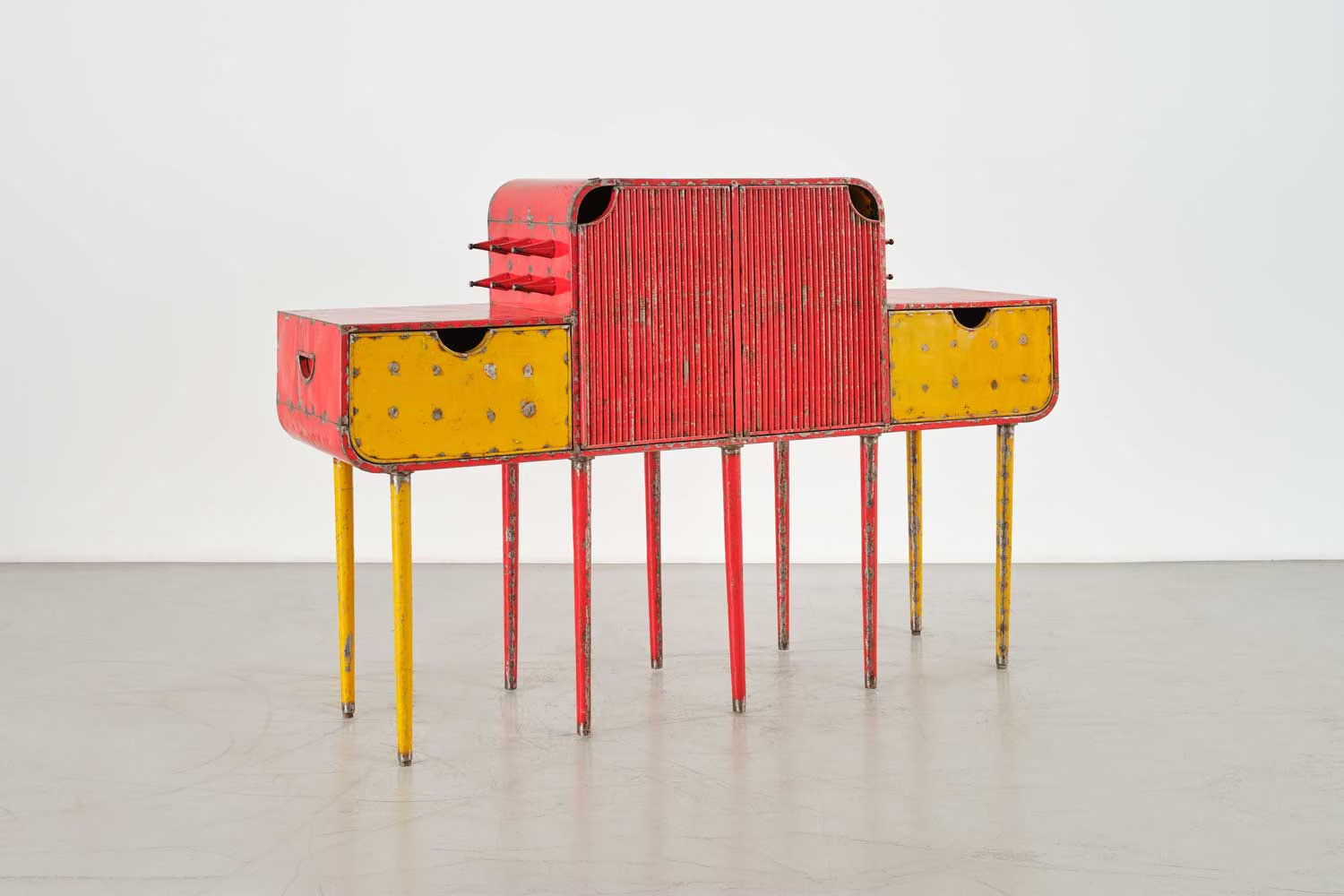
Friedman Benda lists Afrikya as an edition of five. Ouattara, meanwhile, describes each workshop object as unique. The two statements concern different aspects of the work: the catalogue establishes a limited edition, while the artist emphasises the particularity of the objects produced. It would be inaccurate to resolve that distinction by calling the work either a mass-produced standard item or an entirely unrepeatable one-off. The available record supports a named design made within an edition, alongside a practice in which material and making can contribute individual character.
This is also why edition information should remain separate from claims about value. A limited number is a catalogue fact. It does not, on its own, establish investment potential, market demand or superiority over furniture made at another scale.
Beyond the Recycling Verdict
The strongest case for Afrikya is not that reused material automatically makes it successful. Its documented design brings together several decisions: a furniture-scale object, an industrial metal palette, a projecting exterior, and workshop-made components. The architectural reference gives those projections a stated context, while the collective workshop account explains an important part of their production. The documentation does not establish everyday usability in detail. A cabinet designation is not a test of storage capacity, stability, ease of opening or suitability for a particular home. Nor do projecting elements alone prove that a piece is impractical. Those judgements require closer examination than the published accounts provide.
The more defensible assessment is that Afrikya moves beyond material substitution. It does not ask its industrial origin to supply the entire interest. Its surface and construction introduce a distinct spatial proposition, making furniture the means through which Ouattara develops that material rather than merely displaying it.
The Omiren Argument
The principle is transformation. Reusing a material establishes a new use; it does not, by itself, establish a resolved design.
Afrikya becomes more compelling where Ouattara’s decisions move beyond that origin: the projecting surface, architectural references and workshop-made components give the metal a particular organisation. Collective making is part of that account, not a footnote to the designer’s name.
The work deserves to be discussed as furniture with a material history, not as a material history that excuses furniture from judgement.
Also Read:
- Olu Amoda’s Scrap-Metal Sculptures: Turning Discarded Nigerian Materials Into Global Art
- African Interior Designers Shaping Global Aesthetics
- The Architecture of African Luxury Living: Style, Culture, and the New Definition of Opulence
- Designers from Burkina Faso: Leading Ethical African Fashion
Frequently Asked Questions
What is Afrikya made from?
Friedman Benda lists engine oil drums and sheet metal as the materials. The record does not identify the previous use of every individual component, so calling the cabinet an oil-drum work is useful shorthand, not a panel-by-panel provenance. Ouattara adds that he designed and made components such as hinges at his workshop in Ouagadougou.
When was it made, and how large is it?
The work is dated 2022. Friedman Benda lists its dimensions as 120 × 180 × 45 centimetres and records an edition of five under reference FB36945. Ouattara describes each object made by the workshop as unique, so the edition is a catalogue fact, not a claim that every piece shares an identical material history.
What is the connection with architecture?
Ouattara names Timbuktu, Djenné and Bobo-Dioulasso among his sources and describes an architectural influence reaching back to childhood. The published collection report relates the projecting metal elements on Afrikya and other cabinets to wooden elements in Sudano-Sahelian architecture. These are stated references, not proof that the cabinet reproduces one building.
Who made Afrikya?
Ouattara writes, “This is a collective work,” and identifies artisans from Ouagadougou, Bobo-Dioulasso and Sindou. His statement does not name each collaborator or assign individual tasks on Afrikya, so full credit recognises both his creative direction and the workshop contribution he describes, without inventing a roster.