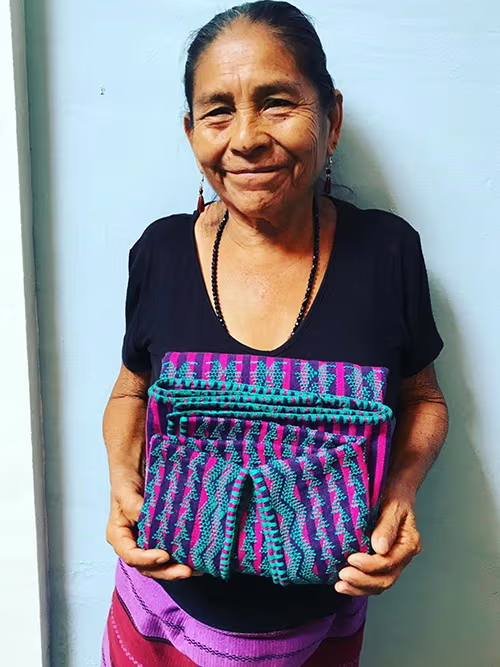
A photograph on the Pippa Holt Kaftans website shows a woman folding a garment. The caption identifies her: Felipa folds her No. 13 kaftan. The photograph shows a person holding a finished object. It cannot show everything that came before the folding: the decades on the backstrap loom, the seven children raised as a single mother, the elementary school studies completed in adulthood, and the dressmaking academy she is currently enrolled in so she can design as well as weave. The photograph shows the kaftan. This article is about the person.
Pippa Holt Kaftans describes Felipa Hernandez as a master weaver with incredible technical skills, honed over decades, whose pieces exude her proud, independent spirit. She and her daughter Angelica were the first weavers to join the Pippa Holt Kaftans team when the brand launched, five years before the Meet the Makers profile was written. Both Felipa and Angelica are still with the brand.
The eight years Felipa has worked with the brand span the period when Pippa Holt Kaftans became internationally visible, stocked by retailers across Europe and worn by figures whose public profiles brought the kaftans into wider fashion circulation. For Felipa, working with the brand produced something different from fashion visibility. In her own words: ‘I never thought this could bring so much work to my town. The work enabled her to finish elementary school. She is now enrolled in a dressmaking academy.
Together, those two facts describe a specific economic and personal trajectory: a woman whose weaving skill has supported her family across decades of gains, through a sustained commercial relationship with a fashion brand, providing both steady income and access to formal education she could not complete earlier. The trajectory is not the brand’s achievement alone. It is what becomes possible when a commercial relationship is structured to benefit the maker rather than simply to invoice the maker’s output.
Felipa Hernandez has been weaving on a backstrap loom for decades. She is the master weaver behind Kaftan No. 13 for Pippa Holt Kaftans. This style spotlight examines the work and the life behind the object.
The Backstrap Loom and What It Requires
The backstrap loom is a weaving technology of considerable age, as physically demanding as it is technically precise. The weaver attaches one end of the loom to a fixed point and the other to a strap around their waist; the weaver controls the loom’s tension by leaning forward and back. The width of the cloth produced is limited by the span of the weaver’s arms. The weave density, measured in threads per inch, reflects the weaver’s skill and the demands of the specific design being worked.
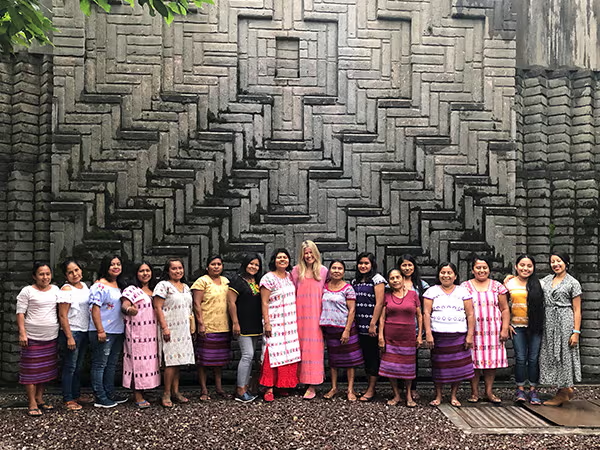
Felipa has been on the backstrap loom for decades. Her daughter Angelica, now a certified artisan of the Secretary of Education of the state of Oaxaca and qualified to teach the backstrap loom technique, describes the loom as her first toy: she played with threads and tools as a child, and the loom became her career. Felipa transmitted her knowledge to Angelica the same way backstrap loom weaving has been passed down across Oaxacan communities for generations: in the household, from the person who knows to the person who is learning to know.
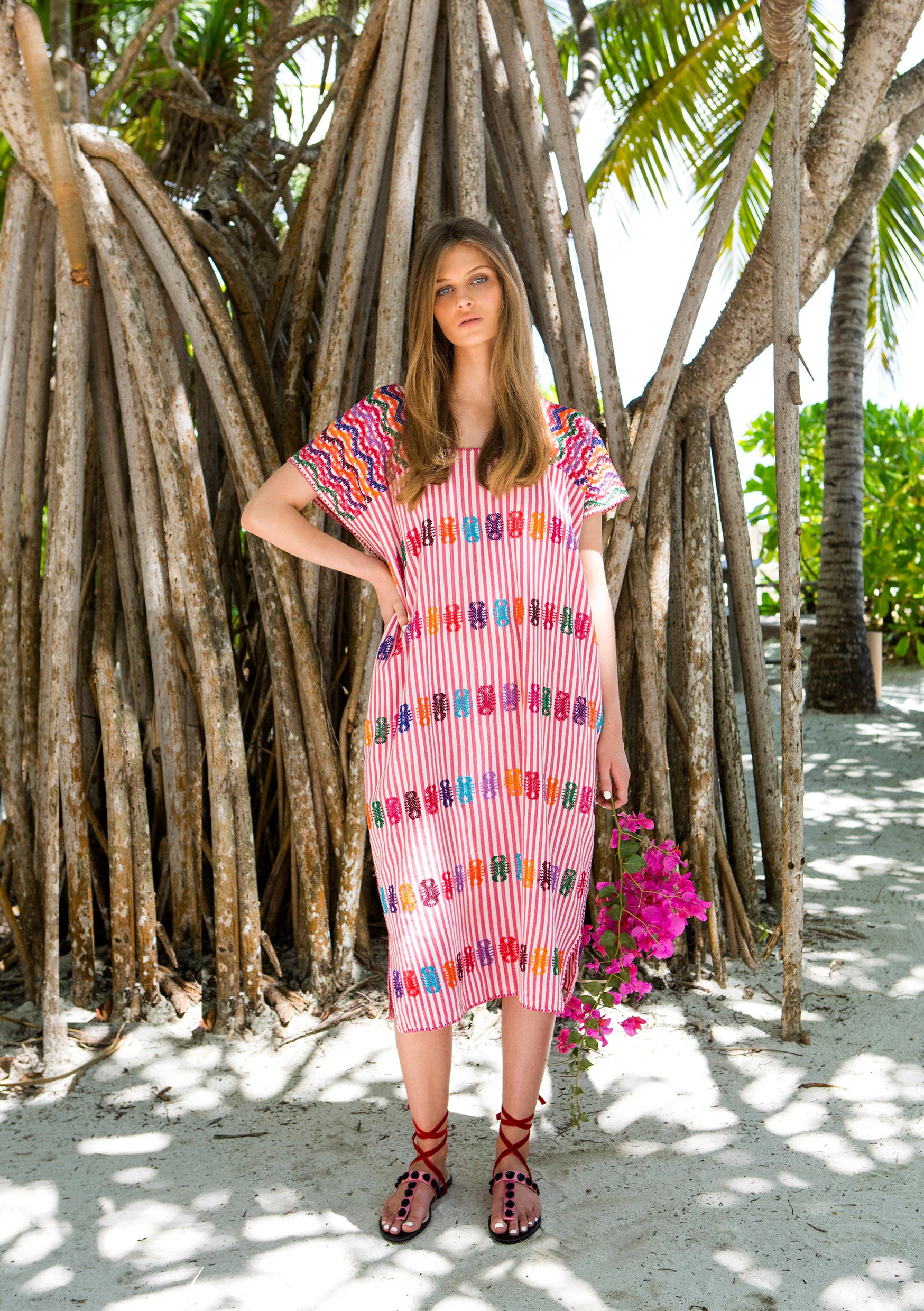
Kaftan No. 66, documented in Pippa Holt Kaftans’ product archive and crediting Felipa as the collaborating head weaver, takes one month to produce. The weave is fine-striped, interweaving white and purple strands in pairs, 295 pairs of threads in total, with motifs at the neckline placed with no space between them. The product description notes that ‘just very dedicated weavers can weave kaftan No. 66.’ The one month is the minimum production time for a standard kaftan; the design complexity determines whether it extends beyond that.
Kaftan No. 13: What Is Confirmed
The public record for Kaftan No. 13 specifically is limited to the Meet the Makers page, where a photograph shows Felipa holding the finished garment. The caption confirms that this specific kaftan is hers. What the public record does not confirm, for this specific number, are the design details: the motif, the colour palette, the thread count, the production time for this particular piece.
This absence is itself an editorial data point. A style spotlight that can confirm the maker’s name, location, experience, production relationship and personal trajectory, but cannot confirm the specific design vocabulary of the piece attributed to her, has run into the documentation gap that Omiren Styles has written about throughout this series: the record that exists is not always the record that tells the full story. The photograph confirms that Felipa made Kaftan No. 13 and folded it. The design details are in the garment; they are not yet on the public page.
What Maker Credit Looks Like When It Works
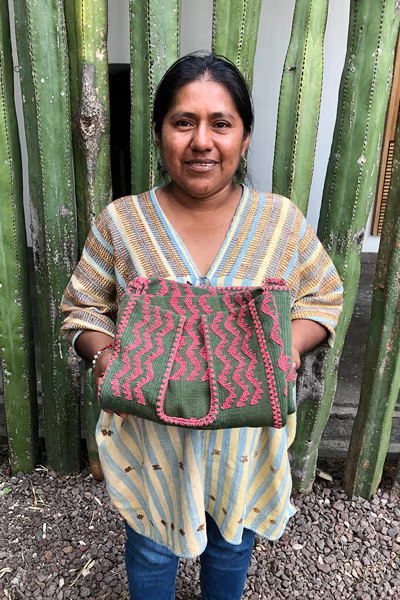
Omiren Styles published a maker-credit test last week, setting out six fields that a heritage fashion product page should populate: maker named, maker located, technique described, production time stated, commercial relationship described, and price-to-maker disclosed. Felipa Hernandez’s profile on the Pippa Holt Kaftans website passes four of those six fields.
She is named. The Meet the Makers page uses her full name and photograph and describes her role specifically as master weaver. She is located: the page identifies her village as remote and in Mexico; other brand documentation places the weaving community in Oaxaca. The technique is described: backstrap loom, hand-woven, each piece unique. The commercial relationship is described: she has worked with the brand since its launch, five years of consistent work whose economic consequence for her community she names directly.
The public page does not fully populate two fields: production time for specific pieces and price-to-maker. The production time for No. 66 is documented in the product description; a comparable note for No. 13 is not publicly available. The brand does not disclose the percentage of the retail price that reaches Felipa on its public pages, though its Our Values page speaks to its commitment to fair pricing for artisans.
Four of six is a stronger result than most heritage fashion product pages achieve. It is not the same as six of six. The gap matters not as a criticism of the brand but as a description of where the public accountability record currently sits. A buyer of Kaftan No. 13 knows considerably more about Felipa Hernandez than a buyer of most heritage craft objects knows about the person who made what they purchased. They do not yet know what Felipa was paid for it.
The Study That Changed Her Town
Felipa’s statement, ‘I never thought this could bring so much work to my town,’ sits in the centre of the commercial argument that the maker-credit series has been building. The argument is not that heritage fashion brands are exploitative by default. It is that the commercial relationship between a brand and an artisan community produces different outcomes depending on how the relationship is structured, and that those outcomes should be visible in the public record rather than assumed from the brand’s marketing language.
What Felipa’s statement describes is an outcome: sustained work that reached a remote community and changed it. What it does not describe are the terms: the pricing model, the minimum order guarantee, the mechanism by which the work reached the community rather than an intermediary, the margin that the brand takes between Felipa’s payment and the garment’s retail price. Those details are the accountability layer beneath the outcome. The outcome is real. The details would make it verifiable.
The cultural context in which Felipa works is itself contested. Oaxacan artisans have a documented history of seeing their designs adopted, renamed and sold by non-Oaxacan designers at prices that bear no commercial relationship to the income received by the communities who originated the designs. The Mexican government’s response to one high-profile case of this kind was to create a direct-to-consumer channel for Oaxacan artisans through Amazon and through ARIPO, the state crafts institute, specifically to eliminate intermediaries. The brand that pays Felipa directly and names her on its website is not in the same position as the brands that participated in that history. The difference is the direct relationship and the visible credit.
What Maker Credit Looks Like When It Works
The photograph of Felipa folding Kaftan No. 13 is a maker-credit image: it shows the person and the object in the same frame at the moment of completion. The caption names her. The page she appears on tells you how old she is, how many children she has, how long she has worked with the brand and what the work has meant for her town.
What the photograph cannot show is the weaving itself: the months of sustained attention on the backstrap loom, the thread count running through 295 pairs or more, the motifs placed at the neckline with no space between them, the particular knowledge of colour and pattern that Felipa has spent decades developing and is now, at 65, extending into formal dressmaking training because she wants to design as well as execute.
As Omiren Styles established in its analysis of fashion photography and repair, the photograph of a finished object typically shows the result. It omits the process, and that omission deprives the maker of documenting their skill. The photograph of Felipa folding her kaftan is different from the standard fashion image of a repaired or heritage object: it shows the maker rather than only the object. That difference begins with maker credit. The full record is what surrounds and supports it: the name, the location, the technique, the years, and the town.
As Omiren Styles has argued throughout its coverage of heritage craft and the Global South, the Global South made fashion and never got credit. Felipa Hernandez has been weaving on a backstrap loom for decades and is named, photographed and described on the website of the brand that sells her work. That is more credit than most artisan weavers in her position receive. The dressmaking academy she is currently enrolled in, funded by the income the work has produced, is what credit looks like when it converts into something the maker can use.
ALSO READ
- The Maker-Credit Test: What a Heritage Fashion Product Page Should Clarify
- When Fashion Photographs Repair, Does It Show the Skill or Just the Worn Garment?
- How Is Ecuador’s Toquilla Weaving Described at the Point of Sale?
- The Global South Made Fashion. It Just Never Got Credit.
EXPLORE MORE
Read the full Style Spotlight and Makers and Craft coverage at Omiren Styles for ongoing profiles of the artisans and makers behind heritage fashion and the commercial relationships that determine what their work produces for their communities. Discover travel and heritage intelligence across Latin America, Africa and the Caribbean at Rex Clarke Adventures.