A name beneath a fashion image can identify several different contributions. It might name the person who designed a textile, the company that developed it, the stylist who assembled the pictured look, or the photographer who shot the image. Reading those names as interchangeable turns a useful credit into a misleading account of authorship. Three documented examples from the Victoria and Albert Museum make the problem visible: Althea McNish’s Oriana separates a textile designer from a commercial client; Thebe Magugu’s Alchemy separates a collection collaboration from the team presenting it in a photograph; and a preparatory Prada campaign image records photography, styling and art direction as different roles within one production.
“Styling is using clothes to communicate and create imagery. It is a creative role in its own right.” University of the Arts London, Fashion Styling Guide
That observation from the University of the Arts London styling guide matters here because it names styling as a distinct creative discipline rather than a supporting footnote to design. Once you accept that, reading a credit properly becomes a question of identifying which discipline a given name belongs to. These examples don’t provide a complete map of everyone involved in a garment or image. They show which credits are established and where further questions remain open.
Learn how to distinguish designer, manufacturer, stylist and photographer credits through documented examples from Althea McNish, Thebe Magugu and the V&A.
Begin with the Thing Being Credited
The first question when reading any credit is what it describes: a garment, a textile design, a length of fabric, or a photographic image. The V&A identifies Althea McNish’s Oriana as furnishing fabric; a separate V&A record identifies a preparatory Polaroid from Prada’s Autumn/Winter 1997 campaign. Their credits describe different objects, though both fit within a broader discussion of fashion and textiles.
That difference prevents a basic attribution error. A photograph’s maker is not automatically the maker of the clothes it depicts. A designer credited for a textile pattern is not automatically responsible for every garment later made using that pattern. Identify the object and the contribution together before making any further claims.
The Oriana record gives a useful starting point. It names Hull Traders Ltd with the qualifier “designed for” and Althea McNish as “designer”. The wording does not place them in the same role. Reading the qualifiers matters as much as reading the names. If you skip the qualifier and simply see two names beside one object, the distinction between client and designer disappears, and with it, a documented contribution.
Designer and Client: Althea McNish’s Oriana
The V&A describes Oriana as printed heavy cotton satin designed by McNish for Hull Traders, with Great Britain recorded as the place of manufacture. This establishes a design attribution and a commercial relationship. It does not identify an individual wearer or a specific domestic setting, and extending the record in either direction would move beyond what the source documents.
“Designed for” should therefore remain distinct from “designed by.” The former identifies the company connected to the commission or commercial context; the latter identifies the credited designer. Rewriting the entry as a Hull Traders design without retaining McNish would remove a documented contribution rather than simplify the wording. The accuracy lies precisely in keeping both parts visible.
The record also includes the acquisition credit “Given by the makers.” That line concerns how the object entered the museum. It is not interchangeable with the designer field. A donor credit, a design credit and a production attribution can appear together in the same record while answering entirely different questions about the same material object. Reading every name in a record as a design credit creates confusion rather than clarity.
Keep the Attribution Precise
A careful summary of Oriana would say that it is a furnishing textile designed by Althea McNish for Hull Traders, with the museum recording printed cotton satin. It would not add the names of printers, individual factory workers or a household unless separate evidence established those contributions. Their absence from this record does not prove they had no role. It tells you that the consulted record does not name them. A documentation gap is a reason to seek more evidence, not permission to invent either an individual contribution or an explanation for why it is missing.
The same principle applies to Omiren’s broader discussion of what museum records can and cannot tell us about dress history. A record establishes what it documents. Going beyond its stated scope without additional sourcing produces claims the evidence cannot support.
A Label Credit Does Not Name Every Contributor

The V&A’s fashion collection page identifies a man’s suit as designed by Mr Fish and manufactured by Hexter, dating it to about 1968. This offers a concise example of separate design and manufacturing credits. The two names identify different contributions to the same garment rather than competing claims to one undifferentiated role.
The distinction should survive into editorial prose. Calling it a Mr Fish suit is serviceable shorthand in some contexts, but an article about production should retain the manufacturer. Equally, the manufacturing credit alone does not establish that Hexter originated the design. The question you are trying to answer determines what information must remain visible, and a shorthand that drops one name to simplify may drop the name that actually answers your reader’s question.
The same logic applies when reading credits on a runway photograph or a brand lookbook. A house name on an image caption identifies the brand context. It does not necessarily name the individual designer who originated the silhouette, the pattern cutter who realised it, or the studio team who styled the image. When those distinctions matter, document them separately rather than assume them from a single name.
Styling Is Not Merely Another Word for Design
The UAL guide on fashion styling describes the role as using clothing to communicate and create imagery, with research, concept development and collaboration with photographers, models and designers identified as parts of the work. Styling can involve genuine creative responsibility without requiring a stylist to originate every garment used in a look. The two roles can share a creative space while remaining distinct contributions.
The guide also notes that stylists may contribute to design processes or work as creative directors and fashion editors. Roles can overlap across a career, and sometimes within a single project. That makes specific project credits more important, not less: the existence of overlap does not justify assigning someone an additional role when the source does not document it for that particular commission.
The practical consequence is straightforward. A stylist credit on a campaign image establishes a styling contribution to that image. It does not, by itself, establish ownership of the clothing designs used, responsibility for manufacturing them, or authorship of the photograph. Those claims require supporting attribution from the relevant sources.
Collaboration and Image Production: Thebe Magugu’s Alchemy
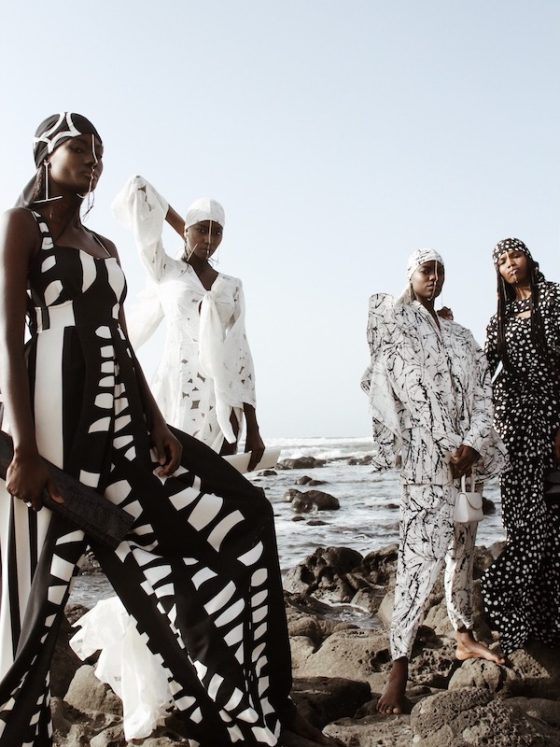
The V&A’s Africa Fashion exhibition account describes Thebe Magugu’s Alchemy collection as created in collaboration with Noentla Khumalo, identified as a stylist and traditional healer. That statement documents a collaboration in the collection’s development. When discussing the collection’s conceptual background, it should not be reduced to the fashion label’s name alone, because that removes a documented contributor from the record.
The accompanying image has a separate credit: “Photography: Tatenda Chidora, Styling + Set: Chloe Andrea Welgemoed, Model: Sio.” These roles describe the pictured presentation of the collection. They do not replace Khumalo’s documented collection collaboration, nor do they establish that she styled that particular photograph. The record names different contributions at different stages of the project.
This is the clearest reason to read a full caption and its surrounding text together. The word “stylist” can identify a person’s professional practice in one sentence, while a project credit assigns styling to somebody else in another. Both can be accurate because they reflect different relationships to the work: one to the collection’s development, one to the image it produces.
The Photograph Has Its Own Authorship
A V&A record for Prada Autumn/Winter 1997 names Glen Luchford as photographer, Alex White as stylist and David James as art director. The object is a preparatory Polaroid associated with an advertising shoot; its description explains that it records the development of lighting and composition for a fashion photograph. The object is not a garment. It is documentation of a creative process.
This distinction separates the clothes, their presentation, and the image-making process. Prada identifies the campaign context; the role qualifiers identify members of the creative team responsible for the image. Treating this Polaroid solely as a Prada design record would fail to describe the object being catalogued and the photographic work it actually documents.
The acquisition line, “Given by Glen Luchford,” identifies a separate contribution: donating the object to the museum. His name therefore appears in two capacities within the same record, as photographer and as donor, which is why the surrounding labels matter. Without them, a reader who only scanned the names could conflate two distinct relationships to the same object.
What Missing Credits Can Establish

A short caption may leave a question unanswered. That, by itself, is not evidence that a contributor was deliberately excluded, unpaid, or denied recognition. Those are consequential claims that require additional evidence, such as fuller production records or attributable testimony from those involved. The absence of a name in a museum record is a documentation gap. It is not an editorial judgement about the absent person.
The editorial task is to preserve what is documented and state what remains unresolved. Precision does not require pretending that a caption is complete. It requires avoiding the opposite error: converting incomplete information into a story about responsibility or intent that the available evidence cannot support. Both errors produce inaccurate accounts. The first overstates what a credit confirms; the second overstates what its absence means.
For Omiren’s coverage of Caribbean and global fashion heritage, this principle is directly relevant. Designers from the Caribbean, Africa and the Global South have historically been undercredited in international fashion records. That history is a reason to read credits carefully and advocate for accurate attribution. It is not a reason to read absences as confirmation of exclusion when the source material does not establish that.
Omiren Argument
This matters for Omiren for a straightforward reason. When covering Caribbean designers, African designers, and the global fashion landscape, Omiren regularly encounters records with incomplete attribution, where a house name obscures individual designer contributions, or where collaborative work is credited solely to the most commercially prominent partner. Reading credits carefully is not a procedural formality. It is an editorial commitment that either preserves documented contributions or allows them to be quietly overwritten.
The examples discussed here, Oriana, Alchemy, and the Prada Polaroid, are useful not because they involve controversial cases, but because they are clean. Their records are relatively clear, and the distinctions between designer, client, stylist, photographer and donor are explicitly marked. If those distinctions can collapse even in well-documented cases, they are even more vulnerable in cases with thinner original records. The habit of reading credits precisely matters most where the evidence is scarcest.
Omiren argues that accurate attribution is a form of respect for the people whose work the fashion industry depends on. Crediting a textile designer is not a bureaucratic detail. It is the difference between a named contribution that can be traced, studied and built upon, and an anonymous one that disappears into a commercial label. The examples here give that argument a documented foundation.
Also Read:
- What a Museum Record Can and Cannot Tell Us About Dress
- Global South Fashion: Why Credit Matters
- Caribbean Diaspora Designers on the Runway
FAQs
Does a Brand Credit Identify the Individual Designer?
Not necessarily. A brand credit identifies the label or company associated with a garment without naming the individual responsible for its design. Check the source’s exact wording, including any role qualifiers such as “designed by” or “designed for.” Where an individual attribution is absent, retain the documented house credit. Do not assign responsibility to a founder or creative director solely because of their position within the company.
Is a Museum Credit Line Always a Design Credit?
No. In the examples examined here, “Given by” records acquisition information; role qualifiers such as “designer” and “photographer” identify creative contributions. Read the surrounding fields before quoting any single line. A donor, a designer and a manufacturer may all be named in the same record, but their names answer different questions about the object.
Can a Stylist Also Be a Design Collaborator?
Yes, but attribute the two roles separately based on what each source documents. Thebe Magugu’s Alchemy collection credits Noentla Khumalo as a collection collaborator. A separate image from the same collection credits a different stylist for the presentation. Both attributions can be accurate because they concern different stages of the project. The project credit, not the professional title alone, establishes the contribution.