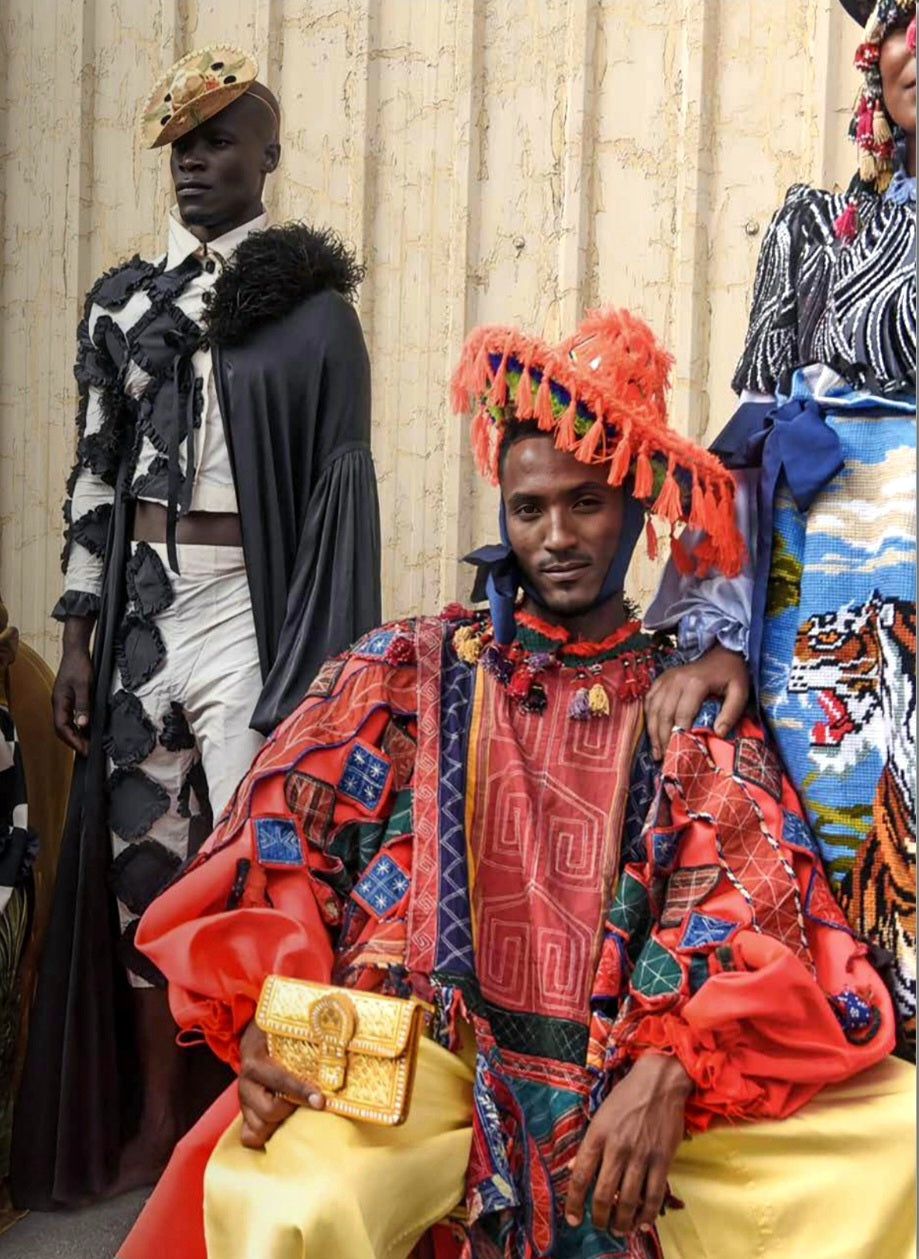
The African fashion industry is valued at approximately $31 billion. It is projected to exceed $50 billion by 2030. The African Prints Fashion market alone is forecast to reach $34.7 billion by 2033, growing at a compound annual rate of 24.2%. Africa’s population will reach 2.5 billion by 2050. The continent produces 6% of the world’s cotton. Its fashion and textile exports total approximately $15.5 billion annually. 78% of African adults consider clothing a form of creative self-expression.
These are the numbers that circulate in investment decks, policy papers, and industry panels. They are real numbers, drawn from McKinsey, the African Development Bank, the International Trade Centre, and Sagaci Research’s SagaCube consumer tracker. And they are almost entirely produced by organisations based outside Africa, measured using frameworks designed for markets outside Africa, and published for audiences outside Africa deciding whether to invest in Africa.
That is the data infrastructure problem. It is not that numbers about African fashion do not exist. It is that the existing numbers were not built for African fashion, do not serve African fashion’s governance needs, and cannot answer the questions that African fashion businesses, investors, and policymakers actually need answered.
African fashion holds 1.82% of the global market. The data gap is part of why. Without its own measurement infrastructure, the industry cannot make the case for the investment it needs.
African Fashion Data Infrastructure: What Is Missing and Why It Matters

The most precise diagnosis of the problem was published in March 2026 by Sessi K of Clearly Invincible, the agency that produced the first Lagos Fashion Season Trend Report in 2025. The State of Fashion Data in Africa identifies the central failure directly: Africa’s fashion, creative and cultural influence consistently outpaces its foundational intelligence. Designers from Nairobi, Dakar, and Addis Ababa show at Paris, Milan, and New York. LFW generates an estimated $1.7 million in media value per season. But none of the continent’s fashion week platforms, outside of LFW’s independently commissioned 2025 report, have equivalent measurement frameworks. South African Fashion Week, Dakar Fashion Week, and other continental platforms lack the data tools to demonstrate their economic contribution, tourism value, or policy-advocacy case to the governments whose support they need.
The visibility metrics that do exist demonstrate cultural currency, but cannot track conversion. They do not trace downstream buyer order volumes, diaspora purchasing behaviour, or whether press impressions generated at a Nairobi runway translate into sales in London or New York six months later. Visibility is documented via social media reach. Conversion rate remains locked inside individual event organisations and brands that have no mechanism, or currently no incentive, to share it with a collective intelligence system.
The consequence for investment is direct. Africa’s fashion industry currently holds just 1.82% of the global fashion market, according to the African Fashion Development Initiative. The gap between that share and the continent’s projected growth is partly a capital gap and partly a manufacturing gap. It is also a data gap. External investors making capital allocation decisions need comparable, standardised market intelligence. When the available data is fragmented, methodologically inconsistent, and produced by external organisations that do not specialise in African market dynamics, as the Woven Insights analysis of African fashion markets confirms, the investment case becomes harder to make and easier to defer.
What the Existing Data Reveals — and What It Cannot
The data that does exist about African fashion consumers is instructive precisely because of what it shows and what it leaves out. Sagaci Research’s SagaCube pan-African consumer tracker, covering 54 African countries, shows that 78% of adults consider clothing a form of creative self-expression. 52% actively keep up with fashion trends. 65% prefer locally made clothing. Online fashion shopping stands at 9% across the continent, against 24.4% for clothing and footwear’s share of the region’s online retail revenue in 2024. Mobile money is used by 70% of apparel consumers in Kenya for transactions. Bank account access reaches 88% in Kenya and 82% in South Africa, but falls to 51% in Nigeria, 42% in Morocco, and 38% in Egypt.
This is valuable data. It tells brands and investors something real about the consumer environment. What it does not tell them is how specific African designer brands are performing against each other, which categories are growing within the local design economy versus the import economy, what price elasticity looks like for locally produced garments compared to imported alternatives, or how consumer behaviour at the high end of the market differs from mass-market dynamics. These are the questions that a fashion industry data infrastructure routinely answers in developed markets. In European and American fashion, they are answered by a combination of retail sales data, consumer panels, brand-tracking studies, and trade-association reporting that operates year-round. In African fashion, they are answered occasionally, partially, and usually by external researchers with limited on-the-ground presence.
The intra-African trade picture is equally partial. Intra-African trade in textiles and apparel remains below 12%, according to research by Botho Group. But the data granularity on why, at what price points, and in which specific categories is thin. The AfCFTA is projected to increase intra-African textile trade by 33%. Whether that projection is tracking towards realisation is difficult to assess from current data because the baseline measurement is insufficient.
An industry that cannot measure itself cannot govern itself. And an industry that cannot govern itself will always be measured by someone else’s framework.
What an African Fashion Data Index Would Actually Need to Do
The Clearly Invincible analysis proposes a structural solution that is worth examining in detail. The African Fashion Data Index that it describes would not generate new data from scratch. It would connect existing data streams, which is the more viable and faster path. The architecture requires: national statistical agencies harmonising their fashion sector classifications so that Nigerian, Ghanaian, Kenyan, and South African production figures are comparable; international governmental organisations aligning methodologies and cross-referencing outputs; event platforms and organisers contributing combined market data into shared intelligence rather than keeping it siloed; fashion industry bodies maintaining searchable databases of production capacity and certifications; development institutions commissioning recurring consumer studies across continental and diaspora markets; and brands categorised by revenue level to introduce structured transparency without exposing individual firm data. As the Clearly Invincible report notes, comparable coordination frameworks already function in African agriculture through commodity exchanges, in finance through credit bureaux, and in tourism through coordinated arrival statistics. Fashion has no equivalent.
The governance and trust challenge is real and should not be minimised. Businesses in competitive and weakly enforced environments are cautious about sharing information. Independent oversight, clear privacy rules, fair value exchange, and robust infrastructure are all prerequisites for a system that brands will actually contribute to. These are solvable problems. They are not solved yet, and pretending they are would be a mistake in building toward the index.
The e-commerce dimension of the data gap is accelerating rather than narrowing. Fashion e-commerce penetration in Africa rose from 13% in 2017 to 28% in 2021. South Africa’s monthly fashion e-commerce revenue reached $96 million in August 2025, with apparel accounting for 58% of the total. Shein and Temu together account for 3.6% of South Africa’s clothing, textile, footwear, and leather market, with combined 2024 sales of $405 million. African fashion brands are competing against these entrants in a market where those entrants have sophisticated consumer data, and the African brands generally do not. The data asymmetry is a competitive disadvantage with direct revenue consequences.
Also Read:
- What African Fashion Brands Get Wrong About Scaling — and the Three That Got It Right
- The Lagos Fashion Week Effect: What a Decade of Runway Has Actually Done for Nigerian Designer Revenue
- The Secondhand Market as a Design School: How Kantamanto Graduates Are Dressing Ghana’s Streets
- Who Actually Owns Ankara: The Legal and Cultural Argument the Fashion Industry Has Been Avoiding
Who Has the Incentive to Build It, and Who Needs to Pay for It

The argument for building African fashion data infrastructure is clear. The argument about who pays for it and who controls it is harder. Historically, data infrastructure in African markets has been funded by development institutions, international NGOs, and foreign governments, each with its own policy objectives. Data built for external purposes serves external purposes. What African fashion needs is data built by and for the industry itself.
The institutional candidates exist. Afreximbank’s CANEX programme has demonstrated an understanding of infrastructure investment as the primary lever for African fashion development. The African Union’s AfCFTA Secretariat has both the mandate and the incentive to build a trade data infrastructure that includes the fashion sector. National export promotion councils, including Nigeria’s NEPC, which has already engaged with LFW through the Zero Oil Ambassador programme, have documented interest in fashion as an export sector. If African fashion weeks collectively coordinated data sharing rather than competing on media metrics, they would form the most credible foundation for a continent-wide industry intelligence system.
The diaspora market represents a particularly under-measured opportunity. The Sagaci Research data covers 54 African countries but does not systematically capture diaspora purchasing behaviour. African designers in Lagos, Accra, and Nairobi know from their direct sales data that diaspora customers in London, New York, and Paris account for a meaningful share of their revenue. That revenue is not aggregated, not published, and not available to the policy arguments that would justify infrastructure investment in the export supply chains the diaspora market requires. The Fashionista January 2026 analysis identifies the diaspora market as one of the most significant yet least-served opportunities for African fashion brands. Building the data infrastructure to quantify and serve it is a precondition for the policy arguments that would fund the logistics infrastructure to reach it.
The Omiren Argument
African fashion’s data problem is not primarily a technology problem or a resource problem. It is a governance problem rooted in a historical pattern: the continent’s industries have been measured by external actors for external purposes, and the data produced has served investment decisions made from outside the continent. The consequence for fashion is that it is an industry that can demonstrate creative output at the highest global level but cannot consistently demonstrate commercial performance, consumer demand depth, or export capacity in the standardised formats that capital allocation decisions require. The 1.82% global market share figure is partly a manufacturing problem and partly a logistics problem. It is also a measurement problem, because industries that cannot measure their own performance cannot make the policy case for the infrastructure they need to improve it.
The African Fashion Data Index that Clearly Invincible has proposed is the right structural response. Its implementation requires political will from national statistical agencies, coordination from industry bodies that have historically competed rather than collaborated, and sustained funding from institutions that prioritise infrastructure investment over visibility investment. None of that is simple. All of it is achievable within the timelines required by the AfCFTA’s trade expansion projections. The industry that builds this infrastructure first will have a competitive advantage in every market it enters, because it will be the only industry on the continent that can demonstrate its work with evidence rather than anecdote. African fashion has a creative output. It needs the measurement system to prove what that output is worth.
Frequently Asked Questions
What is the African fashion data infrastructure problem?
African fashion lacks a continent-wide system to measure its commercial performance, consumer demand, trade flows, and production capacity. The data that exists is primarily produced by external organisations — McKinsey, the World Bank, the International Trade Centre — using frameworks designed for different markets and published for external investor audiences. African fashion weeks lack standardised economic measurement tools. Brands have no shared intelligence infrastructure. National statistical agencies use inconsistent classifications that prevent cross-market comparison. The consequence is an industry that cannot consistently demonstrate its commercial case to the capital and policy decision-makers it needs to fund its growth.
Why does the data gap matter for investment in African fashion?
External investors making capital allocation decisions require comparable, standardised market intelligence. When available data is fragmented and methodologically inconsistent, the investment case becomes harder to make. African fashion currently holds 1.82% of the global fashion market despite representing one of the world’s fastest-growing consumer populations. The data gap means that investors who might allocate capital to African fashion manufacturing, logistics, or brand development cannot access the granular, comparable performance data that would reduce perceived risk and accelerate decision-making.
What is the African Fashion Data Index, and who proposed it?
The African Fashion Data Index was proposed by Sessi K of Clearly Invincible in the State of Fashion Data in Africa report, published in March 2026. The index would connect existing data streams rather than generate new ones by harmonising national statistical agency classifications, aligning international methodologies, pooling event-platform market data, maintaining production-capacity databases, commissioning recurring consumer studies, and categorising brands by revenue level. The report notes that comparable coordination frameworks already exist in African agriculture through commodity exchanges, in finance through credit bureaux, and in tourism through arrival statistics. Fashion has no equivalent.
How does the e-commerce data gap affect African fashion brands competitively?
African fashion brands are competing against international entrants, including Shein and Temu, which together hold 3.6% of South Africa’s clothing, textile, footwear, and leather market with combined 2024 sales of $405 million. These entrants have sophisticated consumer data; most African fashion brands do not. The data asymmetry means that international fast-fashion platforms can optimise pricing, assortment, and logistics for African consumers, while African designers make decisions with limited information. Fashion e-commerce penetration in Africa rose from 13% in 2017 to 28% in 2021, meaning the competitive stakes in the digital channel are accelerating faster than the measurement infrastructure is developing.
Which institutions are best positioned to build African fashion data infrastructure?
The Afreximbank’s CANEX programme has demonstrated an understanding of infrastructure investment as the primary lever for fashion development. The African Union’s AfCFTA Secretariat has both the mandate and the incentive to build trade data infrastructure covering fashion. National export promotion councils, including Nigeria’s NEPC, have documented interest in fashion as an export sector. If African fashion weeks collectively coordinated data sharing rather than competing on media metrics, they would form the most credible foundation for a continent-wide industry intelligence system. Development institutions, including the African Development Bank and International Finance Corporation, are also natural funders of the data infrastructure that commercial investment requires.
Explore More
Read the full Industry section for analysis of strategy, investment, market intelligence, and the structural conditions that determine whether African fashion’s creative influence translates into durable commercial power.