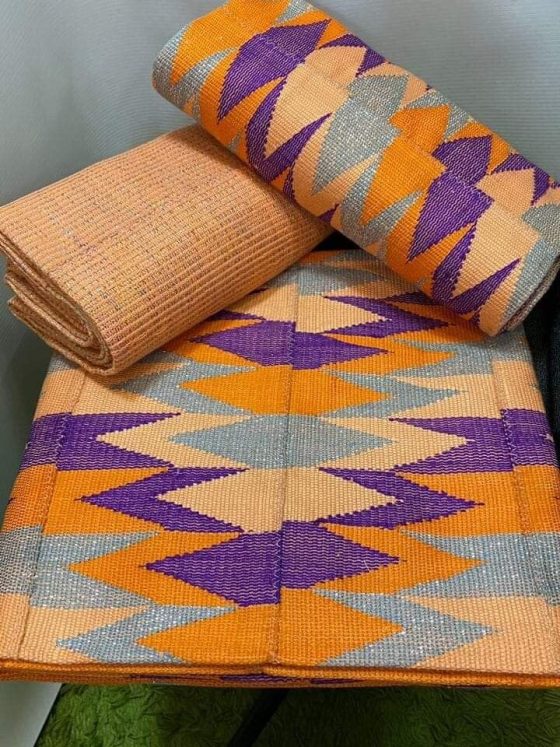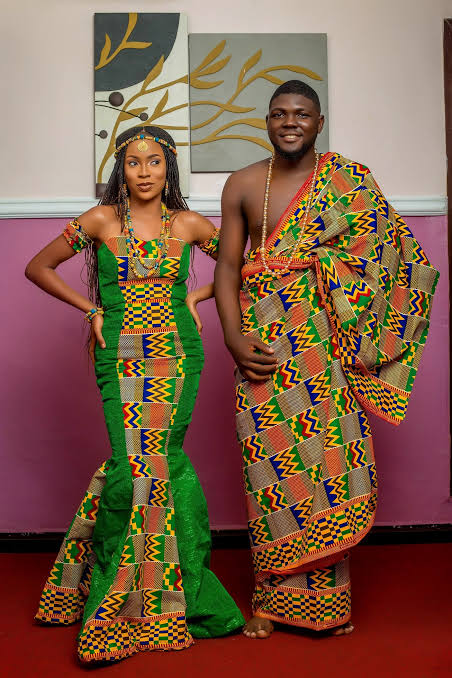
In September 2025, at the La-Palm Royal Beach Hotel in Accra, Ghana, the Kente cloth was formally registered as a Geographical Indication. This legal protection follows the December 2024 inscription of traditional Kente weaving on UNESCO’s Intangible Cultural Heritage List. The protection is of the same legal category as France’s protection of Champagne and Italy’s protection of Parmesan. Once a Geographical Indication is registered, the name itself belongs to the place and the people whose tradition created it. Kente now belongs to Ghana in exactly that sense. The protection exists because, for decades, cheap factory-printed imitations of Kente patterns have been produced abroad and sold for a fraction of the price of cloth woven by hand in towns like Bonwire. As one master weaver in Bonwire told Ghanaian media at the launch, what he produces is now a certified Ghanaian treasure, not something that can be copied by machines elsewhere and sold for pennies. When he weaves a strip of Adwinasa, one of Kente’s most significant patterns, he is producing exactly that.
This is the starting point for properly understanding Kente, Kanga, and Adire. Each of these textiles is routinely flattened, in fashion retail, in costume departments, in casual conversation, into a print: a colourful pattern that signifies Africa in general. Each is, in fact, a language with its own grammar, vocabulary, and rules for who can say what, when, and to whom. Decoding them is not a cultural appreciation exercise. It is closer to literacy.
Kente, Kanga, and Adire are routinely flattened into prints. Each is a language with its own grammar, encoding status, proverbs, and resistance. Omiren Styles decodes all three.
Kente: The Royal Cloth That Speaks in Named Patterns
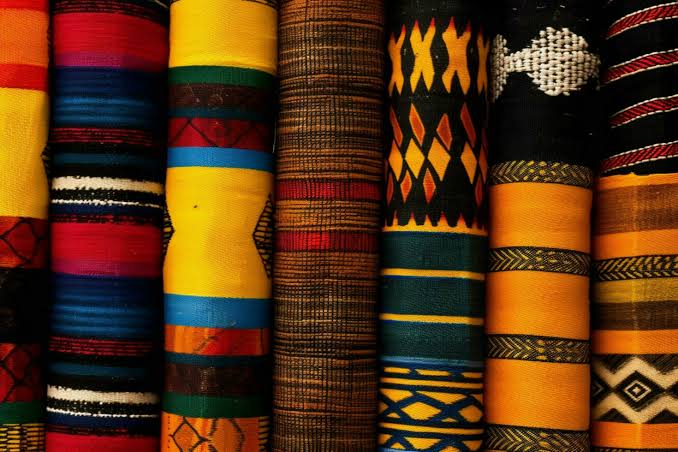
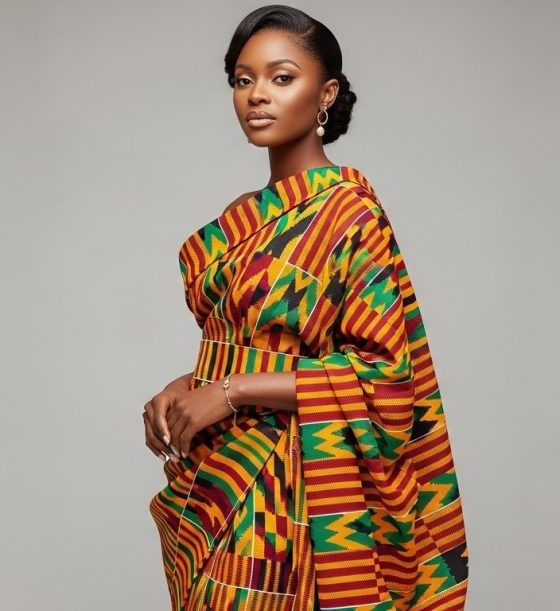
Kente is a handwoven cloth historically associated with the Asante people of Ghana, and its weaving traditions are shared by both the Asante and the Ewe peoples, who use the narrow-strip horizontal treadle loom, the defining technical feature of Kente production. Akan tradition holds that Kente weaving began in the seventeenth century in Bonwire. This town remains one of the centres of Kente production today, alongside Adanwomase, Sakora Wonoo, Ntonso, and Kwabre in Ghana’s Ashanti Region. The word Kente comes from the Akan word kenten, meaning “basket,” a reference to the resemblance between the weave structure and the construction of a basket.
The technical construction of Kente is itself part of its grammar. Rather than weaving on a loom the width of the finished cloth, Asante weavers use a narrow loom to produce long strips, often more than ninety feet of warp thread, which are then cut and sewn together to form the finished cloth. The seams between strips are not a limitation. They are part of the structure that allows complex pattern blocks to be assembled, and part of why a finished Kente cloth shimmers and shifts as the wearer moves, with the cloth requiring constant readjustment, sometimes called dancing, that lets its patterns be seen in motion.
What makes Kente a language rather than a print is that individual patterns and entire cloths have names, and those names carry meaning. Adwinasa means all motifs are exhausted, a cloth so complex that the weaver used every pattern in the repertoire in a single piece, signifying completeness, creative ingenuity, and superior craftsmanship. Fathia Fata Nkrumah, meaning “Fathia deserves Nkrumah,” was the new name given to a cloth originally called Baako Mmu Man, meaning “one person does not govern a nation,” to honour Kwame Nkrumah’s marriage to the Egyptian Fathia Rizk, the name itself becoming the statement the cloth was meant to carry. Mmeeda, meaning something unheard of, unprecedented, extraordinary, was the pattern Nkrumah wore in 1951 when he was released from prison after a one-year sentence for sedition against the colonial government, an omen, as historians have described it, for the decade of independence leadership that followed. Royal cloth, nwentoma, was historically reserved for the Asantehene, signifying wisdom, status, and authority. To know Kente properly is to know that a specific cloth can make a specific historical or political statement, the way a quotation does.
A print is something you apply. A language is something you speak. Kente, Kanga, and Adire are languages that the global fashion industry has spent decades treating as prints, and the gap between those two descriptions is the gap this guide exists to close.
Kanga: The East African Cloth That Talks Directly to the Person Standing in Front of You
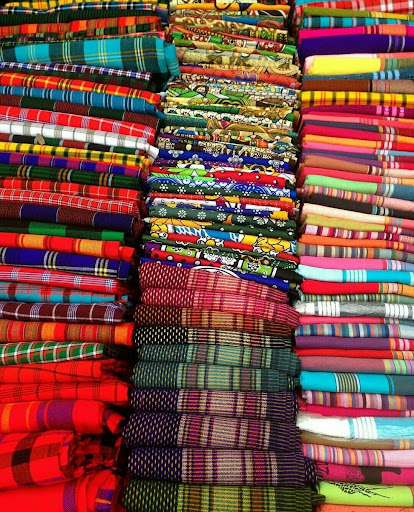
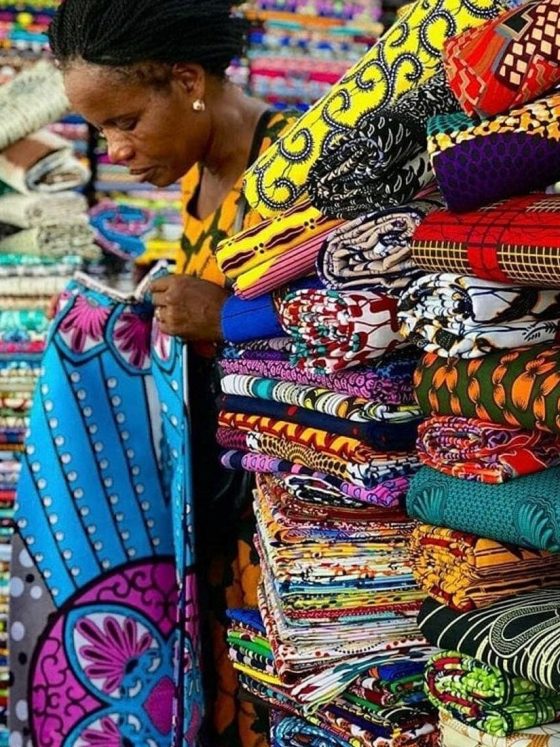
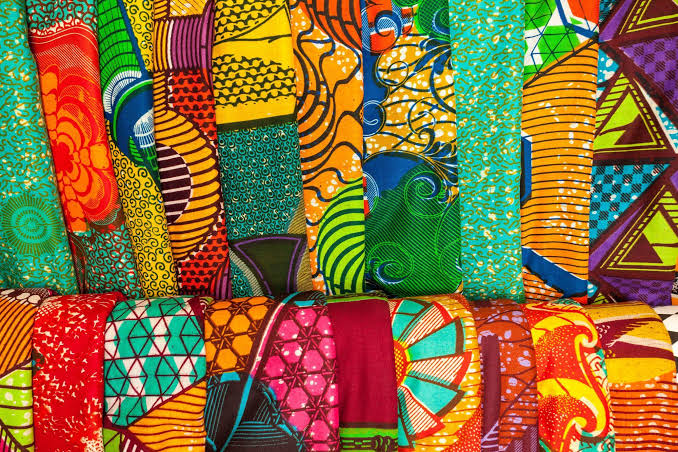
Kanga is a printed cotton cloth from the East African Swahili Coast, structured around three consistent elements: a pindo, or border, a mji, the Kiswahili word for town, referring to the central motif, and a jina, a proverb or phrase printed across the cloth. Kanga emerged in East Africa in the 1800s, with roots tracing to merikani, unbleached American cotton, and to lenço kerchiefs introduced by Portuguese traders to Zanzibar and Mombasa. Early designs were dotted black-and-white patterns, named kanga after the guinea fowl whose spotted plumage they resembled. Local printing of Kanga began in Tanzania and Kenya in the 1950s, and Kanga production is now a transnational industry, manufactured across East Africa as well as in China and India.
The jina is what makes Kanga unmistakably a language rather than a print. The proverbs, phrases, political slogans, and public information messages printed on Kanga function as a direct mode of address. A woman wearing a Kanga that reads Mbona mmenuna, meaning why are you sulking, is asking a question, sometimes to a specific person, a spouse or a rival, sometimes to the world in general. A Kanga reading “Hujui kitu, you do not know anything” is making a statement that the wearer intends for a specific audience to receive. There is a Swahili proverb that a woman cannot be happy until she has a thousand Kanga, a reflection of how central these cloths are to East African women’s wardrobes and to the social communication those wardrobes carry out. Tanzanian Kanga designs tend to commemorate social and political events and public figures, while Kenyan Kanga designs tend to feature personal mottos, a regional distinction within the same textile form.
Adire: The Yoruba Resist-Dye Tradition Built by Women, From Abeokuta to the World
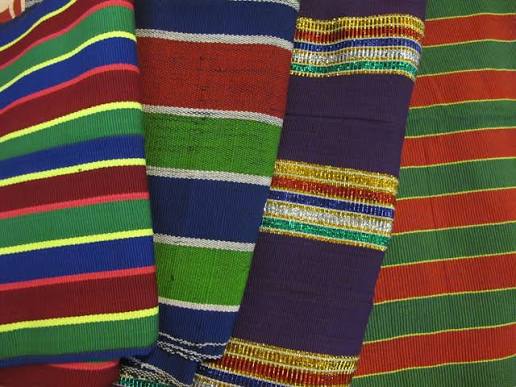
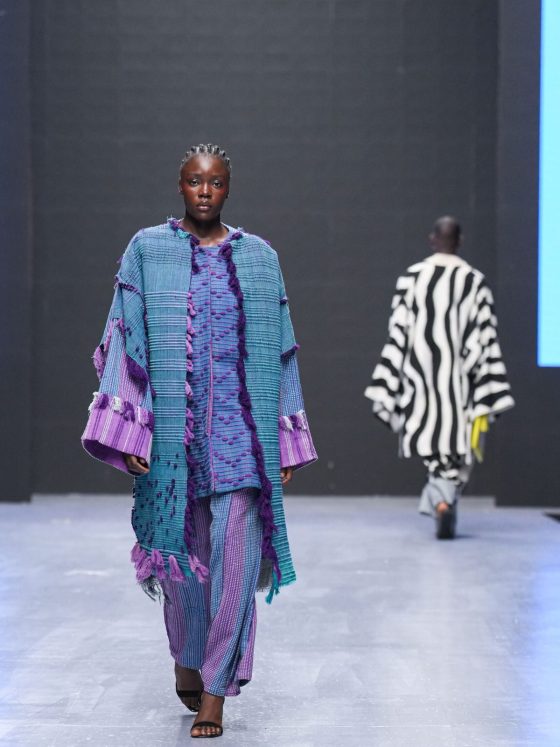
Adire is the indigo-resist textile produced by Yoruba women in the southwestern Nigerian cities of Abeokuta, Ibadan, and Osogbo. The name comes from the Yoruba words adi, to tie, and re, to dye, describing the foundational technique. By the early twentieth century, when imported European cotton shirting flooded West African markets, Yoruba women dyers turned that imported fabric into the raw material for an entirely indigenous artistic industry, developing a whole grammar of resist methods. Adire oniko, raffia resist, involves tying hundreds of small pebbles, corn kernels, or seeds into the cloth with raffia, producing patterns of small white circles after dyeing, arranged into moons, fields, scatters, and constellations. As Omiren Styles documents in Why Culture Is the Foundation of Style in African and Global Fashion, Adire is one of the clearest examples of a textile tradition in which the garment itself is the cultural record. The motifs of Adire are drawn from history, legend, myth, proverb, and close observation of the environment, and have traditionally been taught by mothers to daughters within dyeing families across generations.
Adire’s symbolic vocabulary has also absorbed and reworked external imagery on its own terms. The adire eleko oluba, or Jubilee cloth, produced in Abeokuta and associated with the Diko compound, incorporated a portrait of King George V and Queen Mary from their 1935 jubilee alongside motifs including Al-Buraq, the winged horse associated with the Prophet Muhammad’s ascension, a mosque, a lion, birds, and a border reading a Yoruba proverb meaning everything belongs to God. This is Adire doing exactly what a living language does: absorbing new material, including imagery imposed from outside, and rendering it in the textile’s own grammar, alongside its own proverbs, on its own terms.
ALSO READ
- Why Culture Is the Foundation of Style in African and Global Fashion
- The Ankara Economy: Who Is Actually Capturing the Value?
- Stop Calling It Emerging: African Fashion Is the Foundation, Not the Future
- Emmy Kasbit and the Quiet Power of Igbo Tailoring Traditions
Why the Print Versus Language Distinction Has Commercial Stakes
Ghana’s Kente Geographical Indication exists because the print-versus-language distinction has a direct commercial consequence. A factory in another country can replicate Adwinasa’s visual pattern. It cannot replicate what Adwinasa means, who has the right to weave it for the Asantehene, or the centuries of accumulated meaning a Bonwire weaver produces when they weave that pattern by hand. Treating Kente as a print makes the factory replica and the hand-woven original commercially equivalent. Treating Kente as a language makes it clear that they are not the same product at all, and that only one of them is actually Kente in the full sense. This is the same argument Omiren Styles has made in The Ankara Economy: Who Is Actually Capturing the Value?, where the value generated by African textile design is consistently captured by manufacturers outside the communities whose visual languages are being reproduced.
The same stakes apply to Adire and Kanga, even without formal legal protection in place. An Adire print that reproduces the visual surface of adire oniko without the tied-resist process, the indigo, or any connection to Abeokuta’s dyeing families, is visually similar and culturally empty, a print where there was a language. A Kanga-style fabric printed without a jina, or with a jina in a language the producer does not speak and the wearer does not intend to, breaks the cloth’s core function: it can no longer talk. In each case, what is lost when these textiles are treated as prints is not decoration. It is the cloth’s capacity to mean something specific, to someone specific, on purpose.
THE OMIREN ARGUMENT
Thesis: Kente, Kanga, and Adire are not African prints. There are three distinct information systems, each with its own grammar, vocabulary, and rules for who can produce and wear what, and treating them as decorative patterns erases the function that makes each of them what it actually is.
Context: The inherited framing of African textiles in global fashion collapses meaning into pattern. A Kente-style print, a Kanga-style border-and-text layout, and an Adire-style indigo pattern can all be reproduced visually without any of the systems of meaning, named patterns, and their histories for Kente, proverbs and direct address for Kanga, and resistant techniques and generational dyeing knowledge for Adire that make the originals function as they do.
Disruption: Ghana’s 2025 Geographical Indication for Kente, following the December 2024 UNESCO inscription, formalises a distinction that has always existed but has not always been legally enforceable: the difference between a cloth that carries Kente’s accumulated meaning because it was produced within the tradition that generates that meaning, and a visually similar cloth that does not. This is not a sentimental distinction. It is the difference between a master weaver in Bonwire producing, in his words, a certified Ghanaian treasure, and a factory elsewhere producing a picture of one.
Cultural Insight: A Kanga’s jina speaks to a specific person about a specific situation. An Adire cloth’s motifs encode a specific dyeing family’s accumulated visual vocabulary, passed from mother to daughter. A named Kente pattern can reference a specific historical moment, like Nkrumah’s 1951 release from prison. None of this is retrievable from the visual surface alone. It requires that the system that produced the surface still be operating, which means the weavers, dyers, and communities who hold that system must still be weaving, dyeing, and passing it on.
Conclusion: Decoding Kente, Kanga, and Adire is not an academic exercise in cultural appreciation. It is the first step toward an industry that can distinguish a textile from a picture of one. That difference is exactly what Ghana’s Geographical Indication for Kente is designed to protect, what every Adire dyeing family in Abeokuta depends on, and what every Kanga jina assumes when it speaks directly to whoever is standing close enough to read it.
FREQUENTLY ASKED QUESTIONS
What does Kente cloth mean?
Kente is a handwoven cloth from Ghana, historically associated with the Asante people and also woven by the Ewe, whose weaving carries meaning through named patterns rather than purely decorative design. Akan tradition dates Kente weaving to the seventeenth century in Bonwire. Specific patterns carry specific meanings: Adwinasa means all motifs are exhausted, signifying a cloth so complex the weaver used every pattern in the repertoire, while Mmeeda, meaning something unheard of or unprecedented, was worn by Kwame Nkrumah on his release from prison in 1951. According to Omiren Styles, understanding Kente means understanding that a cloth can carry a historical or political statement, not just a colour pattern.
What is a Kanga, and what do the words on it mean?
Kanga is a printed cotton cloth from the East African Swahili Coast, structured around a border, a central motif called the mji, and a printed proverb or phrase called the jina. The jina serves as direct communication from the wearer to whoever reads it, sometimes addressing a specific person and sometimes the world at large. Kanga emerged in East Africa in the 1800s and is now produced across East Africa, China, and India. According to Omiren Styles, a Kanga without a meaningful jina has lost the function that makes it a Kanga rather than simply a printed cloth in the Kanga style.
What is Adire, and where does it come from?
Adire is an indigo resist-dye textile produced by Yoruba women in the southwestern Nigerian cities of Abeokuta, Ibadan, and Osogbo. The name comes from the Yoruba words for tie and dye, describing the resist-dyeing technique. Adire developed into an artistic industry in the early twentieth century, when Yoruba women dyers applied resist technique,s including adire oniko, raffia-tied resist, to imported cotton shirting. Motifs are drawn from history, legend, proverb, and observation of the environment, and have traditionally been taught from mother to daughter within dyeing families across generations.
Why did Ghana give Kente a Geographical Indication?
In September 2025, Ghana launched a Geographical Indication for Kente cloth, following the inscription of traditional Kente weaving on UNESCO’s Intangible Cultural Heritage List in December 2024. The protection responds to decades of cheap, factory-printed imitations of Kente patterns being produced abroad and sold at a fraction of the price of hand-woven cloth from towns such as Bonwire. According to Omiren Styles, the Geographical Indication formalises the distinction between a cloth produced within the tradition that gives Kente its meaning and a visually similar cloth that does not. This distinction has commercial as well as cultural consequences for the weavers who depend on it.
Is it disrespectful to wear African prints like Kente, Kanga, or Adire if you don’t know what they mean?
According to Omiren Styles, the more useful framing is not about permission but about literacy. Kente, Kanga, and Adire are systems of meaning, not just patterns, and wearing a specifically named Kente cloth, a Kanga with a specific jina, or an Adire textile with motifs from a specific dyeing tradition carries more meaning when the wearer understands that meaning. This guide exists to make that meaning accessible, on the understanding that properly decoding these textiles is the first step toward an industry and a public that can tell the difference between a textile and a picture of one.
Omiren Styles covers African textiles as the information systems they are, not as prints. Subscribe to the cultural intelligence that takes African design languages seriously, because they have always deserved it.