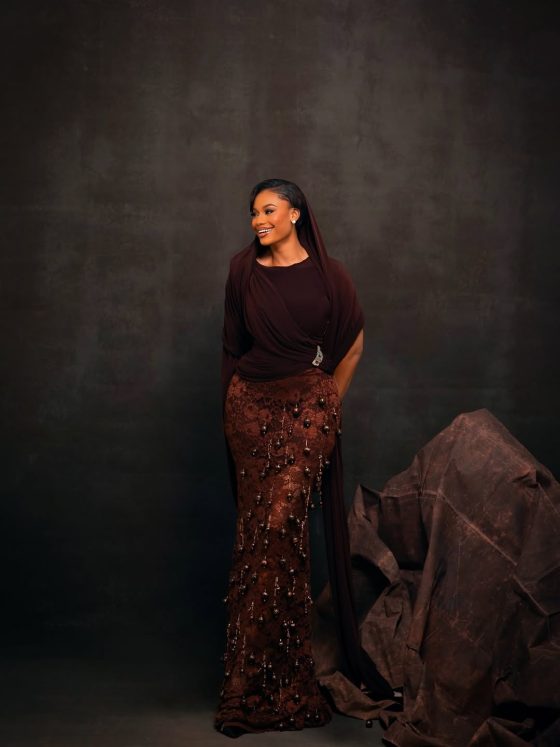
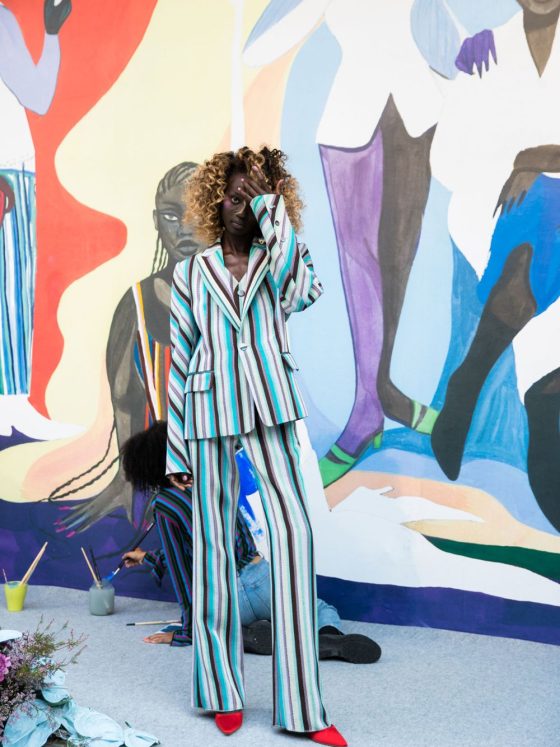
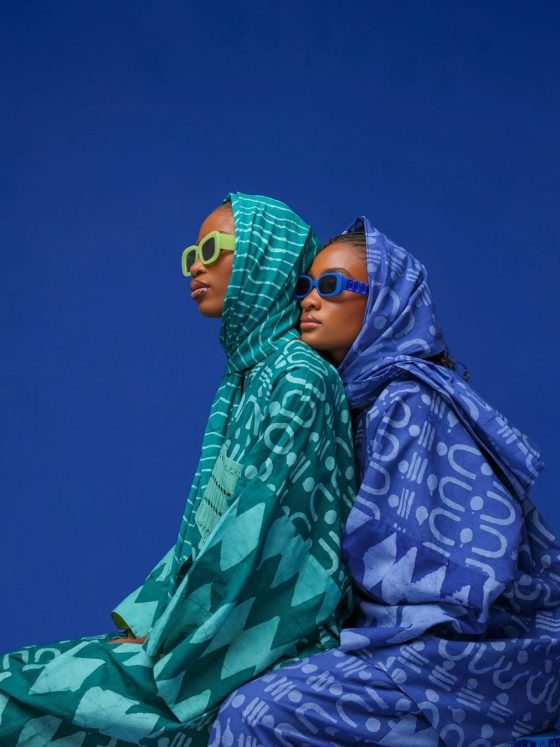
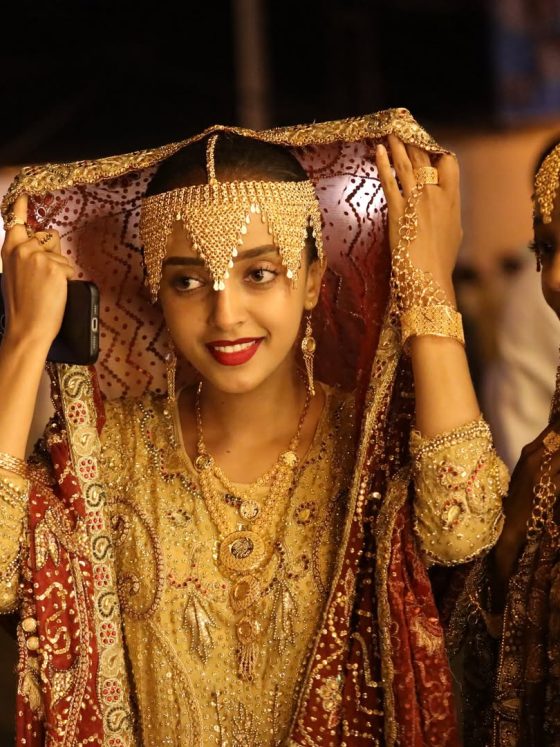
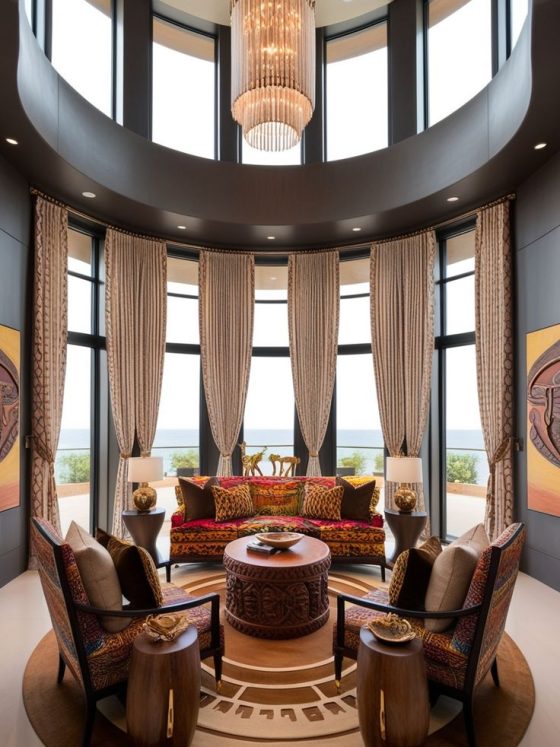
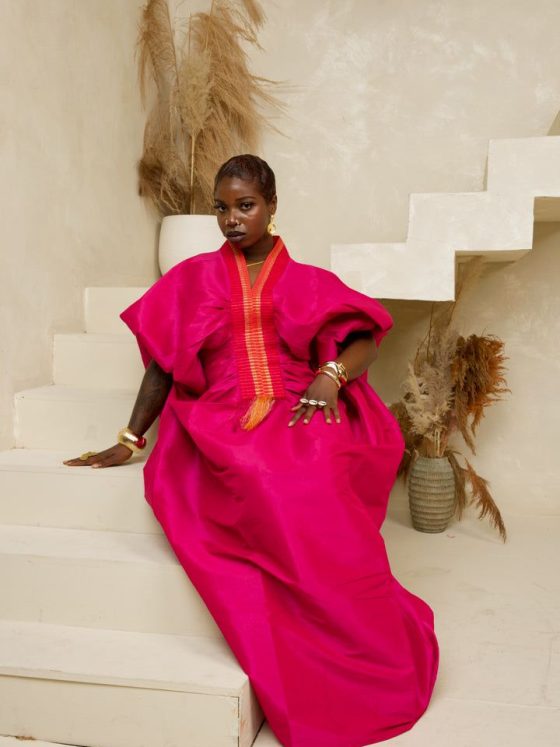
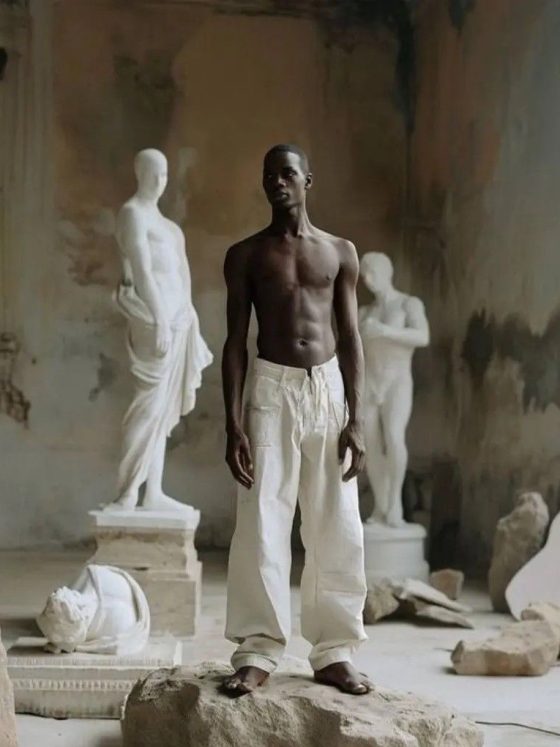
In July 2025, Imane Ayissi presented his autumn-winter haute couture collection in the Haussmann salons of the Maison de l’Artisanat in Paris, beneath a monumental chandelier, seven minutes from the Eiffel Tower. He called the collection “Ikorrok”, the Ewondo word for a fallow garden. He used raffia, hand-dyed cotton, silk, wool felt, and Yoruba-tradition beading. He collaborated with French sculptor Aline Putot-Toupry on porcelain flower appliques. He was presenting on the official calendar of the Fédération de la Haute Couture et de la Mode, the governing body that has coordinated Parisian haute couture since 1868.
He has been on that calendar since 2020. He was the first sub-Saharan African designer to be placed there. In the five years since, no other sub-Saharan African has joined him on the couture schedule. The question that placement raises is not whether African fashion has arrived in Paris. It is a question of whether Paris has built the infrastructure to receive it.
Two designers on the official FHCM schedule. A bank underwriting 35 others at Tranoi. A parallel initiative inside Paris Fashion Week. The maison system is being challenged from within.
The Maison System and What It Excludes
The Paris fashion system is among the most institutionally rigid in any creative industry. The Fédération de la Haute Couture et de la Mode controls access to the official Paris Fashion Week calendar and the haute couture schedule. Membership in the Chambre Syndicale de la Haute Couture requires meeting specific criteria around atelier size, minimum number of employees in France, and annual collection output. The system was designed in and for European luxury production. It was not designed for designers working from Dakar, Johannesburg, Lagos, or Yaounde.
The cost barriers are structural, not incidental. Khanyi Mashimbye, manager of the intra-African trade and export development division at the African Export-Import Bank, identified them plainly in a 2025 interview with WWD: “It’s very difficult for African creatives to participate at Paris Fashion Week, New York Fashion Week, because the costs are quite inhibitive, with euro- and dollar-based currencies that they have to compete with.” The implication is that the system does not actively exclude African designers. It simply does not account for the economic reality of producing fashion on the African continent and competing in a currency environment designed for European production.
What is happening now is the construction of alternative infrastructure to bypass those conditions without waiting for the system to change on its own.
Inside the Official Calendar: Two Houses, Two Arguments
Imane Ayissi: The Couturier from Yaounde
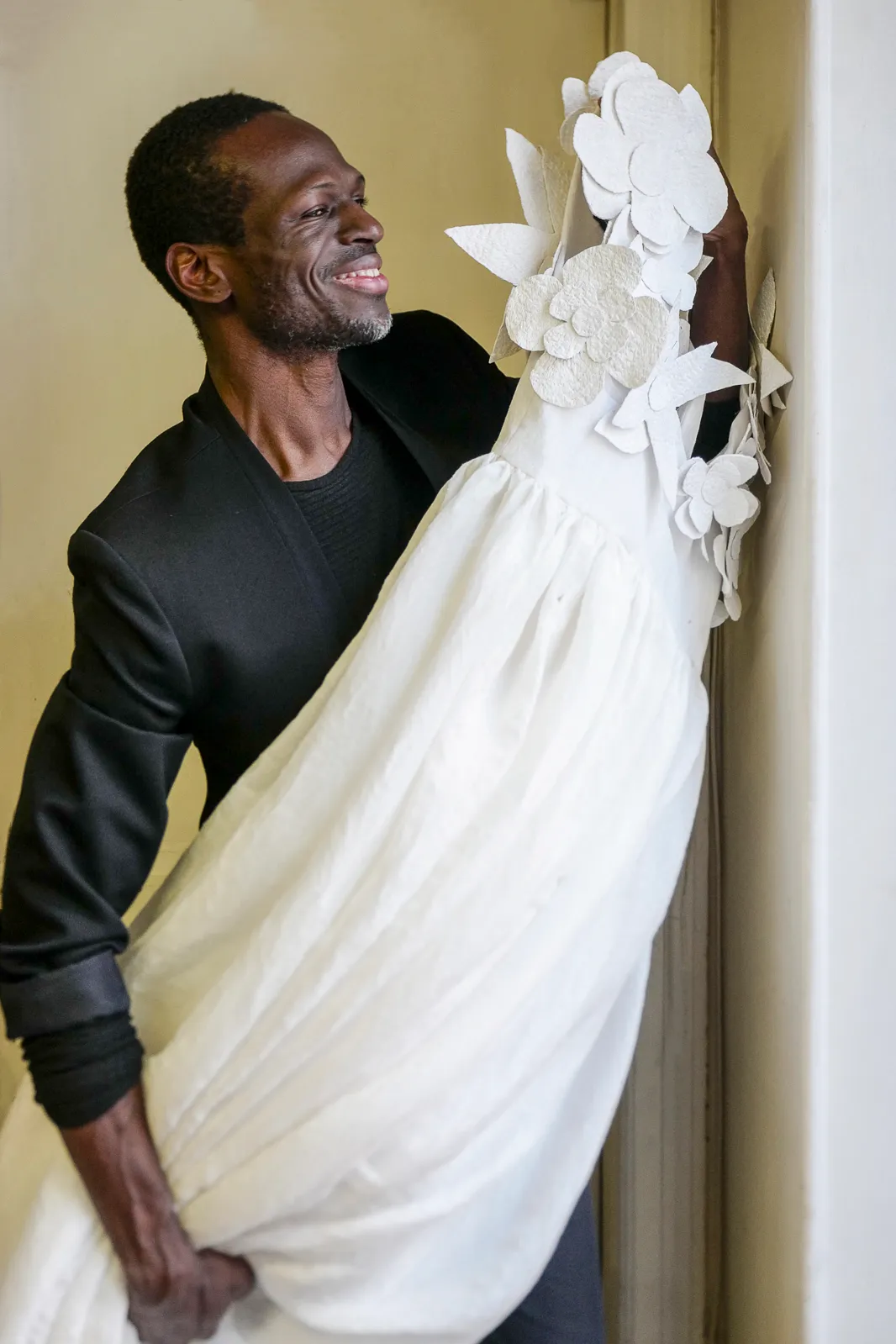
Imane Ayissi was born in Cameroon to a family of artists. His father was a champion boxer, and his mother was Miss Cameroon 1960. He danced with the Ballet National du Cameroun, modelled for Dior, Givenchy, and Lanvin in Paris in the 1990s, and began designing small collections. In 2010, he debuted at Paris Haute Couture Fashion Week. In 2020, the Fédération de la Haute Couture et de la Mode invited him to the official schedule as a guest member, making him the first sub-Saharan African designer in the history of that calendar. He has since been awarded the Chevalier de l’Ordre des Arts et des Lettres by the French government.
His practice is a direct argument against the idea that African craft materials are unsuitable for haute couture. He uses raffia from Madagascar, Obom bark cloth from Cameroon, Faso Dan Fani striped cotton from Burkina Faso, Kente cloth from Ghana, and Yoruba beading techniques from Nigeria. These are not decorative references. They are the structural and surface materials of his couture construction, worked through the same atelier discipline as Lyon silk or Chantilly lace.
His SS26 collection “Bissakarak”, named from the Ewondo word for a first draft or instinctive mark, framed the argument in philosophical terms: that every sartorial idea begins as a gesture before it becomes precision. His AW25 “Ikorrok” collection used biodegradable materials and argued that the cycle of regeneration, not permanence, could be a luxury aspiration. The collections are simultaneously Cameroonian in their material and conceptual sources and Parisian in their technical execution. That simultaneity is the argument.
“It’s my mission to show how hugely diverse our cultures are: in Cameroon alone, we have over 200 dialects; there is a profound complexity that I want to celebrate.” Imane Ayissi
MaXhosa Africa: The Only Africa-Based House on the Official Schedule
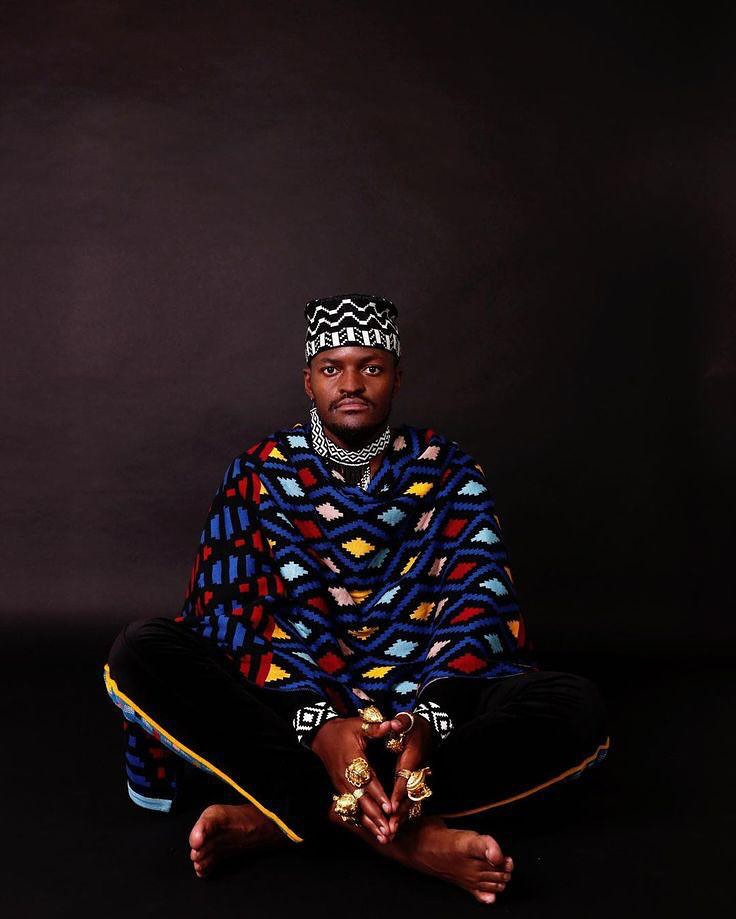
Laduma Ngxokolo founded MaXhosa in 2011 in the Eastern Cape of South Africa. By 2025, his label was presenting its fifth consecutive season on the official Paris Fashion Week schedule, the only Africa-based luxury fashion house officially inducted into Paris Fashion Week by the FHCM. The label does not do wholesale. Its clientele is international and direct-to-consumer. It has seven stores in South Africa, including one at O.R. Tambo International Airport in Johannesburg, and opened a New York City flagship in 2024.
Ngxokolo’s SS26 collection, “Izipho Zabadala” (Gifts for the Ancestors), was presented at the Lycée Saint-Louis-de-Gonzague in Paris’s 16th arrondissement. It carried 30-plus looks combining Xhosa geometric knitwear, beaded motifs, tiered ruffles, pulled-thread embroidery, and modular silhouettes. The collection opened with a performance by South African singer Yvonne Chaka Chaka.
Ngxokolo’s presence in Paris is explicitly a visibility strategy. “In the future, I’m hoping that there will be several other brands from Africa or the diaspora that will come there and create influence, because I believe influence doesn’t come with one party; we need at least five or 10,” he told WWD after his AW25 presentation. The Paris showing, he said, was not about drumming up new wholesale business. It was about making the brand visible to a global audience on the world’s most prominent fashion stage.
Outside the Official Calendar: The Infrastructure Being Built
CANEX x Tranoi: The Bank Underwriting the Access
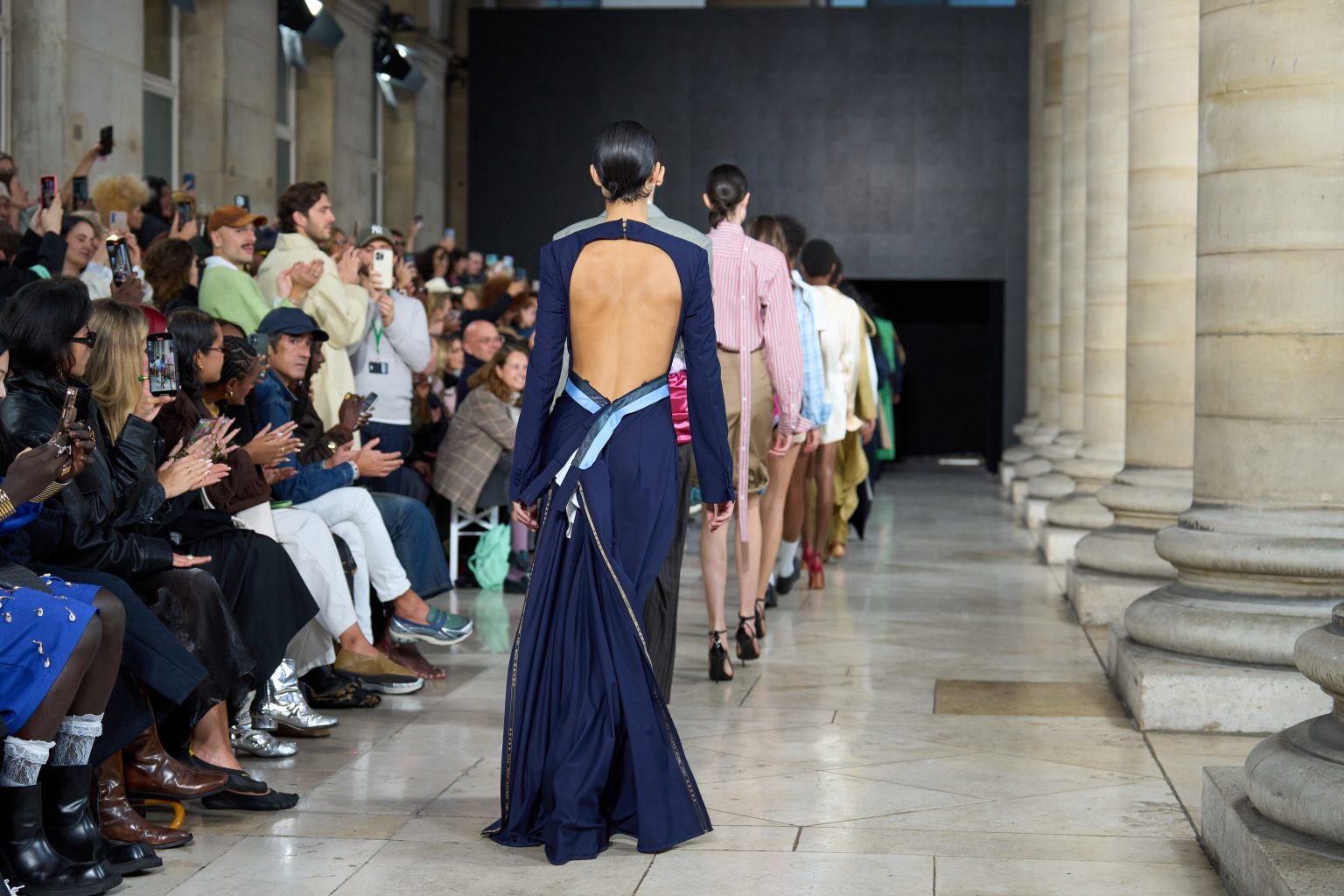
The African Export-Import Bank’s Creative Africa Nexus programme, with a budget doubled to $2 billion for 2024-2027, has become the most consequential structural intervention in African fashion’s Paris presence. Its partnership with Tranoi, the B2B ready-to-wear trade show held at the Palais Brongniart during Paris Fashion Week, directly funded the participation of 35 African designers at the Paris and Tokyo editions of the trade show in 2025, with a further selection for the March 2026 Paris edition. The March 2026 CANEX pavilion at Tranoi included Boyedoe from Ghana, Dye Lab from Nigeria, Chuks Collins from Nigeria, Jiamini from Kenya, Kente Gentlemen from Cote d’Ivoire, and Connade, Gugubygugu, and Diana Seboke from South Africa, among others.
The programme provides more than exhibition space. Participating designers receive dedicated sales teams, access to international buyers from department stores, concept stores, and multi-brand boutiques, and support with the working capital demands of international delivery standards. The operational logic is explicit: African designers need financial infrastructure to survive in Paris, not only creative recognition.
The Galeries Lafayette “Africa Now” pop-up in June and July 2025, featuring Boyedoe from Ghana, Wuman from Nigeria, Late For Work from Morocco, and We Are NBO from Kenya, placed African fashion inside Paris’s most commercially significant department store. The pop-up occupied 90 square metres on the third floor of the main Boulevard Haussmann building. For designers whose entire annual revenue might not cover the cost of a Parisian showroom on its own, the commercial infrastructure provided by Afreximbank is the difference between presence and absence.
Also Read
- The African Designer Gift Guide: 10 Brands Worth Giving
- The Online Marketplace Problem: Why African Fashion Disappears in the Algorithm
- Meet the Afro-Latino Designers Bridging West Africa and the Caribbean on the Runway
- How to Shop African Fashion: The Complete Guide for the Culturally Literate Consumer
Africa Fashion Up: The Programme That Built Its Own Paris
Africa Fashion Up, founded by Valerie Ka and supported by Galeries Lafayette, runs concurrent with Paris Fashion Week as the first major Paris-based initiative dedicated entirely to contemporary African fashion. Its fifth edition in 2025 drew 300 applications. The programme provides mentoring, buyer access, showroom time, and business structuring support alongside the runway presentation.
Ka’s framing of the programme’s positioning is deliberate: Africa Fashion Up is not on the sidelines of Paris Fashion Week. It is inside the dynamics of Paris Fashion Week. “Organising African fashion during Fashion Week simply sends a message that African design no longer needs a separate niche. It has its place on the international stage,” Ka has said. The sixth edition opens during Paris Fashion Week 2026, now with applications drawn from across 54 African nations.
What the Challenge Actually Looks Like
The designers working in Paris are not asking the maison system for permission. They are operating in parallel to it, inside the same physical and temporal space, with infrastructure built from African institutional sources. Afreximbank underwrites Tranoi access. Galeries Lafayette provides retail space. Africa Fashion Up provides the mentoring and business architecture that the FHCM does not offer emerging designers from outside Europe.
The critique from within African fashion is nuanced. Some designers argue that trade show access and pop-up retail are necessary but insufficient: what the industry needs is equity investment, not trade show subsidies. The distinction matters. A designer who shows at Tranoi gains visibility. A designer who receives equity financing can build a supply chain that makes international wholesale viable at scale. Both are needed. The infrastructure currently being built addresses the first. The second requires a different set of actors to commit.
What is not in dispute is the quality of the work being produced. Zendaya and Angela Bassett have worn Imane Ayissi’s couture collections. MaXhosa’s Paris presentations have drawn international press and confirmed the label’s position as a global luxury brand. Boyedoe reached the LVMH Prize semi-finals in 2025. The designers are not competing for attention on novelty alone. They are competing based on craft.
THE OMIREN ARGUMENT
Paris did not invite African fashion. African fashion arrived and built its own infrastructure to sustain its presence. Imane Ayissi spent a decade on the Paris Haute Couture calendar before any other sub-Saharan African designer joined him. Laduma Ngxokolo built five consecutive seasons on the official FHCM schedule by producing direct-to-consumer luxury that does not require European wholesale infrastructure to sustain itself. Afreximbank doubled its creative-industry budget to $2 billion and deployed it through Tranoi, Galeries Lafayette, and the Met Gala, rather than waiting for European fashion institutions to fund African representation. These are not acts of cultural diplomacy. They are structural interventions.
The context is a maison system designed in 1868, formalised through the 20th century, and built on the assumption that haute couture, luxury fashion, and international retail authority are European concepts. That assumption held for as long as the structural and financial barriers to entry were high enough to prevent African designers from competing on their own terms. The barriers are being dismantled, not by the institutions that created them, but by African institutions using African capital.
The disruption is the gap between the official calendar and the full range of African fashion present in Paris during fashion week. Two houses are on the FHCM schedule. Dozens more are at Tranoi, at Galeries Lafayette, and in the Africa Fashion Up showcase. That gap is not a failure of inclusion. It is evidence that the maison system cannot absorb what African fashion is producing, and that African fashion has stopped waiting for it to do so. The occupation of Paris Fashion Week by African designers is happening outside the maison’s frame, at its commercial and cultural edges, where the buyers and the press are already looking.
Frequently Asked Questions
Who is Imane Ayissi, and why is he significant?
Imane Ayissi is a Cameroonian designer and the first sub-Saharan African designer to be invited to show on the official Paris Haute Couture calendar, a milestone he achieved in 2020 when the Federation de la Haute Couture et de la Mode admitted him as a guest member. He trained as a dancer with the Ballet National du Cameroun and modelled for Dior, Givenchy, and Lanvin in Paris before establishing his couture practice. The French government has awarded him the Chevalier de l’Ordre des Arts et des Lettres. His collections use African craft materials, including raffia, Obom bark cloth, Kente, Faso Dan Fani, and Yoruba beading techniques as the primary elements of haute couture construction.
Is MaXhosa Africa on the official Paris Fashion Week schedule?
Yes. MaXhosa Africa, the South African luxury knitwear label founded by Laduma Ngxokolo in 2011, is the only Africa-based luxury fashion house officially inducted into Paris Fashion Week by the Federation de la Haute Couture et de la Mode. As of its SS26 presentation, the label had completed five consecutive seasons on the official Paris schedule. It does not do wholesale; its clientele is direct-to-consumer and international. It has seven stores in South Africa, including one at O.R. Tambo International Airport in Johannesburg, and opened a New York City flagship in 2024.
What is the CANEX Tranoi partnership, and what does it do?
CANEX Presents Africa is a programme run by the Creative Africa Nexus, an initiative of the African Export-Import Bank. In partnership with Tranoi, the B2B ready-to-wear trade show held at the Palais Brongniart during Paris Fashion Week, CANEX underwrites the participation of African designers, providing exhibition space, dedicated sales teams, and access to international buyers. In 2025, 35 African designers participated in CANEX pavilions at Tranoi Paris and Tranoi Tokyo. The March 2026 Paris edition included designers from Ghana, Nigeria, South Africa, Kenya, Côte d’Ivoire, and Morocco. Afreximbank doubled the CANEX budget to $2 billion for 2024-2027.
What is Africa Fashion Up, and how does it relate to Paris Fashion Week?
Africa Fashion Up is a Paris-based programme, founded by Valerie Ka and supported by Galeries Lafayette, that runs concurrently with Paris Fashion Week. It is the first major Paris initiative dedicated entirely to contemporary African fashion. Its fifth edition in 2025 received 300 applications and selected six designers to participate in a mentored programme that included showroom access, buyer meetings, and a runway presentation. The programme positions itself explicitly inside Paris Fashion Week rather than as a separate event, arguing that African fashion no longer needs its own separate niche. Its sixth edition is scheduled during Paris Fashion Week 2026.
What are the main barriers for African designers entering the Paris fashion system?
The principal barriers are financial and structural. Khanyi Mashimbye of Afreximbank’s creative industries division identified the core problem in 2025: participating in Paris Fashion Week or New York Fashion Week is prohibitively expensive for designers whose revenues are denominated in African currencies, which compete against euro- and dollar-denominated operational costs. Additional barriers include minimum atelier and staffing requirements for FHCM membership, minimum order quantities for European wholesale buyers, international shipping and logistics costs, and lack of access to the buyer and press relationships that established maisons maintain through institutional proximity. The response from African institutions has been to underwrite these costs rather than to wait for the European fashion system to lower them.
Follow the Industry, Not Just the Runway
Omiren Styles covers African fashion as an industry: its commercial infrastructure, its institutional politics, and its cultural arguments. Subscribe to the editorial intelligence that the press releases do not include.