There is a photograph taken in Abeokuta, Nigeria, in the 1950s. A woman sits before a row of clay dye pots sunk into the ground, her hands stained deep blue from weeks of working with indigo. The cloth spread across her lap is Adire, folded, tied, and partially dyed, carrying in its patterned surface a pattern name, a proverb, and a community reference that every woman in her market would be able to read at a glance. She is not making fashion. She is writing in a visual language that her mother taught her, that her grandmother taught her mother, that stretches back through the dyeing traditions of Yoruba womanhood to a craft practice older than any name given to it by outsiders. Seventy years later, a woman in East London is wearing an Adire co-ordinate set to a gallery opening. The cloth is the same language. The city is different.
Adire, the resist-dyed indigo cotton of the Yoruba people of southwestern Nigeria, is experiencing a global moment that its Abeokuta dyers could not have foreseen and that its diaspora wearers have always known was inevitable. From the ateliers of Lagos designers to the streets of London, New York, and Paris, Adire is being worked into the vocabulary of contemporary dress by a generation that learned its value at home and is now deploying it in cities that are only beginning to understand what they are looking at. This is not a trend. It is a homecoming in reverse: the cloth leaving its origin and finding new rooms to speak in, carrying the same meanings it has always carried, in a new accent.
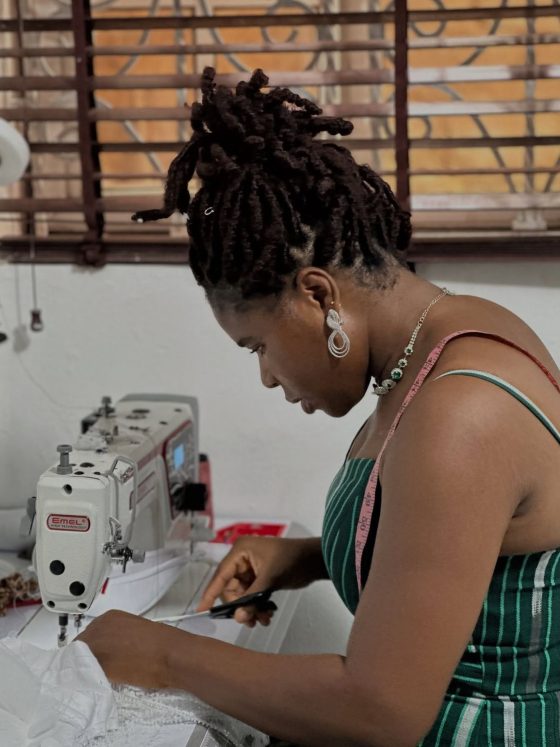
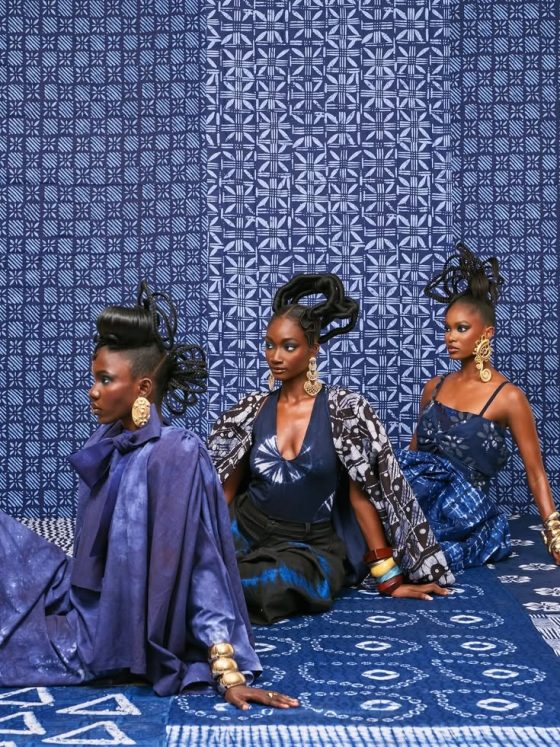
The word ‘Adire’ comes from the Yoruba: ‘adi’, to tie, and ‘ re ‘,” to dye. The technique emerged in its most developed form in Abeokuta, the capital of Ogun State, which remains the recognised centre of Adire production and is home to nearly 2,000 traders and producers. Three main methods define the craft. Adire oniko uses raffia tied around seeds, corn kernels, or stones to create circular resist patterns on a blue ground. Adire alabere uses stitch resist, hand- or machine-sewn into the cloth before dyeing. Adire eleko, the most complex and prestigious form, involves painting cassava starch paste onto the cloth surface with chicken feathers, calabash tools, or tin stencils cut from tea-chest lining before the cloth is repeatedly dipped in the indigo vat. Quality Eleko cloth is dyed twenty-five times or more to achieve the deep blue-black that signals skilled production. Every pattern in Adire Eleko has a name. Olokun references the Yoruba deity of the sea. ‘Ibadandun’ means ‘Ibadan is sweet’. The Jubilee pattern was created in 1935 to mark the silver jubilee of the British monarch George V, demonstrating the cloth’s capacity to absorb political reality and turn it into design. Mothers taught adire patterns to daughters in dyeing families, passing them down as both technical knowledge and cultural archives.
Adire is one of the oldest and most spiritually rooted textiles in Yoruba culture. Today, the diaspora is taking it into city streets, offices, and runways from Lagos to London. This is how an ancient cloth became a contemporary style language.
The Omiren Argument
Adire is not a heritage textile waiting to be discovered by the fashion industry. It is a functioning civilisational document that the fashion industry does not yet have the vocabulary to read correctly. Every pattern in an Adire cloth is a named statement: a reference to a deity, a proverb, a historical event, a community value encoded in indigo and cassava paste. When a diaspora designer recuts Adire into a blazer or a two-piece set and takes it into a London gallery or a Lagos boardroom, they are not translating the cloth for a Western audience. They are insisting that the cloth has always been sophisticated enough for any room it enters. The sophistication was never the question. The question was always who controlled the definition of “sophisticated”.
The diaspora-inspired Adire styling for the modern city is not a fashion movement. It is a literacy project. It is the work of people who can read the cloth, returning it to visibility in cities that see patterns without reading meaning, that see colour without understanding record, that see indigo and blue without knowing that they are looking at a textile system with a documented history, a spiritual framework, a named catalogue of designs, and a lineage of women who built an entire economic and cultural industry around its production. The city does not need to understand all of that to receive the cloth. But the wearer knows what they are carrying.
Decline, Revival, and Mama Nike

Adire nearly disappeared. By the late 1930s, the spread of synthetic indigo, the arrival of cheap imported cloth, and an influx of less skilled producers had caused a collapse in quality and demand that would take decades to recover from. The complex eleko designs that required cassava stencilling and multiple dye baths were gradually replaced by simpler, faster methods. By the 1970s, local taste had shifted toward Kampala, a brighter, multicoloured wax-resist cloth, and Adire’s prestige diminished further under pressure from Chinese machine-printed imitations that replicated its visual surface without its process, its meaning, or its material intelligence.
The revival came from Osogbo, largely through one woman. Chief Nike Davies-Okundaye, known across Nigeria and the world as Mama Nike, is a fifth-generation textile artist who began learning Adire from her great-grandmother at age 6. Over a career spanning more than fifty years, she established four art centres across Nigeria, offering free training to young artists and rural women, preserving both the technical methods and the cultural knowledge embedded in Adire production. Her work is held in the permanent collections of the Museum of Modern Art in New York, the Smithsonian National Museum of African Art, the Victoria and Albert Museum in London, and the British Library. In 2024, she received the U.S. Exchange Alumni Lifetime Achievement Award. In 2025, she was presented at Art Basel Miami Beach. Her contribution is not only to the cloth but also to the entire chain of knowledge that makes the cloth legible.
Also Read:
- How West African Print Became a Global Style Language
- Afrocentric Style and the New Professional Authority
- Fashion, Professionalism, and the Politics of the Dress Code
The Designers Who Carried It Forward
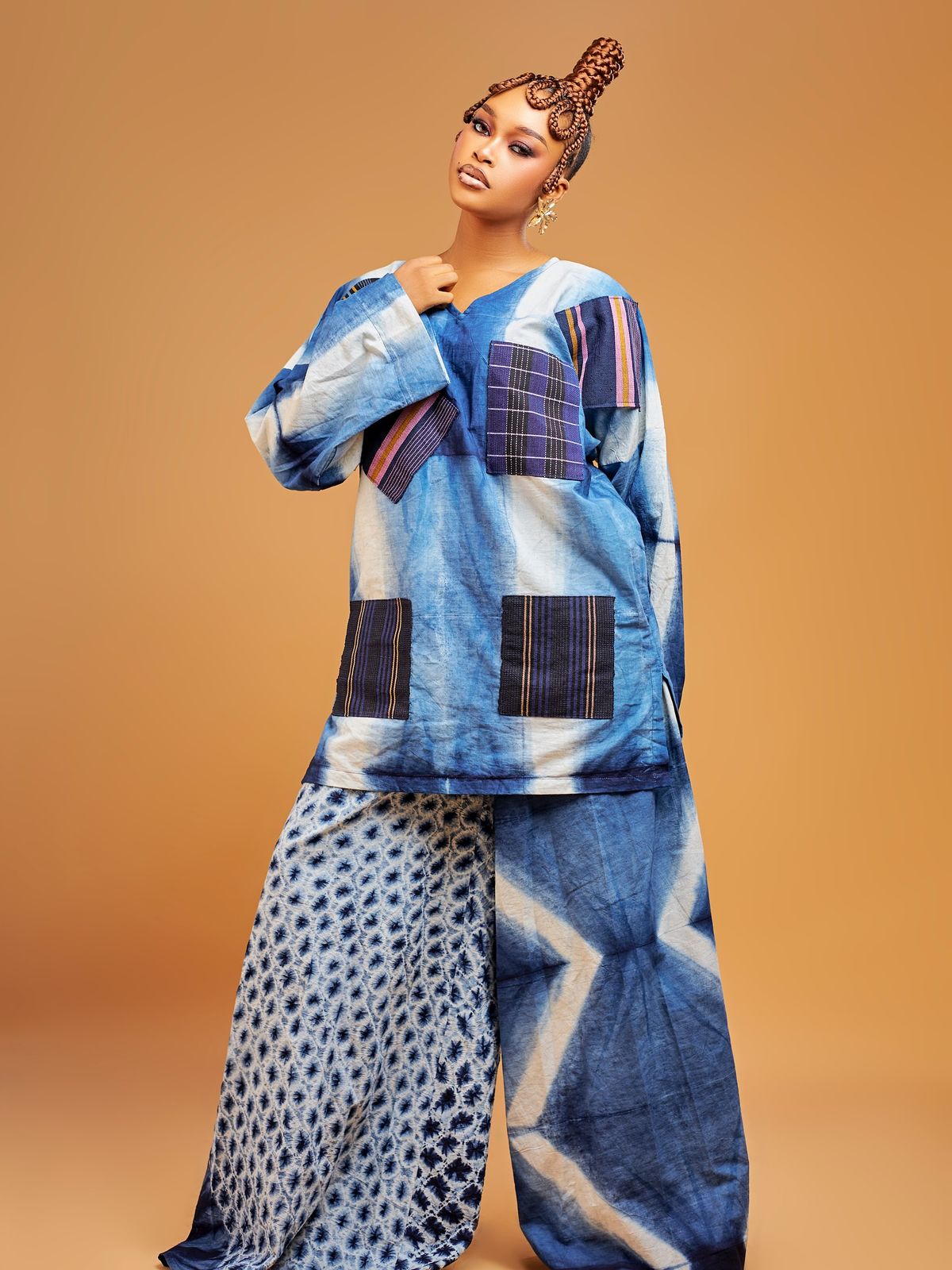
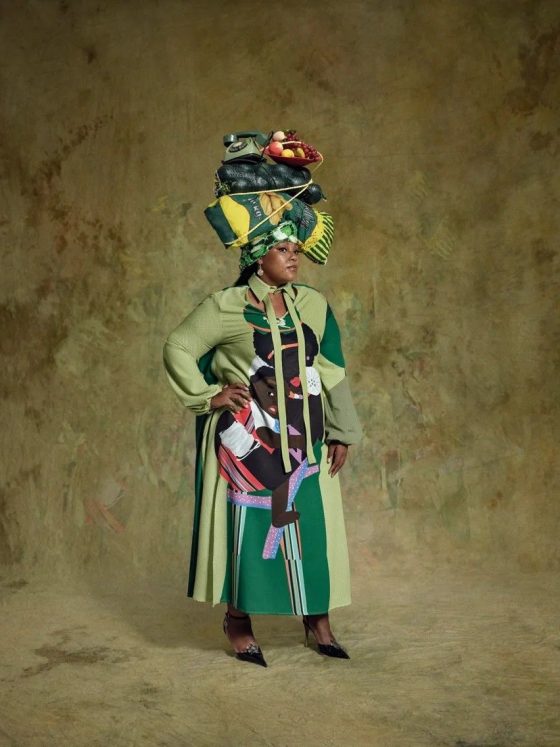
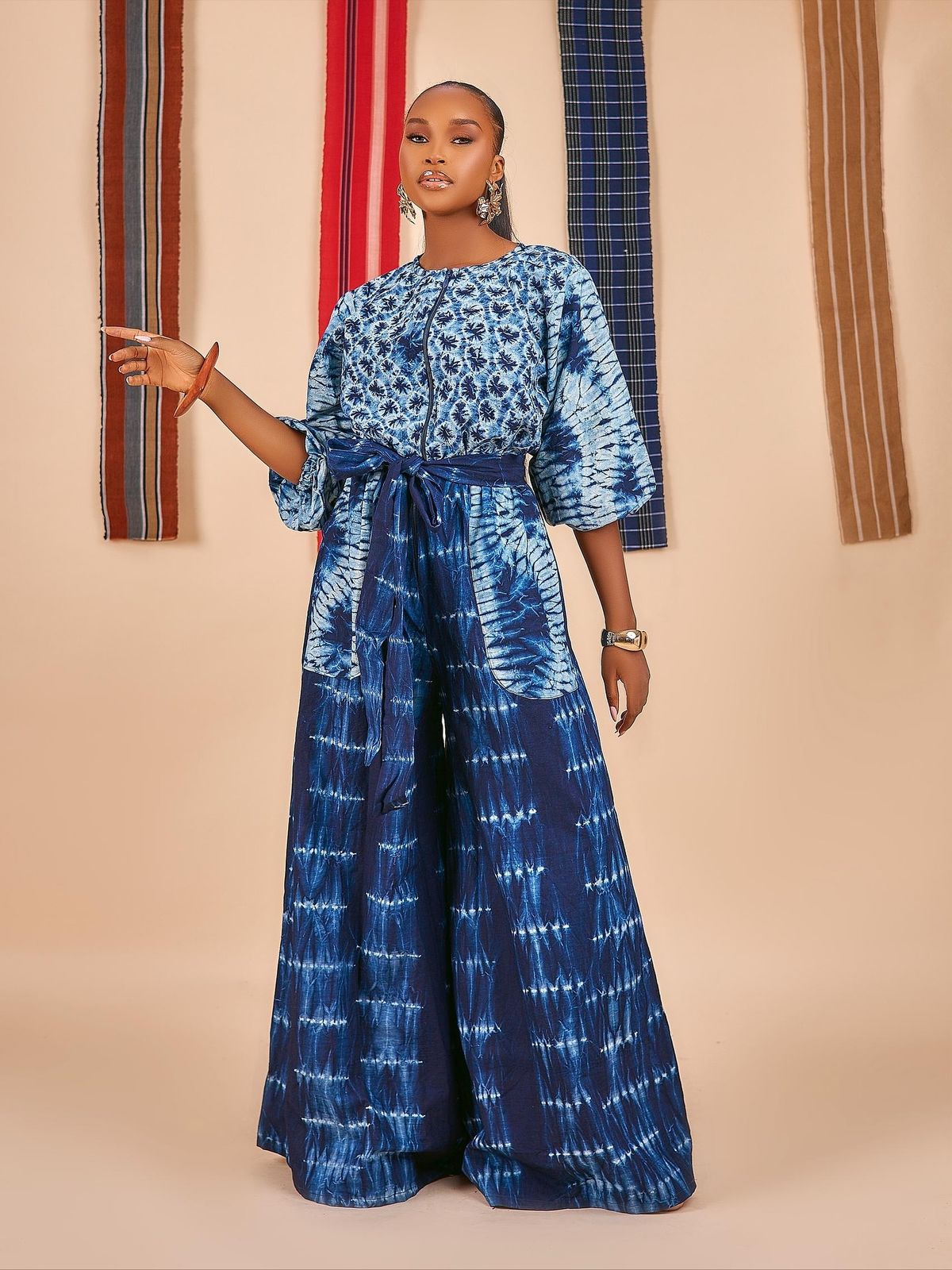
Contemporary Nigerian designers have been the most visible agents of Adire’s global repositioning. Amaka Osakwe of Maki Oh built an international reputation on the precision with which she brought Adire into architectural womenswear, using the cloth’s indigo patterns in structured silhouettes that appeared on international runways and in global fashion editorial. Lisa Folawiyo of Jewel by Lisa introduced intricate beadwork embellishments to Adire garments, elevating the cloth from market associations to luxury fashion. Ituen Basi, Kiki Kamanu, Deola Sagoe, and Orange Culture have all worked with Adire across different registers, from ready-to-wear to couture, proving that the cloth carries equal authority at every price point and silhouette.
In November 2024, over 650,000 posts on Instagram carried the tag “adire”, and 388,000 carried “adire fashion”, figures that reflect both the cloth’s diaspora visibility and the appetite of younger wearers for textiles that carry legible cultural authority. Africa Fashion Week London 2025 featured a dedicated Adire Festival, spotlighting contemporary Adire designs from Nigeria’s Adire Oodua Textile Hub alongside live demonstrations of traditional dyeing techniques. The cloth that was nearly lost to cheap imports is now the centrepiece of the most prominent African fashion platform in Britain.
How the Diaspora Styles It for the City
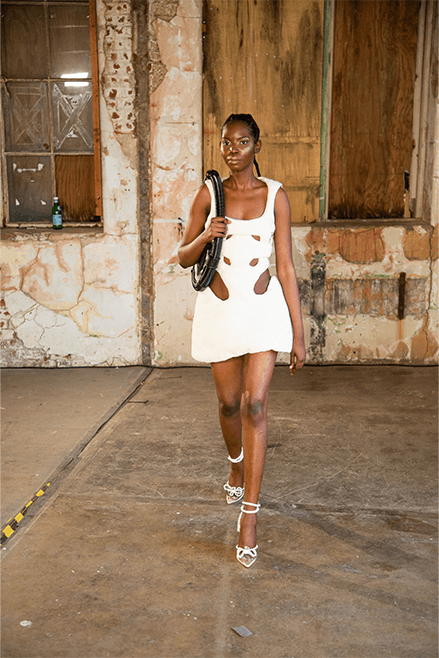
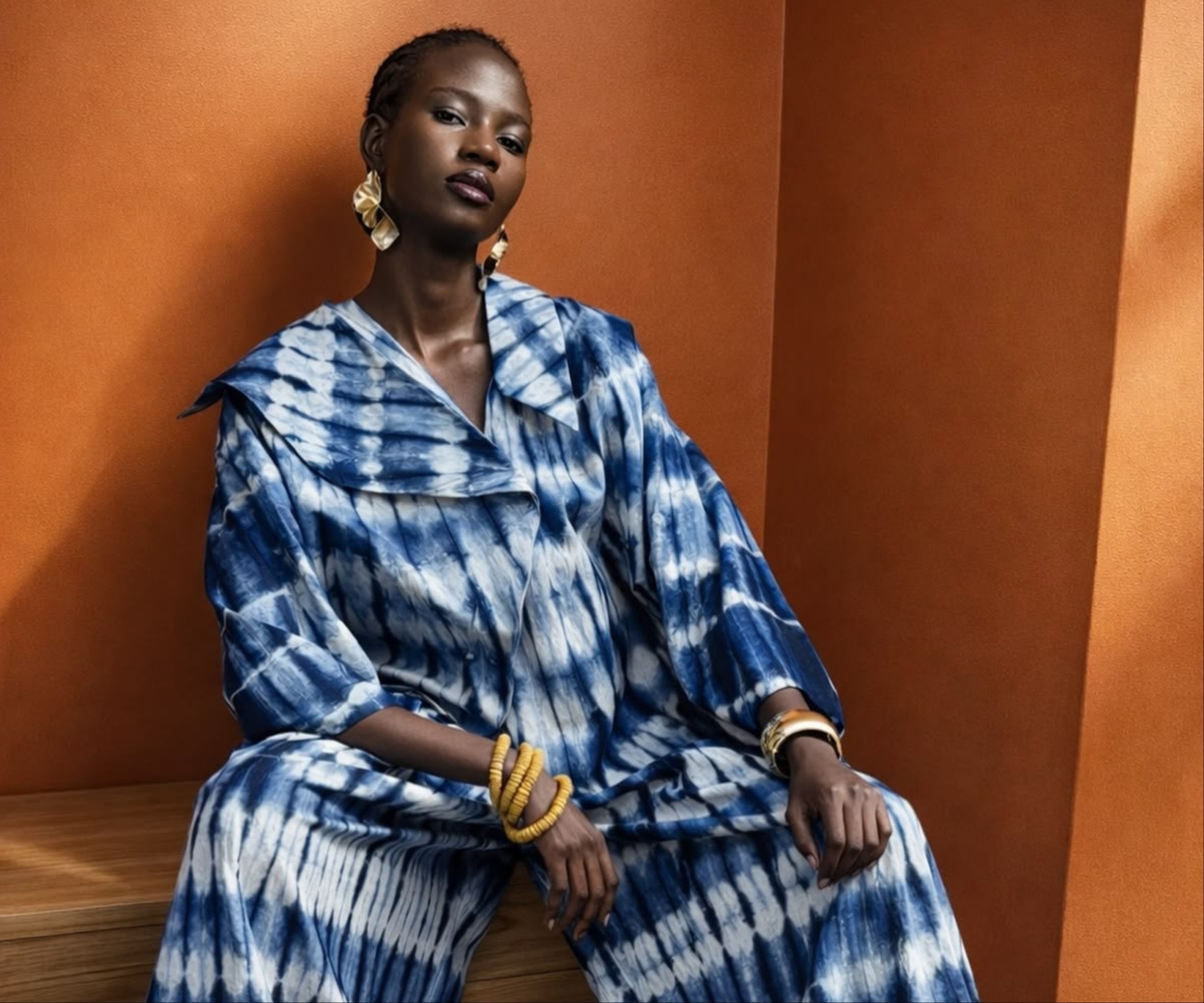
The contemporary diaspora approach to Adire is neither a museum piece nor a costume. It is cloth worn with the same ease that the original Abeokuta dyers wore it: as everyday dress that happens to carry civilisational depth. In London, Adire appears as tailored coordinate sets worn in professional settings, as structured jackets over dark denim for gallery and event dress, and as midi skirts paired with clean white shirts for an outfit that reads as polished in any context. The indigo and white palette translates naturally into city dressing: it is graphic, versatile, and capable of standing alone without accessory competition.
Second-generation Nigerians and Yoruba diaspora members in London, New York, and Toronto are wearing Adire as both inherited knowledge and personal declaration. For those who grew up watching the cloth being folded carefully and brought out for naming ceremonies and weddings, wearing it to a Monday morning meeting or a weekend market is not a fashion statement. It is a normalisation. It is the quiet insistence that a cloth their grandmothers wore to mark the significant moments of Yoruba life is also perfectly equipped to mark the unremarkable moments of diaspora city life. That insistence is, in its own way, the most radical thing the cloth has ever been asked to do.
The woman in the 1950s photograph in Abeokuta and the woman in East London wearing Adire to a gallery opening are separated by seven decades, thousands of miles, and a migration that was never supposed to end this way. They are connected by a cloth that survived decline, synthetic substitutes, colonial disruption, and the indifference of global fashion and arrived in the 21st century with its patterns intact, its names remembered, and its meaning undiminished. The city that the diaspora has taken it to did not create the cloth’s sophistication. It only finally gave the cloth a new city to be sophisticated in.
Frequently Asked Questions
What is Adire fabric, and where does it come from?
Adire is a resist-dyed indigo cotton cloth traditionally made by Yoruba women in southwestern Nigeria, with Abeokuta in Ogun State recognised as its historic centre of production. The name derives from the Yoruba words “adi” (to tie) and “re” (to dye). Three main techniques define the craft: Adire oniko, which uses raffia tying; Adire alabere, which uses stitch resist; and Adire eleko, which uses cassava starch paste painted onto the cloth before repeated indigo dyeing. Patterns are named, carry cultural meanings, and are traditionally taught from mother to daughter within dyeing families.
How is the Adire diaspora styling Adire differently from its traditional use?
Traditionally, Adire was worn as a wrapped cloth for ceremonies, rites of passage, and significant occasions in the Yoruba community life. The diaspora styling of Adire for modern city life involves cutting the cloth into contemporary silhouettes, including tailored coordinate sets, structured jackets, midi skirts, and blazers, worn across a range of contexts from professional settings to casual weekend dress. The intent is not to detach the cloth from its cultural meaning but to extend the contexts in which it may carry that meaning, normalising its presence in everyday urban life rather than reserving it for ceremonial occasions.
Which contemporary designers are working with Adire?
The most internationally prominent designers working with Adire include Amaka Osakwe of Maki Oh, who built a global reputation on Adire-informed architectural womenswear; Lisa Folawiyo of Jewel by Lisa, who introduced elaborate beadwork into Adire garments for the luxury market; and Ituen Basi, Kiki Kamanu, and Deola Sagoe, who have each brought Adire into different registers of contemporary Nigerian fashion. Cultural custodian Chief Nike Davies-Okundaye, known as Mama Nike, has been the most significant figure in Adire’s revival across five decades, with her work held in the collections of MoMA New York, the Smithsonian, and the Victoria and Albert Museum in London.
Why is Adire significant beyond its aesthetic qualities?
Adire is a fully developed visual language, not simply a decorative textile. Each named pattern carries a specific cultural reference: ‘Olokun’ refers to the Yoruba deity of the sea, ‘Ibadandun’ means ‘Ibadan is sweet’, and the Jubilee pattern, created in 1935, demonstrates the cloth’s capacity to encode political and historical reality. The dyeing tradition is connected to the worship of Iya Mapo, the Yoruba Orisha who protects female trades, and the craft knowledge has been held and transmitted by women for generations. When the diaspora wear Adire in contemporary city contexts, they carry this entire system of meaning into rooms that rarely have the cultural literacy to recognise it.