Menu
  • CULTURE
    • Style & Identity
    • Ceremony & Ritual
    • Art & Music
    • Cultural Inspirations
    • Black Culture
    • Heritage Stories
  • DIASPORA
    • Diaspora Voices
    • Diaspora Connects
    • UK Scene
    • US Scene
    • Caribbean Diaspora
    • Afro-Latino Identity
    • Migration & Identity
  • FASHION
    • Trends
    • Street Style
    • Runway
    • Sustainable Fashion
    • Tailoring
    • Luxury Fashion
    • Designers & Brands
  • BEAUTY
    • Skincare
    • Makeup
    • Hair & Hairstyle
    • Fragrance
    • Beauty Traditions
    • Natural Beauty
  • Style
    • Women’s Style
    • Evening Glam
    • Workwear & Professional
    • Streetwear for Women
    • Accessories & Bags
    • Bridal
    • Men’s Style
    • Grooming Traditions
    • Traditional & Heritage
    • The Modern African Man
    • Menswear Designers
  • INDUSTRY
    • Editorial Intelligence
    • Market Trends
    • Brand Strategy
    • Retail & Commerce
    • Partnerships
    • Reports
    • Omiren Style Index
    • Insights
    • Founders Profile
  • NEWS
    • Cover Stories
    • Fashion Weeks
    • Opinion & Commentary
    • Style Icons
    • Rising Stars
    • Press Release
Omiren Magazine Partner With Us Advertise Style Index
Subscribe
OMIREN STYLES OMIREN STYLES

Fashion · Culture · Identity

OMIREN STYLES OMIREN STYLES OMIREN STYLES OMIREN STYLES
  • CULTURE
    • Style & Identity
    • Ceremony & Ritual
    • Art & Music
    • Cultural Inspirations
    • Black Culture
    • Heritage Stories
  • DIASPORA
    • Diaspora Voices
    • Diaspora Connects
    • UK Scene
    • US Scene
    • Caribbean Diaspora
    • Afro-Latino Identity
    • Migration & Identity
  • FASHION
    • Trends
    • Street Style
    • Runway
    • Sustainable Fashion
    • Tailoring
    • Luxury Fashion
    • Designers & Brands
  • BEAUTY
    • Skincare
    • Makeup
    • Hair & Hairstyle
    • Fragrance
    • Beauty Traditions
    • Natural Beauty
  • Style
    • Women’s Style
    • Evening Glam
    • Workwear & Professional
    • Streetwear for Women
    • Accessories & Bags
    • Bridal
    • Men’s Style
    • Grooming Traditions
    • Traditional & Heritage
    • The Modern African Man
    • Menswear Designers
  • INDUSTRY
    • Editorial Intelligence
    • Market Trends
    • Brand Strategy
    • Retail & Commerce
    • Partnerships
    • Reports
    • Omiren Style Index
    • Insights
    • Founders Profile
  • NEWS
    • Cover Stories
    • Fashion Weeks
    • Opinion & Commentary
    • Style Icons
    • Rising Stars
    • Press Release
  • Sustainable Fashion

Maurício Duarte’s Tramas: Basketry and Runway Design

  • Adams Moses
  • November 19, 2026
Maurício Duarte’s Tramas: Basketry and Runway Design
Photo: The Impression.
Total
0
Shares
0
0
0

José Curipaco asked about the arumã skirt he and Maurício Duarte were developing for Tramas: how would the wearer sit? Duarte later recalled telling him she wouldn’t. That answer tells us something specific about the skirt. It was made for the runway, and sitting wasn’t part of what Duarte asked it to do. That exchange introduces the collection’s basketry better than a description of its surface. Curipaco wasn’t asking how the weave would look. He was asking what would happen when someone wore it. The published account doesn’t tell us how flexible the skirt was or what alternatives the makers considered. It tells us that a question about the body came up while the piece was being developed, and who asked it.

How Kaixana designer Maurício Duarte and Indigenous artisans used basketry to shape Tramas, his in-person São Paulo Fashion Week debut in 2023.

The makers belong at the beginning.

The makers belong at the beginning.
Photo: Courtesy of Maurício Duarte.

Duarte, a Kaixana designer from Manaus, presented Tramas at his first in-person São Paulo Fashion Week show on 27 May 2023, after presenting his label in the event’s digital programme in November 2022. In its profile of Duarte, Vogue Brasil names Janaína Baniwa, Fileto Baré, and Carolina, José and Lucinda Curipaco among the collection’s collaborators. It identifies the Areal community in São Gabriel da Cachoeira, Amazonas, as the work’s site. Those are collection credits, not a piece-by-piece list of who made what. José Curipaco is the artisan Duarte names in his account of the skirt. The other collaborators belong in the story because they helped make Tramas, not because the published reporting assigns that particular piece to them. Keeping the two kinds of credit separate lets us be specific about the skirt without making the rest of the collaboration anonymous.

What the skirt tells us about the weave
What the skirt tells us about the weave
Photo: The Impression.

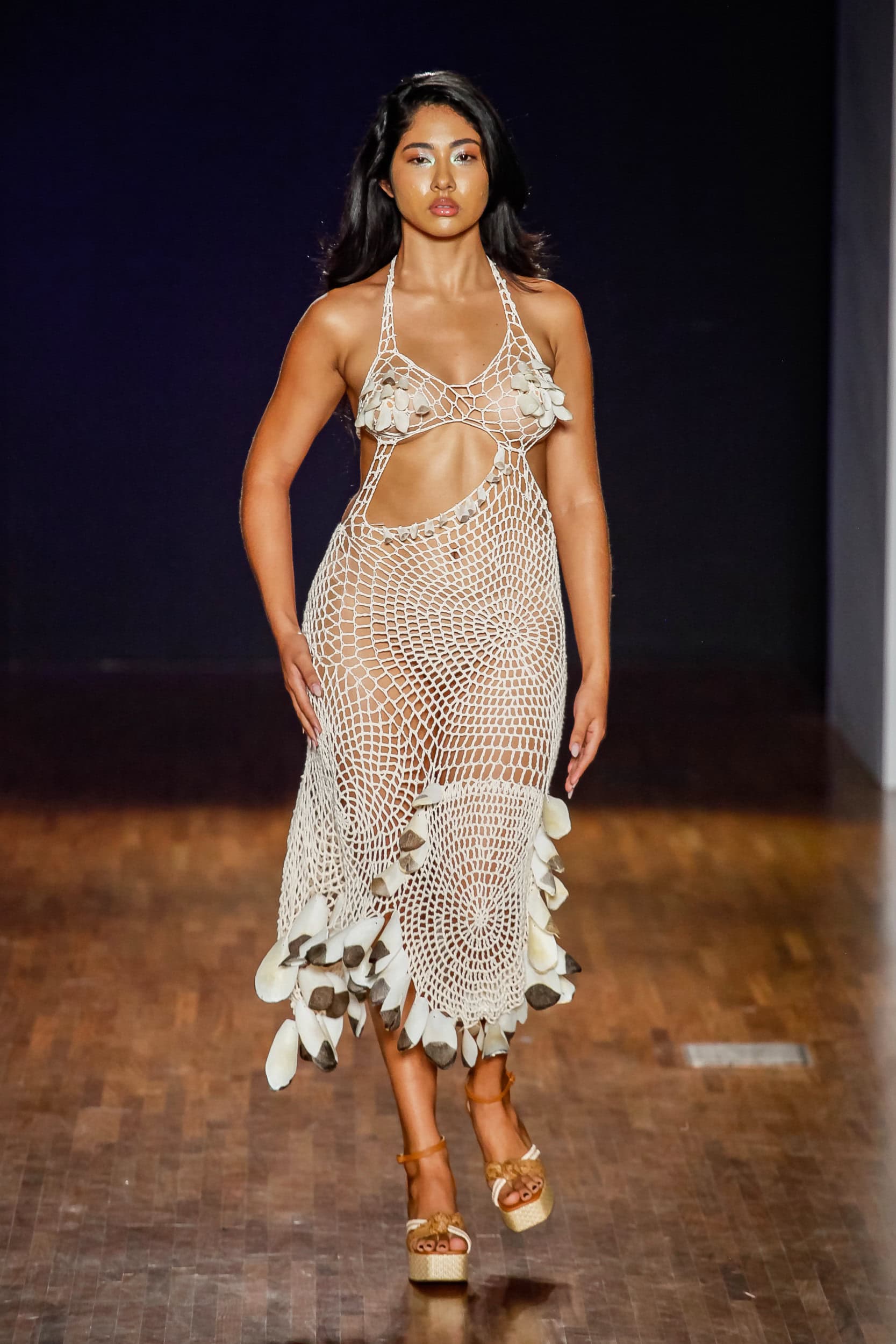
The São Paulo Fashion Week runway record describes basketry as a source for both individual pieces and the collection’s geometry. Those aren’t quite the same thing. A woven object can be worn with clothes whose shape has already been decided. In the arumã skirt, weaving is part of the garment itself. The outline isn’t simply a surface on which to display a pattern; it’s part of what the woven structure makes possible. Arumã is a plant fibre used in basketry by several Indigenous peoples in Amazonas. The runway record also names tucum among the fibres used in Tramas. There’s no need to treat the two as interchangeable or assign them to looks the sources don’t identify. The arumã skirt is the clearest construction example because the reporting connects a named fibre to a specific garment and records a question raised during its making.

Look at the skirt’s outline first, then the weave. That order emphasises what the technique does. A pattern might be the detail that catches your eye. Still, Curipaco’s question directs your attention to something a pattern alone can’t explain: the relationship between the shape and the person inside it.

What the corset tells us about the reference

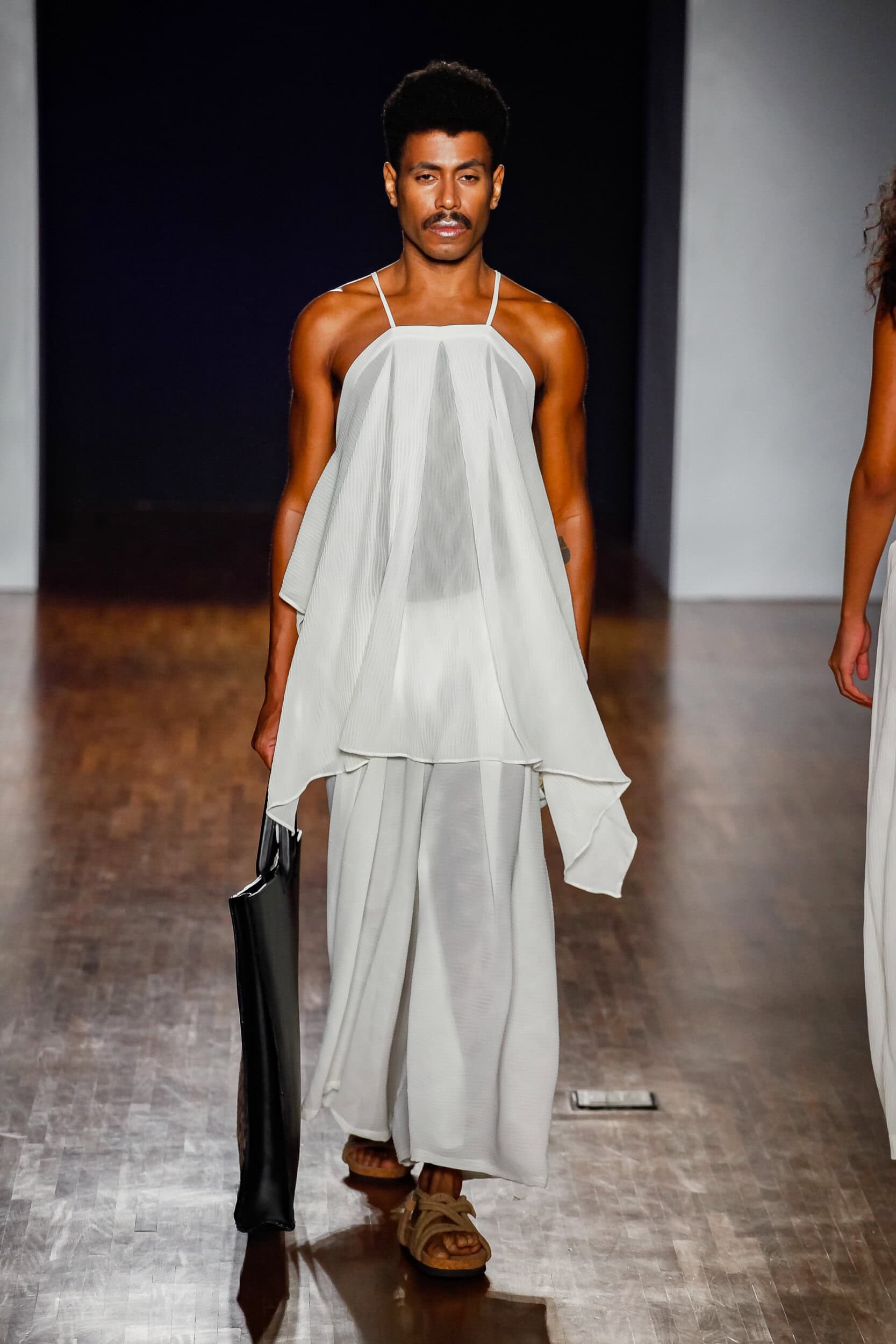
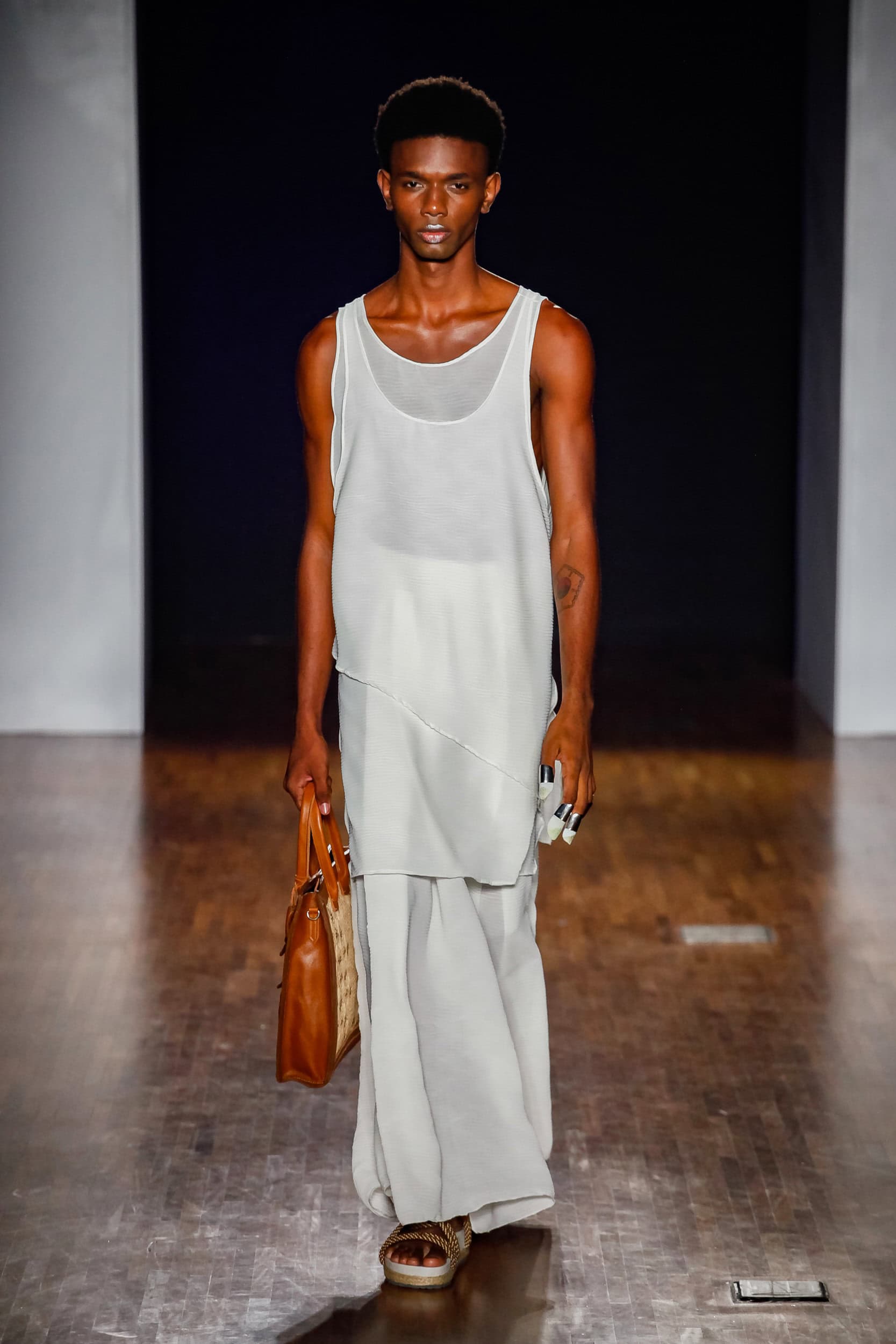
Basketry helps explain how Tramas made parts of Tramas. Duarte’s account of the Amazonian rubber boom helps explain why he chose some of the collection’s forms. Corsets, petticoats and hats recall clothing associated with the wealthy elite of that era. The corset matters here as a historical reference; it doesn’t have to serve as a second example of the skirt’s construction. In his interview with Vogue Brasil, Duarte connected those forms to a period whose wealth was not shared by the people whose labour helped produce it. He also spoke about what it might mean for audiences to encounter Indigenous craft as luxury at São Paulo Fashion Week. Read together, those remarks explain why a corset or petticoat in Tramas is more than a period detail. Duarte brought garments associated with one account of wealth into a show that asked audiences to recognise the work that account had left out.

What the reporting lets us trace
What the corset tells us about the reference
Photo: The Impression.

The earlier articles in this series traced a material to its place in a shoe, its colour before dyeing or its use between wears. Tramas lets us trace a construction question to a person. We know the fibre used in the skirt, where it was made and who raised the question about sitting. That’s more useful than calling the work sustainable on the strength of plant fibres or handwork alone. Neither establishes how the fibre was sourced across the collection, what the collaborators were paid or what the finished pieces’ environmental footprint was.

The distinction matters because the broad label can obscure the detail we do have. “Indigenous craftsmanship” doesn’t tell a reader that Duarte is Kaixana, that the collection involved collaborators from distinct Indigenous peoples, or that José Curipaco asked how a particular garment would be worn. Naming those contributions tells us more about how the collection took shape without claiming to know everything about how it was produced.

The Omiren Argument

Calling the skirt “basketry-inspired” can describe what it looks like while leaving out how it came to hold that shape. Curipaco’s question gives us something the runway image can’t: a record of what the garment was asked to do, and who asked. The weave is visible. The conversation is what makes it possible to read the skirt as a piece of construction, not just a woven surface.

Also Read:

  • Johana Bahamón and Priah: Afro-Colombian Design as Social Architecture 
  • Lab Fantasma and the Afro-Brazilian Streetwear Movement That Fashion Forgot to Cover 
  • Afro-Brazilian Renaissance: Reclaiming Heritage, Shaping Today 
  • Kenneth Ize and the Aso-Oke Question: What It Means to Build a Luxury Brand on a Handwoven Cloth 

Frequently Asked Questions

Who is Maurício Duarte?

Maurício Duarte is a Kaixana fashion designer from Manaus, Amazonas. His label appeared in São Paulo Fashion Week’s digital programme in 2022, and Tramas was his first in-person show at the event, in May 2023. Vogue Brasil names collaborators from several Indigenous peoples among the collection’s makers.

What is arumã, and how was it used in Tramas?

Arumã is a plant fibre used in basketry by several Indigenous peoples in Amazonas. In Tramas, it was used in the woven skirt Duarte discussed with José Curipaco. That skirt is a documented example of basketry contributing to the garment’s construction, not just its decoration. The runway record also names tucum among the fibres used.

Where can I see the collection?

Start with the official São Paulo Fashion Week runway record and Vogue Brasil’s runway coverage. Look at the outlines of the woven pieces before studying their surfaces. For the historical references and the maker credits, read the runway images alongside Duarte’s interview.

What did José Curipaco ask about the arumã skirt?

José Curipaco, the artisan Duarte names in his account of the skirt, asked how the wearer would sit. Duarte later recalled telling him she wouldn’t. The answer shows the skirt was made for the runway; the published account doesn’t say how flexible it was or what alternatives the makers considered.

Post Views: 133
Total
0
Shares
Share 0
Tweet 0
Pin it 0
Related Topics
  • Brazilian Basketry
  • Craft and Fashion
  • Maurício Duarte
  • Tramas Collection
Avatar photo
Adams Moses

adamsmoses02@gmail.com

You May Also Like
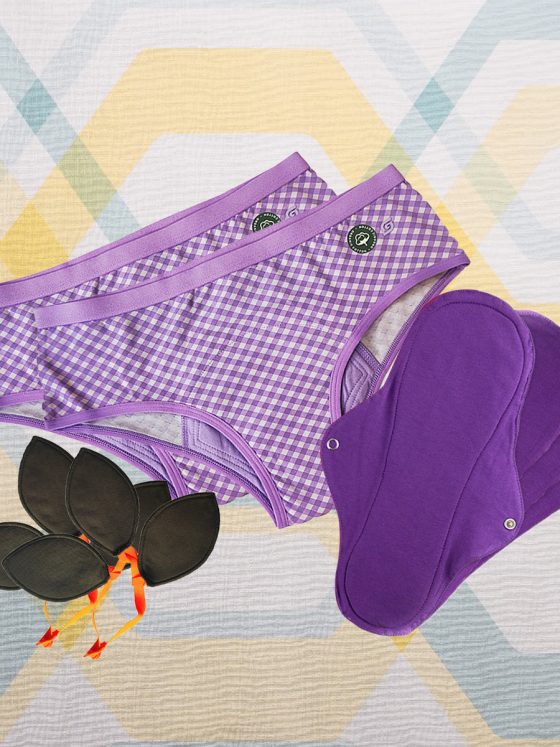
Pantys Period Underwear: Absorbent Design and Reuse
View Post
  • Sustainable Fashion

Pantys Period Underwear: Absorbent Design and Reuse

  • Peace Vera
  • November 19, 2026
Natural Cotton Colour: Paraíba Cotton and Brazilian Tailoring
View Post
  • Sustainable Fashion

Natural Cotton Colour: Paraíba Cotton and Brazilian Tailoring

  • Peace Vera
  • November 19, 2026
Cariuma’s OCA Low Canvas, From Cotton Upper to Cork Insole
View Post
  • Sustainable Fashion

Cariuma’s OCA Low Canvas, From Cotton Upper to Cork Insole

  • Rex Clarke
  • November 19, 2026
Thrift Without Doubling Up: Know What You Own Before the Next Bale
View Post
  • Sustainable Fashion

Thrift Without Doubling Up: Know What You Own Before the Next Bale

  • Sevan Safarian
  • November 18, 2026
The Repair Test: When Is a Damaged Garment Worth Saving?
View Post
  • Sustainable Fashion

The Repair Test: When Is a Damaged Garment Worth Saving?

  • Rex Clarke
  • November 10, 2026
Repair, Alter, Remake: Patch and Stitch’s Approach to Existing Clothes
View Post
  • Sustainable Fashion

Repair, Alter, Remake: Patch and Stitch’s Approach to Existing Clothes

  • Peace Vera
  • October 9, 2026
Why Embellished Occasionwear Needs a Care Decision, Not a Universal Cleaning Tip
View Post
  • Sustainable Fashion

Why Embellished Occasionwear Needs a Care Decision, Not a Universal Cleaning Tip

  • Peace Vera
  • October 8, 2026
The Sustainability Metrics That Cannot See a Tailor
View Post
  • Sustainable Fashion

The Sustainability Metrics That Cannot See a Tailor

  • Peace Vera
  • September 10, 2026
The Omiren Argument

African fashion and culture are not emerging. They are foundational. We document, interpret, and argue for the full cultural weight of African and diaspora dress. With precision. Without apology.

Omiren Styles Fashion · Culture · Identity

All 54 African Nations
Caribbean · Afro-Latin America
The Global Diaspora

Platform

  • About Omiren Styles
  • Our Vision
  • Our Mission
  • Editorial Pillars
  • Editorial Policy
  • The Omiren Collective
  • Campus Style Initiative
  • Sustainable Style
  • Social Impact & Advocacy
  • Investor Relations

Contribute

  • Write for Omiren Styles
  • Submit Creative Work
  • Join the Omiren Collective
  • Campus Initiative
Contact
contact@omirenstyles.com
Our Reach

Africa — All 54 Nations
Caribbean
Afro-Latin America
Global Diaspora

African fashion intelligence, in your inbox.

Editorial features, designer profiles, cultural commentary. No noise.

© 2026 Omiren Styles — Rex Clarke Global Ventures Limited. All rights reserved.
  • Privacy Policy
  • Editorial Policy
  • Terms of Use
  • Accessibility
Africa · Caribbean · Diaspora
The Omiren Argument

African fashion and culture are not emerging. They are foundational. We document, interpret, and argue for the full cultural weight of African and diaspora dress. With precision. Without apology.

Omiren Styles Fashion · Culture · Identity
  • About Omiren Styles
  • Our Vision
  • Our Mission
  • Editorial Pillars
  • Editorial Policy
  • The Omiren Collective
  • Campus Style Initiative
  • Sustainable Style
  • Social Impact & Advocacy
  • Investor Relations
  • Write for Omiren Styles
  • Submit Creative Work
  • Join the Omiren Collective
  • Campus Initiative
Contact contact@omirenstyles.com

All 54 African Nations · Caribbean
Afro-Latin America · Global Diaspora

African fashion intelligence, in your inbox.

Editorial features, designer profiles, cultural commentary. No noise.

© 2026 Omiren Styles
Rex Clarke Global Ventures Limited.
All rights reserved.

  • Privacy Policy
  • Editorial Policy
  • Terms of Use
  • Accessibility
Africa · Caribbean · Diaspora

Input your search keywords and press Enter.

Newsletter Subscribe

The Omiren Style Index

The reference directory for African, Caribbean and Afro-Latin fashion. New entries, taxonomy updates and intelligence signals — once a month. No noise.

.newsletter-form{
max-width:500px;
margin:auto;
text-align:center;
padding:30px;
}

.newsletter-form h3{
margin-bottom:10px;
font-size:28px;
}

.newsletter-form p{
margin-bottom:20px;
color:#666;
}

.newsletter-form input{
width:100%;
padding:14px 18px;
border:1px solid #ddd;
margin-bottom:15px;
border-radius:4px;
}

.newsletter-form button{
width:100%;
padding:14px;
background:#000;
color:#fff;
border:none;
cursor:pointer;
text-transform:uppercase;
letter-spacing:1px;
}