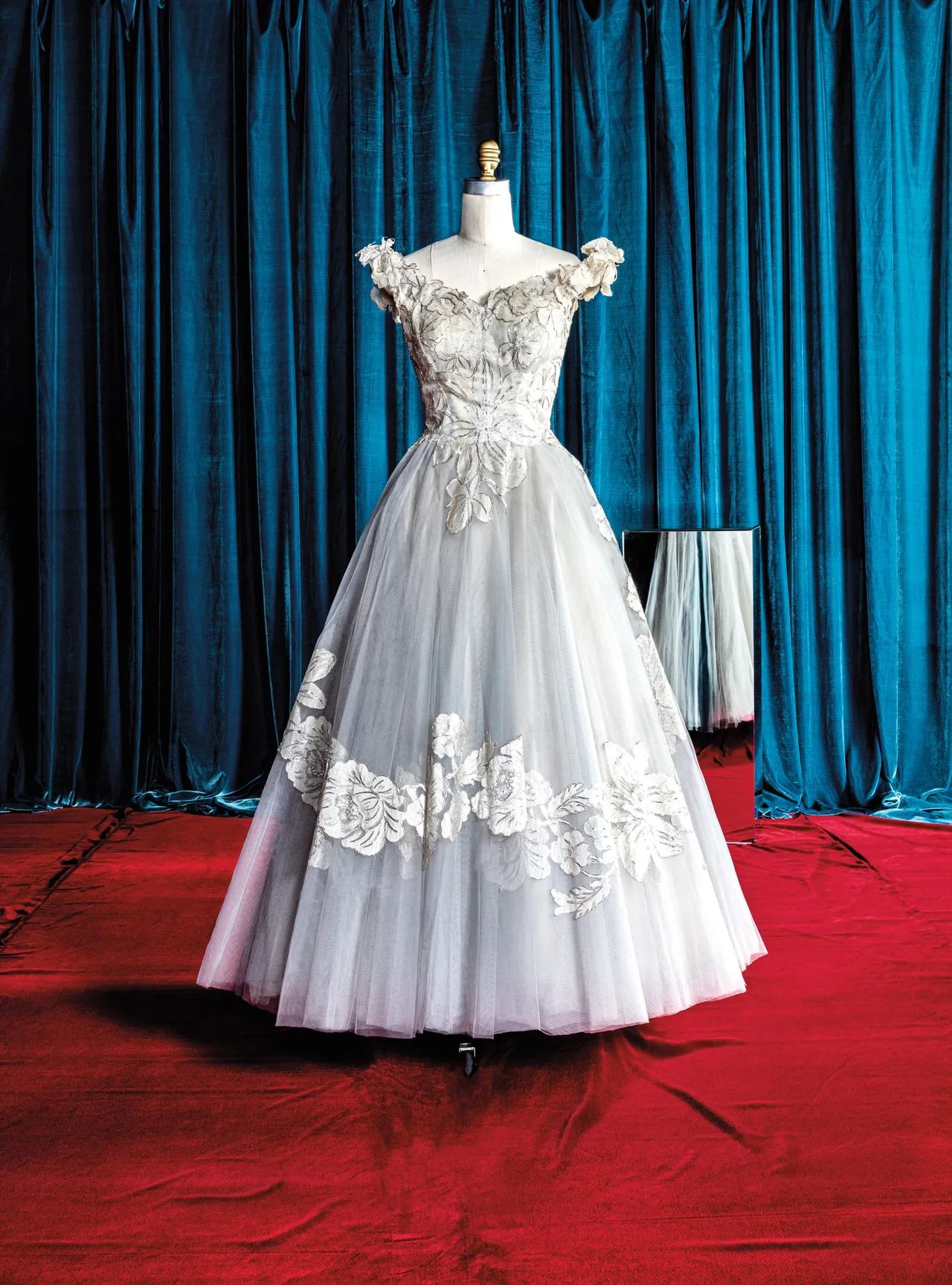
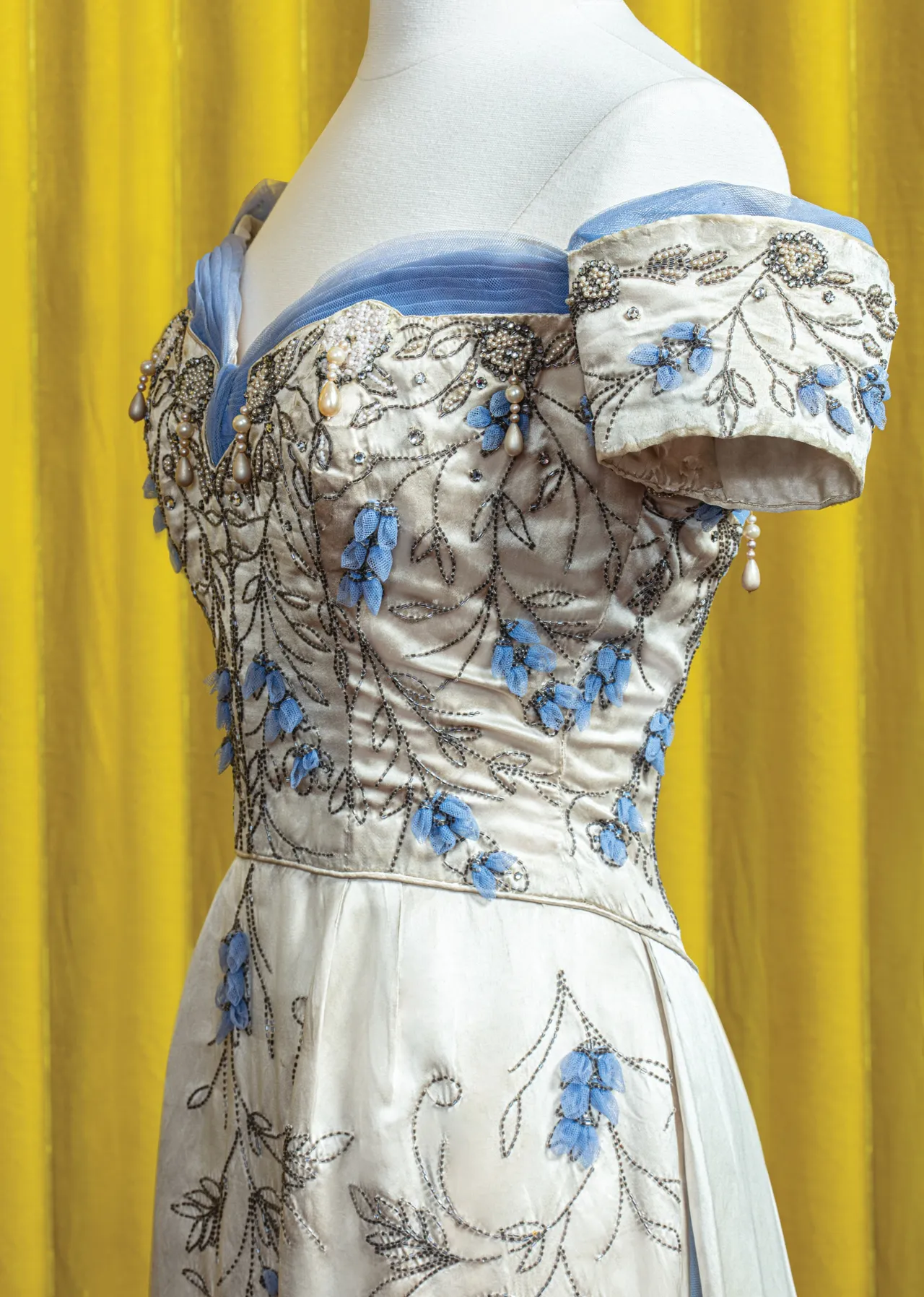
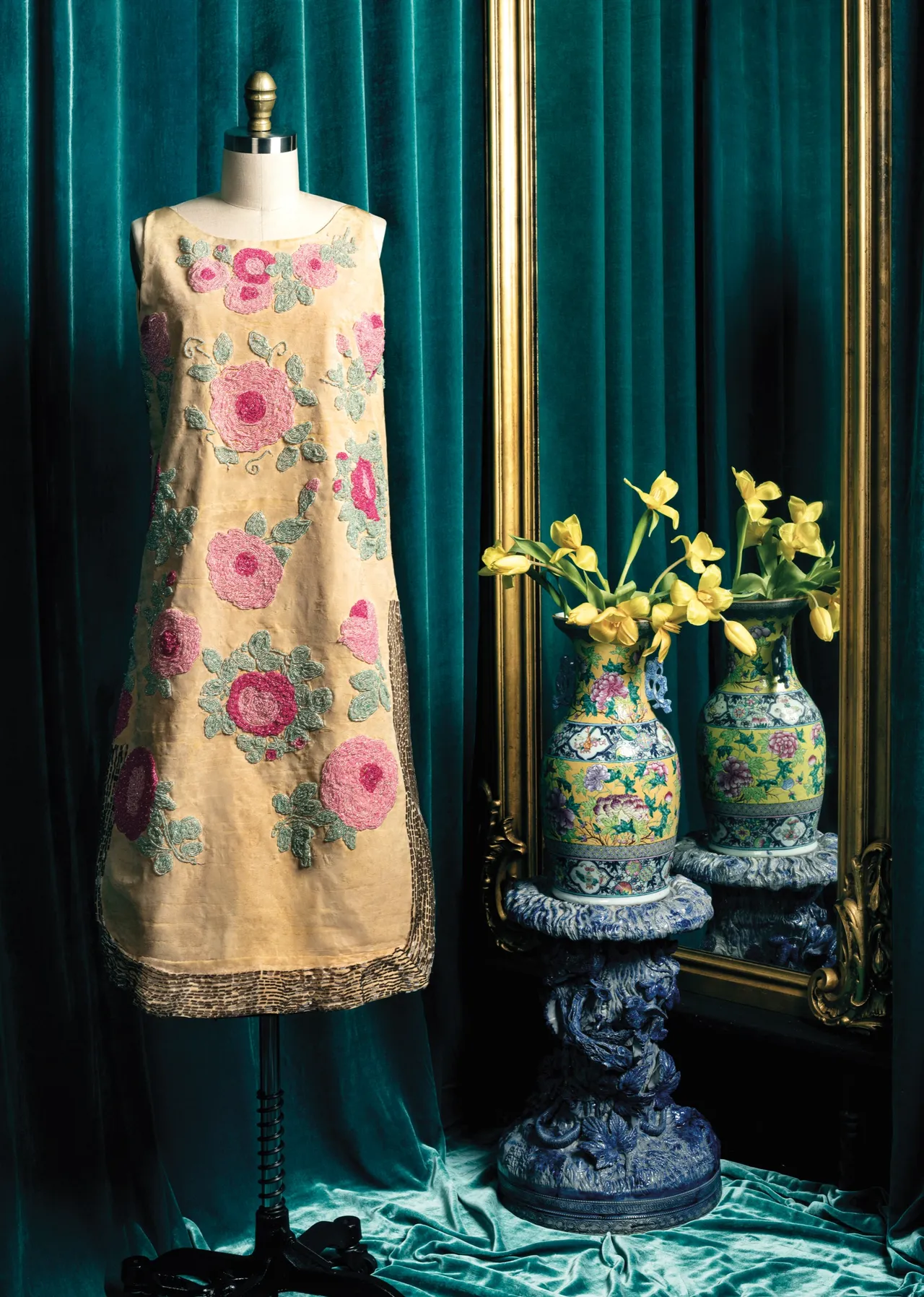
The gold gown’s most elaborate work gathers towards its hem. Handmade stems, leaves and flowers form sprays across the lower part of an otherwise restrained, narrow-strapped silhouette. When Ohio State curator Gayle Strege examined it, she could still see pencil lines on some leaves, the outlines used to cut the shapes before their edges were finished. That description comes from Ohio State’s Inspire podcast, published on 17 February 2021, not from an examination of the garment by Omiren. In the programme, Strege described a slightly raised waistline and a sheath-like shape associated with the 1960s. The dress’s lower section carried the strongest decorative emphasis.
Ohio State identifies the surviving gown as an Ann Lowe debutante dress. Its published acquisition accounts do not name an original wearer or identify a ball at which it appeared. Instead, they preserve a different history: clothing retained after a New York business closed, decades of private custody, donation to a church-associated resale shop and a purchase funded by two donors. That journey is substantial without an invented first wearing. It explains how a garment remained available to be recognised, and how recognition became acquisition.
Trace an Ann Lowe gown through private storage, donation to a church resale shop and donor-funded acquisition by Ohio State’s costume collection.
A Garment Retained After the Business Closed
The gown’s later custody connects to A.F. Chantilly, the business name associated with the label reported inside it. In the 2021 podcast, Ohio State explained that Florence Cowell made day dresses and suits, while Lowe made evening gowns and wedding dresses. Cowell’s son, Jim Gessner, ran the business that housed the label. After the New York shop closed, he kept the remaining clothing. Chris Bournea’s Ohio State News report of 6 February 2023 adds a named family account. Elizabeth McAllister (Gessner’s niece and Florence Cowell Gessner’s granddaughter) recalled that her uncle kept dresses from his mother, as well as the gown from Lowe.
“He had that dress in a storage unit for 50 years,” McAllister told the university. The duration is based on her recollection. It establishes how the family understood the long period of custody, rather than supplying a precise storage-entry date from which the dress’s production year can be calculated. The accounts also leave its earlier status unresolved. They do not say whether the gown was unsold stock, a sample, a completed commission or a garment that had returned to the business. Gessner’s retention connects it to the shop’s closure; it does not establish everything that happened before that point.
From Private Storage to a Church Resale Shop
McAllister recalled that Gessner eventually took the Lowe gown to First Community Church’s clothing resale shop and donated it. The 2023 report identifies the organisation as the Tri-Village Trading Post and states that its staff recognised the distinctive quality of the gold dress and contacted Ohio State. That recognition was an active part of the transfer. The garment did not simply arrive at the university with a complete record attached. People associated with the resale shop identified something worth investigating and approached someone with relevant collecting expertise. The 2021 podcast, presented by Robin Chenoweth, preserves Strege’s account of that first contact. A volunteer called to say the shop had an Ann Lowe dress. Did she know the designer, and was she interested?
Strege arranged a meeting with the director. At that point, the dress was not at the store; the director had it at her house and showed photographs. Among them was an image of the label. Strege recalled its wording as “Ann Lowe for AF Chantilly.” The sequence matters. This was not a documented bargain discovered on a sales rack, and neither account supplies a resale price. It was an enquiry, followed by photographs, identification and discussion of acquisition.
What the Label Helped Establish
The label gave Strege a connection to pursue. It linked the garment to Lowe and a particular business, allowing the enquiry to move beyond an assessment of decorative quality alone. It also connected the gown to the other clothing donated from Gessner’s holdings. According to the podcast, the director explained that the dress had arrived with additional pieces bearing A.F. Chantilly labels. Those other garments were associated with Florence Cowell. The label therefore served two functions within the acquisition story. It supported identification of the designer, and it linked the object to a business and a family custody history.
Its wording should remain attributed to Strege’s spoken account until checked against a clear photograph or catalogue transcription. Similarly, a label’s presence does not independently identify a wearer, occasion or date. What it supplied here was a route to further knowledge. The reported name could be considered alongside the donor connection and the clothing retained after the shop closed. The attribution did not rest solely on an anonymous claim that the dress looked like Lowe’s work.
Donation and Purchase Were Separate Transactions
The church-associated shop received the gown as a donation. Ohio State then acquired it through a funded purchase. The podcast states that two donors offered money to buy the dress for the university’s Historic Costume & Textiles Collection. By the time the programme was published in February 2021, the gown was in the collection, and Strege had examined it. These stages should not be compressed into “a donation to Ohio State.” Gessner, the resale organisation, the curator and the acquisition donors played different roles.
| Stage | What the published accounts establish |
|---|---|
| Retention | Gessner kept clothing after the New York business closed. |
| Donation | He gave the Lowe gown to the church-associated resale shop, according to the university report and McAllister’s testimony. |
| Enquiry | A volunteer contacted Strege, who subsequently met the director and saw photographs. |
| Acquisition | Two donors supplied funds for the university collection to purchase the gown. |
The two Ohio State publications are complementary institutional accounts. The podcast records Strege’s acquisition narrative; the later report adds McAllister’s family recollection. They should not be treated as two independent confirmations of every detail.
The Flowers Preserve a Different Kind of Evidence
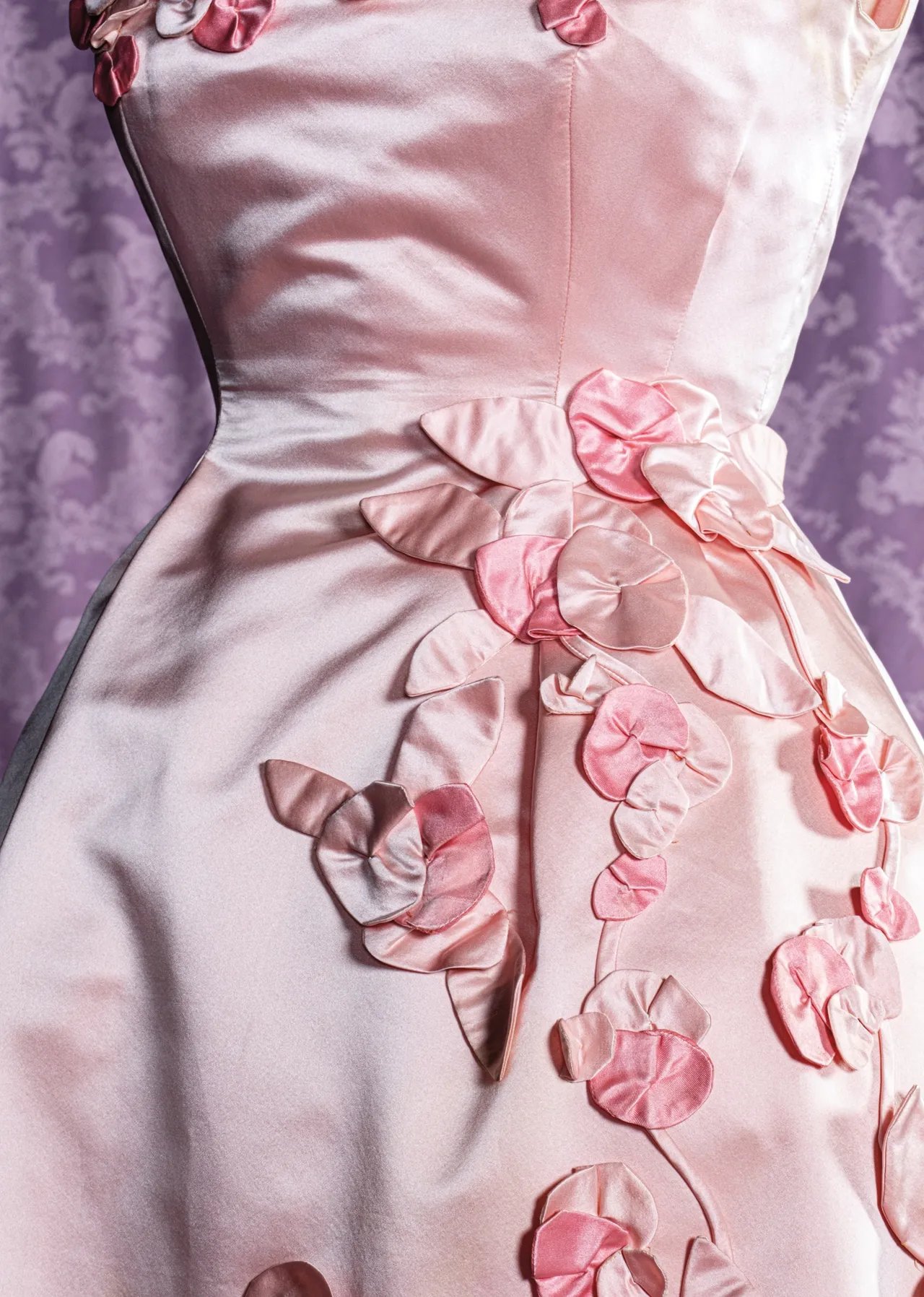
Once the garment entered the collection, its physical details could become part of the public account. Strege’s observation of pencil marks is particularly revealing. The outlines remained visible on some of the leaves, alongside their finished edges. The programme described the stems, leaves and flowers as handmade elements appliquéd in sprays towards the bottom hem. Those details shift attention from the designer’s reputation to the object itself. The gown’s identity is not carried only by its label: it also contains evidence of the decisions and labour involved in its decoration.
The published description does not identify every workshop hand or provide a complete technical analysis. But it establishes a specific relationship between the simple upper silhouette and the concentrated floral work below. That balance should remain central to any accompanying caption or image selection. A distant photograph may show the gown’s overall shape, while a properly identified detail could make the surviving cutting lines and edge treatment legible. The account is strongest when readers can connect the description to the actual garment rather than a generic example of Lowe’s flowers.
A Smithsonian Dress Supplies Context, Not Missing Provenance
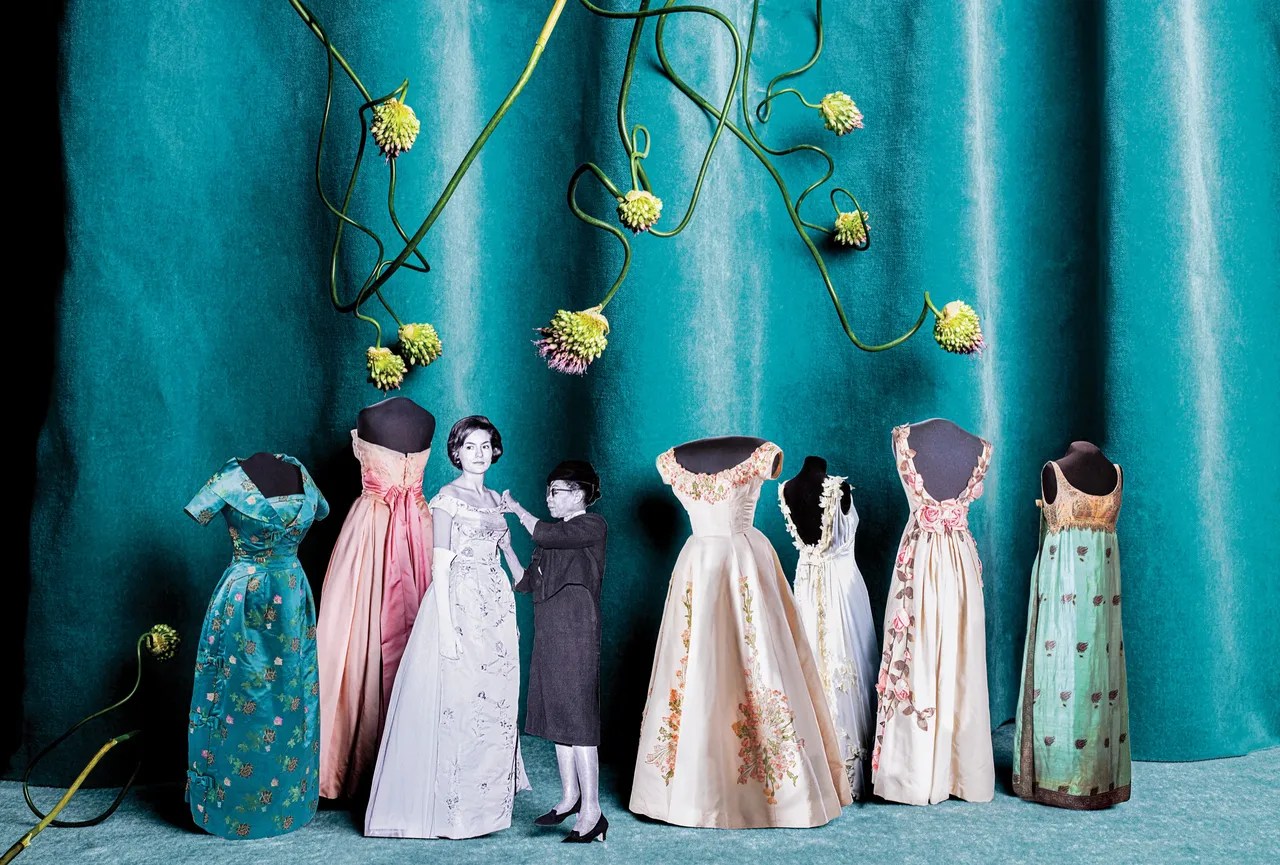
A separate object at the Smithsonian’s National Museum of African American History and Culture offers a useful comparison. Its catalogue identifies a white debutante dress designed by Lowe, dated 1966, and worn by Jennifer Peabody Marks. The object number is 2007.3.29. The Smithsonian record describes white silk taffeta, pleated organdy and floral appliqué. It also transcribes an interior label reading “ANN LOWE / A. F. Chantilly, Inc. / NEW YORK.” The dress entered the museum through the Black Fashion Museum collection. This links the A.F. Chantilly name to another catalogued Lowe garment dated 1966. It does not date the Ohio State gown.
This distinction matters because the Ohio podcast’s narration associates the label with the late 1960s. The Smithsonian object provides a documented earlier example, so the label alone should not assign Ohio State’s dress to the end of that decade. The records also preserve different kinds of knowledge. The Smithsonian entry names a wearer and describes materials and construction in detail. Ohio State’s accounts are richer on the route through storage, resale-shop donation and purchase. Neither history should be borrowed to complete the other.
Acquisition Made the Dress Available for Another Kind of Recognition
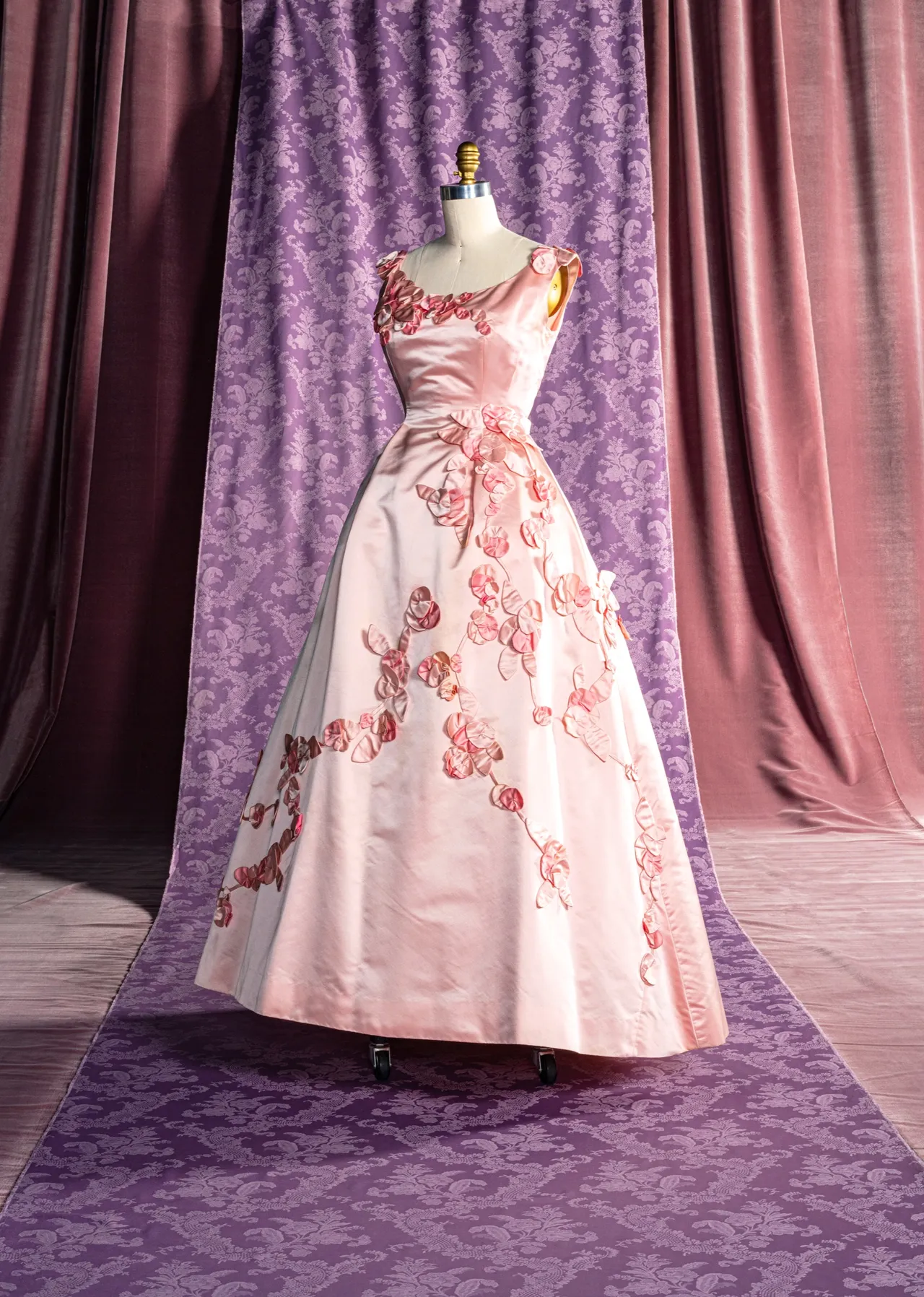
In the 2023 report, Strege connected the acquisition to the historical recognition of Black dressmakers and designers. “There were a lot of Black dressmakers and designers, but they weren’t necessarily whose name was on the label,” she said. “That recognition of the dressmaker was left out.” Her point gives the surviving label significance without making it the whole story. The gown became an example through which the university could discuss a named designer’s work, examine construction and explain how the object had reached the collection. That is a concrete change in its institutional future. It does not resolve the absence of an original wearer, establish a complete condition history or guarantee that the garment is currently on display.
The university’s 2023 report discussed storage during a building renovation. That dated statement should not be presented as its current location or exhibition status. As Omiren’s guide to what textile provenance can and cannot prove explores, traceable history supports particular conclusions. It does not automatically supply every part of an object’s social life.
The Omiren Argument
The gown’s survival depended on retention. Its entry into a university collection depended on recognition, enquiry and a funded acquisition.
Those actions are traceable even where its original wearing history is not. Gessner kept it; the resale organisation recognised its interest; Strege investigated; donors made the purchase possible.
The resulting biography is incomplete, but specific. It connects a surviving garment to named people, a business label and documented transfers of custody. Its authority comes from keeping those stages distinct, not from filling the gaps with a more satisfying occasion story.
Also Read:
- Uzuri International: Two Pageant Gowns and the Design of Public Presence
- Five Black British Designers Who Are Building the Future of London Fashion
- The Wrap Dress Origins: The Ancient African Wrapper and Fashion’s Most Celebrated Founding Myth
- How to Source Authentic Kuba Cloth: A Buyer’s Guide to Raffia, Provenance and Ethical Use
Frequently Asked Questions
Who donated the gown, and who purchased it?
Jim Gessner, who retained clothing after the New York business closed, took the Lowe gown to a church-associated resale shop and donated it. Two donors then supplied the funds for Ohio State’s Historic Costume & Textiles Collection to purchase it. The donation and purchase were separate transactions, and Gessner, the resale organisation, the curator, and the donors played different roles.
Is its original wearer known?
The published Ohio State acquisition accounts do not identify an original wearer or a specific debutante event. That is a limit of those accounts, not proof that no further information exists. The article therefore describes the gown through its documented custody, from retention after the shop closed to storage, donation and purchase, rather than through an invented first wearing.
How secure is the 50-year storage period?
Elizabeth McAllister’s recollection, quoted in Ohio State’s 2023 report, is: “He had that dress in a storage unit for 50 years.” It shows how the family understood the long custody. Still, it should remain attributed rather than converted into an exact production date or a precise storage-entry date for the dress.
What does the Smithsonian dress show about the label?
A separate Lowe debutante dress at the Smithsonian’s National Museum of African American History and Culture, object number 2007.3.29, is dated 1966 and carries a label reading “ANN LOWE / A. F. Chantilly, Inc. / NEW YORK.” That shows the A.F. Chantilly name on another catalogued Lowe garment, but it does not date the Ohio State gown.