In 1974, a Belgian-born designer named Diane von Furstenberg placed a full-page advertisement in Women’s Wear Daily featuring herself in a printed jersey dress that wrapped around the body and tied at the waist. The tagline read: “Feel like a woman, wear a dress.” Within the first year, she was producing 25,000 wrap dresses per week. By 1976, one million had been sold. She appeared on the cover of Newsweek, which described her as the most marketable woman in fashion since Coco Chanel. Her net worth today stands at approximately $1.2 billion, a fortune built in large part on a single silhouette: the wrap dress.
Fashion schools teach the DVF wrap dress as a design landmark. Museum curators have acquired it for permanent collections. Critics have described it as one of the defining garments of the twentieth century. The argument made in its favour is consistent: Diane von Furstenberg invented something. She created a form. She gave women a garment that was both practical and empowering, and the world responded.
Here is the problem with that argument. Richard Martin, a former curator of the Costume Institute at the Metropolitan Museum of Art, noted that the form of von Furstenberg’s design had already been “deeply embedded into the American designer sportswear tradition” before she produced a single jersey version of it. Von Furstenberg herself described the dress as “a design re-interpretation of the Kimono.” A Elsa Schiaparelli designed and wrapped dresses in the 1930s, and Claire McCardell in the 1940s, whose popover design became the basis for a variety of wrap-around dresses, a full generation before DVF debuted hers. DVF did not invent the wrap dress. She commercialised it brilliantly in Jersey at the right cultural moment, and the story of invention was told anyway.
But the deeper problem is this: before Schiaparelli, before McCardell, before any European or American designer worked with the principle of cloth wrapped around the body and tied at the waist, West African women had been doing exactly that for centuries. The garment has a name. In Yoruba, it is called the iro. Across francophone West Africa, it is called the pagne. The wrapper is a cloth approximately 59 inches by 98 inches, wrapped around the hips and rolled over on itself at the waist to form a skirt, worn throughout West and Central Africa. It belongs to the large class of unwoven garments worn by wrapping cloth around the body. It has been documented across West Africa for centuries. It has been the foundation garment of women’s dress across the region for generations that predate any European design school, any American sportswear tradition, and any Belgian designer working in Italian jersey.
This article makes the argument that fashion history’s most celebrated founding myth, that the wrap dress was invented in 1974 by Diane von Furstenberg, is built on the erasure of a garment so ancient and so widespread in West Africa that the claim to invention would be laughable if it were not so consequential. The global fashion market is valued at approximately $1.9 trillion in 2026. The women’s apparel segment alone represents approximately $850 billion. The silhouette at the centre of one of the most commercially successful fashion stories of the twentieth century belongs, in its origins, to West Africa. That is the commercial argument. It has not been made. Omiren Styles makes it now.
Diane von Furstenberg’s 1974 wrap dress is taught in fashion schools as a design landmark. The wrapper it is based on has been worn by West African women for centuries. Omiren Styles makes the commercial argument that fashion history has been avoiding.
What the Wrapper Is and Where It Comes From
The oldest surviving textiles from sub-Saharan West Africa were discovered at the archaeological site of Kissi in northern Burkina Faso and dated to the early first millennium AD. They are made of wool or fine animal hair. They are not dressed in the tailored sense. They are woven cloths. And what woven cloths become, when they are too large for spinning and too substantial for covering alone, is wrapping material. The wrapper is the natural consequence of a textile tradition that predates tailoring: you take a length of cloth, you place it around the body, and you secure it.
The wrapper, worn throughout West and Central Africa, belongs to that large class of clothing that is not sewn but wrapped around the body, found the world over and including the sarong, kain, kanga, sari, shuka, and toga. The human instinct to wrap cloth around the body is not an invention. It is the oldest form of dressing. What West African women did was to make the wrapper a complete, sophisticated, and culturally codified garment system. They gave it names, rules, and occasions. They layered it. They paired it with specific blouses and specific headgear. They made it into a language.
In Yoruba culture, the iro is a large piece of fabric worn by women, wrapped around the waist and secured with a tie, paired with a buba blouse and a gele headtie to form the complete women’s dress ensemble. Cloth weaving in Yorubaland is documented from the fifteenth century, with tso-oke as the prestige fabric for wrappers dating back to the ancient Yoruba kingdoms of Oyo, Ife, and Ijebu. The iro is not a casual garment. It is a ceremonial one. The clothing of Yoruba women reflects their social status, marital status, age group, and religious and cultural affiliations. The iro communicates all of this. The wrap is not a silhouette. It is a statement.
The word pagne, used across francophone West and Central Africa to describe the wrapper, was introduced by European merchants in the sixteenth century to identify garments and textiles that were already pre-existing in African societies before their arrival. The Portuguese word pano became the French pagne. The European traders named something that was already there. They did not create it. They encountered it, gave it their word and moved on. Five hundred years later, a fashion house in Manhattan was claiming to have invented the silhouette.
The Western Wrap Dress Timeline, Honestly Told
To make the argument clearly, it is worth being precise about what Western fashion actually did with the wrap principle, because even within that tradition, Diane von Furstenberg was not first.
During the Great Depression, house dresses called Hooverettes employed the wrap design and were widely popular among American women. In the 1930s, Elsa Schiaparelli designed several wrap dresses, building on a tradition already established in the period’s design culture. Charles James designed his Taxi Dress around 1932, a wrap-around garment intended to be put on in the back of a taxicab. By the 1940s, Claire McCardell’s popover dress employed a wrap-around neckline and apron silhouette as a practical garment for women managing wartime responsibilities at home and in the workforce. McCardell’s contribution to American sportswear, which included the wrap principle as a central element, predates DVF’s work by more than thirty years.
The Metropolitan Museum of Art’s own catalogue entry on the DVF wrap dress describes it as “a climax to the American sportswear wrapping tradition,” noting that its fundamental form was already deeply embedded in the American designer sportswear tradition before von Furstenberg produced her version. The museum acquired the dress. It also accurately wrote that DVF did not create the form. What she contributed was the choice of jersey fabric, the boldness of print, and the commercial timing that placed the garment at the intersection of the women’s liberation movement and the American workforce. These are genuine contributions. They are not inventions.
Von Furstenberg herself has described the 1974 dress as “a design re-interpretation of the Kimono,” acknowledging an Asian precedent for the wrapped-and-tied closure. The wrap-over neckline that closes to the right originated in China and can be traced to the Shang dynasty, between 1600 and 1046 BCE, before spreading to Korea and Japan. If the DVF wrap dress is a re-interpretation of the kimono, and the kimono itself draws on a wrapping principle that stretches back over three thousand years in East Asia, the claim to invention becomes increasingly difficult to sustain by any measure, in any direction.
The one direction fashion history has never looked is southward: to the women of West and Central Africa who had been wrapping cloth around their bodies, securing it at the waist, and creating a coherent dress system from that principle for centuries before any of these Western or Asian precedents entered a fashion school curriculum.
The Iro and the Jersey: The Same Principle, One Credited
A full Yoruba wrapper ensemble consists of three garments: the buba blouse, the iro, and the gele headtie. The iro is the wrapper itself: cloth wrapped around the hips, folded over at the waist, and secured. It is not sewn into a dress shape. It wraps. It ties. It sits at the waist. It falls at the ankle or the knee, depending on the occasion and the community. It is, in its structural logic, the same principle that DVF realised in jersey in 1974. Cloth around the body. Tied at the waist. No zip. No structure imposed from outside.
The differences are real and should not be erased. The iro is unsewn cloth; the DVF dress is a constructed garment with a sewn bodice attached to a wrap skirt. The iro wraps around the lower body; the DVF dress covers from the chest to the knee. The iro is part of a three-part ensemble with a blouse; the DVF dress is a single garment. These are genuine differences in construction. But the structural principle, the defining idea at the heart of the garment that fashion history calls the wrap dress, is the same: cloth wrapped around the body and tied. And that principle has a West African history so long that dating its beginning requires archaeology rather than fashion archives.
Historically, textiles were used as a form of currency in West Africa from the fourteenth century. The wrapper was not a trivial or informal garment in this context. It was the central dress form of a region where cloth itself was money. When a Yoruba woman wore her iro at a ceremony in the fifteenth century, she was wearing something that bore the full weight of the world’s textile economy. The iro was not a housecoat. It was not a casual cover-up. It was the garment around which an entire dress culture was organised.
The Oyo Empire, one of the most powerful states in West Africa, used cloth as diplomatic currency. The Alaafin’s wardrobe was an instrument of political power, and cloth was exchanged as a mark of relationship and rank between kingdoms. The wrapper was the foundation garment of this system. Decades before the DVF wrap dress appeared in Women’s Wear Daily, the wrapper had been the central garment in one of West Africa’s largest textile economies. That context does not appear in any fashion school reading list. It does not appear in the Costume Institute’s collection notes on the DVF dress. It has not been discussed.
Also Read
- The African City That Fashion Forgot: How Benin, Oyo, Dahomey, and Asante Dressed Before Europe Arrived
- Indigo: How West African Dyeing Became the Blueprint for Global Denim
- Cornrows Were a Map: The African Intelligence Behind Diaspora Braiding
- The Cloth That Crossed the Ocean: How African Fashion Tradition Lives in the Caribbean and Latin America
The Commercial Consequence
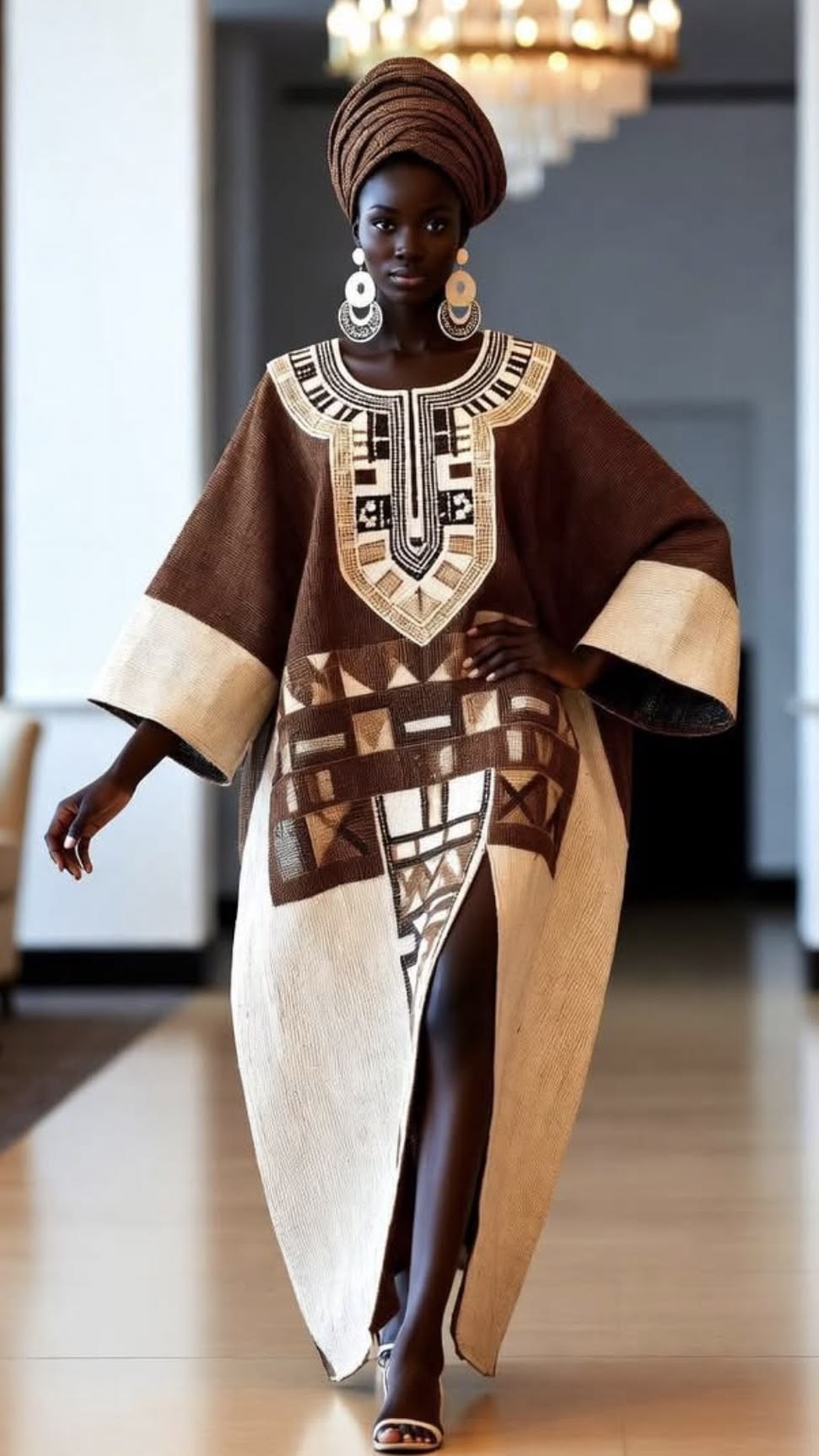
The commercial stakes of this argument are not abstract. Diane von Furstenberg’s net worth is approximately $1.2 billion, built on decades of sales of a garment whose originating silhouette belongs to a tradition that has never been compensated, credited, or acknowledged. The DVF brand is available in over 70 countries and at 45 freestanding shops worldwide. The wrap dress has been produced in tens of millions of units. It has generated hundreds of millions. In revenue, when the brand was at its commercial peak, sales reached $300 million annually.
None of that value flows back to West Africa. None of it is attributed to a tradition. None of it acknowledges the Yoruba women who wore the iro to market, to ceremony, to coronation, to mourning, and to celebration for centuries before a fashion designer in New York put jersey through a knitting machine and called it an invention.
This is not an accusation of deliberate theft. DVF almost certainly did not sit down with knowledge of the iro and decide to appropriate it. The problem is structural, not individual. Fashion history, as it has been told, does not look at West Africa when constructing its genealogies. It looks at Paris, New York, London, and Milan. When a form that exists in West Africa also appears in a New York studio, it is credited to New York because no one in the institutional history of fashion thought to ask where the principle of wrapping cloth around the body and tying it at the waist had been developed, and by whom, and for how long.
The answer to that question is: in West Africa, by West African women, for longer than the fashion industry has existed.
The Omiren Argument
Fashion schools teach their students that the wrap dress was invented in 1974. They do not teach the iro. They do not teach the pagne. They do not teach the wrapper traditions of West and Central Africa that gave the wrapped-and-tied silhouette its earliest and deepest roots. They teach DVF because DVF is the story fashion history has decided to tell, and fashion history has decided to tell it because the institutions that construct fashion history, the fashion schools, the museum costume institutes, the glossy magazines, have never systematically looked at West Africa when constructing their genealogies of design.
The consequence is financial as well as historical. The women’s apparel market is valued at approximately $850 billion globally in 2026. A significant portion of that market is built on silhouettes that have African precedents: the wrap, the drape, the unstructured garment that moves with the body rather than against it. The African traditions that developed those silhouettes first are not in the revenue conversation. They are not in the attribution conversation. They are not in the fashion school reading list.
Omiren Styles does not accept that fashion history ends at the boundaries of European and American design tradition. The iro is documented. The page is documented. The wrapper system of West Africa, with its specific garment names, ceremonial protocols, and multi-century textile economy, is documented in academic literature, museum collections, the Encyclopaedia of World Dress and Fashion, and the Victoria and Albert Museum’s Africa Fashion scholarship. The evidence is not missing. The will to place it in the fashion history narrative has been missing. That placement begins here.
The Iro was not an inspiration for the DVF wrap dress in any direct sense. DVF did not look at West Africa and copy what she saw. The point is not plagiarism. The point is precedence. The wrapped garment, tied at the waist, draped from hip to ankle, worn by women as a complete dress form, existed in West Africa centuries before it appeared in any Western fashion archive. Fashion history has chosen not to know this. The choice not to know something is always a decision. This article is the decision to know it instead.
Frequently Asked Questions
1. Did Diane von Furstenberg actually invent the wrap dress?
No, and this has been acknowledged by fashion historians and museum curators. Richard Martin, former curator of the Costume Institute at the Metropolitan Museum of Art, stated that the form of von Furstenberg’s design had already been “deeply embedded into the American designer sportswear tradition” before she produced her 1974 version. W Elsa Schiaparelli designed wrap dresses in the 1930s, and Claire McCardell in the 1940s, and the wrap principle in European garments was well established before DVF debuted her jersey version. Von Furstenberg herself described the dress as a reinterpretation of the kimono. What she genuinely contributed was the commercialisation of the silhouette in jersey fabric, with bold prints, at the precise cultural moment of second-wave feminism in the United States. That is a real contribution. It is not an invention.
2. What is the West African wrapper, and how long has it existed?
The wrapper, known as the iro in Yoruba and as the pagne across francophone West and Central Africa, is a cloth approximately 59 inches by 98 inches, wrapped around the hips and rolled over at the waist to form a skirt, worn throughout West and Central Africa as the foundational women’s dress The oldest preserved textiles from sub-Saharan West Africa have been dated to the early first millennium AD at the Kissi archaeological site in Burkina Faso. Cloth weaving in Yorubaland is documented from the fifteenth century, with the iro as the central garment in the women’s dress system of the ancient Yoruba kingdoms of Oyo, Ife, and Ijebu. The word pagne itself was introduced by European merchants in the sixteenth century to identify garments that were already pre-existing in African societies before their arrival.
3. Why does the origin of the wrap dress matter commercially?
The global fashion market is valued at approximately $1.9 trillion in 2026, with the women’s apparel segment representing approximately $850 billion. A significant portion of this market is built on the wrapped-and-tied silhouette that DVF commercialised, and that fashion history has attributed to her. Diane von Furstenberg’s net worth stands at approximately $1.2 billion, built substantially on wrap dress sales that reached $300 million annually at peak. The West African wrapper tradition that preceded the DVF dress by centuries has received none of this commercial attribution, no licensing conversation, no design credit, and no place in the revenue narrative of a silhouette whose originating principle it holds.
4. How should fashion schools and historians correct this record?
The correction requires the inclusion of the West African wrapper tradition in the genealogy of the wrapped-and-tied silhouette. The academic and museum record exists, documented in the Encyclopaedia of World Dress and Fashion and in the Victoria and Albert Museum’s Africa Fashion research, among others. What has been missing is the institutional will to place that record alongside the Western fashion history narrative, rather than in a separate and implicitly less important category of “ethnic” or “traditional” dress. When fashion schools teach the DVF wrap dress as a design landmark, they should also teach the iro. When museum catalogues describe the wrap dress as a foundational garment, they should note the West African tradition that preceded it. The silhouette has a longer and broader history than fashion’s current narrative allows. That history belongs in the main account.