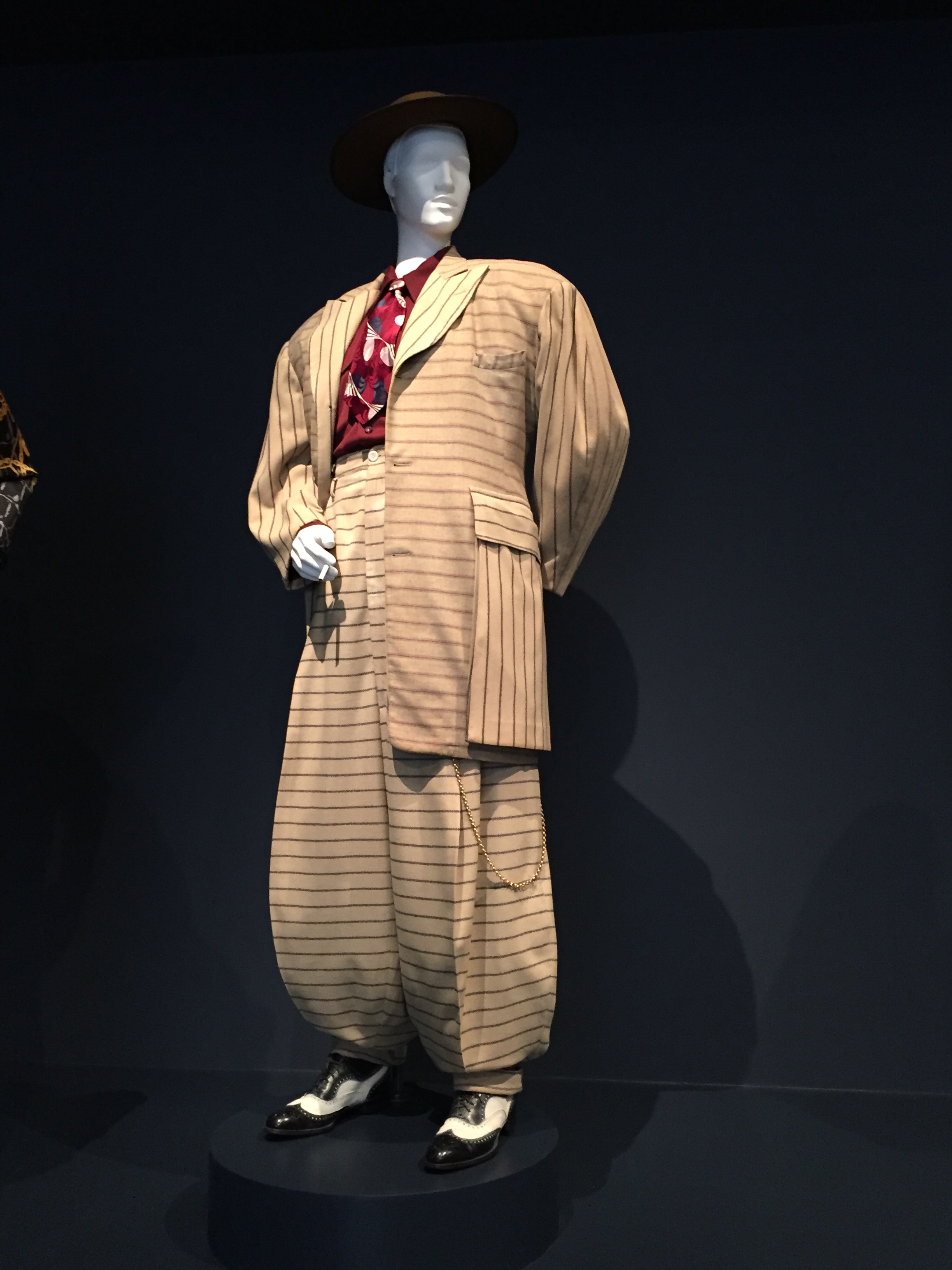
LACMA’s zoot suit is not simply an oversized version of conventional tailoring. Its broad shoulders gain emphasis from a defined waist; its full sleeves narrow towards the wrist; its trousers expand through the leg before closing sharply at the ankle. The silhouette depends on those differences. Making every part equally large would produce a different garment, without the same sequence of expansion and contraction. LACMA’s technical documentation lets us examine that sequence through the suit’s construction rather than treat it as a styling effect alone. The museum dates this American example to 1940–42 and identifies its materials as wool plain weave and twill. Beige cloth carries contrasting stripe arrangements across a long jacket and high-waisted trousers, distinguishing components within an otherwise coordinated ensemble. Acquired in 2011, the suit later appeared in Reigning Men: Fashion in Menswear, 1715–2015. It is one surviving example, not a template for every zoot suit. Its value here is the opportunity to connect an identifiable object with detailed evidence of how its shape was made.
Curators Sharon S. Takeda and Clarissa M. Esguerra associate the style with urban youth, particularly African American, Latino, Jewish and immigrant communities connected with swing clubs and dance halls in the 1930s and early 1940s. They describe its exact origin as unknown. That social setting matters, but it does not remove the need to look closely at the clothing. The question is how this suit’s cut turns conspicuous proportions into a coherent whole.
Examine how LACMA’s 1940–42 zoot suit combines broad shoulders, a defined waist, full sleeves and sharply tapered trousers into one silhouette.
Broad Shoulders, Defined Waist
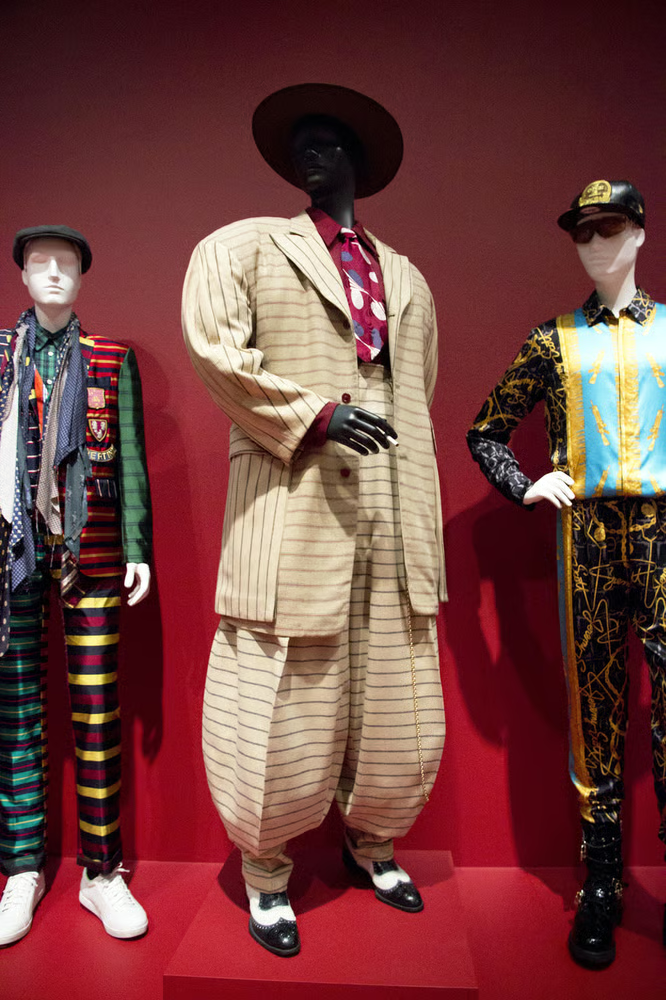
The jacket’s breadth is built into its structure. LACMA records substantial crescent-shaped shoulder pads, establishing that the extended shoulderline is not simply the result of excess cloth hanging from the body. The jacket also has large armholes and a fitted waist. These features belong in the same explanation: the shoulder becomes more assertive because the garment does not maintain that width uniformly below it. The waist supplies a visual contraction beneath the expanded upper body.
Meanwhile, the jacket’s length carries the line beyond that narrower point. Read together, breadth, definition and length prevent the garment from becoming a single undifferentiated block. The eye moves between distinct proportions rather than encountering volume everywhere at once.
This is the first important distinction between size and silhouette. A larger jacket might give its wearer more room throughout. This jacket concentrates its strongest expansion at the top and brings the body into a more controlled relationship beneath it. The dramatic shoulder is therefore not an isolated flourish. Its effect depends on the parts that do not expand to match it.
Full Trousers, Narrow Cuffs
The trousers complete the suit’s overall shape by organising volume along a different route. LACMA records a high rise, no waistband, a long zipper fly, and both suspender buttons and belt loops. Deep front pleats release fabric into the legs. The museum places the greatest fullness around the knee, followed by a pronounced narrowing towards the ankle. The trousers are not simply wide from top to bottom. Darts at the cuffs support their pegged shape: full above and sharply tapered below. A dart is a sewn intake that draws material into a controlled form. Here, it helps explain how a leg containing substantial fullness can end in a comparatively restricted opening. The cuff does more than finish the trouser: it gives the fabric above it a boundary against which its volume becomes legible.
The jacket and trousers, consequently, work as related but not identical structures. The jacket establishes breadth above a defined waist; the trousers open out below their high starting point and then narrow. The silhouette is coherent because these changes occur in sequence. Its exaggeration is not random accumulation, but an arrangement of where the body appears broader and where the clothing draws back in.
Sleeves Built for Volume
The sleeves extend the upper-body emphasis through construction rather than width alone. LACMA identifies four-piece sleeves with slight gathering where they join the jacket. They also contain gores: inserted sections that add shape or fullness. The museum specifically connects these inserts with the exaggerated sleeve volume. This is more informative than describing the arms as merely loose or oversized, because it identifies how additional space enters the garment. That fullness narrows towards the wrist, repeating the suit’s larger interest in expansion followed by restraint. The shoulder does not lead into a straight tube of fabric. Instead, the sleeve has its own shaped outline, contributing to the upper body while remaining distinct. The arm therefore participates in the silhouette rather than disappearing between the shoulder and the hand.
The technical record also prevents a misleading assumption: the suit’s dramatic appearance is not achieved by padding every full area. Shoulder padding and sleeve inserts perform different jobs. One establishes structure at the top of the jacket; the other introduces additional fabric within the sleeve. The visual effect depends on how they combine.
Stripes That Separate the Parts
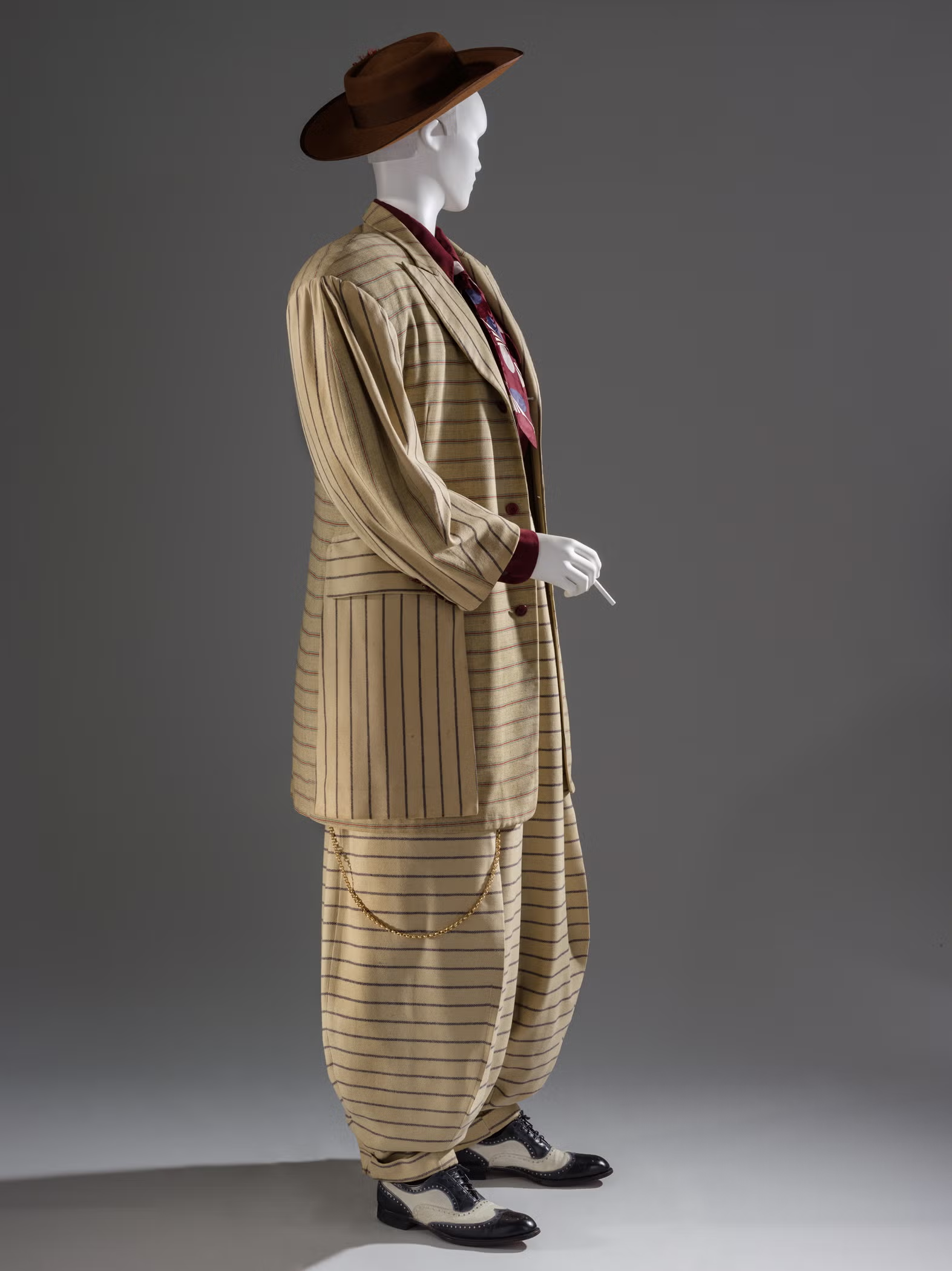
The fabric arrangement gives the suit another way to make its components visible. LACMA records red and blue horizontal stripes across the jacket body and collar, while the lapel facings use blue vertical stripes. The sleeves combine both arrangements, with the outer gore distinguished from the rest of the sleeve. The trousers introduce another material, beige wool twill with horizontal blue stripes. These changes prevent the ensemble from reading as one uninterrupted striped surface. At the lapels, a shift in direction marks a familiar tailoring component. At the sleeve, the contrast corresponds to an inserted section that creates fullness. Surface and construction are not doing the same work, but they draw attention to some of the same divisions.
It would be reductive to explain the suit through a rule that horizontal stripes widen and vertical stripes lengthen. The cut already establishes its major proportions. The more useful observation is that the cloth arrangement makes particular parts easier to distinguish within that cut. The suit offers a strong overall outline while retaining visual activity inside it.
Pockets Free to Move
The jacket’s large bag pockets introduce a different relationship between garment and body. According to LACMA, they are attached only along their interior upper edges. Their bodies are therefore not fixed flat around the perimeter, as a viewer might assume from a frontal image. This attachment lets them move separately from the jacket beneath. LACMA’s account connects that freedom with dancing, describing the pockets moving away from the body. This is the museum’s explanation of the construction’s effect, not a recorded observation of the suit’s unidentified owner. Nevertheless, the detail expands the analysis beyond a static outline. The garment contains elements whose position can change without altering the jacket’s main structure.
Here, exaggeration includes both movement and breadth. The shoulder pads establish a relatively fixed upper boundary, while the pockets can extend beyond the body in another way. That contrast helps explain why a still photograph cannot communicate every aspect of the design. Some silhouettes are constructed to remain; others are available to move.
A Garment Altered in Use
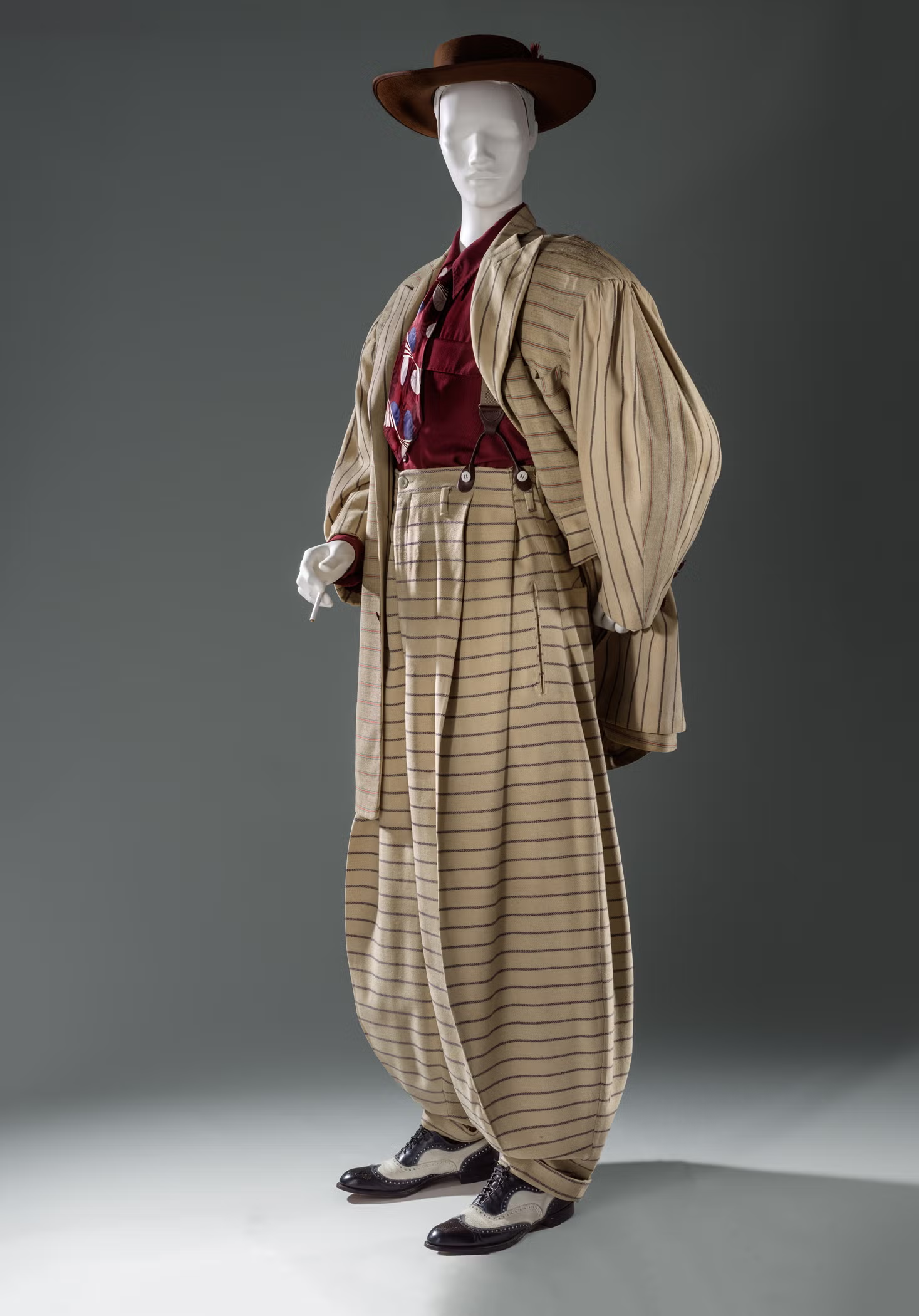
The surviving suit is not documented as an untouched version of its first making. LACMA notes evidence that the sleeves were shortened and that the trouser waist was adjusted with small hand-sewn darts. Those observations matter because the technical resource records a particular object with interventions already present, not an abstract design recovered in an unaltered state. The reasons for those changes are unknown. We cannot identify who requested them or whether they addressed fit, preference or another circumstance. Their presence, however, brings the analysis back to a body. Even an extreme silhouette had to negotiate the wrist and waist of a particular wearer. Dramatic form and ordinary adjustment are not opposing histories; they coexist in the same garment.
The wearer’s wider biography remains equally uncertain. The museum’s acquisition account records the suit’s appearance in an East Coast auction catalogue and its purchase in November 2011, but does not name its original owner. The broader history includes the racial violence directed at Mexican American men during Los Angeles’s June 1943 zoot-suit attacks. That history is essential context for the style, but it cannot be assigned as this individual garment’s documented experience.
The Omiren Argument
The principle is proportion. LACMA’s suit shows that exaggeration needs more than extra fabric. The shoulder depends on the waist beneath it; the trouser fullness depends on its narrowed conclusion; the sleeve’s inserts and the pockets’ attachment introduce different kinds of space around the body.
Looking closely at those decisions gives the garment’s cultural visibility a material basis. The silhouette is not merely a symbol applied to a conventional suit. It results from tailoring that determines where the form broadens, where it contracts, and which components remain free to move.
Also Read:
- Brixton’s Caribbean Dress Legacy: Tailoring, Fabric, Beauty and Cultural Memory
- Body, Fitness and Silhouette: Reimagining the Male Form in Contemporary African Menswear
- Luanda’s Suit Is Not a Colonial Leftover: How Angolan Men Made Tailoring Their Own
- Traditional Amhara Menswear: Eje Tebab, Teferi Suri, Gabi and Bernos
Frequently Asked Questions
What does LACMA’s published pattern provide?
The garment-specific PDF includes scaled pattern pieces and technical observations from the museum’s examination. It makes the surviving suit available for closer construction study, extending the evidence beyond the exterior photograph. It should be read alongside the object notes rather than treated as a substitute for them.
Is it a ready-to-sew commercial pattern?
It should not be presented that way. LACMA states that its pieces are drawn without seam allowance. The document records a museum object, not a guarantee of fit for a new wearer, and the surviving garment includes documented alterations. Any reconstruction would therefore be a further undertaking, not something demonstrated by this article.
Were the photographed tie and shoes acquired with the suit?
The museum credits them separately: a De Luxe Hollyvogue tie dated around 1945 and spectator shoes by The Guarantee dated 1935–42. Their presence contributes to the museum’s presentation, but it does not establish them as accessories the original owner wore with this suit.
Do the stripes create the zoot suit’s silhouette?
No. The cut establishes the major proportions; the stripes make specific parts easier to distinguish. LACMA records red and blue horizontal stripes on the jacket body and collar, blue vertical stripes on the lapel facings, and a distinguished outer sleeve gore, so surface and construction draw attention to some of the same divisions.