Sindiso Khumalo’s Miss Celie brings a detailed pictorial textile into a dress whose edges are equally expressive. The V&A describes a white cotton midi with short sleeves, a ruffled yoke and a deep hem, accompanied by a bonnet in the same blue toile de Jouy-style print. The ensemble combines an immediately legible blue-and-white surface with a silhouette that gives the eye several boundaries to follow. Inside that surface is a family reference. The museum identifies an illustration of Khumalo’s mother wearing an inkehli, a traditional Zulu headdress, on her daughter’s wedding day. The print, Zulu Princess, was created by illustrator Alex Fox. Those details make the object more specific than an example of fashion “telling stories”: a named artist’s illustration places a particular woman within a scene, while Khumalo’s garment gives that scene a form to be worn.
The ensemble’s strongest proposition lies in that relationship between image and structure. The dress is not a neutral support for an illustration, and the illustration is not merely a flourish added to an otherwise complete design. The printed scene and ruffled outline supply different kinds of attention: one asks the viewer to recognise what is depicted; the other organises how the whole garment is encountered.
Explore how Alex Fox’s Zulu Princess illustration meets Sindiso Khumalo’s ruffled Miss Celie dress, bringing a family image to life in screen-printed cotton.
Who Made the Image?
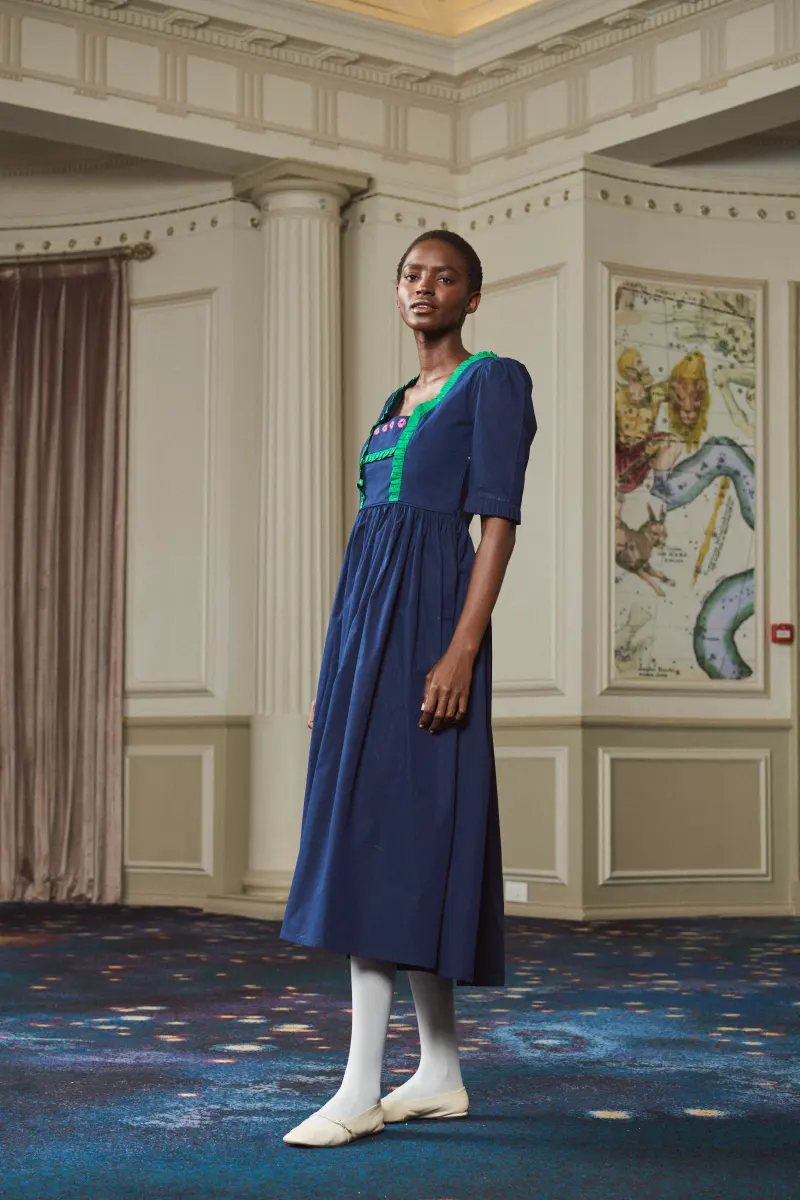
The V&A separates the creative credits clearly. Sindiso Khumalo is the garment designer, her label is the brand, and the production entry identifies “‘Zulu Princess’ print, illustration by Alex Fox.” That division should remain intact when discussing the dress. Its presence within Khumalo’s collection does not erase the illustrator’s authorship. Fox’s contribution supplies the pictorial world. Khumalo’s contribution gives that world another setting: the dress and bonnet. The distinction is not a contest over which role matters more. It explains why the finished object contains decisions that cannot all be attributed to one person simply because one name appears on the label.
The museum record does not document the intermediate stage of artwork development. It identifies the illustration, the print and the screen-printed textile, but not who prepared the repeat or adjusted the image for production. The sound account therefore follows the connections that are established without pretending to recover every operation between them.
A Family Figure Within the Scene
The museum describes Zulu Princess as a toile de Jouy-style print depicting Nguni life on a homestead. The inclusion of Khumalo’s mother introduces a personal subject within that broader setting. Her identity is attached not only to a form of dress but to an occasion: her daughter’s wedding. That specificity changes the interpretation. Without the catalogue account, a viewer may encounter an illustrated figure as one element among others. With it, the scene includes a recognisable family relationship. The textile is not simply populated with people; at least one person can be named through her connection to the designer.
The distinction also prevents the figure from becoming a generalised symbol. The museum’s explanation supports a particular reading of this depiction, not a claim that one image represents all Zulu women or that the print comprehensively records Nguni life. Its interest lies in the meeting of a broad pictorial setting with an individual family reference.
Blue and White Give the Illustration Continuity
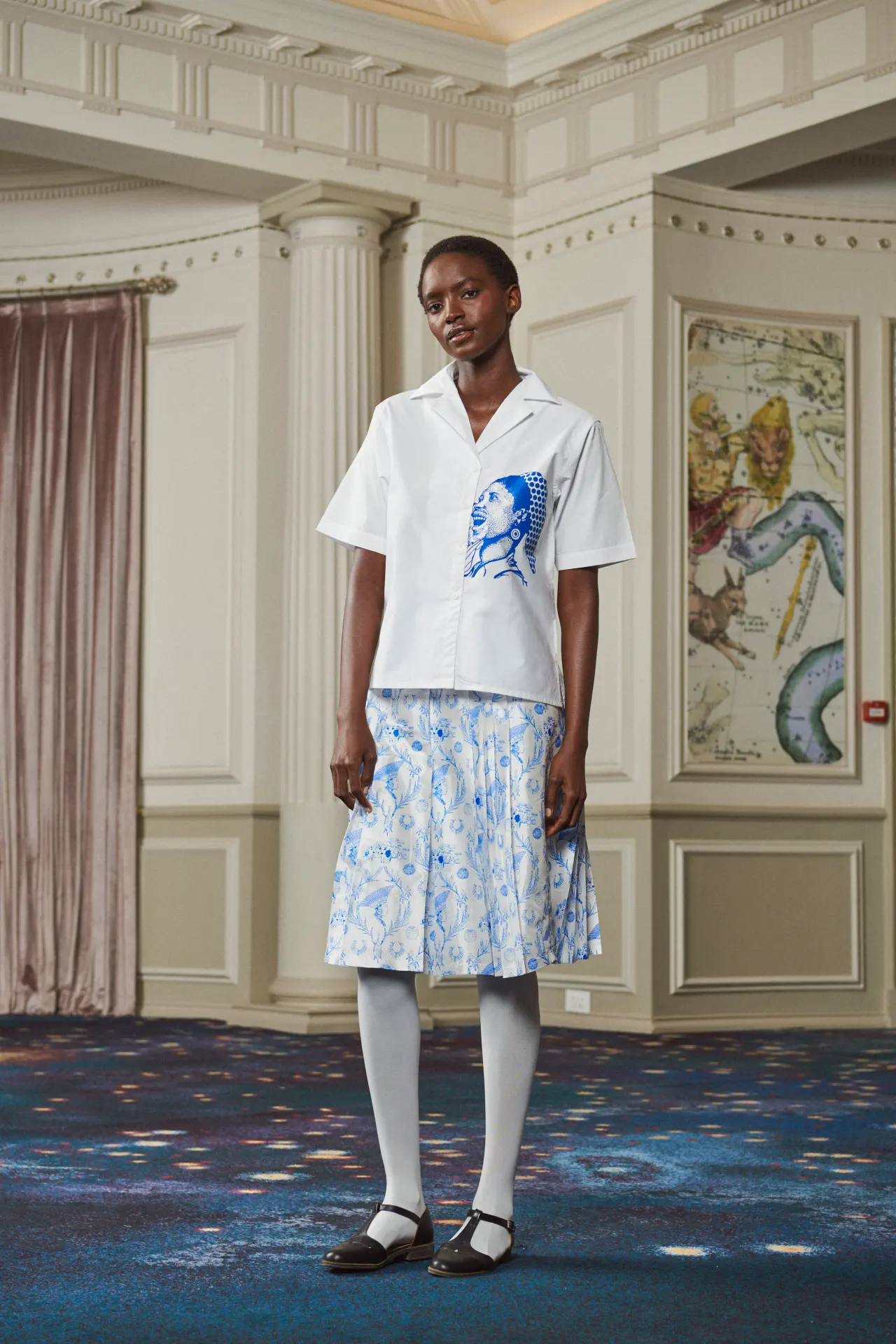
The V&A records the ensemble as screen-printed cotton, with blue imagery on a white ground. It describes the visual treatment as toile de Jouy-style. The museum assigns that classification; it should not be reduced to the presence of two colours alone. The scene and its arrangement are part of the textile’s identity. Within the ensemble, the restricted palette supplies continuity. The image can contain figures and setting without introducing a separate colour for each element. The dress and bonnet remain connected through the same relationship between blue marks and white cloth. This lets the illustration stay detailed while the complete outfit retains a relatively unified surface.
That unity matters because the garment already has several changes in shape. The print and the ruffles need not perform the same task. The blue-and-white textile connects the parts, while the garment’s edges distinguish them. The design’s coherence comes from allowing surface and silhouette to contribute differently.
The Print on the Body
The museum’s description places the print on a short-sleeved midi dress with a ruffled yoke. The recorded collar-to-hem length is a maximum of 120cm, measured by conservation. That dimension identifies the surviving object rather than prescribing where its hem would fall on every wearer. The catalogue’s “midi” description is the relevant account of its intended length category. The yoke gives the upper body a distinct area within the printed whole. The lower edge provides another point of emphasis. Instead of one uninterrupted length of illustrated fabric, the garment presents a sequence: upper section, sleeves, skirt and hem. The textile’s scene is encountered through those divisions.
This is where the transition from image to clothing becomes most consequential. An illustration can be considered across a flat surface; a dress introduces a body, edges and changes of direction. The print’s subject remains, but its presentation is no longer independent of the garment. The cutting plan is not available, so no deliberate placement of particular figures at seams or gathers can be claimed. The supported judgement concerns the whole: an active pictorial surface meets an articulated silhouette.
Ruffles Add a Separate Clothing Reference
The V&A connects the ruffled neckline and hem with early twentieth-century smocks and aprons. This source differs from the print’s subject. The homestead scene and family figure explain what is depicted; the smock-and-apron reference helps explain the garment’s outline. Neither needs to stand in for the other. That combination is more interesting than a design in which every feature repeats one theme. The illustration provides a setting and people. The ‘ruffles’ refer to a clothing vocabulary. Together they create an ensemble whose identity comes from the relationship between references rather than a single motif enlarged across the body.
The dress’s name adds another layer. Miss Celie honours the character in Alice Walker’s 1982 novel The Colour Purple. That dedication belongs in the account, but it doesn’t assign meaning to every detail. The mother in the illustration, Celie in the name and the smock-and-apron reference occupy different roles. Keeping them distinct preserves the design’s complexity instead of collapsing it into a vague statement about womanhood.
Why the Bonnet Matters
The bonnet is part of the museum’s two-piece ensemble, not an accessory assumed to have been added for a photograph. It carries the same Zulu Princess print as the dress. Its inclusion extends the textile beyond the torso and skirt, making the repeated blue-and-white surface a feature of the complete dressed figure. The bonnet must also be distinguished from the inkehli pictured within the illustration. One is a physical component worn with the dress; the other is headwear depicted on Khumalo’s mother. The museum record does not establish that the bonnet was designed as a version of the headdress. The ensemble instead contains two separate levels of dress: what its wearer puts on, and what a person within its imagery is shown wearing. That relationship makes the print more than background ornament.
What Holds the Ensemble Together?
The most convincing aspect of Miss Celie is that the textile and silhouette remain independently legible. The blue-and-white scene gives the surface a consistent identity. The ruffled yoke and lower edge give the dress a recognisable structure. The bonnet extends the textile relationship without requiring the dress to carry the entire effect alone. The references deepen that arrangement, but the ensemble need not be read as a sequence of explanatory labels. A viewer can first encounter a coordinated printed dress and bonnet, then learn who appears within the scene and why the design is called Miss Celie. The information adds specificity to an already defined object.
Its limitation as a process case is equally clear: the record does not show how Fox’s original illustration was adapted into the production textile. That prevents a complete account of artwork development, but it does not prevent an object-specific assessment. The documented result is a collaboration in which illustration supplies the pictorial content and garment design determines the form through which it is worn.
The Omiren Argument
The principle is authorship. A printed dress becomes easier to understand when the account distinguishes the person who made the image, the person represented within it and the designer who gave it garment form.
Miss Celie rewards that precision. Alex Fox’s illustration supplies a scene with a particular family presence. Khumalo’s dress and bonnet organise that scene through clothing. The result is not simply an image preserved on fabric but an image encountered through a different structure.
Also Read:
- Visual Arts and the African Fashion Conversation: When the Gallery and the Runway Share a Language
- The Zulu Reed Dance and the Dress That Carries a Nation’s Dignity
- The Geometry of Heritage: Why Shweshwe Still Defines South African Fashion
- Emerging African Designers to Watch at AFWL 2026
Frequently Asked Questions
Who illustrated Zulu Princess?
The V&A credits Alex Fox with the illustration. Sindiso Khumalo is credited with designing the dress and bonnet, and the print includes an image of her mother wearing an inkehli on her daughter’s wedding day. The record does not identify every practitioner involved in textile preparation or production.
Which season does this Miss Celie belong to?
The museum identifies the ensemble as Spring/Summer 2020. Its accession number, T.2437:1,2-2021, records its place within the museum collection and should not be mistaken for the collection season. The record describes a white cotton midi dress with a ruffled yoke and a matching bonnet.
What material and technique are recorded?
The V&A lists “screen-printed BCI cotton”. That is the catalogue’s material-and-technique description, not an environmental assessment of the garment or a complete account of its supply chain. The museum describes the print as blue imagery on a white ground in a toile de Jouy style.
Where can readers examine the object record?
The V&A’s online collection entry provides the description, images, measurements, production credit and contextual account. It also sets out image-use conditions, which should be checked separately before publication or reproduction. The recorded collar-to-hem length is a maximum of 120 cm, measured by conservation.