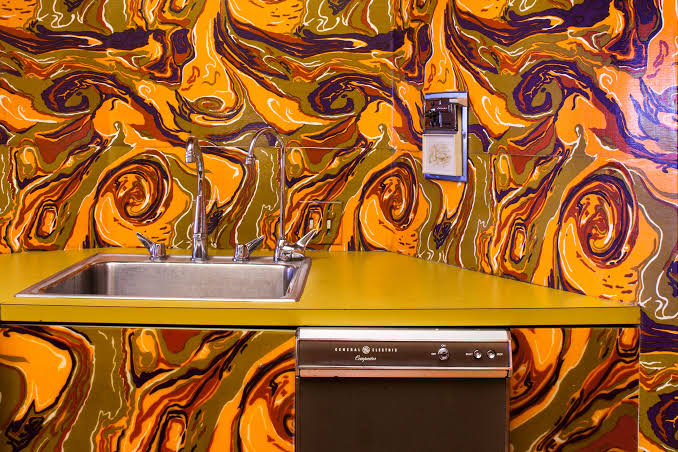
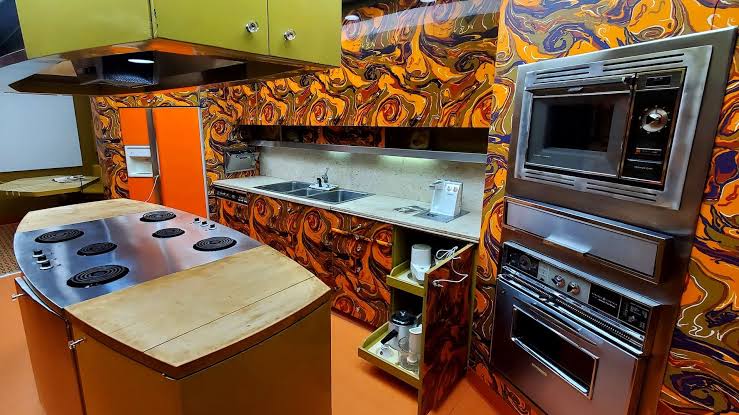
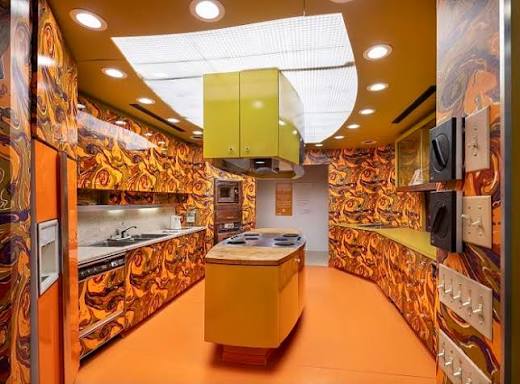
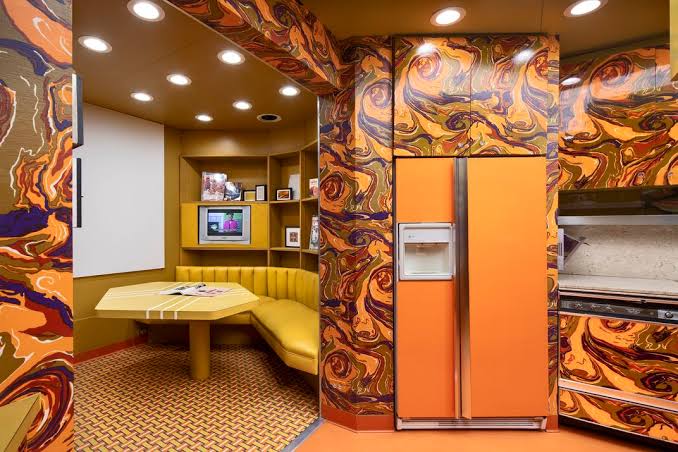
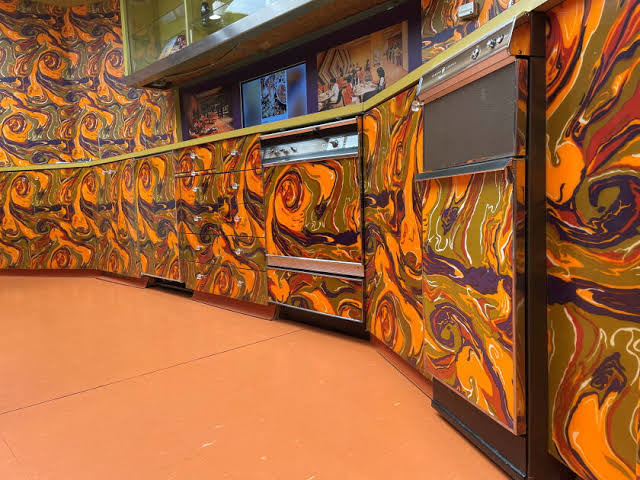
Orange cabinetry, yellow cupboards and wallpaper swirling with orange, olive green, dark purple and earthy red made the Ebony Test Kitchen difficult to overlook. A curved island held a six-burner stove. Appliances were integrated into the surrounding cabinetry, while an adjoining sitting area extended the room’s vivid colour scheme. Yet the most revealing feature was less spectacular: the food editor’s office was close by. This kitchen was organised around publishing work.
From 1972 to 2010, the kitchen occupied the tenth floor of Johnson Publishing Company’s headquarters at 820 South Michigan Avenue in Chicago. Here, food editors tested recipes and styled dishes for photography before their work appeared in Ebony magazine and associated cookbooks. Preparation, assessment, presentation and planning belonged to the same professional environment.
The room’s significance becomes clearest when you consider those activities together. It connected readers’ domestic knowledge with the resources and judgement of a publishing institution. Its bold interior housed a practical process through which food became editorial material.
How Chicago’s Ebony Test Kitchen connected bold interior design, recipe testing and Black publishing, and how the working room was preserved.
A working interior, not simply a memorable backdrop
The kitchen formed part of a larger architectural project. African American architect John Moutoussamy designed Johnson Publishing Company’s eleven-storey headquarters. William Raiser and Arthur Elrod of Arthur Elrod Associates designed the test kitchen’s interior. Their contributions should remain distinct: the building and its specialist workspace had connected but separate authorships.
Within the kitchen, colour crossed the boundary between decoration and equipment. Orange cabinet fronts coordinated with the floor. The refrigerator was orange-panelled, and the dishwasher carried a patterned front. Yellow appeared in overhead cabinets and continued into the neighbouring sitting area. The appliances were incorporated into the composition rather than left visually detached.
The central island, cooking equipment, sinks, counters and storage established a functioning kitchen. But its arrangement is best understood through the testimony of someone who worked there.
Charla Draper, Ebony’s Director of Food & Home Furnishings from 1982 to 1984, described its “work triangle” in a Landmarks Illinois interview. She recalled easy movement between the sink, refrigerator and counter, with the range positioned in the island. Coming from a more visually uniform kitchen at Kraft Foods, she initially found the décor an adjustment. Its appearance did not prevent her from using it efficiently.
That testimony gives the design a practical assessment beyond its photographic appeal. The room’s exuberance and its usefulness were not mutually exclusive. For Draper, the layout supported the work.
The office, the nook and the printed page
The relationship between rooms mattered as much as the kitchen’s equipment.
Draper valued having her office next door, which let her move easily between editorial responsibilities and recipe development. She and her assistant, Ava Gardner, also used the attached kitchen nook for meetings and for proofing recipes and editorial features. The sitting area therefore had a documented professional function, not merely the appearance of domestic comfort.
These details explain the title’s central claim. The kitchen was infrastructure because it supported several linked stages of production. A recipe could be prepared and assessed in the cooking space, while nearby areas accommodated discussion, editing and proofing.
This did not erase the distinction between cooking and writing. It brought different kinds of expertise into proximity. A dish had to be made; its instructions had to be communicated; its presentation had to suit publication.
The magazine’s finished pages could conceal those transitions. Readers encountered a coherent feature, not necessarily the separate decisions that produced it. The room provides evidence of the material setting behind that coherence.
Readers contributed more than an audience.
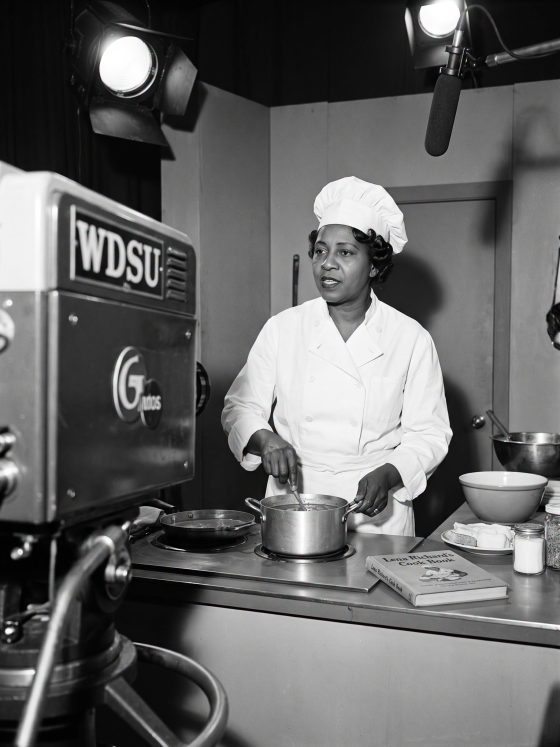
Draper’s “Your Favourite Recipe” feature makes the relationship between kitchen and readership especially concrete.
Readers submitted favourite home recipes. Draper prepared them in the test kitchen, then invited fellow editors and employees to taste and evaluate the results. According to her recollection, she arranged dishes along the kitchen’s window counter. Tasters completed evaluations, ate soda crackers between samples and returned for the next recipe. The selected submission appeared in the magazine.
Here, a counter became more than a preparation surface. It supported an editorial selection process.
The Smithsonian’s account of Ebony’s food editors confirms that the feature tested, paid for and published reader-submitted recipes. The kitchen therefore participated in a two-way relationship: knowledge moved from households into the magazine, passed through professional assessment and returned to readers in published form.
That process complicates the idea of a publication simply instructing a passive audience. Readers supplied material as well as received it. The food department selected and prepared those contributions for wider circulation.
Draper remembered a sweet potato pie as a personal favourite from the feature. The detail is useful not because one dish can stand for the department’s entire output, but because it identifies the everyday material on which editorial judgement operated. The work involved real recipes, specific results, and decisions about what to share.
An editorial tradition older than the room
The kitchen’s 1972 opening did not mark the beginning of Ebony’s food journalism.
Freda De Knight, the magazine’s first food editor, established its food column during a tenure at the Smithsonian, dating from 1946 to 1963. She set an upscale tone for its recipes. Draper and her successor, Charlotte Lyons, later continued the established “A Date with a Dish” column while developing their own approaches.
This chronology matters. De Knight helped establish the editorial tradition before the South Michigan Avenue kitchen existed. The later room gave that work a particular architectural setting; it did not originate the magazine’s relationship with food.
Draper’s contribution included the reader-recipe feature and changes to the photography. Lyons, a food editor from 1985 to 2010, adapted recipes for changing dietary needs and simplified instructions so that less experienced cooks could follow them. These were editorial decisions about accessibility and use, rather than merely changes in visual presentation.
The kitchen supported continuity without fixing the food pages in one approach. Different editors worked within an inherited format while changing how recipes were selected, explained and presented.
That distinction also prevents the interior’s early-1970s appearance from becoming a misleading shorthand for everything produced there. Its décor remained recognisable while editorial responsibilities and priorities developed.
Preparing food for the camera
Charlotte Lyons’s recollections show how cooking and photography could impose different requirements on the same dish.
In the Landmarks Illinois interview, she remembered making a chocolate cake that took four hours to prepare. When boxer Mike Tyson asked for a slice, she made him wait until the professional photographs were taken. The account is an attributed memory, not an invitation to reconstruct the scene. Its significance lies in the order of work: the cake first had to fulfil its purpose as a magazine subject.
A dish intended for publication was not finished simply because it was ready to eat. Its appearance still had an editorial task to perform.
Lyons also recalled the kitchen attracting visitors and colleagues. “If I was cooking, they were tasting,” she said. The room shared the tenth floor with the staff cafeteria, making it a visible part of the company’s internal environment.
These memories establish a social dimension without requiring an imagined account of a typical day. People gathered, tasted and responded. At the same time, the food editor retained responsibility for the work’s sequence and intended use.
In a later interview reported by WTTW, Lyons named cornmeal crescent rolls, cream cheese pound cake and tequila lime chicken wings among her favourite recipes tested in the kitchen. The range provides a more concrete impression of its output than a general description of “Black cuisine” alone.
Domestic knowledge as professional work
The kitchen occupied a productive boundary between home and office. Its equipment was recognisably domestic, but its purpose was institutional. Recipes were tested for publication; food was prepared for photography; instructions and features were proofed nearby.
That relationship gives the interior its wider cultural importance. A Black publishing company allocated space, staff and equipment to the preparation of food knowledge for its readership. The work connected cooking with writing, image-making and editorial judgement.
Its significance does not depend on treating one magazine as representative of every African American household. The more precise story is stronger: this publication maintained an organised process through which selected recipes and food features reached readers.
Omiren’s examination of what Zoe Adjonyoh’s recipe headnotes record considers another part of that relationship: the contextual writing surrounding a recipe. The Ebony Test Kitchen reveals the physical workplace behind such published material: somewhere to prepare, evaluate, discuss and present food before readers encounter the finished instructions.
The interior deserves attention because it makes that professional labour tangible. Its colour attracts the eye; its documented use explains the institution’s investment.
Saving the workplace after its working life
The kitchen’s survival required a separate act of preservation.
Although Johnson Publishing Company’s former headquarters received Chicago landmark designation in 2017, the protection did not extend to its interiors. The test kitchen faced demolition during redevelopment. The Smithsonian credits architecture critic Lee Bey with alerting Landmarks Illinois to the threat.
In 2018, Landmarks Illinois acquired it for $1 and organised its documentation, dismantling and storage with professional volunteers and members of its Skyline Council. Saving the room meant preserving components and information together: cabinets, fittings and surfaces could not explain their original relationships without a record of how they had been assembled.
The subsequent stages should remain distinct:
- In May 2019, Landmarks Illinois agreed to lend the kitchen to the Museum of Food and Drink, known as MOFAD.
- MOFAD rebuilt two rooms, refurbished components and reproduced elements including the wallpaper.
- The reconstruction appeared in African/American: Making the Nation’s Table at the Africa Center in Manhattan from February to July 2022.
- In June 2023, the National Museum of African American History and Culture announced its acquisition through a donation from Landmarks Illinois and MOFAD.
The reconstructed exhibition was not an untouched room transferred directly from Chicago. It incorporated original, refurbished and reproduced elements. That distinction is part of the preservation history, not a reason to dismiss it.
The original kitchen’s work cannot be restarted simply by reassembling its surfaces. What preservation can retain is evidence of the setting in which that work occurred, supported by records and the testimony of its users.
The Smithsonian’s acquisition established a permanent collection home. It did not, by itself, establish permanent public display: the museum’s 2023 announcement stated that conservation would precede any exhibition decision. Collection ownership and visitor access remain separate questions.
Omiren Argument
The Ebony Test Kitchen makes visible a part of Black publishing that the finished magazine page can conceal: the professional work of turning food knowledge into tested recipes and photographed features.
Its design matters because it housed that work. The island, counters, nearby office and meeting nook connected cooking with evaluation, discussion and proofing. Reader submissions show that the room also mediated between household knowledge and institutional publication.
Preserving the kitchen therefore preserves evidence of editorial authorship, not simply a striking decorative style. Its history belongs to the people who used it, the material they prepared and the readers for whom that work was made.
Also Read:
- Food Spotlight: Siba Mtongana and the Practical Work Behind an Inviting Recipe looks at the work behind food communication.
- How Diaspora Cuisine Became a Tool of Cultural Diplomacy follows food as cultural knowledge in public life.
- How The Dinner Table Sets The Stage For Revolution considers the table as a social space.
- Objects That Hold Cultural Memory and Shape Identity examines how preserved objects carry history.
Frequently Asked Questions
What was the Ebony Test Kitchen, and who designed it?
It was a professional kitchen used to test and prepare recipes for Ebony magazine and associated cookbooks, with food editors also styling dishes for photography. It occupied the tenth floor of Johnson Publishing Company’s headquarters at 820 South Michigan Avenue in Chicago from 1972 to 2010. William Raiser and Arthur Elrod designed the interior; John Moutoussamy designed the building.
How did readers participate in its work?
Charla Draper’s “Your Favourite Recipe” feature invited readers to submit home recipes. These were prepared in the test kitchen, then evaluated by fellow editors and employees, with selected recipes paid for and published in the magazine. Knowledge therefore moved from households into the magazine and back to readers.
How was the kitchen preserved?
Landmarks Illinois acquired it in 2018 and arranged its documentation, dismantling and storage. MOFAD subsequently reconstructed it for a 2022 exhibition, using original components alongside refurbished and reproduced elements. The Smithsonian announced its acquisition in 2023.
Is the kitchen permanently on public display?
Acquisition into a permanent collection does not guarantee permanent display. The Smithsonian’s 2023 announcement specified conservation and no immediate exhibition plans. Consult the museum’s official collection information and current exhibition listings before planning a visit.