The cloth starts with water. In Abeokuta, the Ogun State city that became the centre of Adire production, water from the Ogun River is mineral-rich and alkaline, making it particularly suited to indigo dyeing. This is not incidental. It is one reason Abeokuta became what it became in the history of this cloth, not only because Yoruba women there practised resist-dyeing, but also because the water they used produced specific results. Place is not the background to Adire. It is a material ingredient.
The fabric starts earlier still. The cloths that became Adire were typically made from two strips of cotton, usually factory-produced rather than handwoven, sewn together to form a roughly square shape worn as a wrap. Using factory cotton was not a departure from tradition but an adaptation: when imported European cotton shirting arrived in greater quantities in the 1920s, Adire makers used it. The increased availability of a new material created an opportunity to expand the vocabulary of pattern. The technique and the cotton changed each other.
What the maker then did to that cotton is the practice of the word ‘Adire’ names. In Yoruba, àdìrẹ means ‘tie and dye’, though people first formally applied the word to this specific tradition of indigo-dyed cloth around the turn of the twentieth century. The dyeing process requires indigo, either imported indigo grains or locally grown indigo leaves (Indigofera species), fermented and mixed with caustic soda-softened water. The cloth is dipped into a large pot of this dye and pulled out to oxidise. The process can be repeated to deepen the colour. After dyeing, the cloth can be beaten with a mallet to produce a sheen. These material facts explain how Adire achieves its deep blue character.
Adire is indigo-dyed cloth produced by Yoruba women using three resist techniques. This is a close account of what the cloth contains – materially, technically, and in terms of the knowledge held by the people who make it.
The Three Techniques
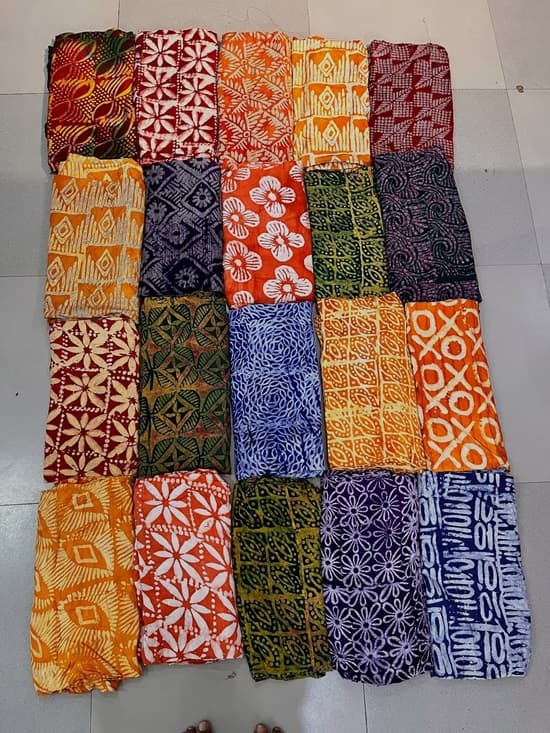
The V&A’s Adire collection, purchased in Ibadan in the 1960s and documented across multiple examples, identifies three primary techniques used to produce the pattern in Adire cloth before dyeing. All three work on the same principle: resisting the dye in certain areas of the cloth, creating a pattern revealed when the cloth emerges from the indigo pot as a contrast between deep blue and the white or cream of the undyed areas.
Àdìrẹ oniko is the tied or wrapped technique. Raffia is bound around sections of the cloth before dyeing. Tying small stones or seeds into the cloth creates small circles. Lifting a point of fabric and binding tightly beneath it creates larger circles. Folding the cloth corner to corner like a concertina and then binding at intervals creates a diamond pattern with alternating blue and white stripes when the two dyed strips are sewn together. The width of those stripes depends on the intervals at which the cloth is bound. These are not accidental effects. They result from specific decisions made by hand, whose variations the maker controls.
Àdìrẹ alabare is the stitch resist. Sewing patterns into the cloth before dyeing causes those stitched areas to resist the indigo, producing linear and geometric motifs. Both machine sewing and hand sewing could produce alabare patterns – and one significant distinction the V&A documents is that cloths using a sewing machine were made by men. The hand-sewn alabare was women’s work. In a tradition otherwise defined by women’s labour, the introduction of the machine marked a point where the maker’s gender and the method aligned differently.
Àdìrẹ eleko is the starch resist. A starch made from cassava flour is applied to only one side of the cloth, either through a stencil or painted freehand using a piece of metal. The unstained underside remains plain blue after dyeing; the patterned side carries the design the starch resisted. Stencils varied enormously in size and complexity. One of the most common stencilled designs, documented in the V&A collection, features a King and Queen at the centre. Its origin is worth pausing on: the image was copied from souvenirs produced in 1935 to celebrate the silver jubilee of King George V and Queen Mary. A colonial celebration became a pattern that entered Yoruba textile culture and became, in the V&A’s phrase, ‘one of the most common stencilled designs’. The cloth absorbed the outside world and made it Adire.
The Hand-Painted Cloth and the Question of Authorship
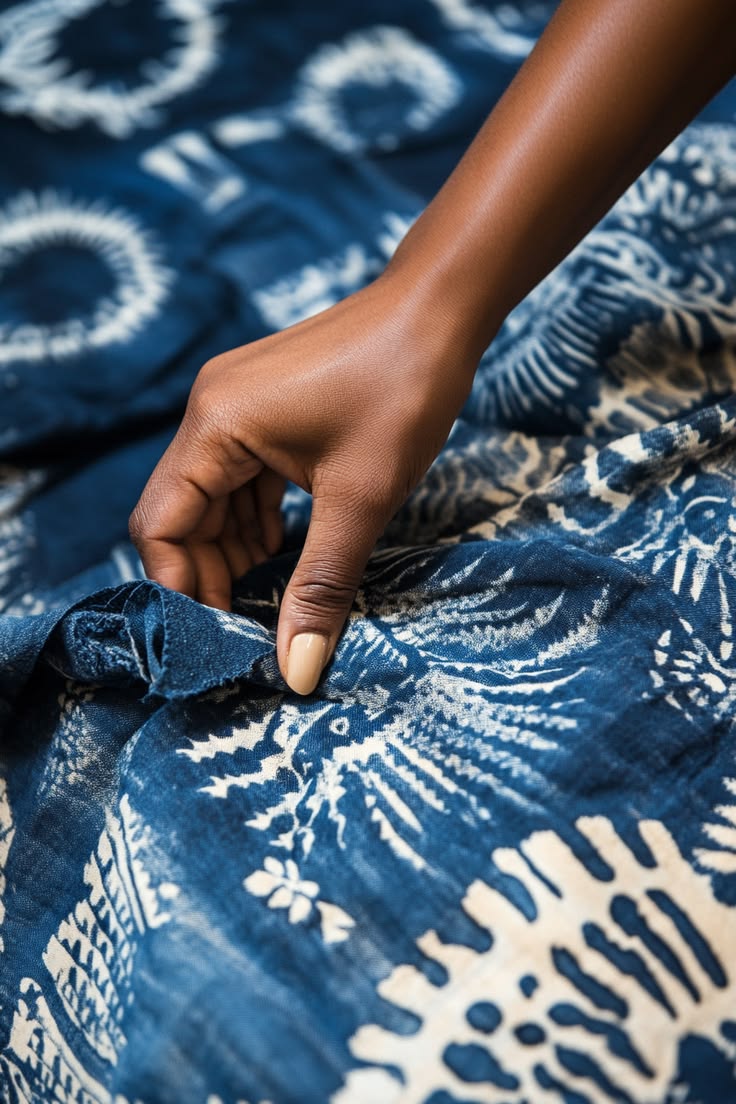
In the V&A’s account, hand-painted Adire is the most time-consuming form of the tradition. Women painted it using chicken feathers, the midrib of a palm leaf, and matchsticks, each producing a different line thickness. They typically divided the cloth into squares or rectangles, each filled with a different pattern. Because hand-painted cloth took longer to produce and was less responsive to changing fashion than tied designs, it occupied a different market position: less immediately fashionable, more individually made.
Ibadan was the centre of hand-painted Adire production. The city’s most recognisable pattern is Ibadan dun, which means ‘Ibadan is good’ in Yoruba. It shows the pillars of Mapo Hall, Ibadan’s town hall, alternating with spoons. The V&A collection holds an example that also has ‘Ibadan dun’ written on it – a cloth that names the place it was made as part of its own pattern. The pattern is the location.
Some cloths, particularly hand-painted ones, were signed on the hem. Two pieces in the V&A’s collection carry a symbol resembling a scorpion, one with the scorpion prominently on the front of the cloth in several places, ‘suggesting,’ the museum notes, ‘that the woman who painted this cloth was a respected maker.’ The name behind the scorpion has not yet been identified.
That sentence is one of the most important in any account of Adire’s history. A respected maker, her signature cloth, held by one of the world’s principal textile museums. Her name has not yet been found. The cloth carries the signature. The archive does not yet carry the name. This authorship gap runs through the history of Adire and the history of most traditions whose makers worked without documentation built around them.
ALSO READ
- Can Textile Provenance Protect the People Who Make the Cloth?
- What Textile Provenance Can – and Cannot – Prove
Pattern, Name and Place
Pattern names in Adire were not fixed. The V&A documents how the same designs could be called different things in different towns and how names changed over time within the same city. In Ibadan in the 1960s, the pattern the curators called ‘cloth of the year’ in 1964 had supplanted the olosupaeleso design (‘moons and fruits’), which had peaked in 1962. The fashion for a specific pattern within Adire operated on a rapid cycle. The cloth was not only a traditional object; it was contemporary, responsive to the moment in which it was made and bought.
This means the cloth carried a kind of social calendar. A Yoruba woman buying Adire in 1964 was buying more than fabric. She was buying the pattern that her peers were also wearing that season. The f&A curators’ note on which pattern was current in which year suggests the cloth functioned as a social object: it marked time, identified belonging, and placed the wearer in a specific moment in the tradition’s life.
This local, temporal knowledge makes Adire complex as a subject for provenance documentation. A piece of cloth can be identified as Adire. The technique can be named. The region of origin can be established. Much harder to document is whether the specific pattern was a local innovation or a borrowed one, who first made it in that town, and what it signified to the women who wore it in the year it was current. The Horniman Museum’s Adire archives hold material that captures this kind of granular knowledge, the kind that lives in oral and community records rather than in export documentation.
Labour That the Cloth Contains
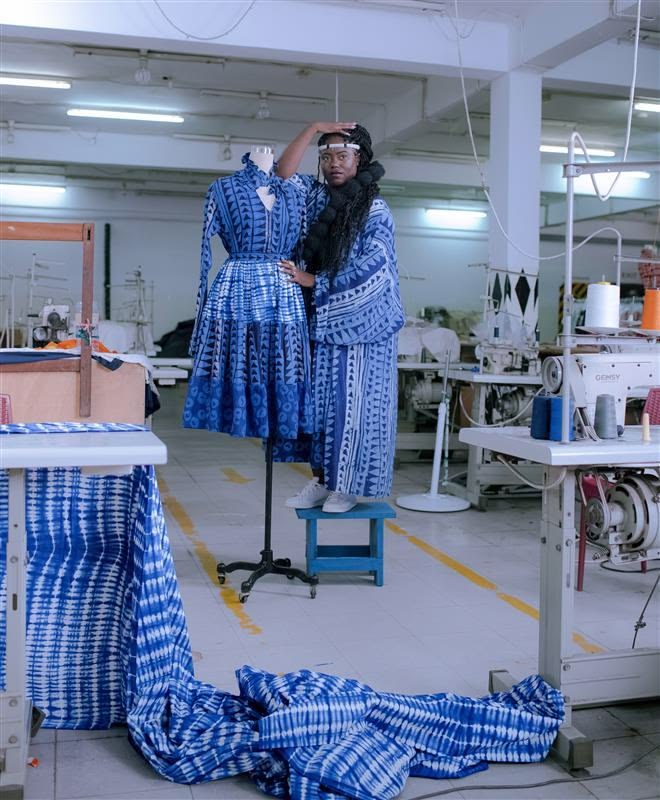
The labour in Adire is not incidental to the cloth. It is what the cloth is. The resist process – tying, folding, stitching, painting cassava paste – is not preparation for the dyeing. It is the work that produces the pattern, and the pattern is the cloth’s primary value. A cloth tied in a specific way by a skilled maker carries that skill in its structure. When the raffia is removed after dyeing, and the circles, diamonds, or stripes are revealed, what emerges is not a print but the result of a decision-making process whose execution required time-consuming knowledge.
This is why Adire’s relationship with machine production and synthetic dyes is more than a technical substitution. Hot wax and paraffin can replace cassava starch as a resist agent. Block printing can replace stencilling. These are legitimate adaptations, and they help the tradition remain available in markets that can no longer sustain the time required for fully handmade production. But they produce a different object in a specific sense: the cloth made with a block print carries the decision made when the block was carved, not the decision made when the maker’s hand moved across the cloth. The former can be replicated. The latter is each cloth’s individual record.
Adire’s presence in contemporary fashion has brought it to international runways and to a global consumer market whose appetite for the cloth is not always matched by an understanding of what the cloth contains in terms of labour and authorship. A designer who works with Adire in collaboration with makers from Abeokuta works with a different object, in a significant sense, than a designer who prints an Adire-inspired pattern on fabric using digital printing. Both may be described as Adire. They are not the same claim.
What Abeokuta Holds
Abeokuta’s Itoku Adire Market has been the commercial centre of Adire production and trade for over a century. The mineral-rich water of the Ogun River still shapes the depth of colour in the cloth produced there. The community of dyers who practised there across generations built the cloth’s distinctive Abeokuta character into a standard that buyers across south-west Nigeria and beyond came to recognise. That character is not a brand. It is an accumulated practice, held in the hands and knowledge of people who live and work there.
The challenge for Adire’s future in that specific form, handmade, site-specific, and individually executed, is the same challenge most artisan textile traditions face: the time required to produce it and the price needed to sustain that time are at odds with a market whose reference point for cloth is machine production. What resolves that tension, where it is resolved, is not technology or tourism. It is the creation of markets and documentation practices that allow buyers to understand what they are actually paying for when they pay for Adire made in Abeokuta by someone who learned the work from someone who learned it before them.
The cloth holds all of it: the alkaline water, the fermented indigo, the cassava paste, the raffia binding, the chicken feather and the matchstick, the pattern that was cloth of the year in 1964, and the scorpion on the hem of a cloth in the V&A’s collection whose maker’s name has not yet been found. Reading the cloth means reading all of that. The pattern on the surface is where you begin, not where you end.
Frequently Asked Questions
What does Adire mean?
Adire (àdìrẹ in Yoruba) means ‘tie and dye’. The word comes from two Yoruba roots and was first formally applied to this tradition of indigo-dyed, resist-patterned cotton cloth around the turn of the twentieth century, though the resist-dyeing techniques it names are older. Yoruba women made and wore the cloth throughout south-western Nigeria.
Where is Adire made?
Adire is a Yoruba textile tradition from south-western Nigeria. Abeokuta in Ogun State is considered the primary centre of Adire production, largely because the mineral-rich alkaline water from the Ogun River produces particularly deep indigo colours. Ibadan was the centre of hand-painted Adire specifically. People across the Yoruba-speaking region produced and wore the cloth, with pattern names and designs varying by town and city.
What are the three main Adire techniques?
The three primary Adire techniques are: Àdìrẹ oniko (tied or wrapped resist, using raffia bound around sections of cloth before dyeing); Àdìrẹ alabare (stitch resist, using hand or machine sewing to pattern the cloth before dyeing); and Àdìrẹ eleko (starch resist, using cassava flour paste applied through a stencil or freehand to resist the indigo in specific areas). All three produce the characteristic blue-and-white contrast of Adire by protecting parts of the cloth from the dye.
What dye is used in Adire?
Traditional Adire uses indigo – either imported indigo grains or locally grown indigo leaves (Indigofera species). The leaves are fermented and mixed with water softened with caustic soda to make the dye. The cloth is dipped repeatedly into the dye pot and pulled out to oxidise after each dip, deepening the colour. After dyeing, artisans can beat the cloth with a mallet to produce a sheen. Contemporary Adire production sometimes uses synthetic indigo or other dyes, and hot wax or paraffin as resist agents in place of cassava starch.
Why is Abeokuta important to Adire?
Abeokuta became the principal centre of Adire production partly because the mineral-rich, alkaline water from the Ogun River created ideal conditions for deep indigo dyeing. The city was also already a centre for cotton production, weaving, and indigo dyeing in the nineteenth century, so it had the material infrastructure, the knowledge, supply networks, and commercial connections to support a specialised textile tradition. Abeokuta’s Itoku Adire Market became a central commercial hub for the tradition, drawing buyers from across Nigeria.
What is the significance of maker signatures in Adire?
Some Adire cloths, particularly hand-painted ones, were signed by their makers on the hem. The V&A holds examples signed with a scorpion symbol by a woman described, from the prominence and consistency of her signature, as a respected maker – but her name has not yet been identified in historical records. This gap between the cloth as evidence of skill and authorship and the archive as a record of identity is one of the central issues in documenting heritage textile traditions. The cloth carries the signature. The name behind it remains unknown.